 Shopping Guide
 HELP / FAQs


 By onemall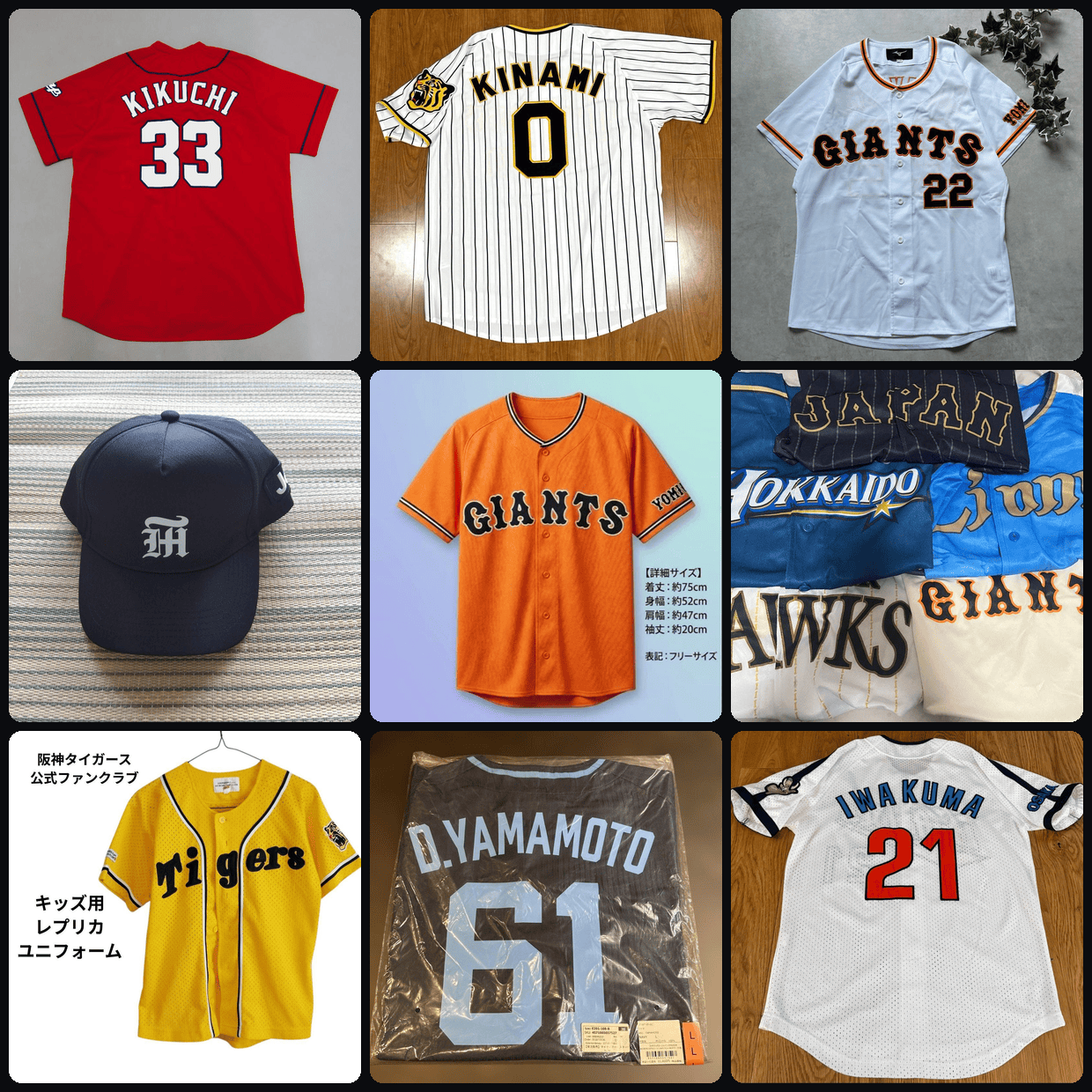
TL;DR
Japanese professional baseball merchandise is one of the most thoroughly Japan-locked categories there is. NPB has twelve clubs[1], each runs its own store, and essentially none of them ship overseas. Worse, a large share of the best material was never sold at all — it was handed out at the gate. The second-hand market inside Japan is where all of it ends up, and it is cheap: club-issue replica jerseys run ¥3,000–¥10,000, and giveaway items start under ¥1,500.
- Twelve clubs, two leagues, no international storefronts. Central and Pacific League club shops are domestic operations[1]; MLB-style global retail does not exist here.
- 非売品 (“not for sale”) is a searchable category, not a warning. Cheering jerseys, caps and towels distributed free at Japanese stadiums are traded openly second-hand.
- Replica ≠ authentic. Club replicas are the ¥3,000–¥10,000 fan product; Mizuno-made embroidered versions sit at the top of that band.
- Defunct clubs only exist second-hand. A Kintetsu Buffaloes jersey can only come from the resale market — the club merged into what is now the Orix Buffaloes for the 2005 season[2].
- OneMall’s service fee measured ¥300 flat on 22 August 2026 across seventeen live listings from ¥300 to ¥31,000. Jerseys are light and soft-packable, so shipping is unusually kind on this category.
The timing argument, as of August 2026: the NPB regular season is in its closing stretch, which is exactly when current-season giveaway items start appearing on the resale market in volume — fans clear out duplicates from a summer of home games. If you want this year’s promotional jersey, the cheapest window is now, not in the off-season when the supply has been picked over.
Why NPB goods are harder to buy abroad than MLB goods
American and European sports leagues run global e-commerce as a matter of course. NPB does not work that way. Each of the twelve clubs[1] operates its own merchandise business aimed at the people who come to the stadium — club shops at the ballpark, a Japanese-language online store, and department-store pop-ups. International shipping is not part of the model.
That leaves overseas fans with three bad options and one good one. The bad ones: pay an importer’s markup, buy the handful of licensed items that reach foreign sites, or accept counterfeits. The good one is to buy on the Japanese second-hand market, where the entire domestic output eventually surfaces.
And the domestic output is bigger than the retail catalogue suggests, because of one Japanese-specific practice: giveaways. Japanese clubs hand out jerseys, caps, towels and tote bags at the gate on themed home dates. Those items carry a printed 非売品 (hibaihin, “not for sale”) mark, were never available at retail in any country, and are traded second-hand in large numbers.
Reading a Japanese baseball listing
| Japanese term | What it means | What it does to the price |
|---|---|---|
| レプリカユニフォーム | Club-licensed replica jersey, the standard fan product | Baseline: ¥3,000–¥10,000 |
| 刺繡 (shishu) | Embroidered name and number, not printed | Premium; top of the replica band |
| 非売品 (hibaihin) | Not for sale — a giveaway item | Cheap now, scarce later |
| 入場特典 (nyūjō tokuten) | Handed out to attendees at a specific game | Dated and unrepeatable |
| 応援ユニフォーム | Lightweight “cheering” jersey worn in the stands | Lowest tier, often under ¥2,000 |
| 美品 / 未開封 | Excellent condition / still sealed | Modest premium |
Replica jerseys: the core purchase
These are live Japanese listings in yen. The spread inside this one category — club-original, official replica, Mizuno-made with embroidery — is most of what you need to understand about NPB pricing.


The Giants jersey above at ¥6,900 and the Carp jersey at ¥2,200 are both genuine club merchandise. The gap is construction: embroidered lettering by a licensed manufacturer versus a printed club-original. Neither is fake; they are different products, and Japanese sellers describe which is which precisely.
Giveaway items: the category that does not exist at retail anywhere
This is the part of the market that has no overseas equivalent. Every item here was free at a Japanese ballpark and can now be bought for the price of a coffee.


Two things make these worth targeting. First, price: a ¥1,000 cap is less than the proxy shipping will cost, which makes them ideal filler when you are consolidating a parcel. Second, scarcity direction: giveaways are printed in fixed quantity for one date and then never again. The cheap ones are cheap because supply is fresh, not because demand is weak.
One caveat, stated plainly: giveaway jerseys are made to be given away. The fabric is thinner than a replica and the sizing is usually one-size-fits-most. Buy them as fan items, not as apparel investments.
Cheap entries, one-off editions and clubs that no longer exist


The third card is the argument for this whole category in one listing. The Kintetsu Buffaloes stopped existing after the 2004 season, when the club merged into the Orix organisation that became the Orix Buffaloes from 2005[2]. No shop anywhere sells Kintetsu merchandise, because there is no Kintetsu. Everything that survives is in Japanese closets, and it comes out onto Japanese resale sites — at ¥14,580 for a full jersey, which is more than any current-season replica on this page. Scarcity, not quality, sets that price.
At the other end, the ¥800 kids’ jersey shows how low the floor goes. Japanese club fan-club membership ships a jersey to every child member every year, so these accumulate. If you want a Tigers jersey for a child and do not care that it says “fan club” on it, this is the whole answer.
How to buy NPB goods from Japan, step by step
- Search the club’s Japanese name. 阪神タイガース returns many times what “Hanshin Tigers” returns; the same holds for 読売ジャイアンツ, 広島東洋カープ and the rest[1].
- Decide replica or giveaway first. They are different products at different prices; sorting one list by price mixes them and makes the market look random.
- Check the size convention. Japanese jersey sizing runs small relative to US sizing. An M in a Japanese replica is not a US M — read the listed measurements, which Japanese sellers almost always provide.
- Use the softness. Jerseys and tees compress; caps do not. Pack the soft goods around the hard ones and you avoid the volumetric-weight penalty entirely — see our guide to shipping methods and volumetric weight.
- Buy several small items in one order. With a flat ¥300 service fee per item and one shared international shipment, three ¥1,000 giveaway items land far better than one at a time.
- Budget duty. The US revoked its US$800 de minimis exemption effective 29 August 2025[5], so US-bound parcels are dutiable whatever they cost.
On cost: we measured OneMall’s service fee at a flat ¥300 per item across seventeen live listings on 22 August 2026, from ¥300 to ¥31,000. For the wider picture see how much Japanese proxy shopping costs in 2026, and if you are still comparing services, our buyer’s checklist for choosing a Japan proxy.
The honest verdict
If you follow an NPB club from outside Japan, the second-hand Japanese market is not a budget option — it is the only complete one. Replicas are cheaper there than importers charge, giveaway items are unavailable anywhere else at any price, and defunct-club material exists nowhere else at all. The one thing to be careful about is sizing, because you cannot try it on and Japanese sizing will surprise you. Read the measurements, buy the giveaway items freely because they cost almost nothing, and consolidate.
When you are ready, OneMall handles the Japanese-side purchase, inspection and forwarding — or start from every live NPB jersey listing.
Frequently Asked Questions
Can you buy NPB jerseys outside Japan?
Only through importers and resellers. The twelve NPB clubs[1] run domestic merchandise operations built around their stadiums and Japanese-language online stores, not international e-commerce. Buying second-hand inside Japan through a proxy is the normal route for overseas fans.
What is the cheapest way to buy Japanese baseball merchandise?
Search in Japanese, target 非売品 (giveaway) items rather than retail replicas, and consolidate several small pieces into one international parcel. Giveaway caps and cheering jerseys start under ¥1,500, against ¥3,000–¥10,000 for a licensed replica.
What does 非売品 mean on a Japanese baseball listing?
“Not for sale” — the item was distributed free, typically to fans attending a specific home game. It is legitimate to resell, and it identifies merchandise that was never available at retail in any country.
Is a Japanese replica jersey the same as an authentic jersey?
No. A レプリカユニフォーム is the licensed fan version. Within that tier, Mizuno-made jerseys with embroidered (刺繡) names and numbers sit above printed club-original versions. Both are genuine club merchandise; the construction and the price differ.
Can I still buy Kintetsu Buffaloes merchandise?
Only second-hand. The club merged into the Orix organisation and the combined team has played as the Orix Buffaloes since 2005[2], so no shop stocks Kintetsu goods. Surviving items circulate on the Japanese resale market, and a full jersey there costs about what a current-season replica does.
How does Japanese jersey sizing compare to US sizing?
Japanese sizing runs smaller. Do not translate letters directly — use the chest and length measurements that Japanese sellers list, which are given in centimetres and are the reliable figure.
References
- Nippon Professional Baseball Organization — official club directory (Central and Pacific Leagues). https://npb.jp/eng/teams/
- NPB, ORIX Buffaloes club page — franchise lineage (ORIX Blue Wave 1991–2004, ORIX Buffaloes 2005–). https://npb.jp/bis/eng/teams/index_b.html; ORIX Buffaloes official Kintetsu history. https://www.buffaloes.co.jp/company/history/kintetsu/
- Mercari, official corporate site — the Japanese resale marketplace these listings come from. https://about.mercari.com/en/
- Japan Post, international mail services (EMS, airmail, sea mail). https://www.post.japanpost.jp/int/ems/index_en.html
- Federal Register, “Suspending Duty-Free De Minimis Treatment for All Countries” (Executive Order 14324; effective 29 August 2025). https://www.federalregister.gov/documents/2025/08/05/2025-14897/suspending-duty-free-de-minimis-treatment-for-all-countries
Last updated: 2026-09-21.