
 Shopping Guide
 HELP / FAQs



 By onemall
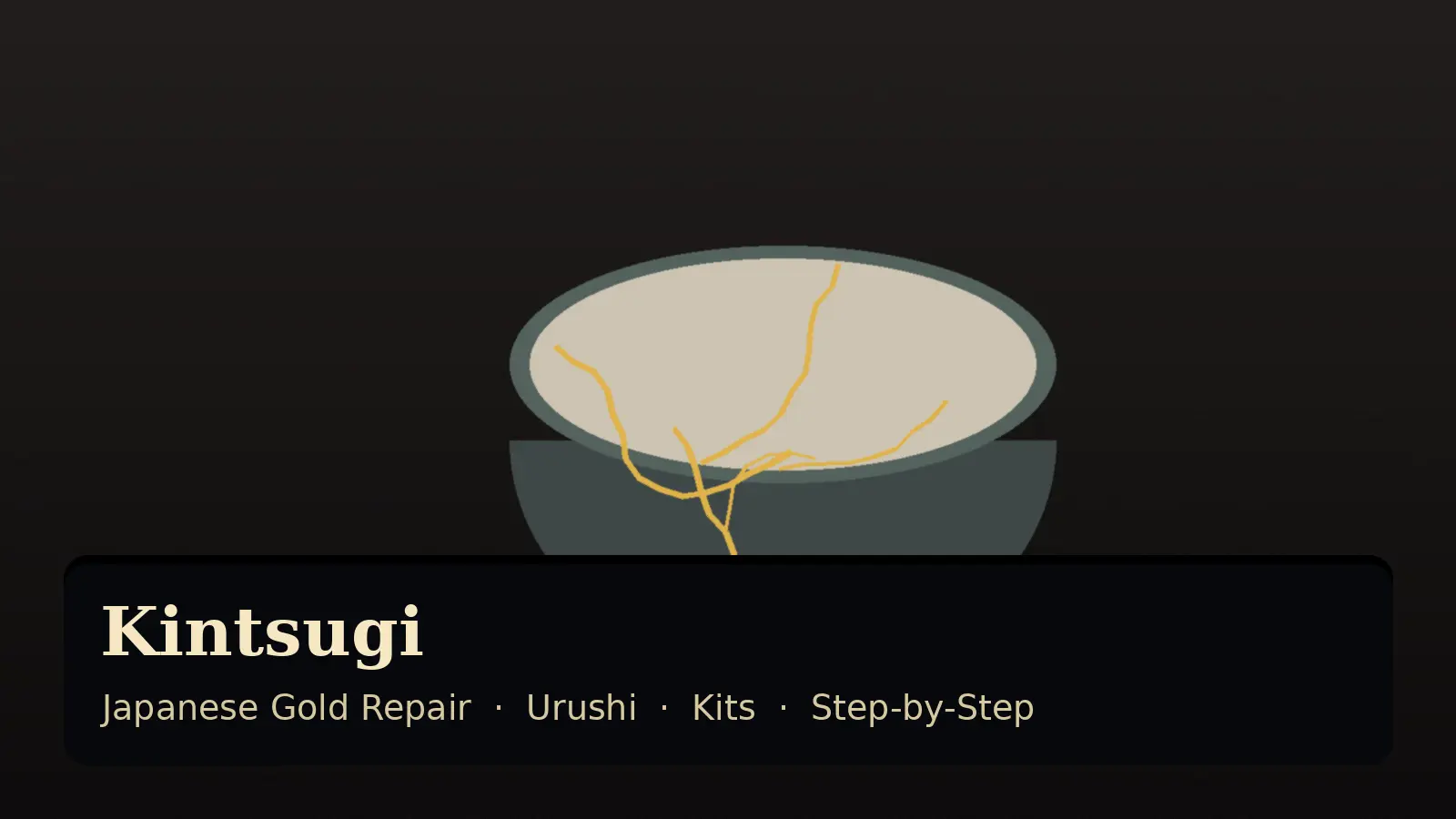
Kintsugi (金継ぎ, “golden joinery”) is the Japanese art of repairing broken pottery with gold: a cracked bowl or chipped cup is joined with urushi lacquer, and gold, silver or platinum powder is dusted onto the seams so the repair shows instead of hiding.[11] This guide covers the kintsugi meaning and philosophy, its history, how urushi lacquer works, the repair types (crack, chip, break and yobitsugi), gold vs silver vs red finishes, how to do kintsugi step by step, traditional urushi vs “easy” epoxy kintsugi, food safety, urushi rash, what Japanese kintsugi kits contain and cost (as of November 2026), workshops in Tokyo and Kyoto, and how to buy kintsugi kits and pieces from Japan.
What Is Kintsugi? Meaning, Kanji and Pronunciation
The Digital Daijisen dictionary defines kintsugi as a repair method that originated in Japan: broken or chipped ceramics are glued with urushi, and powder of gold, silver, platinum or another metal is sprinkled on the joins as decoration. The repaired seam is called keshiki (“scenery”), and the owner enjoys a look that is different from the piece before it broke. The same entry notes that today synthetic adhesives are sometimes used instead of urushi.[11]
- Kintsugi kanji: 金継ぎ. 金 kin = gold, 継ぎ tsugi = joining, splicing. In kana: きんつぎ.
- Kintsugi pronunciation: keen-tsoo-gee, three short syllables (kin-tsu-gi); the “tsu” is one sound, as in “tsunami”. This is also how to say kintsugi in Japanese.
- Kintsugi literal meaning: “gold joining” or “golden joinery”. The kintsugi etymology is simply those two words; the Japanese word for gold repair is kintsugi.
- Kintsugi vs kintsukuroi: there is no difference in meaning. 金繕い kintsukuroi (also kinzukuroi, “gold mending”) is listed as the same thing as kintsugi.[17]
- Keshiki: in ceramics, especially tea ware, keshiki is a point of appreciation: glaze drips, kiln changes, spots, any unplanned change. The dictionary entry cross-refers to kintsugi.[18] That is the kintsugi concept meaning in one word: the repair becomes part of the scenery of the piece.
So, what is Japanese gold repair called, and what is the Japanese word for fixing broken things with gold? Kintsugi (or kintsukuroi). The Japanese art of gold repair, the Japanese technique to repair with gold, the art of golden repair, Japanese gold pottery repair, Japanese gold crack repair and “the Japanese repair broken things with gold” all describe the same practice. Other names you will meet: urushi-tsugi (urushi-only repair, the older term), gintsugi for silver seams, and “kintsugi-inspired” or “kintsugi style” for decoration that copies the look.[5] Kintsugi in Japanese writing is 金継ぎ. Used in a sentence: “The cracked tea bowl came back from kintsugi with a gold seam.” Kintsugi in English has no one-word equivalent; dictionaries and museums keep the Japanese word, and Kotobank’s dictionary sums it up as a method that is unique to Japan.[11]
Kintsugi Philosophy: Wabi-Sabi, Scars and the Meaning in Life
The kintsugi philosophy comes straight from that definition: the break is part of the object’s history, so the repair is highlighted in gold instead of being disguised.[11][18] Kintsugi is often explained alongside two Japanese aesthetic ideas:
- Wabi: finding fulfillment in simplicity and lack. It developed with the tea ceremony (wabi-cha) of Takeno Joo and Sen no Rikyu in the 16th century. Their tea did not reject fine objects; it set famous pieces against plain ones to bring out a deeper beauty.[19]
- Sabi: the beauty of quiet, aged, weathered things, in which something deep and rich appears as they grow older.[20]
Put together, kintsugi and wabi-sabi share a respect for age, use and imperfection. This is an interpretation rather than a dictionary definition, but it explains why the kintsugi meaning in life is so often quoted. People use it as a metaphor for resilience: a broken person, relationship or heart can heal and become more beautiful for the “scars”. Hence the kintsugi heart, kintsugi meaning in love and relationships, kintsugi tattoo ideas, kintsugi quotes and spiritual readings (including Christian ones). A kintsugi tattoo meaning is personal, but it usually draws on the same image of gold-filled cracks. Kintsugi is often linked with Zen and Zen Buddhism through the tea ceremony; the dictionaries cited here tie wabi to tea, not directly to Zen. Kintsugi art therapy and kintsugi art for kids use paper or clay to show the idea without urushi. The meaning behind kintsugi, its symbolism and its “kintsugi mindset” are the same poetic idea: the art of precious scars, or the art of healing, in which the history of the break is honored. As a symbol, a gold crack line is now used on cards, posters, abstract art and decor.
Kintsugi History: From Urushi Glue to Gold Seams
The kintsugi tradition (and the theory behind it) grew from two Japanese crafts: urushi used as glue, and maki-e gold dusting.
- Jomon period: urushi was already used as an adhesive in Japan in the late Jomon period, and lacquered wooden objects have been excavated from that era.[6] Repairs with urushi were long simply called urushi-tsugi and used no gold.[5]
- Nara period: maki-e, the craft of sprinkling gold and silver powder onto urushi designs, began in the Nara period. Kintsugi’s finishing step uses the same principle.[21]
- 15th–16th centuries: one kintsugi school traces the origin of gold kintsugi to the 15th century. In its account, the exact start date is unknown, but the most widely held view links it to the tea culture of the Muromachi period, and it flourished in the Sengoku and Azuchi-Momoyama periods. In the early Edo period, a kintsugi repair could even raise a piece’s value.[5] Yobitsugi, the patchwork of shards from different pieces, is said to have been favored by Momoyama-period tea people.[4]
- The Bakohan tea bowl: the story most often told in kintsugi history is a 13th-century Chinese celadon bowl now at the Tokyo National Museum (an Important Cultural Property). The legend says Ashikaga Yoshimasa owned it. When it cracked, he sent it to China for a replacement, but it came back held together with metal staples (kasugai). The staples looked like a locust, which gave the bowl its name, Bakohan.[22] This was a staple repair, not gold. It is still a good example of the kintsugi origin story’s core idea: a repaired piece can become more celebrated than before.
- Today: quick “easy kintsugi” with modern materials has become popular, and kintsugi is now also used as art, not just repair.[5]
What Is Kintsugi Made Of? Urushi Lacquer Basics
What is urushi lacquer? Urushi (漆) is the sap of the urushi tree, a member of the cashew family (Anacardiaceae), which also includes mango. Tap the bark and a milky sap comes out. Filtered, this raw sap is ki-urushi (生漆). Its main component is urushiol; it also contains water, gum and an enzyme, laccase, that makes it harden.[6] Mixed with oil and pigments it becomes a finish that dries hard and resists water and acids.[6] So what is kintsugi made of? Traditionally urushi, wheat flour, polishing-stone powder (tonoko) and gold, silver or other metal powder. Nothing more.[1]
- Urushi vs lacquer: in Japanese, 漆 means the natural sap and the finish made from it; English calls it “Japanese lacquer”.[6] Urushi natural lacquer is a plant sap that hardens through an enzyme reaction (laccase) in warm, humid air, not by solvent evaporation.[6]
- Urushi lacquer tree and plant: the tree came to Japan from the Asian mainland in ancient times and is grown widely; the dictionary notes its sap can cause skin rash.[6]
- Japanese vs Chinese urushi: encyclopedias rate Japanese and Chinese urushi as the best grades.[6] About 91% of the urushi used in Japan is imported, mostly from China, and only about 9% is Japanese. Japan produced only 2.0 tons in 2021, about 82% of it in northern Iwate around Joboji.[23] Japan’s 2025 urushi production was 1,885 kg.[24] That is why kintsugi kits say whether they use Japanese (国産) or Chinese (中国産) urushi, and why Japanese urushi lacquer is expensive.
- Urushi lacquer drying time: urushi does not “dry” by evaporation. It hardens at about 25–30 °C (77–86 °F) and 75–85% humidity, which is why craftspeople use a special humid cabinet called a muro.[6] The urushi-buro (urushi bath) is the same cabinet; its inside is wiped with water to keep it humid.[25] Kept at the wrong temperature, urushi stays sticky. Heated to about 70 °C (158 °F) the enzyme stops working, and urushi will not harden at room temperature again.[6]
- Urushi lacquer durability: once hard, urushi is glossy, stable against acids and alkalis, resistant to moisture and rot, and a strong adhesive.[6] Repaired pieces still need lacquerware care: no microwave, dishwasher, oven or open flame.[13] So urushi is not dishwasher safe or heat resistant in the kitchen sense.
- Urushi lacquer composition and ingredients: raw urushi is urushiol plus related compounds, water, a little gum and the enzyme laccase.[6] Refining (stirring, then warming to about 38–40 °C to drive off water, a step called kurome) produces refined urushi; oils and pigments are then added.[6] Making urushi lacquer from the tree is a specialist job, so for kintsugi you buy ki-urushi and e-urushi ready-made; the recipe for the mixes (mugi, sabi, kokuso) is below.[1]
- Urushi lacquer colors: pigments turn urushi into colored urushi (iro-urushi): vermilion red, yellow, green, brown and black.[6] Clear or transparent urushi is suki-urushi (透き漆), made by heating and stirring raw urushi; it is the base for colored and black urushi.[1]
- Urushi lacquer application: applied with a brush in very thin coats, each hardened in the muro, then sanded, the same as for lacquerware.[6][1]
- Urushi lacquer alternative or substitute: synthetic “urushi” paints and epoxy are the usual substitutes, with the trade-offs in the comparison table below.[26][14]
- Urushi lacquer for glass: natural urushi grips glass poorly, so there is a glass urushi blended with a little synthetic resin.[1]
- Urushi lacquer vs epoxy, shellac and enamel: epoxy is a two-part synthetic resin that cures chemically. Shellac is an insect resin dissolved in alcohol, and enamel is paint or glass coating. None of these is urushi, though easy kintsugi kits use epoxy instead of urushi (see the comparison below).
Urushi is the same material as Japanese lacquerware. For bowls, trays, boxes, chopsticks and maki-e, see our Japanese lacquerware guide and urushi chopsticks guide.
Is urushi lacquer toxic? Urushi rash (kabure) and safety
Liquid urushi can cause a rash. Urushiol is the cause, and in some people it triggers an allergic reaction (urushi kabure).[27][6] The safety advice below is about working with liquid urushi from a kit:
- Wear disposable gloves and long sleeves and keep skin covered.[16][13]
- If urushi touches your skin, one Kyoto urushi maker advises wiping it off with vegetable oil first, then washing with soap; rinsing with water first makes it harder to remove.[16]
- The urushi lacquer reaction may not appear at once; it can show up a couple of days later. Stop working and see a doctor if it does.[16][13]
- Kit makers say the risk depends on your constitution and condition, and they do not accept responsibility for rashes.[13][15]
- Poison ivy, oak and sumac rashes, which many US readers know, are also caused by plant oils (resin). MedlinePlus advises washing the skin with soap and warm water within 30 minutes, and washing clothes and tools, because the oils can linger on them.[28]
Worried about allergy? One Tokyo school notes that one-day classes use no urushi, so there is no urushi rash, and that with proper gloves the risk with real urushi is low.[29]
Types of Kintsugi Repair (Tsugi Types)
Kintsugi follows the type of damage. Real kintsugi repair splits into a few basic cases:[1][4]
| Type | Damage | How it is repaired | Source |
|---|---|---|---|
| Hibi (ヒビ) — crack repair | A hairline crack, the piece is still in one part | Clean the crack, let raw urushi soak in, fill with sabi-urushi if needed, then paint the line and dust it with powder | [1][2] |
| Kake (欠け) — chip repair | A small chip on the rim, foot or handle | Fill shallow chips with sabi-urushi; deep chips or holes with kokuso-urushi, then coat and dust | [1] |
| Ware (割れ) — break repair | The piece is broken into two or more fragments | Glue the fragments with mugi-urushi (flour + urushi), fill gaps, coat, then dust the seams | [1][3] |
| Tomotsugi (共継ぎ) | All the original fragments are there | Rejoin the piece with its own fragments; only the crack lines turn gold | [4] |
| Yobitsugi (呼継ぎ) | A part is missing or shattered | Fit a shard from a different piece, file it to shape and join it with mugi-urushi; the shard itself becomes the design | [4][5] |
The urushi mixes used at each stage are kintsugi’s real “glue” and “paste”:
| Urushi mix | What it is and does | Source |
|---|---|---|
| Ki-urushi (生漆) | Raw, filtered sap; the base of every other urushi; brushed on fracture faces to seal them | [1][6] |
| Mugi-urushi (麦漆) | Wheat flour + water + urushi; the adhesive for broken fragments | [3][1] |
| Sabi-urushi (錆漆) | Tonoko (polishing-stone powder) + water + urushi; fills shallow chips and cracks | [7][1] |
| Kokuso-urushi (刻苧漆) | Mugi-urushi plus wood powder (or rice-paste based mixes); fills deep chips, holes and missing parts | [1] |
| Kuro-roiro-urushi (黒呂色漆) | Refined urushi turned black with iron; middle coats that smooth the surface | [1] |
| E-urushi / bengara-urushi (絵漆・弁柄漆) | Refined urushi with pigment, often red iron oxide; the sticky layer the gold is dusted onto | [1] |
| Glass urushi (ガラス用漆) | Urushi blended with a little synthetic resin so it grips glass and glazed surfaces | [1] |
Mugi-urushi, sabi-urushi and kokuso-urushi are mixed fresh. They keep about a week in a refrigerator at most, and sabi-urushi only about two days.[1]
Gold, Silver, Red or Black: Kintsugi Finishes and Gold Powder
Is kintsugi real gold? In traditional work, yes: pure gold powder dusted onto urushi. Gold leaf turned into powder (keshifun) is one of the forms. It is not gold paint, gold glue or gold flake mixed in glue. Easy kintsugi often uses brass powder, which looks gold but is not.[8][10][14]
| Finish | What it is | Repair-service guide price (Tokyo school, Nov 2026) | Source |
|---|---|---|---|
| Gold, round powder (純金丸粉, marufun) | Powder flattened then rounded; graded from No. 1 (fine) to No. 15 (coarse); can be burnished | Repair shop guide: chip/crack from ¥26,000, break from ¥30,000 (excl. tax) | [8][9] |
| Gold, keshifun (純金消粉) | Gold leaf mixed with glue or syrup, dried and crumbled into a soft powder | Chip/crack from ¥20,000, break from ¥24,000 | [10][9] |
| Silver (純銀丸粉 / 消粉) | The same round or keshifun powders in silver | Chip/crack from ¥10,000–¥15,000, break from ¥14,000–¥19,000 | [9][11] |
| Platinum | Listed in the dictionary definition alongside gold and silver | — | [11] |
| Red (shu-urushi, 朱漆) | Vermilion urushi made from refined urushi plus vermilion or bengara; no metal powder | — | [12] |
| Black or brown (urushi only) | Finished in urushi without powder, to suit the pottery | — | [13] |
| Brass “gold” / aluminum “silver” | Metal powders used in easy (synthetic) kintsugi | Easy repair: chip/crack from ¥6,000, break from ¥9,000 | [9][14] |
Repair prices are one Tokyo school’s guide prices (excluding tax). It has temporarily paused new repair orders because of demand.[9] The choice between a gold, silver, red or black kintsugi bowl is mostly about the pottery: gold suits dark glazes, silver suits white porcelain and blue-and-white ware, and red (shu) or black urushi suits rustic stoneware. That is a matter of taste. Copper-colored and other powders exist too; maki-e makers use tin, copper, brass and aluminum as well as gold and silver.[8]
How to Do Kintsugi: Step-by-Step (Traditional Urushi Method)
This is the hon-urushi (real urushi) kintsugi process, simplified from a Tokyo kintsugi school’s guide and Japanese kit makers’ manuals. Expect about a month, and two months or more is common.[1][15]
- Prepare the piece. Collect every fragment, even tiny ones, and keep them in a bag or box. Don’t rub the broken edges together or scrub them, so they still fit.[4]
- Seal the fracture faces. Brush thin ki-urushi onto the broken edges so later layers grip, and let it harden.[1]
- Glue the fragments (ware). Knead wheat flour with water, then mix in urushi to make mugi-urushi. Coat the edges, press the fragments together, tape them with masking tape and let it harden. One school says about a week.[3][1][29]
- Fill chips and gaps (kake). Mix tonoko powder with water and urushi to make sabi-urushi for shallow chips and cracks, or kokuso-urushi for deep chips and holes. Build up in thin layers and let each one harden.[7][1]
- Sand and coat. Sand the fills flush with waterproof paper (#600 → #800 → #1000). Brush thin middle coats of black urushi, harden and sand again.[15][1]
- Paint the line. With a fine maki-e brush, paint the seam with e-urushi (often red bengara-urushi).[1]
- Dust the gold. When the e-urushi is just tacky, dust gold or silver powder over it with a soft brush or silk floss (mawata), and let it harden in the muro.[1][13]
- Polish. Fix the powder with a thin coat of urushi if the method calls for it, and burnish round powder for shine. Kits include polishing powders for this.[15][8]
Kintsugi supplies, tools and materials list: ki-urushi and e-urushi, wheat flour, tonoko, polishing powders, gold powder, a spatula and a glass or plastic palette, fine and flat brushes, waterproof sandpaper, masking tape, disposable gloves, a small spoon, tissue, and a humid box to act as the muro.[15][16][13] Kintsugi gold powder is sold in tiny amounts; kits include 0.1 g bags.[16][13] A crack (hibi) is the easiest first project. One Kyoto urushi shop teaches cracks by tracing the line with an urushi-loaded brush, holding your breath, then dusting with silk floss.[2]
Kintsugi DIY tips for beginners
- Start with a small crack or chip on an inexpensive piece before you repair anything precious.
- Mix only as much mugi-urushi or sabi-urushi as you need; it keeps about a week at most.[1]
- Work thin. Thick layers of urushi harden poorly; several thin layers are the rule in every tutorial.[1]
- Keep a humid box for your muro and expect waits of days between steps.[25][15]
- Watch the kit’s video tutorial: all four kits in our table come with written or video instructions.[15][16][13][14]
Easy kintsugi (epoxy) in brief
“Easy” or “simple” kintsugi (簡易金継ぎ) swaps urushi for modern materials. One food-safe-labeled Japanese easy kintsugi kit uses glue for the fragments, epoxy putty for chips, a two-part kintsugi resin for the line and brass powder for the gold. You need acetone nail-polish remover and gloves.[14] One-day classes using no urushi finish in about two hours.[29] The materials are different, but the steps follow the same order as the traditional ones: glue, fill, sand, paint the line, dust.
Traditional vs Easy Kintsugi: Urushi vs Epoxy
| Traditional (hon-urushi) kintsugi | Easy / epoxy kintsugi | |
|---|---|---|
| Main material | Natural urushi sap (urushiol) plus flour, tonoko, gold or silver powder | Epoxy putty, two-part resin, instant glue or synthetic “urushi” paint, brass powder |
| Curing | Hardens through an enzyme reaction in warm, humid air (25–30 °C / 77–86 °F, 75–85% humidity) in a muro | Chemical cure at room temperature; one-day classes finish in about 2 hours |
| Time | About one month, two months or more depending on the break and the season | Same day to a few days |
| Skin | Can cause urushi rash (kabure); gloves and long sleeves | No urushi rash; follow each product label |
| Food use | Kit makers using natural urushi describe it as usable for tableware, with lacquerware care rules | Only if every material is approved for food contact; synthetic urushi may no longer be sold as usable for tableware in Japan |
| Cost | Higher: kits ¥11,000–¥21,600 in our sample | Lower: easy kits from ¥8,800 in our sample |
Sources for the table: curing conditions[6]; time[15][29]; skin[29][16]; food use[13][14][30]; kit prices[15][16][13][14]. The Japanese kintsugi teaching site Kintsugi Library notes that “shin-urushi” is not urushi at all: it is a synthetic paint made to look like urushi, originally for fishing tackle.[26]
Is Kintsugi Food Safe?
It depends on the materials, so read the label of your kit and treat these as the makers’ own statements:
- Real urushi: Tsugu Tsugu says its natural-urushi kit lets you use repaired pieces as tableware, with lacquerware rules: no microwave, dishwasher, oven or open flame. It adds that the repaired piece is not as strong as before.[13] A Tokyo kintsugi school says both its urushi and its food-contact-compliant easy repairs can be used as tableware afterward.[9]
- Synthetic urushi (shin-urushi etc.): the maker’s caution, as quoted by Kintsugi Library, is: it is not a highly toxic substance, but do not use it on tableware or anything that may go in the mouth, and ventilate while it dries.[26] In Japan, since June 1, 2025 synthetic urushi such as shin-urushi can no longer be sold as usable for tableware.[30]
- Why June 2025: Japan’s positive-list system for food utensils, containers and packaging took full effect when its transitional period ended on May 31, 2025. Synthetic resin used on food-contact items must now be a listed substance.[31]
- Food-contact easy kits: one Tokyo kit says every material meets Japan’s Food Sanitation Act standard and the positive list, so repairs can be used as tableware under the new rules.[14]
So, are kintsugi bowls food safe? A bowl repaired with real urushi, or with an easy kit whose materials are approved for food contact, is described by its makers as usable for food. Is kintsugi dishwasher safe or waterproof? Treat it like lacquerware: no dishwasher, no microwave, no oven. For a decorative kintsugi vase or kintsugi wall art, food safety does not matter. For a kintsugi matcha bowl, ramen bowl, rice bowl, mug or tea cup you will eat or drink from, choose urushi or a kit labeled for food contact, and don’t put your lips on a seam made with synthetic paint.[13][26]
Kintsugi Kits from Japan: What’s Inside and What They Cost
A kintsugi kit (金継ぎキット, kintsugi set) bundles the materials and tools for one or more repairs. Here is what four Japanese kits contain, at listed prices on November 2, 2026:
| Kit | What is inside (内容物) | Listed price | Notes | Source |
|---|---|---|---|---|
| Kintsugi Coffret — Tsutsumi Asakichi Urushi-ten (Kyoto) | Natural urushi (no synthetic resin); jou-ki-urushi 20 g, e-urushi 20 g, turpentine oil 100 cc, tonoko, polishing powders, sandpaper #600–#1000, pure gold powder, spatula, brushes, gloves; video guide | ¥16,500 (tax incl.) | The maker says it does not send this kit abroad because it contains solvents that cannot be shipped overseas | [15] |
| urushi no ippo KINTSUGI kit — Urushi Tsutsumi | Overseas version: jou-ki-urushi 10 g, e-urushi 10 g, tonoko, pure gold powder 0.1 g × 2, polishing powders, sandpaper, brushes, spatula, glass board, 2 pairs of gloves; English-subtitled video; no turpentine listed | ¥21,600 (tax incl.); shown sold out on Nov 2, 2026 | Designed for overseas sale; liquid urushi still inside | [16] |
| Tsugu Kit Gold — Tsugu Tsugu | Ki-urushi 30 g, wood and tonoko powders, black and bengara powders, gold powder 0.1 g, brush, spatulas, silk floss (mawata), masking tape, gloves; you add wheat flour and tissue | ¥11,000 (tax incl.) | Natural urushi; the maker says repairs can be used as tableware | [13] |
| Easy kintsugi kit — Kintsugi Kurashi (Tokyo) | Two-part kintsugi resin, brass powder, epoxy putty 10 g, adhesive, sandpaper #400 and #1000, spatula, tray; you add acetone nail-polish remover and gloves | ¥8,800 (listed) | Synthetic; the maker says every material meets Japan’s food-contact rules and the positive list | [14] |
At ¥150 to the dollar (an example rate only), an ¥11,000 kit is about $73 before shipping; check the day’s rate. A traditional urushi kit (kintsugi kit with urushi lacquer, with real gold) costs more than an epoxy one, mainly because of pure gold powder and urushi. Kit names vary (mini kit, hobby kit, making kit, professional kit), so compare the contents rather than the name. A kintsugi starter kit or kintsugi kit for beginners should include video or written instructions: all four above do.[15][16][13][14] Raw urushi is a natural product: one maker recommends using it within a year, storing it cool and dark, and warns that very old unopened tubes can oxidize and burst.[15]
Can a kintsugi kit be shipped abroad? Check the contents first
This is the most important point when buying a Japanese kintsugi kit from overseas. Many traditional kits contain liquids and solvents. The Kintsugi Coffret, for example, includes 100 cc of turpentine oil (テレピン油) for thinning urushi and washing brushes. Its maker states it does not ship this kit overseas because some contents, such as solvents, cannot be sent abroad, and points buyers to a separate overseas kit whose contents list no turpentine.[15][16] OneMall cannot ship flammable liquids such as oil, lighter fluid and paint, or any aerosol or spray. Items OneMall cannot handle are blocked from purchase.[32] Before ordering:
- Read the 内容物 / セット内容 (contents) list. Look for テレピン油 (turpentine), 灯油 (kerosene), うすめ液 (thinner), 溶剤 (solvent), アセトン (acetone), 塗料 (paint) and any spray.
- Kits with flammable solvents or paints may be refused or blocked, and carriers and your country’s customs have their own rules. We cannot promise that any particular kit will ship. Choose kits sold as solvent-free or overseas versions, and buy turpentine or thinner locally if a method needs it.
- Liquid urushi is a natural lacquer and is sensitive to heat, and makers advise storing it cool and dark (in summer, in a refrigerator), so long transits in hot weather are a risk for any urushi kit.[15][13]
- See what you cannot ship from Japan for the full list of restricted items.
Japanese search terms: 金継ぎキット (kintsugi kit), 本漆 金継ぎ (real urushi kintsugi), 簡易金継ぎ キット (easy kintsugi kit), 金継ぎ 純金粉 (pure gold powder), 新うるし (synthetic urushi), and 金継ぎ 道具 (tools), 蒔絵筆 (maki-e brush), 砥の粉 (tonoko), 生漆 (raw urushi).
Kintsugi on Glass, Wood, Mugs, Jewelry and Fabric
- Can you use kintsugi to repair glass? Yes, but plain urushi grips glass poorly; use a glass urushi (ガラス用漆) blended with a little resin.[1] Kintsugi on glass is harder than on pottery because every flaw shows.
- Kintsugi on wood: urushi is the classic wood finish, so a cracked wooden bowl, tray or furniture can be repaired with urushi and gold in the same way.[6]
- Mugs, handles, plates and bowls: a mug handle carries load, and a kintsugi repair is not as strong as the original, so treat it gently.[13] Plates, tea bowls, coffee mugs, jars, vases and other vessels, crockery and everyday dishes are all kintsugi pottery projects, and so are ceramic ornaments.
- Kintsugi jewelry: kintsugi rings (for men and women), necklaces, earrings and bracelets often use yobitsugi-style shards. One Tokyo school even publishes a book on accessories made with kintsugi techniques.[5]
- Kintsugi fabric, clothing and quilts: visible mending of clothes with contrasting thread shares the same idea as kintsugi. In Japan that is sashiko mending.
- Kintsugi artwork, painting and drawing: gold-crack designs on canvas, a print in a frame, a poster, a sculpture or a drawing of a kintsugi bowl are “kintsugi-inspired” art and decor, not repair.
Kintsugi Workshops and Classes in Japan
A one-day kintsugi experience or class in Japan is a popular souvenir activity. Examples, with prices as listed in November 2026:
- Tokyo — Kintsugi Kurashi: a one-day kintsugi workshop, 2–2.5 hours, ¥8,800 (tax incl.). It uses no urushi, so your piece is finished the same day; you may bring your own broken piece, and English lessons are offered on request.[29] Learning hon-urushi kintsugi takes several visits, because the urushi needs time to harden.[29]
- Tokyo and Kyoto — Tsugu Tsugu: kintsugi shops in Ebisu and Asakusa in Tokyo. Its Kyoto store opened on November 1, 2026 in Higashiyama, about 10 minutes’ walk from Kiyomizu-Gojo station. It runs a 90-minute traditional workshop using real urushi and 23-karat gold powder for ¥22,000 (tax incl.), and you take the finished piece home that day. The shop also displays and sells over 100 kintsugi and urushi pieces.[33]
- Kyoto — Shikata Kizo Urushi-ten: an urushi dealer founded in 1867 near Shijo-Kawaramachi. Its kintsugi experience (about 150 minutes, from ¥12,200) teaches a crack and a break repair, plus a talk on urushi.[2]
- Kanazawa: several studios take your own piece for urushi kintsugi over several sessions. One three-session class is ¥6,600 plus repair fees.[4]
Prices and schedules change; book on each studio’s own site. For the matcha bowls that kintsugi grew up with, see our matcha set guide.
Kintsugi Repair Service and Cost
If you’d rather not do it yourself, a kintsugi repair service in Japan quotes by damage and finish. One Tokyo school’s guide prices (excluding tax): easy kintsugi from ¥6,000 for a chip or crack and ¥9,000 for a break; real urushi from ¥10,000 (silver) to ¥26,000 (gold round powder) for a chip or crack, and ¥14,000–¥30,000 for a break.[9] Tsugu Tsugu handles over 1,000 repairs a year with more than ten kintsugi craftspeople.[33] Kintsugi repair cost depends on the size of the damage and the kind of gold. For a repair course rather than a one-off class, look for multi-session hon-urushi classes such as the Kanazawa ones above.[4]
Kintsugi Bowls and Kintsugi Art: What to Buy from Japan
What does a kintsugi bowl look like? A normal bowl with thin gold lines following the cracks. Chips show as gold patches, and with yobitsugi, a shard of a different pattern is framed in gold.[11][4] In Japan you can buy:
- Pieces by kintsugi artists: a kintsugi artist or repair artist is called a kintsugi-shi (金継ぎ師) in Japan.[33] Tsugu Tsugu’s Kyoto store works like a small gallery: it shows and sells over 100 kintsugi and urushi works by its craftspeople, and it has also launched a bonsai-pot kintsugi piece.[33]
- Secondhand repaired pieces: on Mercari and Yahoo Auctions, search 金継ぎ 器 (kintsugi ware), 金継ぎ 茶碗 (kintsugi tea bowl), 金継ぎ 皿 (plate), 金継ぎ 花瓶 (vase) or 呼継ぎ (yobitsugi). Antique kintsugi bowls and vintage kintsugi art are listed this way, and the listing photos work as before-and-after pictures of the repair, but repair quality varies. Ask the seller whether the repair is 本漆 (real urushi) or 簡易 / 合成 (synthetic), especially for food use.
- Pottery to practice on: inexpensive Mino, Hasami or Arita ware; see our Japanese ceramics guide.
- Gifts: a kintsugi kit for couples or newlyweds, or a kintsugi bowl, makes a thoughtful wedding or anniversary gift. See our Christmas gifts from Japan.
Kintsugi bowl price: in Japan, a repair alone costs from ¥6,000 to ¥30,000 or more (Tokyo school guide), so a piece with a real-gold urushi repair carries that cost on top of the pottery.[9] Cheap “kintsugi bowls” made new with printed or painted gold lines (sometimes called fake kintsugi) are a decorative style and not repaired pieces. Large bowls and bronze- or copper-toned finishes are available too.
Urushi lacquer artists and maki-e makers buy their supplies from the same urushi dealers that sell kintsugi kits.[15][1] Browse kintsugi ware, kintsugi tea bowls, yobitsugi pieces or urushi kintsugi tools on OneMall.
Kintsugi vs Other Repair Methods
- Kintsugi vs invisible restoration: museum-style restoration tries to hide the damage; kintsugi shows it.[11]
- Kintsugi vs staple repair (kasugai): metal staples drilled across a crack, as on the Bakohan tea bowl.[22]
- Kintsugi vs superglue or epoxy alone: a quick join with no visible finish. Easy kintsugi adds the gold line on top.[14]
- Gold foil, gold leaf and gold inlay: in kintsugi the gold is a fine powder or powdered leaf (keshifun) sprinkled onto urushi, not foil laid on or gold inlay set into the body; the filling under it is urushi paste.[10][1]
- Kintsugi vs gold paint: gold paint on a plain glued seam looks similar at first, but it is not dusted metal on urushi. Maki-e-style dusting is what gives real kintsugi its depth.[21]
How to Buy Kintsugi Kits and Pieces from Japan
- Search in Japanese: 金継ぎキット, 金継ぎセット, 本漆 金継ぎ キット, 簡易金継ぎ, 金継ぎ 器, 呼継ぎ, 生漆, 絵漆, 純金粉, 蒔絵筆.
- Check the contents for solvents, oils, paints and sprays (see above). Kits with flammable solvents or liquids may be refused or blocked.[32][15]
- Check the material: 天然漆 / 本漆 (natural urushi) vs 合成うるし / 新うるし (synthetic), and whether the maker says the repair can be used for food.[30][13]
- Packing for ceramics: kintsugi bowls and vases are fragile. Add package reinforcement (from ¥100), and unboxing photos (¥500 / ¥700) to check a piece at the Tokyo warehouse before international shipping.
OneMall buys from Japanese marketplaces such as Mercari, Yahoo Auctions, Rakuten and Amazon Japan, and from other Japanese online stores (including maker web shops) through LinkBuy. Items that need a lottery entry, purchase limit, Japanese identity verification or a merchant account cannot be purchased. International shipping is charged on the greater of actual weight and volumetric weight (length × width × height ÷ 5,000) of the box the warehouse uses.
Service fees are ¥300 per item on most marketplaces; from ¥200 per item on Yahoo Auctions and LinkBuy. The first six orders consolidate free; each additional order costs ¥100. Storage is free for 90 days after arrival (30 days after consolidation). Payment is by Visa, Mastercard or PayPal, settled in USD.
US buyers: since August 29, 2025, US-bound parcels of any value go through customs and pay applicable duties, taxes and fees — the $800 de minimis exemption no longer applies. OneMall currently ships to the United States by ECMS, DHL and Japan Post EMS (DDP — declared value up to USD 2,500, duties prepaid with the shipping fee); the live quote at checkout shows which lines accept your parcel.
If something breaks: damage caused inside the warehouse by OneMall is refunded at the item’s purchase price; damage in international transit is compensated up to the international shipping fee paid, and must be reported within 24 hours with the order number, photos and a full unboxing video. Loss in transit is handled by the carrier, and OneMall helps confirm with the carrier and file the claim within 72 hours. Duties and customs fees are paid by the buyer.
Compare the best Japan proxy services and proxy costs by total landed cost. Our LinkBuy guide explains ordering from a Japanese maker’s web shop.
Frequently Asked Questions
What does the word kintsugi mean?
Kintsugi (金継ぎ) means “golden joinery”: a Japanese method of repairing broken or chipped pottery with urushi lacquer and dusting the seams with gold, silver or platinum powder.
What is the difference between kintsugi and kintsukuroi?
None in meaning. Kintsukuroi (“gold mending”) is another word for kintsugi.
What is the kintsugi philosophy?
The break is part of the object’s history, so it is highlighted rather than hidden. Japanese tea culture calls such features keshiki (“scenery”), and kintsugi is often explained with wabi-sabi.
What is kintsugi made of?
Traditionally urushi (natural lacquer from tree sap), wheat flour, tonoko powder and gold or silver powder. Easy kits use epoxy, resin and brass powder.
Is kintsugi food safe?
Makers of natural-urushi kits describe repaired pieces as usable for food, hand-washed and kept out of the microwave. Synthetic urushi such as shin-urushi should not be used on tableware; easy kits are food-safe only if all materials are approved for food contact.
How long does kintsugi take?
Real urushi kintsugi takes about a month, often two or more, because urushi must harden in a warm, humid muro between steps. Epoxy or one-day kintsugi takes about two hours.
Can urushi cause an allergic reaction?
Yes. Urushiol in liquid urushi causes urushi rash in some people, sometimes a couple of days after contact. Wear gloves and long sleeves, wipe urushi off skin with vegetable oil, then wash with soap.
How much is a kintsugi kit in Japan?
In our November 2026 sample, from ¥8,800 for an easy kit to ¥11,000–¥21,600 for natural-urushi kits with pure gold powder.
Can I ship a Japanese kintsugi kit to the US?
Only if its contents can be shipped. Kits containing turpentine, thinner, flammable paint or sprays may be refused or blocked. Check the contents list (内容物) first and choose a solvent-free kit.
Is kintsugi gold real gold?
In traditional kintsugi, yes: pure gold powder on urushi. Easy kintsugi often uses brass powder that looks like gold.
Where can I try kintsugi in Japan?
Tokyo and Kyoto have one-day kintsugi workshops, from about ¥8,800 for a 2-hour class without urushi to ¥22,000 for a 90-minute real-urushi class with 23-karat gold (November 2026).
References
- Kintsugi Kurashi: types of urushi used in hon-urushi kintsugi. https://kintsugikurashi.co.jp/howto/workshop/hon-urushi/
- Otonami: kintsugi experience at Shikata Kizo Urushi-ten, Kyoto. https://otonami.jp/experiences/shikata-kizou/
- Kotobank: 麦漆 (mugi-urushi). https://kotobank.jp/word/%E9%BA%A6%E6%BC%86-641028
- Kanazawa Kintsugi Guide: yobitsugi and tomotsugi. https://marutoamu.com/kintsugi/articles/yobitsugi-tomotsugi/
- Kintsugi Kurashi: history of kintsugi. https://kintsugikurashi.co.jp/howto/workshop/rekishi/
- Kotobank: 漆 (Daijisen, Nipponica, MyPedia, Britannica Japan, Obunsha). https://kotobank.jp/word/%E6%BC%86-35489
- Kotobank: 錆漆 (sabi-urushi). https://kotobank.jp/word/%E9%8C%86%E6%BC%86-511675
- Kotobank: 丸粉 (marufun). https://kotobank.jp/word/%E4%B8%B8%E7%B2%89-636346
- Kintsugi Kurashi: kintsugi repair service price guide. https://kintsugikurashi.co.jp/howto/workshop/repair/
- Kotobank: 消粉 (keshifun). https://kotobank.jp/word/%E6%B6%88%E7%B2%89-2034055
- Kotobank: 金継ぎ (Digital Daijisen). https://kotobank.jp/word/%E9%87%91%E7%B6%99%E3%81%8E-481548
- Kotobank: 朱漆 (shu-urushi). https://kotobank.jp/word/%E6%9C%B1%E6%BC%86-527876
- CRAFT STORE: Tsugu Tsugu kintsugi kit (Tsugu Kit Gold). https://craft-store.jp/products/cf100786
- Kintsugi Kurashi: easy kintsugi kit (food-contact positive-list materials). https://kintsugikurashi.co.jp/shop/tool/kanni-kit/
- Tsutsumi Asakichi Urushi-ten: Kintsugi Coffret kit. https://www.kourin-urushi.com/?pid=140374544
- Urushi Tsutsumi: urushi no ippo KINTSUGI kit (overseas version). https://urushi.life/products/kintsugi-kit
- Kotobank: 金繕い (Digital Daijisen). https://kotobank.jp/word/%E9%87%91%E7%B9%95%E3%81%84-481551
- Kotobank: 景色 (Digital Daijisen, Nihon Kokugo Daijiten). https://kotobank.jp/word/%E6%99%AF%E8%89%B2-488813
- Kotobank: わび (wabi). https://kotobank.jp/word/%E3%82%8F%E3%81%B3-154286
- Kotobank: さび (sabi). https://kotobank.jp/word/%E3%81%95%E3%81%B3-69542
- Kotobank: 蒔絵 (maki-e). https://kotobank.jp/word/%E8%92%94%E7%B5%B5-135695
- Cultural Heritage Online (Agency for Cultural Affairs): celadon tea bowl “Bakohan”. https://online.bunka.go.jp/heritages/detail/479058
- MAFF aff magazine: the world of urushi (Joboji, Iwate). https://www.maff.go.jp/j/pr/aff/2211/spe1_02.html
- Forestry Agency: production trends of special forest products. https://www.rinya.maff.go.jp/j/tokuyou/tokusan/index.html
- Kotobank: 漆風呂 (urushi-buro / urushi-muro). https://kotobank.jp/word/%E6%BC%86%E9%A2%A8%E5%91%82-442201
- Kintsugi Library (hatoya): what is “shin-urushi” synthetic urushi. https://hatoya-f.com/simple-kintsugi/synthetic-resin-urushi/
- Kotobank: 漆かぶれ (Heibonsha World Encyclopedia). https://kotobank.jp/word/%E6%BC%86%E3%81%8B%E3%81%B6%E3%82%8C-1275223
- MedlinePlus: Poison ivy, oak, sumac rash. https://medlineplus.gov/ency/article/000027.htm
- Kintsugi Kurashi: one-day kintsugi workshop, Tokyo. https://kintsugikurashi.co.jp/1day-workshop/
- Kintsugi Kurashi: synthetic urushi for kintsugi. https://kintsugikurashi.co.jp/shop/tool/gousei-urushi/
- Consumer Affairs Agency: positive-list system for food utensils, containers and packaging (from June 1, 2025). https://www.caa.go.jp/policies/policy/standards_evaluation/appliance/positive_list_new
- OneMall: Prohibited Items List for Japan. https://support.onemall.jp/prohibited-items-list-for-japan/
- Koubo (press release digest): Kintsugi Tsugu Tsugu Kyoto store opens Nov 1, 2026. https://koubo.jp/article/137184