
 Shopping Guide
 HELP / FAQs



 By onemall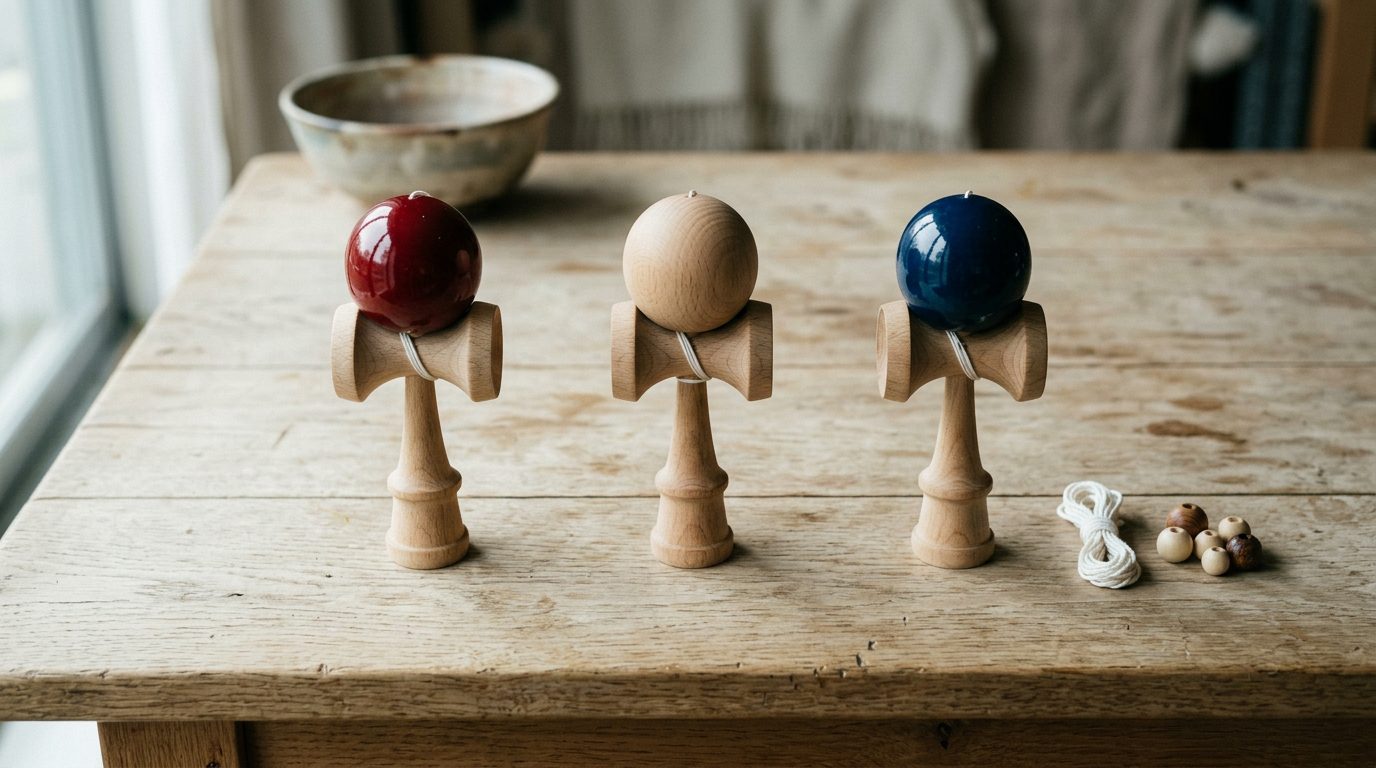
TL;DR
A kendama is one of the cheapest things in Japan that is genuinely worth importing: the
competition-grade ball costs less than a takeaway lunch domestically, and the whole ladder —
toy, competition model, spare strings — came to ¥4,574 (US$31.56) on
12 September 2026. The interesting number is not the toy price. It is that the box you ship it in
changed the freight by 20 per cent on the same day.
- Real prices, checked on 12 September 2026 — a plain school-grade wooden
kendama at ¥521 (US$3.59), a three-pack of replacement strings at
¥643 (US$4.44), an Ikeda competition ball at ¥1,490
(US$10.28) and the Yamagata Koubou 大空 at ¥1,920
(US$13.25).[1] - 認定 (certification) is the only spec that matters. The Japan Kendama
Association, founded on 5 May 1975 and now a public-interest incorporated association, runs the
級/段位 grading system and certifies the balls used in its
tournaments.[2] An uncertified ball is a toy; a certified one is
standardised equipment. - The maker is a small workshop in Yamagata. 山形工房 (Yamagata
Koubou) in 長井市, Yamagata Prefecture, has been making wooden goods since 1973 and produces
the 大空 competition line.[3] - The string is a consumable, and nobody tells beginners that. A three-pack costs
¥643 and weighs nothing. Buy it in the same parcel or you will be sourcing 50 cm of
kendama-specific cotton cord from your own country at a comical markup. - Box size beat weight on the US lane. On 8 September 2026 the same destination
quoted US$17.44 for a 500 g parcel in a 16×12×9 cm box and
US$20.99 for a lighter 300 g parcel in a 25×18×10 cm box.
The Japan Post lanes quoted the same price for both.
As of September 2026, kendama sells abroad as a “skill toy” at skill-toy prices. Inside
Japan it is a school supply, a tournament sport and a ¥521 impulse buy, all at once.
What Certification Actually Buys You
Every kendama looks the same in a listing photograph: a handle, a crossbar with two cups, a spike,
a ball on a string. The differences that matter are dimensional, and they are exactly what the
日本けん玉協会 (Japan Kendama Association) locks down when it certifies a model for competition
use.[2]
- Consistent ball and cup diameters. Certified balls sit in the cups with a
predictable margin, which is what makes the higher-級 tricks reproducible rather than lucky. - A standard string length and hole placement. The 50 cm 糸 is not
arbitrary — it sets the swing radius the trick catalogue assumes. - Balanced weight. A cheap ball is often lighter and glossier; it plays faster and
bounces out of the cup. That is fine for a first week and frustrating in the second.
The grading system is the reason any of this is standardised. The association awards 級
ranks and then 段位 ranks against a published trick list, and it runs national
championships.[2] If you have any intention of testing for a rank,
or of following along with a Japanese trick video, buy the certified ball. If you want something for
a nine-year-old to bash around a garden, the ¥521 model is the correct purchase and the
¥1,920 one is a waste.
The Ladder, and Where to Stop
There are effectively three tiers on a Japanese marketplace shelf, and the gap between them is
small enough that most overseas buyers should skip the middle:
- School / party grade (¥400–¥1,000). Plain beech, printed rather
than painted, no certification. Perfectly playable. - Certified competition (¥1,300–¥2,100). 競技用 models from
Ikeda, Onda and 山形工房. This is the tier that international kendama shops resell. - Finished and special editions (¥2,500 and up). Lacquer, dyed balls, licensed
graphics. Beautiful, and irrelevant to how the thing plays.
Two verified reference points from the same shelf on 8 September 2026: the Onda certified
competition ball listed at ¥1,780 (US$12.28) and a Maruka technical model at ¥990
(US$6.83). In other words the whole certified tier lives inside a ¥700 band, which is smaller
than the shipping difference between a good box and a bad one.
What It Costs in Japan Right Now
Pulled and stock-checked on 12 September 2026 through OneMall. Single listings, a
price reference rather than a permanent link.


| Item | Price in Japan (12 Sep 2026) | Certified? | Best for |
|---|---|---|---|
| Artec 2423 wooden kendama | ¥521 (US$3.59) | No | A first one, or a spare for a child |
| Replacement string, 50 cm ×3 | ¥643 (US$4.44) | — | Anyone who will actually practise |
| Ikeda “Kodama” competition | ¥1,490 (US$10.28) | Yes | The cheapest way into standard equipment |
| Yamagata Koubou 大空 | ¥1,920 (US$13.25) | Yes | The reference competition ball |
| All four | ¥4,574 (US$31.56) | — | — |
Getting It Home — and the Box Trap
Live carrier quotes taken on 8 September 2026 for a 300 g parcel measuring
16×12×9 cm — two kendama and a string pack with padding.
| Destination | Cheapest lane | Fast lane |
|---|---|---|
| United States | ECMS US$17.44 (10–20 d) | DHL US$31.59 (3–7 d) |
| United Kingdom | Sea mail US$19.17 (30–90 d) | EMS US$25.56 (7–9 d) |
| Germany | Sea mail US$17.75 (30–90 d) | EMS US$22.37 (7–9 d) |
| Australia | Sea mail US$17.75 (30–90 d) | EMS US$22.37 (7–9 d) |
| Canada | Sea mail US$18.46 (30–90 d) | EMS US$27.69 (10–12 d) |
| Singapore | EMS US$13.49 (4–7 d) | EMS US$13.49 (4–7 d) |
Now the finding that is worth more than the price list. Quoted on the same day to the same US
postcode:
| Parcel | Box | US economy air |
|---|---|---|
| 500 g | 16×12×9 cm | US$17.44 |
| 300 g | 25×18×10 cm | US$20.99 |
The lighter parcel cost 20 per cent more. The larger box measures 4,500 cm³,
which bills as 900 g of volumetric weight and pushes the parcel into the next band; the small
box does not. Two details make this actionable rather than trivia. First, the effect is
carrier-specific: on the same two parcels the Japan Post lanes returned identical prices
(US$17.75 to Germany either way), because the postal rate schedule is driven by chargeable weight
rather than by the courier’s dimensional divisor.[4] Second, kendama
are exactly the product that invites the mistake — they are light, oddly shaped, and a
consolidator will happily put three of them in a box with room to spare.
Kendama are ordinary wooden goods and are not on Japan Post’s nonmailable
list.[5] On arrival costs, the United States has suspended de minimis
duty-free treatment[6] and the European Commission has issued
guidance on a temporary flat fee for low-value imports.[7]
Step-by-Step: Buying a Kendama From Overseas
- Decide whether you want equipment or a toy. If the answer is equipment, filter
for 認定 (certified) and stop reading the colour options. - Search the Japanese words.
けん玉 大空 returns the Yamagata Koubou line, and
競技用けん玉 returns the certified competition tier
across makers; the English term mostly returns export storefronts. - Add strings to the same order. A three-pack is ¥643 and adds nothing to the
freight. String wear is the first thing that stops a beginner practising. - Buy two, not one. Two balls in one small box ship for the price of one, and the
second is what you hand to whoever asks to try it. - Specify the smallest box that fits. This is the step everyone skips. A
16×12×9 cm box instead of a 25×18×10 cm one was worth US$3.55 on
the US lane on 8 September 2026 — almost the price of the toy-grade kendama itself. - Quote the packed parcel before you commit. Run the real weight and the real
dimensions through the
shipping
calculator rather than guessing from the item weight.
Frequently Asked Questions
Is a JKA-certified kendama actually better to play with?
For learning the standard trick list, yes — the dimensions and weight are held to a spec, so
a trick that works on one certified ball works on another.[2] For
casually throwing a ball at a spike in the garden, no. The gap in price is about US$10.
Why buy from Japan when kendama shops exist in my country?
Because the domestic Japanese price of the reference competition model was ¥1,920 (US$13.25)
on 12 September 2026, and the freight on a small box is fixed regardless of how many you put in it.
The arbitrage disappears entirely if you buy one ball and ship it in a large box, which is the
point of the section above.
How long does a kendama string last?
Weeks, if you practise daily — it frays where it passes through the ball and the handle. It
is a consumable, which is why a three-pack costs ¥643 and why it belongs in the first order
rather than the second.
Can I post a kendama internationally?
Yes. It is ordinary wooden merchandise and not on Japan Post’s nonmailable
list.[5] The only practical issue is the box, not the contents.
Which one should a complete beginner buy?
The Ikeda competition ball at ¥1,490 (US$10.28) is the sensible floor for anyone who intends to
learn tricks: it is certified, it is the cheapest certified model on the shelf, and it leaves the
budget for a spare and strings inside the same flat freight band.
The Short Version
Buy a certified ball, buy spare strings with it, buy two if anyone else in the house has hands,
and then spend thirty seconds specifying a small box — on the US lane that last step was worth
more than the cheapest kendama on this page. If you are filling the rest of the parcel, the
Japanese
stationery guide and the
Japanese
hand tools guide cover two more categories that are light, cheap domestically and heavily marked
up abroad. For the mechanics of buying from a domestic-only listing, the
best
Japan proxy service guide and the
cheapest
proxy fee comparison explain what the service layer costs.
Live kendama listings are here.
Last updated: 2026-09-12.
Related guides
References
- OneMall, marketplace used for the kendama price and stock observations recorded in this article on 12 September 2026. https://www.onemall.jp/
- Japan Kendama Association (日本けん玉協会), about the association: founded 5 May 1975, public-interest incorporated association, operator of the kendama grading system and national championships. https://kendama.or.jp/about/
- 山形工房 (Yamagata Koubou), maker of the 大空 competition kendama, 長井市, Yamagata Prefecture; company history notes its 50th year in 2023. https://www.kendama.co.jp/
- Japan Post, EMS rate schedule (all zones), which sets out how chargeable weight is determined. https://www.post.japanpost.jp/send/oversea/charge/list-ems/all_en.html
- Japan Post, Nonmailable Articles in International Mail. https://www.post.japanpost.jp/int/use/restriction/index_en.html
- U.S. Customs and Border Protection, guidance on the suspension of de minimis duty-free treatment. https://www.help.cbp.gov/s/article/Article-1919
- European Commission, guidance on the temporary flat fee for low-value imports. https://taxation-customs.ec.europa.eu/news/guidance-and-legal-text-temporary-flat-fee-low-value-imports-which-will-apply-until-1-july-2028-2026-06-08_en