
 Shopping Guide
 HELP / FAQs



 By onemall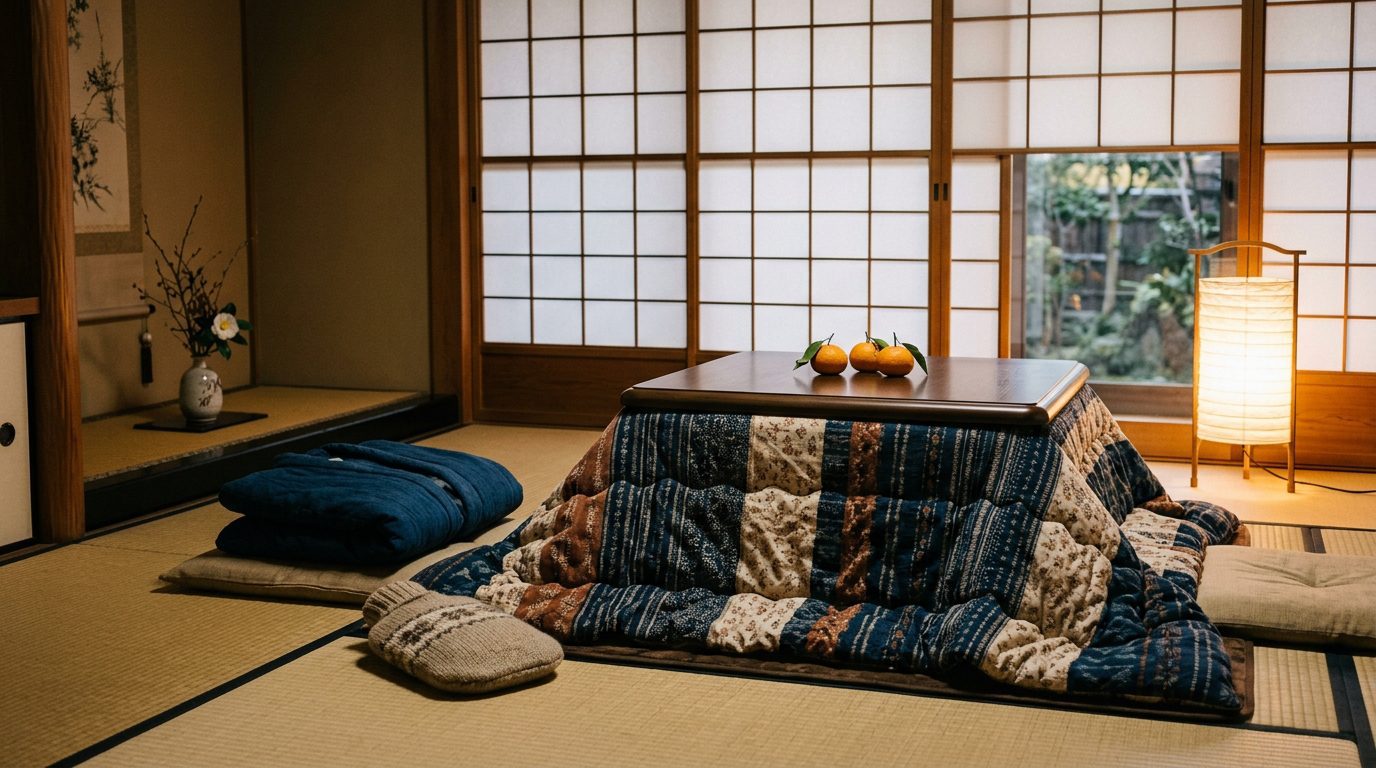
TL;DR
A こたつ is worth sitting under and usually not worth importing. Japan runs on 100 V mains, so the heater unit needs a transformer almost everywhere else,[1] and the futon is so bulky that a 4 kg one quoted $196.71 to ship to the US on 7 September 2026 — several times what the futon itself costs. Import the non-electric, low-volume half instead.
- Japan is 100 V, 50 Hz in the east and 60 Hz in the west — lower than every other major market.[1][2]
- The futon, not the weight, is the problem — OneMall bills freight on the greater of actual and volumetric weight, and volumetric weight is length × width × height in cm divided by 5,000.
- Same 700 g, different box, different price — a compact 700 g parcel quoted $20.99 to the US; a bulkier 700 g one quoted $29.88.
- What is worth importing: はんてん padded jackets (¥1,600), silk 腹巻 belly warmers (¥1,180), a tin 湯たんぽ hot-water bottle (¥3,470), and a kotatsu mid-blanket (¥2,880).
- Skip rechargeable warmers — lithium batteries face strict international mail conditions and standalone batteries are not accepted.[3]
As of September 2026, every autumn brings the same search and the same disappointing answer. People want the kotatsu — the low table with a heater underneath and a quilt trapping the warmth — and every proxy blog cheerfully quotes them a price for one. We ran the real freight numbers on 7 September 2026 instead. The honest conclusion is that the heater and the quilt are the two parts you should leave in Japan, and the textiles and the tin are the parts that ship for almost nothing.
What a Kotatsu Is Made Of — and Which Parts Travel
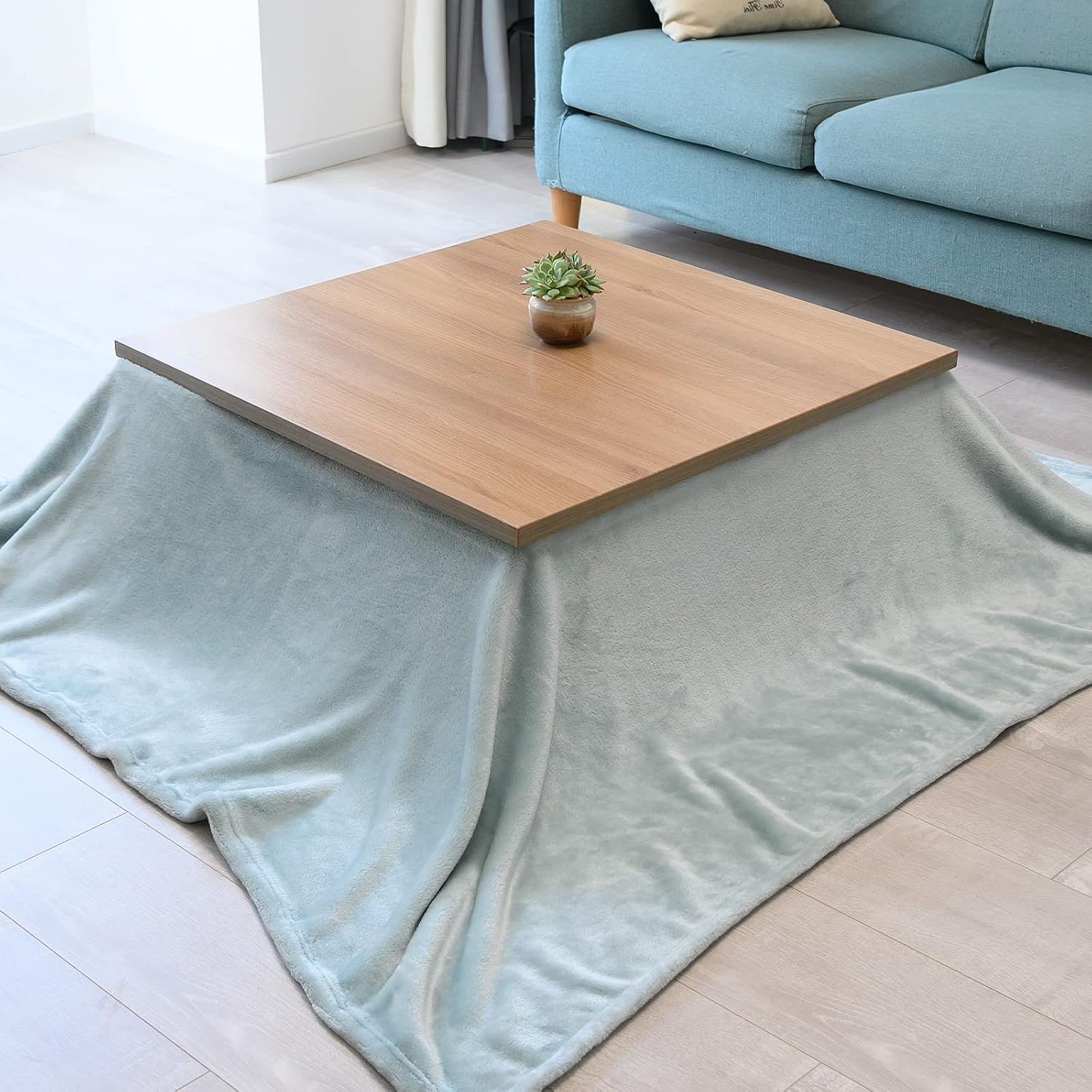
A modern こたつ is four separate objects sold in various combinations:
- The frame — a low wooden table. Bulky, heavy, and available from furniture makers worldwide.
- The heater unit — an electric heating element bolted to the underside of the tabletop. This is the 100 V problem.
- The futon — the thick quilt that drapes over the frame. This is the volumetric weight problem.
- The top board — a flat board that sits on the futon. Bulky, low value.
Only one of those four is genuinely Japan-specific in a way that justifies freight, and it is the textile aesthetic rather than the engineering. Which is why the practical shopping list looks nothing like “buy a kotatsu.”
The 100 V trap
The voltage used throughout Japan is 100 V AC, with 50 Hz in eastern Japan and 60 Hz in the west.[1][2] Every Japan-market kotatsu heater is built for that. What that means in practice:
- North America (120 V) — the unit will usually run, but it runs above its rated voltage. For a resistive heating element that means more heat than designed, on a device you will leave on for hours under a quilt. This is the wrong appliance to improvise with.
- Europe, the UK, Australia (220–240 V) — a step-down transformer is mandatory, and it must be rated for the wattage printed on the heater’s own label. Heating elements draw far more than the small travel converters sold for phone chargers.
- Frequency — a resistive heater does not care about 50 vs 60 Hz, but anything in the same order with a motor or a clock does.
If you want a kotatsu experience abroad, buy a locally-voltaged heater unit or a heated table sold in your own market, and import the parts that plug into nothing.
The Real Reason the Quilt Never Makes Sense
OneMall bills international freight on the greater of actual weight and volumetric weight, where volumetric weight is length × width × height in centimetres divided by 5,000. Carrier rate bands themselves step up by weight, so a light-but-huge parcel jumps several bands at once.[4] A compressed kotatsu futon is light and enormous, which is the worst possible combination.
We put a realistic 4 kg kotatsu futon carton (60 × 45 × 35 cm, so 18.9 kg volumetric) through the OneMall shipping calculator on 7 September 2026:
| Destination | Kotatsu futon, 4 kg / 60×45×35 cm | はんてん jacket, 700 g | Hand-warmer box, 1.5 kg |
|---|---|---|---|
| United States | DHL $196.71 — only option | ECMS $29.88 | ECMS $24.55 |
| United Kingdom | Japan Post EMS $100.11 | Seamail $19.17 | Seamail $24.14 |
| Germany | DHL $175.43 — only option | Seamail $17.75 | Seamail $22.01 |
| Australia | DHL $196.46 — only option | Seamail $17.75 | Seamail $22.01 |
| Canada | Japan Post EMS $90.17 | Seamail $18.46 | Seamail $23.43 |
| Singapore | Japan Post EMS $49.35 | Seamail $14.91 | Seamail $18.46 |
Japanese kotatsu futon sets were listing around ¥3,800–¥5,980 on the same day, which is roughly $26–$41. Shipping one to the US or Australia costs close to five times the price of the goods, and in three of the six destinations above there is only one carrier willing to take the parcel at all. That is the whole argument.
The same weight can cost 42% more
Volumetric weight is not an abstraction. Two parcels we quoted on the same day both weighed 700 g:
- Compact box, 20 × 15 × 10 cm → 0.6 kg volumetric → $20.99 to the US by ECMS.
- Padded jacket, 35 × 28 × 12 cm → 2.35 kg volumetric → $29.88 to the US by ECMS.
Identical weight, 42% difference, entirely because of the box. Anything soft and compressible should be vacuum-packed or folded flat before it is boxed — that single step is worth more than switching carrier.
What Is Actually Worth Importing
Japanese winter goods are excellent precisely where they are small, non-electric and hard to buy elsewhere. Everything below was verified in stock on OneMall on 7 September 2026.


- はんてん — a short padded indoor jacket, traditionally cotton-wadded. 久留米, in Fukuoka, is the classic source. At ¥1,600 on the second-hand market these are the single best value in Japanese winterwear, and they fold flat.
- 腹巻 — a knitted band worn over the abdomen. Silk-cotton versions made in Japan start under ¥1,000, weigh almost nothing, and are genuinely hard to find outside Japan.
- 湯たんぽ — the tin hot-water bottle. Maruka’s 2.5 L “A” model is the one you see in Japanese homes; it takes direct heat, has no electronics, no battery and no voltage, and will outlive you.
- Kotatsu mid-blanket — if you already have a heated table or simply want the textile, the thin inner blanket is a fraction of the bulk of a full futon and ships in the ordinary rate bands.
One thing to avoid: rechargeable warmers
Rechargeable electric hot-water bottles and USB warmers are everywhere in Japanese shops and are a bad import. Japan Post does not accept standalone lithium batteries in international mail, and batteries built into equipment are subject to capacity limits, quantity limits and destination-country restrictions.[3][5] Buy the tin one.
How to Buy Japanese Winter Goods: Step by Step
- Step 1 — Rule out the electrics. If it plugs in or charges, either buy it locally or accept a transformer sized to its label wattage.
- Step 2 — Search the Japanese words. はんてん, 腹巻, 湯たんぽ and カイロ return completely different inventory from their English translations. Search them on OneMall across Mercari, Rakuten, Amazon Japan and Yahoo Auctions at once.
- Step 3 — Buy second-hand for textiles. Japanese flea-market listings for はんてん and kotatsu blankets are frequently unused or as-new, at a third of shop prices.
- Step 4 — Order through OneMall. First payment covers item plus service fee: ¥200 flat under ¥7,000 on Mercari, ¥300 per item on Rakuten (¥200–¥1,000).
- Step 5 — Consolidate everything into one parcel. The first six orders combine free (¥100 per order beyond six), and storage is free for 90 days (30 days after consolidation) — so start buying in September and ship once in October.
- Step 6 — Ask for compression. Soft goods folded flat rather than lofted can drop a parcel a whole rate band, as the 700 g comparison above shows.
- Step 7 — Pick the carrier at second payment. Seamail is 30–90 days and the cheapest for bulky soft goods; if you want it before winter, order early rather than paying for DHL.
Frequently Asked Questions
Can I just use a Japanese kotatsu heater with a plug adapter?
A plug adapter changes the pin shape, not the voltage. Japan is 100 V.[1] On 220–240 V mains an adapter alone will destroy the unit and is a fire risk; you need a step-down transformer rated for the heater’s stated wattage. On 120 V North American mains the unit runs above its design voltage, which we would not recommend for an appliance that sits under a quilt for hours.
Is it ever worth shipping a full kotatsu futon?
Only if you want that specific Japanese quilt and accept that the freight will exceed the goods. On 7 September 2026 the quotes were $196.71 to the US, $196.46 to Australia and $175.43 to Germany, with DHL the sole available carrier in all three. The mid-blanket is the sensible compromise.
What is a haramaki and why would I want one?
It is a knitted band worn over the abdomen and lower back under normal clothes. It is genuinely common in Japan, weighs 50–100 g, and Japanese-made silk-cotton versions start under ¥1,000 — the highest warmth-per-gram-of-freight of anything in this article.
Can I ship disposable hand warmers?
Disposable air-activated warmers are iron-powder sachets, not batteries, and are ordinarily mailable, unlike lithium-battery devices.[5] Check your destination’s rules before ordering a large quantity, and note that a 1.5 kg box quoted $24.55 to the US — worth it only as part of a consolidated parcel.
When should I order for winter?
Now. Japanese retailers put winter stock out from September, second-hand supply peaks before the cold, and Seamail takes 30–90 days. Ordering in September and consolidating into one October parcel gets you the cheapest rate band and the goods before it actually gets cold.
Buying the Warm Half and Leaving the Rest
The kotatsu is one of the best things about a Japanese winter and one of the worst things to import. The good news is that the parts that make it work — the padded jacket, the belly warmer, the tin bottle, the quilted textile — are cheap, light, unavailable at home, and ship in the ordinary rate bands.
OneMall searches Mercari, Rakuten, Amazon Japan, Yahoo Auctions, Suruga-ya and Rakuma together, stores purchases free for 90 days (30 days after consolidation), consolidates your first six orders at no charge and quotes every carrier before you commit. Run your own numbers in the shipping calculator before you put a futon in the cart.
US buyers should also note that the United States revoked its US$800 de minimis duty-free exemption on 29 August 2025, so parcels are dutiable regardless of value.[6]
If you are new to buying bulky Japanese household goods through a proxy, the fee arithmetic behind that sits in two companion guides: the cheapest Japan proxy services fee comparison and how to pick the best Japan proxy service.
Last updated: 2026-09-28.
References
- Japan National Tourism Organization, plugs and electricity in Japan (100 V, 50/60 Hz). https://www.japan.travel/en/plan/plug-and-electricity/
- Kansai Electric Power Company, voltage and frequency in Japan. https://www.kepco.co.jp/english/home/denki/01.html
- Japan Post, conditions for sending lithium batteries by international mail (PDF). https://www.post.japanpost.jp/service/send/oversea/attention/restriction/restriction02_en.pdf
- Japan Post, international mail rates and conditions (EMS and surface mail weight bands). https://www.post.japanpost.jp/int/charge/list/ems_all_en.html
- Japan Post, nonmailable articles in international mail. https://www.post.japanpost.jp/int/use/restriction/index_en.html
- U.S. Customs and Border Protection, guidance on the suspension of the de minimis exemption. https://www.help.cbp.gov/s/article/Article-1919