
 Shopping Guide
 HELP / FAQs



 By onemall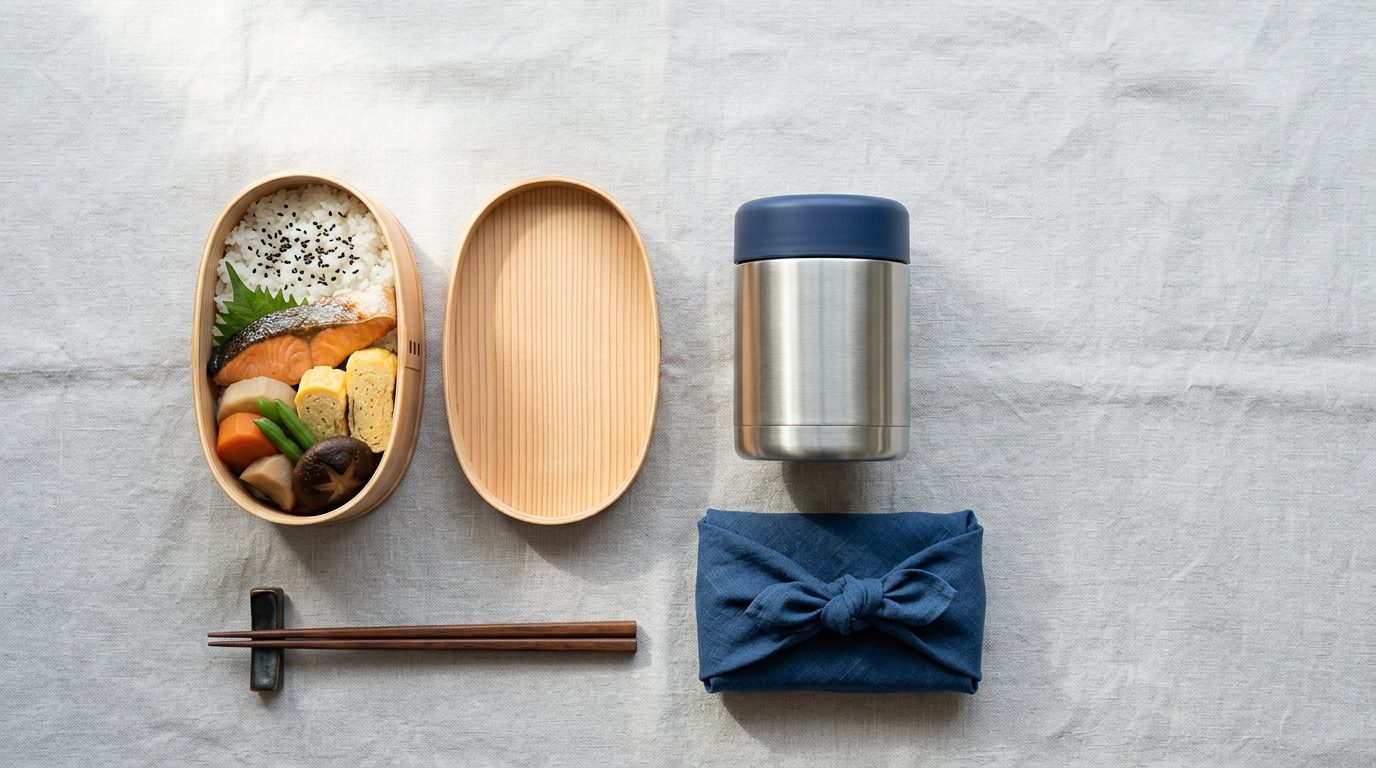
TL;DR
Japanese lunch gear splits cleanly into two families that get confused constantly: bent-cedar
magewappa, which is a craft object that happens to hold rice, and stainless lunch jars,
which are vacuum flasks shaped like a lunch box. They are bought for opposite reasons, they cost
about the same in Japan, and only one of them keeps your food hot.
- Real prices, checked on 15 September 2026 — a single-tier magewappa box at
¥2,980 (US$20.56), a wappa-style plastic box at
¥1,091 (US$7.53), a Thermos stainless lunch jar at
¥3,573 (US$24.65) and a Zojirushi jar at ¥3,282
(US$22.65).[1] - “Wappa style” is not magewappa. The genuine Odate craft is made from natural
Akita cedar, softened by boiling, bent by hand and stitched with cherry bark; lacquered versions
must use natural urushi.[2] A moulded plastic oval with the same
silhouette is a third of the price and a different object. - The jar numbers are published, so use them. The Thermos JBG-1801 keeps
≥68 °C at six hours, measures 16.0×13.5×21.0 cm, weighs about
1.0 kg empty, and splits into 0.6 L rice, 0.4 L sides and 0.3 L
soup.[3] - No voltage problem, unlike the rest of the Japanese kitchen. Nothing here has a
plug, which makes lunch gear one of the safest categories to import. - Shipping is weight-banded and cheap. A 400 g magewappa quoted US$20.99
economy air to the United States and US$13.49 EMS to Singapore on 6 September 2026; a 900 g jar
parcel quoted US$20.99 and US$20.59 on the same lanes.
As of September 2026, Japanese lunch boxes have become a mainstream export interest
rather than a niche one — and the export-market versions of both families carry export markups.
Inside Japan they are everyday goods sold at everyday prices, which is the entire arbitrage.
Magewappa: What You Are Actually Paying For
Odate magewappa from Akita Prefecture is a nationally designated traditional craft. The
specification is unusually concrete: the bending stock is straight-grained cedar, planed and then
boiled before it is bent by hand; joins are stitched with cherry bark using a purpose-made awl; and
where the piece is lacquered, the lacquer has to be natural urushi.[2]
Makers use only natural Akita cedar, sawn so the grain runs straight, then soaked overnight and
boiled for a few minutes before bending.[2]
That construction is why an uncoated wappa box manages moisture the way it does — the cedar
absorbs steam from warm rice, so the rice does not sit in its own condensation. It is also why the
care rules are strict:
- Uncoated (白木) — hand wash, no soaking, no dishwasher, no
microwave, air-dry face down. Best texture, most work. - Urushi- or resin-coated — more tolerant of detergent, easier to live with,
slightly less of the moisture effect. - Wappa-style plastic — dishwasher and microwave friendly, none of the
craft, a third of the price. A real product, just not the same one.
The tell in a listing is the material line rather than the shape. If it says
天然秋田杉 (natural Akita cedar) you are looking at the craft; if it
says the box is antibacterial-coated resin, you are looking at the lookalike. Both were in stock
this week, at ¥2,980 and ¥1,091 respectively.
Lunch Jars: Read the Six-Hour Number
A Japanese lunch jar is a vacuum flask with stacking containers inside. The specification that
matters is the heat-retention figure at six hours, because that is roughly the gap between packing
breakfast and eating lunch. Thermos publishes it per model — the JBG-1801 holds ≥68 °C
at six hours, with 0.6 L of rice capacity (0.23 L measured as uncooked rice), 0.4 L
of sides and 0.3 L of soup, in a body of 16.0×13.5×21.0 cm weighing about
1.0 kg.[3] Zojirushi publishes the same class of figures across
its own bento range.[4]
Two practical consequences. First, only the rice and soup containers are insulated in most
designs; the side-dish container deliberately is not, because nobody wants six-hour-warm salad.
Second, a 1.0 kg empty weight means the jar is the heaviest thing in this article by a wide
margin — it is the item where consolidating with something else pays for itself.
What It Costs in Japan Right Now
Pulled and stock-checked on 15 September 2026 through OneMall. Single listings, a
price reference rather than a permanent link.


| Type | Price in Japan (8 Sep 2026) | Keeps food hot? | Care |
|---|---|---|---|
| Magewappa, bent Akita cedar | ¥2,980 (US$20.56) | No | Hand wash, air dry, no microwave |
| Wappa-style plastic | ¥1,091 (US$7.53) | No | Dishwasher and microwave safe |
| Thermos stainless jar | ¥3,573 (US$24.65) | ≥68 °C at 6 h[3] | Hand wash the flask body |
| Zojirushi stainless jar | ¥3,282 (US$22.65) | Yes, per model spec[4] | Hand wash the flask body |
Getting It Home
Live carrier quotes taken on 6 September 2026, for a 400 g magewappa box
(22×15×10 cm) and a 900 g insulated-jar parcel
(20×14×14 cm).
| Destination | Magewappa (400 g) | Lunch jar (900 g) |
|---|---|---|
| United States | ECMS US$20.99 (10–20 d) / DHL US$31.59 | ECMS US$20.99 / DHL US$31.59 |
| United Kingdom | Sea US$19.17 / EMS US$25.56 | Sea US$19.17 / EMS US$34.08 |
| Germany | Sea US$17.75 / EMS US$22.37 | Sea US$17.75 / EMS US$29.47 |
| Australia | Sea US$17.75 / EMS US$22.37 | Sea US$17.75 / EMS US$29.47 |
| Canada | Sea US$18.46 / EMS US$27.69 | Sea US$18.46 / EMS US$35.64 |
| Singapore | EMS US$13.49 / Sea US$14.91 | EMS US$20.59 / Sea US$14.91 |
The jar’s own empty weight is about 1.0 kg[3], so a boxed jar
sits a little above the 900 g profile quoted here — budget one weight band higher on the EMS
lanes, where the price climbs with weight. Sea mail barely moves between these two parcels, and the
United States has no Japan Post option in these quotes at all: it is ECMS or DHL, and ECMS is the
cheap lane. EMS chargeable weight rules are published in the rate
schedule.[5]
On arrival costs: the United States has suspended de minimis duty-free treatment, so even a US$25
lunch box can be assessed[6], and the European Commission has issued
guidance on a temporary flat fee for low-value imports.[7]
Step-by-Step: Buying a Japanese Bento Box From Overseas
- Choose the family first. Hot lunch, eaten at a desk? A stainless jar. Cold
lunch, rice you care about, willing to hand wash? Magewappa. There is no single box that does both. - Match the capacity to a real meal. Around 500–600 ml is a standard
adult single-tier box; a jar quotes its rice, side and soup volumes separately, so add them up rather
than reading the headline figure.[3] - Read the material line on a wappa listing. Natural Akita cedar and cherry-bark
stitching mean the craft;[2] “wappa style” in resin means the
lookalike. Decide which one you actually want. - Search the Japanese term.
弁当箱
/ 曲げわっぱ returns the domestic catalogue; English-language
searches surface export listings at export prices. - Check what is in the box before shipping. Jars ship with a carrying bag and
chopsticks in most cases; a wappa box does not include a band or a bag, and those are cheap to add
while the parcel is still open. - Quote the freight, then decide the carrier. Run the packed weight through the
shipping
calculator — the jar is heavy enough that the gap between sea and express is real money.
Frequently Asked Questions
Can a magewappa box go in the microwave?
No. Uncoated bent cedar is hand-wash, air-dry only, and microwaving it will crack it. If you need
to reheat, buy the coated resin version — that is exactly what it is for.
How long does a Japanese lunch jar actually stay hot?
Manufacturers publish a six-hour figure. Thermos rates the JBG-1801 at ≥68 °C after
six hours from a 95 °C fill at 20 °C room
temperature.[3] The side-dish container is usually uninsulated by
design.
Is there a voltage or plug problem?
None — nothing in this category is electrical. That is the difference between buying a lunch jar
and buying a Japanese rice cooker, where 100 V is the whole conversation.
Is real magewappa worth triple the plastic one?
If you eat cold rice from it regularly, yes: the cedar absorbs steam, so the rice does not go
soggy, and the box is a designated traditional craft rather than a shape
imitation.[2] If it is for reheated leftovers, the plastic box is the
more honest purchase.
Do these need special customs paperwork?
No. Wood, lacquer and stainless steel travel as ordinary goods; the paperwork question in 2026 is
arrival duty, not export permission.[6]
The Short Version
Jar for hot food, magewappa for rice you care about, and read the material line so you know which
one you are buying. If the Japanese kitchen is what brought you here, the
rice
cooker guide covers the 100 V problem and the
chef’s
knife guide covers the other craft purchase people make on the same trip.
Live
lunch jar listings are here.
Last updated: 2026-09-15.
None of the shops above sell abroad directly. For the part that gets a Japanese listing to your door, see the guide to choosing a Japan proxy service and the breakdown of what proxy fees really cost.
References
- OneMall, marketplace used for the bento price observations recorded in this article on 15 September 2026. https://www.onemall.jp/
- Association for the Promotion of Traditional Craft Industries, Odate Magewappa (bent cedar work), Akita Prefecture. https://kougeihin.jp/craft/0604/
- Thermos Japan, stainless lunch jar JBG-1801 specification. https://www.thermos.jp/product/detail/jbg-1801.html
- Zojirushi, bento and lunch jar product range. https://www.zojirushi.co.jp/syohin/bento/
- Japan Post, EMS rate schedule (all zones), which sets out how chargeable weight is determined. https://www.post.japanpost.jp/int/charge/list/ems_all_en.html
- U.S. Customs and Border Protection, guidance on the suspension of de minimis duty-free treatment. https://www.help.cbp.gov/s/article/Article-1919
- European Commission, guidance on the temporary flat fee for low-value imports. https://taxation-customs.ec.europa.eu/news/guidance-and-legal-text-temporary-flat-fee-low-value-imports-which-will-apply-until-1-july-2028-2026-06-08_en