 Shopping Guide
 HELP / FAQs


 By onemall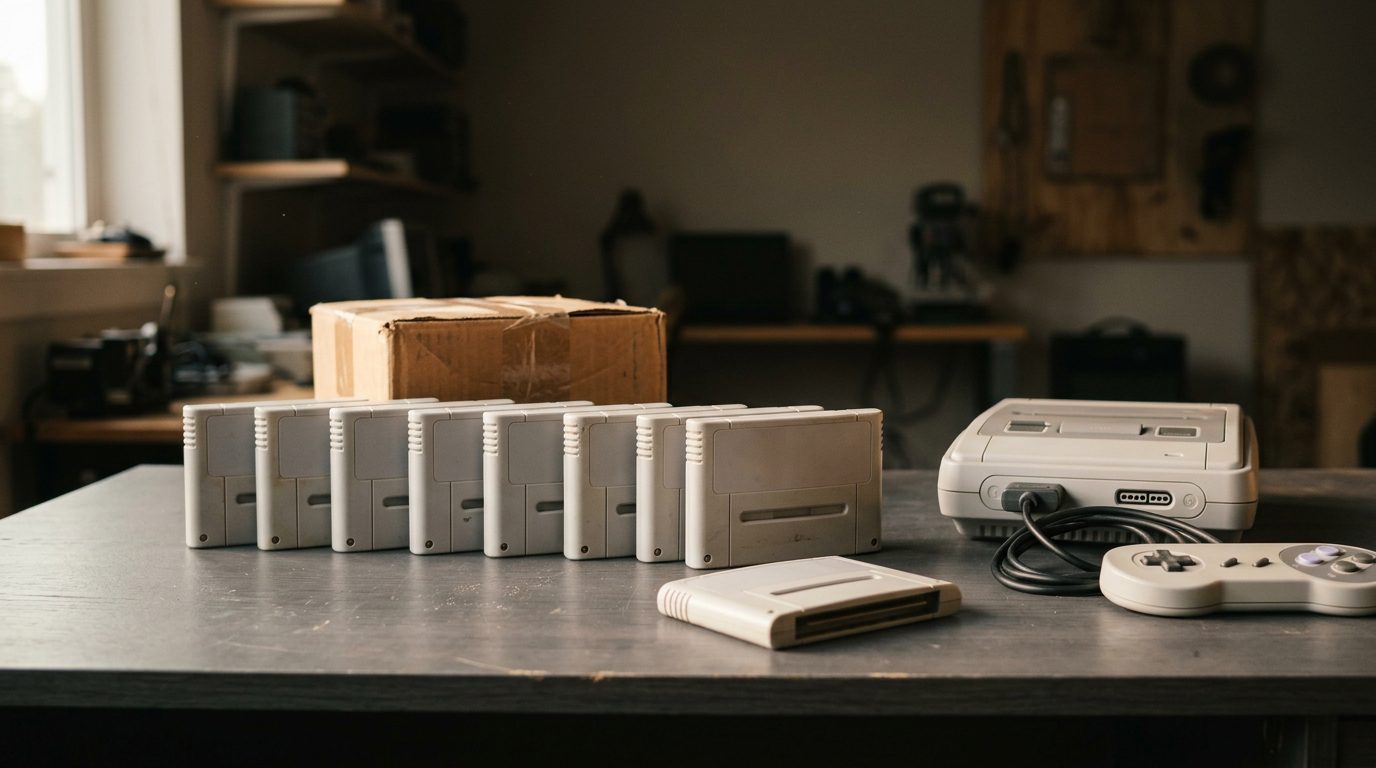
TL;DR
Japanese Super Famicom and Famicom cartridges are the cheapest retro games in the world
right now — single-digit-dollar cheap — because Japan still has the stock and the
domestic platforms never ship abroad. The catches are physical, not legal: the cartridge does
not fit a North American SNES, the console runs on a 100 V adapter, and the save battery in
your RPG is thirty years old.
- Real prices, checked on 3 September 2026 — Super Mario RPG at
¥400 (US$2.76), Dragon Quest VI at ¥590 (US$4.07),
Famicom Super Mario Bros. 3 at ¥520 (US$3.59).[7] - A Super Famicom console body was ¥1,500 (US$10.35) and a Super Game
Boy adapter ¥1,600 (US$11.04) the same day. - Japanese SFC cartridges do not fit a US SNES without an adapter —
different shell shape, same silicon. The Japanese console is NTSC, so it is the easy machine
to run at 60 Hz. - The 100 V adapter is the part that does not travel. Buy the console, power
it locally.[3] - Save batteries are dead or dying. Look for
電池交換済 (battery replaced) on anything you intend to finish.
As of September 2026, western retro prices have detached from Japanese ones almost
completely. A boxed North American SNES RPG is a collector item with a collector price; the
Japanese cartridge of the same game, minus the box, is pocket change on a domestic flea-market
app. The Super Famicom launched in Japan in November 1990 and sold in enormous
numbers[1], and that installed base is now sitting in
cupboards being cleared out one listing at a time.
What Japanese Carts Actually Cost in 2026
Every figure below came off a live listing on 3 September 2026. Loose cartridges dominate
the cheap end; boxes and manuals are what you pay for.
| Item | Listing wording | Price (3 Sep 2026) | Platform |
|---|---|---|---|
| Super Mario RPG (SFC) | cartridge | ¥400 (US$2.76) | Yahoo Flea Market |
| Dragon Quest VI (SFC) | 〇ソフトのみ (cart only) | ¥590 (US$4.07) | Yahoo Flea Market |
| Seiken Densetsu 2 + 3 (pair) | cartridges | ¥650 | Yahoo Auctions |
| Shanghai III | 中古A (used, grade A) | ¥1,290 | Yahoo Auctions |
| Romancing SaGa 2 | 中古AB (used, grade AB) | ¥1,490 | Yahoo Auctions |
| MOTHER 2 (EarthBound) | cartridge | ¥1,200 (US$8.28) | Mercari |
| Super Famicom console, grey | 本体 (body) | ¥1,500 (US$10.35) | Mercari |
| Super Game Boy (SHVC-SGB, 1994) | peripheral | ¥1,600 (US$11.04) | Yahoo Flea Market |
| Super Mario Bros. 3 (Famicom) | cartridge | ¥520 (US$3.59) | Mercari |
Read that table next to any western retro price list and the arbitrage is obvious. It also
shows the two pricing systems in play: individual sellers on Mercari and the flea-market apps
price by guesswork, while the Yahoo Auctions shop listings carry
中古A / AB / B / C shop grades and price accordingly. Grade A is
close to unused; C is a scuffed, playable cart.
The Three Physical Problems
1. The cartridge does not fit a US console
Japanese Super Famicom cartridges and European SNES cartridges share a shell shape. North
American SNES cartridges are a different, longer shape with different tabs, so a Japanese cart
will not physically enter a US machine. Inside, the hardware is compatible — which is why
passive adapters exist and why the tidiest answer is to buy the Japanese console at ¥1,500
and stop fighting the plastic. The Famicom is a separate matter again: it uses a 60-pin
cartridge, while the American NES used 72 pins, so Famicom carts need an adapter in every
case.[2]
2. The power adapter is 100 V
Japan’s mains supply is 100 V, lower than North America’s 120 V and far below Europe’s
230 V, and it splits at 50 Hz in the east and 60 Hz in the west.[3]
The console itself is fed low-voltage DC, so the part that matters is the little AC adapter in
the box. Do not plug a Japanese adapter into a 230 V outlet. In practice, buy the console body
and use a correctly specified local supply or a step-down transformer; several Japanese
Nintendo consoles of that era share a supply, so the part is easy to source at home.
3. The save battery is thirty years old
Super Famicom RPGs save to SRAM backed by a CR2032 coin cell soldered inside the cartridge.
Those cells were specified for years, not decades. A cart bought today may hold saves
perfectly, may lose them at power-off, or may have already been fixed — listings that
say 電池交換済 (battery replaced) are telling
you the seller has done it. It is a ¥100 part and fifteen minutes with a soldering iron if
they have not, but for a 40-hour RPG it is the difference between playable and decorative.
The Listing Words Worth Knowing
- 本体 — the console body itself, as opposed to
accessories. Searching for the console without this word returns mostly cables and controllers. - ソフトのみ / カセットのみ
— cartridge only, no box, no manual. This is the cheap tier. - 箱説付き — with box and instructions. Expect
to pay several times the loose price. - 動作確認済 / 動作未確認
— tested / untested. On a ¥400 cart, untested is a reasonable gamble; on a console it
is not. - 端子清掃済 — contacts cleaned. Worth
a small premium, because dirty cartridge contacts are the number one reason an old cart looks
dead. - 日焼け — yellowing. Cosmetic. The Super Famicom’s
grey plastic yellows famously; it does not affect play. - ジャンク — junk: no guarantee, no returns.
Which Games Are Actually Worth Importing
The Japanese library is not a subset of the western one. Whole series stayed home —
much of the Famicom-era RPG catalogue, a long tail of licensed and sports titles, and the
Japanese versions of games that were localised years later or not at all. Meanwhile the
Japanese cartridge of a game you already know is usually the cheapest copy in existence,
because there is no domestic collector premium on a common title.
Text-heavy Japanese RPGs are the obvious caveat: Dragon Quest VI at ¥590 is a bargain
only if you read Japanese. Action, platform, racing and fighting games carry almost no language
load, which is why they are the sensible first import.
Getting a Box of Carts Home
Cartridges are the friendliest thing Japan exports: small, light, unbreakable and with
nothing a customs officer needs to think about. International post bills the greater of actual
and volumetric weight, so a tight box of twenty carts is charged on real weight and a
half-empty box of five is not.[4] The one thing that has
changed recently is duty: the United States suspended its US$800 de minimis exemption on
29 August 2025, so a US-bound parcel is assessable regardless of
value[5], and the EU is running a temporary flat fee on
low-value imports[6]. On a ¥400 cartridge that is
annoying rather than fatal, but it is a reason to send one full box rather than four small
ones.
Step-by-Step: Buying Super Famicom Hardware From Overseas
- Step 1 — Search in Japanese. Use
スーパーファミコン(or
SFC) plus the Japanese title. This search
covers Mercari, Yahoo Auctions and Yahoo Flea Market together; searching in English returns a
fraction of the stock. - Step 2 — Decide console or adapter before you buy carts. At
¥1,500 for a body, importing the Japanese machine is usually cheaper than adapters plus
region workarounds. Console listings are here. - Step 3 — Order through a proxy. None of these platforms ship abroad
or take foreign cards. OneMall places the order on your behalf; service fees are ¥300 per item on most marketplaces; from ¥200 per item on Yahoo Auctions and LinkBuy, and Yahoo Auctions is charged at 3% of the winning bid including tax, capped at
¥300. - Step 4 — Buy the batch, not the cartridge. Retro carts are small and
light. Ten of them cost barely more to ship than one, and OneMall consolidates the first six
orders free (¥100 for each order after that) with 90 days of free storage after arrival (30 days after consolidation) while you keep
hunting. - Step 5 — Ask for photos on anything untested. A cheap unboxing photo
service will show you the label, the contacts and whether the console has its expansion port
cover — details sellers rarely photograph. - Step 6 — Weigh the box before choosing a carrier. A console plus a
dozen carts lands in the range where carrier prices diverge sharply; run it through the
shipping calculator first.
Frequently Asked Questions
Will a Japanese Super Famicom game work on my SNES?
Electrically yes, physically no on a North American console — the cartridge shells are
different shapes. European SNES machines take the same shell as a Super Famicom cart but run
at 50 Hz on PAL displays, which is its own compromise. Buying the Japanese console is the
cheapest clean answer.
Is the Super Famicom region locked?
The console reads Japanese and North American cartridges as compatible silicon; the
practical blocks are the cartridge shape and, on some titles, a lockout check. Since a working
console body was ¥1,500 on 3 September 2026, the workaround costs less than the workaround
hardware.
Do I need a step-down transformer?
The console runs on low-voltage DC from an external adapter, and that adapter is rated for
Japan’s 100 V supply. Use a locally rated replacement supply of the correct voltage and
polarity, or a step-down transformer — never a bare plug adapter on a 230 V outlet.
Will my saved games survive?
Only if the internal coin cell is still alive. Look for 電池交換済
in the listing, or plan on replacing it — it is a common, cheap repair and it does not
harm the cartridge’s value.
Are boxed copies worth the premium?
For play, no — a loose cart is a tenth of the price. For collecting, the Japanese box
and manual are usually in better condition than western equivalents, because Japanese
collectors kept them. Decide which of the two you are before you sort by price.
The Short Version
Buy the Japanese console rather than fighting cartridge shapes, power it locally, check for
a replaced save battery on anything you plan to finish, and ship carts in bulk. If you are
building a wider Japanese retro shelf, our Game Boy model guide,
Saturn and Dreamcast guide and PS1/PS2 import guide
cover the neighbouring machines, and the cheapest Japan proxy comparison
plus the true-cost breakdown cover the fees.
Live Super Famicom listings are here.
Last updated: 2026-09-28.
Buying any of this means going through a domestic-only checkout. The Japan proxy service guide explains the mechanics end to end, and the proxy fee comparison shows where per-item and per-order charges land.
References
- Nintendo, corporate information and hardware history. https://www.nintendo.co.jp/
- Nintendo Museum, hardware exhibits and model documentation. https://museum.nintendo.com/
- TEPCO, corporate information on Japan’s electricity supply. https://www.tepco.co.jp/en/
- Japan Post, EMS rate schedule (all zones), which sets out how chargeable weight is determined. https://www.post.japanpost.jp/int/charge/list/ems_all_en.html
- U.S. Customs and Border Protection, guidance on the suspension of de minimis duty-free treatment. https://www.help.cbp.gov/s/article/Article-1919
- European Commission, guidance on the temporary flat fee for low-value imports. https://taxation-customs.ec.europa.eu/news/guidance-and-legal-text-temporary-flat-fee-low-value-imports-which-will-apply-until-1-july-2028-2026-06-08_en
- OneMall, marketplace used for the Super Famicom and Famicom price observations recorded in this article on 3 September 2026. https://www.onemall.jp/