
 Shopping Guide
 HELP / FAQs


 By onemall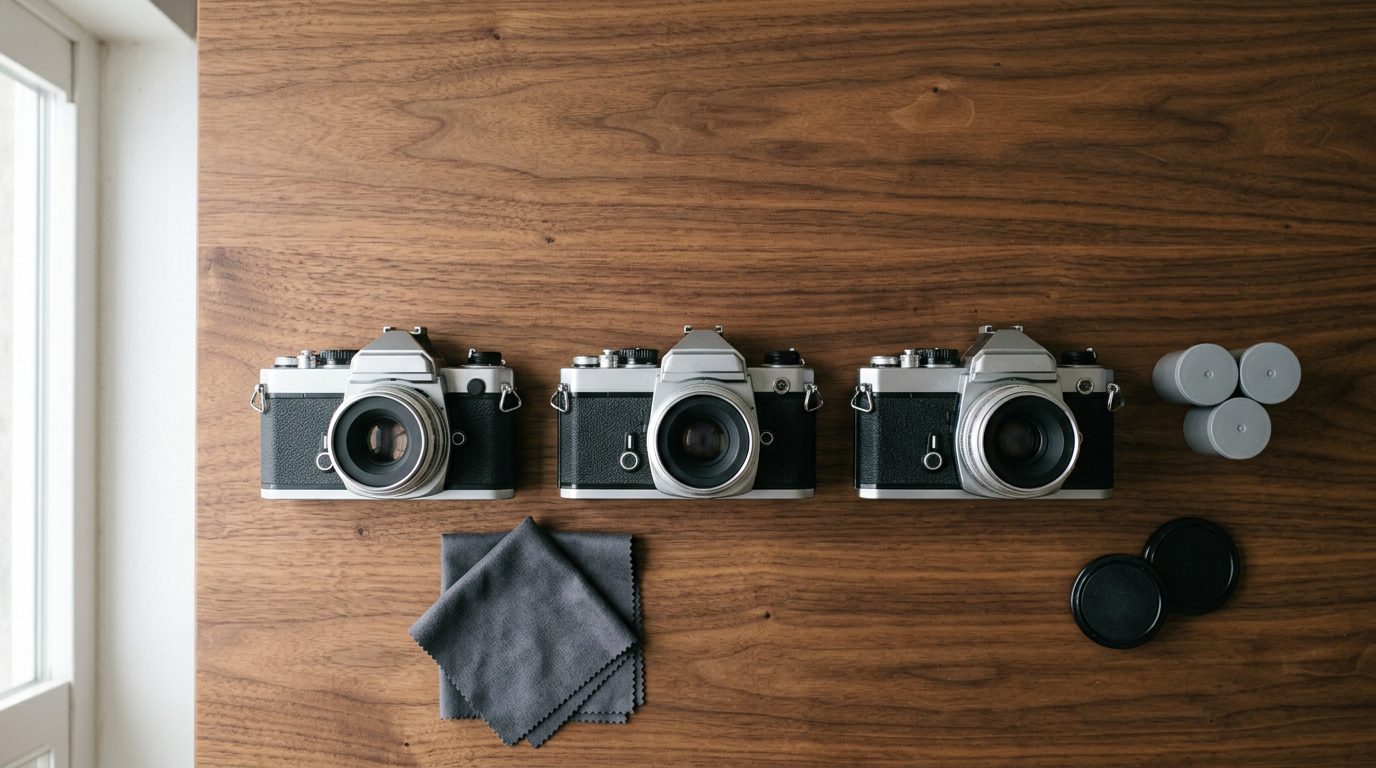
TL;DR
Japan is the deepest used film-camera market on earth, and its domestic secondhand
platforms are where the cheap bodies actually sit. The thing that decides whether you get a
working camera or a paperweight is not the brand — it is one Japanese word,
ジャンク (junk), and the three condition phrases that sit
next to it.
- Real prices, checked on 3 September 2026 — a Canon AE-1 body at
¥6,200 (US$42.78), a Canon T50 with a lens at ¥2,500
(US$17.25), an Olympus OM10 body at ¥2,800 (US$19.32).[8] - ジャンク does not mean broken — it means the seller
will not promise anything. A junk-marked Pentax compact was ¥1,800 (US$12.42) the
same day; a tested body of similar vintage costs two to four times that. - Manual-focus glass is the real bargain. A Canon FD 50mm f/1.4 S.S.C.
described as fully working was ¥5,980 (US$41.26), and a second copy of the same lens
¥4,280 (US$29.53). - Nothing here has a voltage problem — a mechanical camera has no
plug. That makes film gear one of the safest categories to import from Japan. - Loose lithium batteries cannot go in international mail, so leave the
modern compact’s cell behind and buy it locally.[4]
As of September 2026, the film revival has been running long enough that overseas
prices have caught up with demand — but Japan’s domestic secondhand supply has not
thinned in the same way. Japanese households bought an enormous number of SLRs between 1975
and 1995, those cameras are now being cleared out, and they are listed on platforms that never
ship abroad. That gap, not any special Japanese pricing magic, is the whole opportunity.
What a Japanese Film Camera Actually Costs in 2026
Every figure below was read off a live listing on 3 September 2026. Prices move, and a
single cheap body is a single seller’s decision — treat these as the shape of the market,
not a price list.
| Item | Condition wording | Price (3 Sep 2026) | Platform |
|---|---|---|---|
| Canon AE-1, silver, body only | plain used | ¥6,200 (US$42.78) | Mercari |
| Canon AV-1 + FD 50mm f/2 | 完動美品 (fully working, excellent) | ¥6,200 (US$42.78) | Mercari |
| Canon T50 SLR with lens | plain used | ¥2,500 (US$17.25) | Mercari |
| Olympus OM10 body | plain used | ¥2,800 (US$19.32) | Mercari |
| Pentax compact | 【ジャンク品】 (junk) | ¥1,800 (US$12.42) | Mercari |
| Canon FD 50mm f/1.4 S.S.C. | 【完動品】 (fully working) | ¥5,980 (US$41.26) | Mercari |
| Canon FD 50mm f/1.4 S.S.C. (second copy) | plain used | ¥4,280 (US$29.53) | Mercari |
| Nikon Nikkor 50mm f/1.4 non-Ai | plain used | ¥5,999 (US$41.39) | Mercari |
| Canon film camera, unspecified model | 中古 (used), price reduced | ¥2,899 (US$20.00) | Yahoo Flea Market |
Two things jump out of that table. First, the spread between the two identical Canon FD
50mm f/1.4 S.S.C. lenses is 40% — and the more expensive one is the one the seller
actually tested. Second, an entire working SLR with a lens attached can cost less than a
standalone lens. In a market this deep, the price is set by how much work the seller did, not
by the hardware.
The Vocabulary That Decides Whether It Works
Japanese listings are unusually honest, but only if you can read the disclaimer. These are
the words that carry the risk:
- ジャンク (junk) — the single most important
word. It does not mean scrap. It means sold with no functional guarantee, no returns.
Some junk cameras work perfectly; the seller simply has no film, no battery, or no wish to be
responsible. Others have a dead shutter. Buy junk only if you can repair it or you are buying
it for parts. - 動作未確認 (untested) — the softer
cousin of junk. Usually means an estate clearance seller who never opened the back. - 動作確認済 (tested) and
完動品 (fully working) — the seller ran the shutter at
every speed and says so. This is what you pay the premium for. - 美品 (beautiful item) — cosmetic, not functional. A
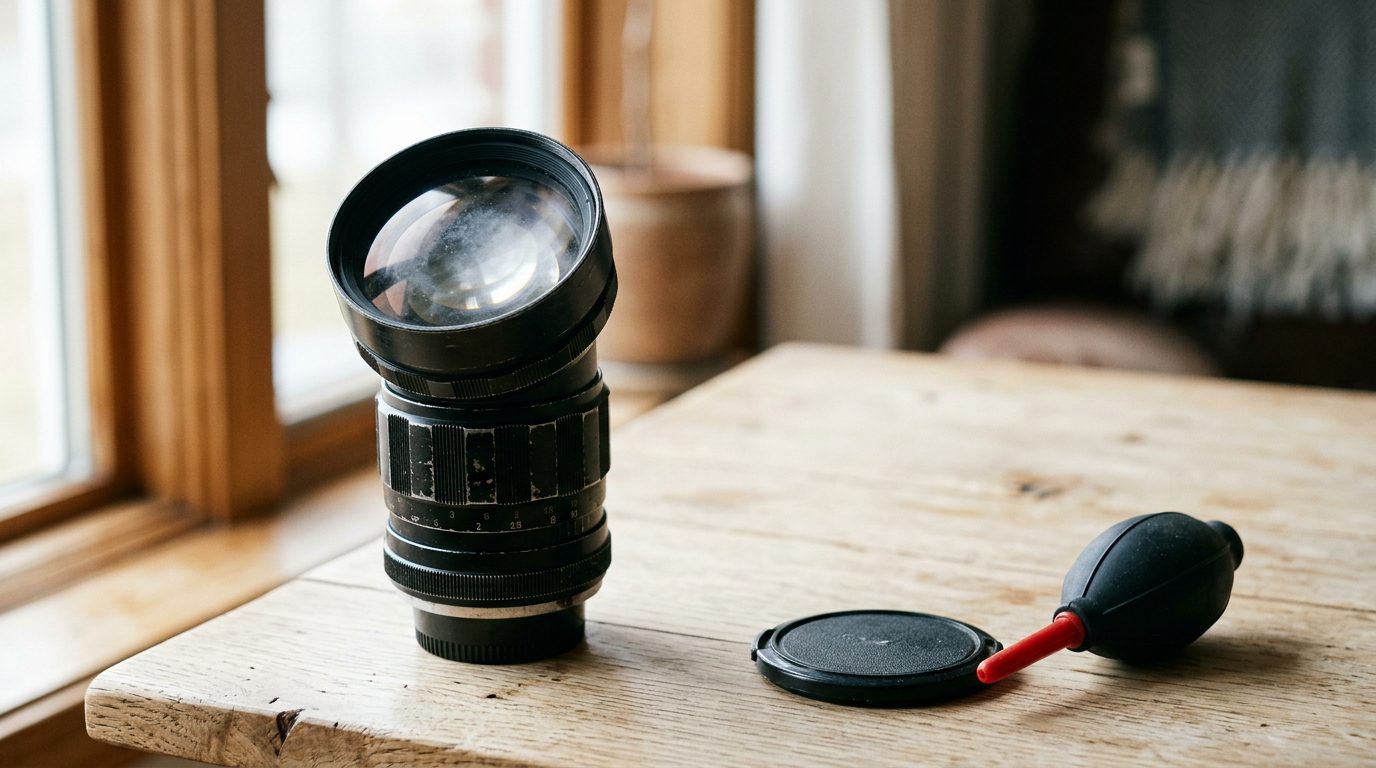
美品 body can still have a sticky shutter. - カビ (fungus), クモリ (haze),
チリ (dust) — the three lens defects. Dust is harmless. Haze softens
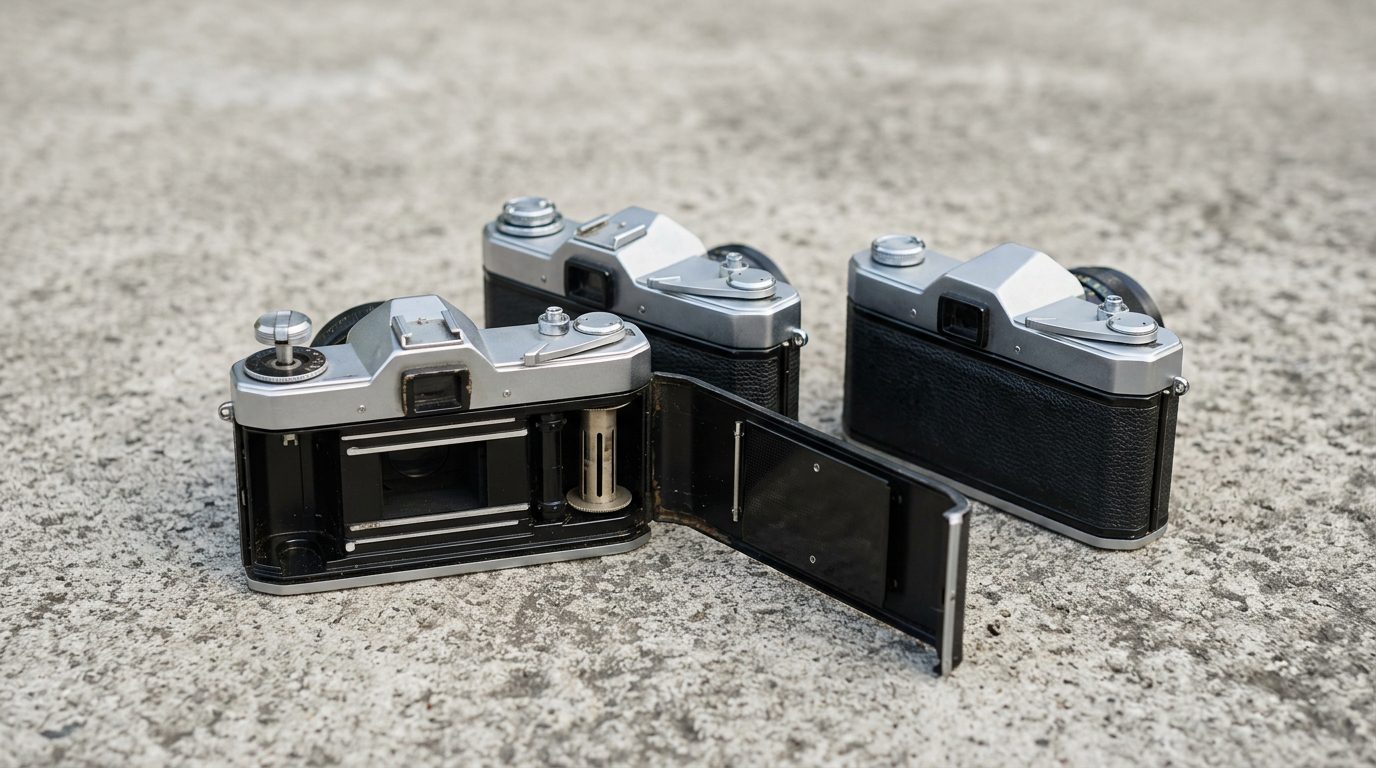
contrast. Fungus spreads and can etch coatings; walk away unless the price is parts money. - モルト (light seals) — the foam around the film
door. On any camera built before about 1995 it has turned to tar. It is a ¥500 fix and a
completely normal disclosure.
What to Buy, and What to Leave
Manual SLR bodies
The mechanical and semi-mechanical bodies of the late 1970s and 1980s — Canon’s
A-series, Olympus OM bodies, Nikon’s manual line — are the sweet spot. They are simple
enough to be repairable, common enough to be cheap, and Japan has them in volume. Canon has
kept the full model history of these cameras published in its own museum
archive[1], which is the fastest way to confirm what a
listing’s model number actually is before you bid.
Manual-focus lenses
This is the category that has outlived its own camera systems, because mirrorless
digital bodies mount old glass through cheap adapters. A Nikkor 50mm f/1.4 non-Ai at
¥5,999 or a Canon FD 50mm f/1.4 at ¥4,280 is a lens that costs meaningfully more
almost anywhere it has been exported to.[2] Lenses are also
denser than bodies, so think about weight before adding a fifth one to the box.
Compacts, with one caveat
Point-and-shoot compacts are the hyped end of the market and the one where junk listings
concentrate, because their electronics fail invisibly. A ¥1,800 junk Pentax compact is a
lottery ticket, not a camera. If you want a compact that works, pay for the tested one.
Leave behind
Anything sold with its lithium battery installed if the seller cannot remove it, anything
described only as ジャンク when you have no repair skills, and
— unless you are collecting — late 1990s autofocus zoom bodies, which are heavy,
plastic, and worth less than their shipping weight.
Getting It Home Without the Bill Doubling
Film cameras are small and dense, which is the good case for international post: chargeable
weight is the greater of actual and volumetric weight, so a compact, heavy parcel is billed on
its real weight rather than on air.[3] A body and three lenses
in one box is far cheaper than four separate parcels.
Two hard rules. Loose lithium batteries are non-mailable in international
post[4], so any modern compact should travel with its cell
removed and left behind. And the duty position has changed: the United States suspended its
US$800 de minimis exemption on 29 August 2025, so a US-bound parcel is assessable whatever it
cost[5], while the EU is running a temporary flat fee on
low-value imports[6]. Declare the real value; a ¥6,200
camera is not worth a customs dispute.
Step-by-Step: Buying a Japanese Film Camera From Overseas
- Step 1 — Search in Japanese. Use
フィルムカメラplus the model
(AE-1,OM-1,FM2) rather than the English name.
This search covers Mercari, Yahoo Auctions, Yahoo Flea
Market and Rakuten at once, which is where the domestic stock actually is. - Step 2 — Read the disclaimer before the price. Find
ジャンク, 動作未確認 or
完動品 in the description and decide what you are buying. If none of them
appear, ask. - Step 3 — Order through a proxy. Japanese secondhand platforms
require a domestic address and domestic payment. OneMall places the order for you; the service fee is ¥300 per item on most marketplaces, Mercari included, and from ¥200 per item on Yahoo Auctions and LinkBuy. - Step 4 — Pay for unboxing photos. On a used camera this add-on
(¥500 or ¥700, depending on the photo package) earns its cost: unboxing photos show whether the
lens has haze, whether the light seals are gone, and whether the body matches the listing
picture. OneMall’s optional photo services exist for exactly
this case. - Step 5 — Consolidate, then ship. Warehouse storage is free for 90
days after arrival (30 days after consolidation), so a body bought today can wait for the lens you find next week. The first six orders
consolidate free; each order beyond six adds ¥100. - Step 6 — Choose the shipping line by weight, not habit. Run the
numbers in the shipping calculator before you commit
— on a 2–3 kg camera box the gap between carriers is routinely larger than the
price of the camera.
Frequently Asked Questions
Is it actually cheaper to buy a film camera from Japan?
For common Japanese-brand bodies and manual-focus lenses, yes — the domestic
secondhand supply is much larger, and the tested-versus-untested price ladder gives you a
cheap entry point that export markets do not have. For rare or collector-grade equipment the
gap narrows, because Japanese sellers know exactly what those are worth.
What does ジャンク mean on a camera listing?
It means the seller offers no guarantee that it works and will not accept a return. It is a
disclaimer, not a diagnosis. Junk-marked gear is the cheapest thing in the market and the
easiest way to waste money if you cannot service it yourself.
Can old lenses be used on a modern digital camera?
Manual-focus lenses in the common Japanese mounts adapt to mirrorless bodies with a simple
mechanical adapter, which is why the used-lens market has stayed strong. Autofocus and
aperture control are lost; focusing is manual.
Will the battery ship with the camera?
Loose lithium batteries are not accepted in international mail, so plan on buying the cell
at home. Many older mechanical cameras need no battery at all except for the light meter, and
mercury cells for pre-1980 meters are no longer made — an adapter or a modern equivalent
is the normal fix.
Do I pay Japanese consumption tax on a secondhand camera?
The listed price on a Japanese platform includes domestic tax where it applies. Import
duty and VAT in your own country are separate and are assessed on arrival — see the
customs guidance linked below for the current position.[7]
The Short Version
Buy the tested body rather than the cheap one, buy the glass while you are there, read the
disclaimer before the price, and put everything in one box. If you want the same approach
applied to Japan’s secondhand shops rather than its flea markets, our
Suruga-ya guide and BOOK OFF guide cover those
catalogues, and the cheapest Japan proxy comparison plus the
true-cost breakdown cover the fee arithmetic.
Live manual-focus lens listings are here.
Last updated: 2026-09-28.
None of the shops above sell abroad directly. For the part that gets a Japanese listing to your door, see the guide to choosing a Japan proxy service and the breakdown of what proxy fees really cost.
For the brands behind these bodies — current, defunct and the lens makers — see our Japanese camera brands guide.
References
- Canon, Camera Museum model archive. https://global.canon/en/c-museum/
- Nikon, corporate and product information. https://www.nikon.com/
- Japan Post, EMS rate schedule (all zones), which sets out how chargeable weight is determined. https://www.post.japanpost.jp/int/charge/list/ems_all_en.html
- Japan Post, nonmailable articles in international mail. https://www.post.japanpost.jp/int/use/restriction/index_en.html
- U.S. Customs and Border Protection, guidance on the suspension of de minimis duty-free treatment. https://www.help.cbp.gov/s/article/Article-1919
- European Commission, guidance on the temporary flat fee for low-value imports. https://taxation-customs.ec.europa.eu/news/guidance-and-legal-text-temporary-flat-fee-low-value-imports-which-will-apply-until-1-july-2028-2026-06-08_en
- Japan Customs, export and import information. https://www.customs.go.jp/english/index.htm
- OneMall, marketplace used for the film-camera price observations recorded in this article on 3 September 2026. https://www.onemall.jp/