
 Shopping Guide
 HELP / FAQs


 By onemall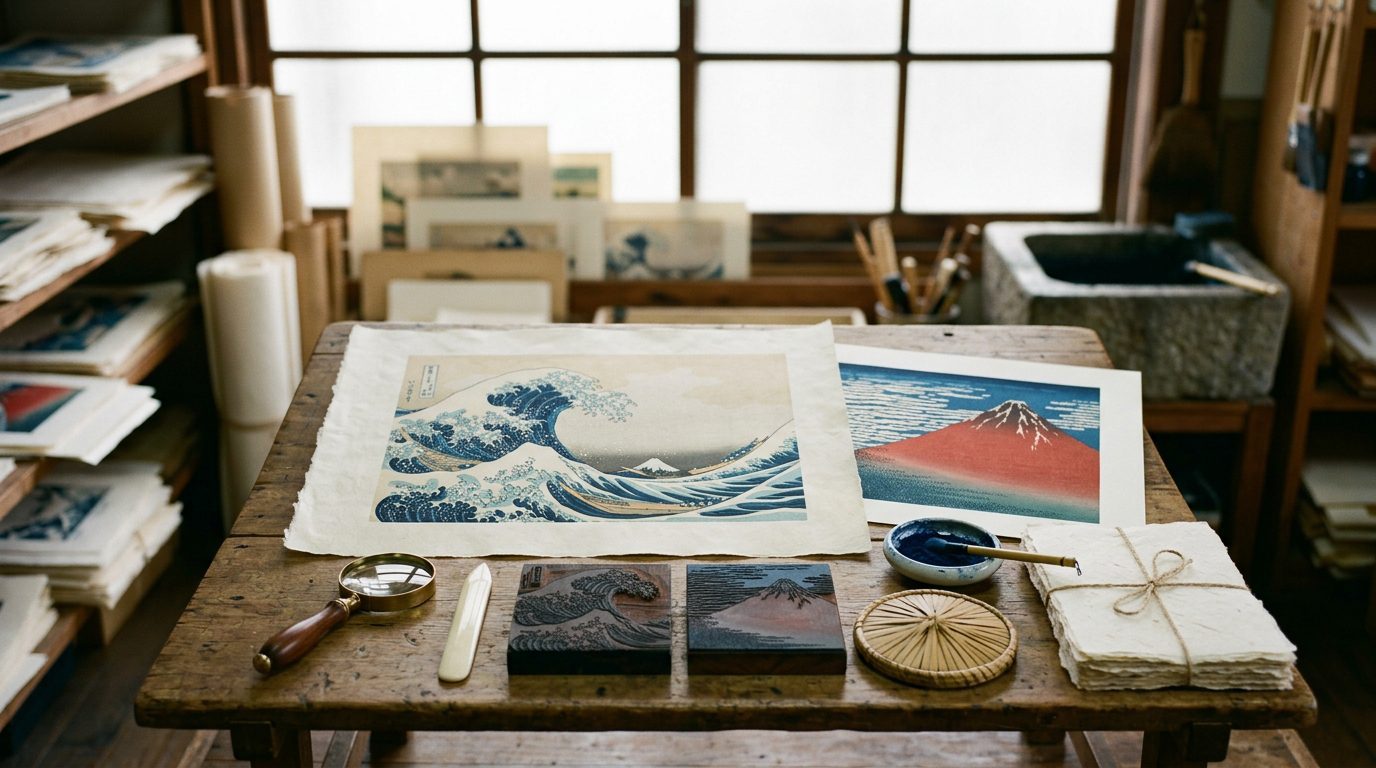
TL;DR
The most expensive ukiyo-e print is Hokusai’s Great Wave: HK$21.7 million (about US$2.8 million) at Sotheby’s Hong Kong on 22 November 2025, which beat the US$2.76 million paid at Christie’s New York in March 2023. The same sale set Black Fuji at HK$7.1 million and Red Fuji at HK$5.7 million. Below Hokusai the records are Utamaro (US$883,519 for a single print, 2016), Sharaku (£151,200, 2022), Hiroshige (£138,600 for the Sudden Shower over Ohashi, 2022) and Hasui (£32,760). Every record on this page is a documented auction result; the sources are at the bottom.
- Why the range is a million to one: impression (first or later printing), condition, publisher seals, rarity and whether it is an Edo original, a Meiji reprint, a 20th-century recut reproduction or a poster. The table below sorts it out.
- What you can actually buy from Japan today: hand-printed recut reproductions by Adachi, Yuyudo, Unsodo and the Kyoto studios from ¥2,750 to ¥88,000 for the full 46-print Fuji set; genuine Edo-era book pages from ¥2,500; catalogues and art books from about ¥2,090.
- Vintage and original: in listings, “vintage Japanese woodblock print” usually means a Meiji or Taisho impression or a Showa reproduction; “antique” and “Edo” mean pre-1868. Both are in the term table.
- The four artists to know: Hokusai (value), Hiroshige (volume), Utamaro and Sharaku (rarity); Kuniyoshi and Yoshitoshi for the collectors who came later.
- Shipping: prints are paper: flat between boards, or in a tube, under 1 kg by Japan Post or DHL (times and tracking). Ordinary prints have no export restriction; only designated cultural properties do.
The most expensive ukiyo-e prints ever sold at auction
Prices are the hammer price plus premium as reported by the auction houses; Hong Kong dollar results are converted at the rate the auction house used in its own reporting (about HK$7.8 to US$1).
| # | Artist | Price | Sale | Note | |
|---|---|---|---|---|---|
| 1 | Katsushika Hokusai | Under the Wave off Kanagawa (The Great Wave), from Thirty-six Views of Mount Fuji, c. 1831 | HK$21,725,000 (about US$2.8 million) | Sotheby’s Hong Kong, 22 November 2025 (Okada Museum of Art collection) | The auction record for the design and for any ukiyo-e print; estimate was HK$5–8 million.[1] |
| 2 | Katsushika Hokusai | Under the Wave off Kanagawa (The Great Wave) | US$2,760,000 | Christie’s New York, 21 March 2023 | The previous record; estimated at US$500,000–700,000, catalogued as one of the twenty or so best surviving impressions.[2][3] |
| 3 | Katsushika Hokusai | Under the Wave off Kanagawa (The Great Wave) | US$1,590,000 | Christie’s New York, 2021 | First Great Wave over US$1.5 million; another impression made US$687,500 at Christie’s the same year. |
| 4 | Katsushika Hokusai | Under the Wave off Kanagawa (The Great Wave) | US$1,110,000 | Christie’s New York, September 2020 | First Great Wave over US$1 million; the record before it was US$943,500 at Christie’s in 2017.[5] |
| 5 | Katsushika Hokusai | Sudden Rain beneath the Summit (Black Fuji) | HK$7,112,000 (about US$910,000) | Sotheby’s Hong Kong, 22 November 2025 | Estimate HK$2–2.5 million; the second of the three famous Fuji designs. |
| 6 | Katsushika Hokusai | Fine Wind, Clear Weather (Red Fuji) | HK$5,715,000 (about US$730,000) | Sotheby’s Hong Kong, 22 November 2025 | The same design made US$600,582 at Christie’s New York in 2019 and £352,800 at Sotheby’s London in July 2022. |
| 7 | Katsushika Hokusai | Under the Wave off Kanagawa (The Great Wave) | £567,000 | Sotheby’s London, July 2022 | Sotheby’s highest Great Wave in London; another sold there for £441,000 in March 2022. |
| 8 | Kitagawa Utamaro | Deeply Hidden Love (Fukaku shinobu koi), from Anthology of Poems: The Love Section | US$883,519 | Paris, 2016 (French auction house in association with Christie’s) | The record for an Utamaro print and, at the time, the second-highest price for any Japanese print.[5] |
| 9 | Toshusai Sharaku | The actor Bando Hikosaburo III as Sagisaka Sanai | £151,200 | Sotheby’s London, 2022 | Sharaku worked for ten months in 1794–95; his actor portraits are the scarcest of the classic ukiyo-e. |
| 10 | Utagawa Hiroshige | Sudden Shower over Shin-Ohashi Bridge and Atake, from One Hundred Famous Views of Edo, 1857 | £138,600 | Sotheby’s London, July 2022 | A world record for a single Hiroshige print: an early deluxe impression in pristine condition.[4] |
| 11 | Kawase Hasui | Port of Ebisu on Sado Island | £32,760 | Sotheby’s London, 2022 | The shin-hanga (new print) price ceiling is far lower than Edo ukiyo-e; Hasui’s rarest pre-earthquake designs lead it. |
How the Great Wave got to US$2.8 million
Ronin Gallery counted 38 public sales of the Great Wave over thirty years to the March 2023 record.[2] The decade averages show a print that went from a rich collector’s purchase to a trophy asset:
| Decade | Average price of a Great Wave at public auction |
|---|---|
| 1990s | US$33,793 |
| 2000s | US$85,144 |
| 2010s | US$307,741 |
| 2020s (to March 2023) | US$924,271 |
The 2023 Christie’s print was catalogued as one of the twenty or so best impressions surviving; it was estimated at US$500,000–700,000 and made almost four times the top estimate. Two and a half years later a museum-deaccessioned impression in Hong Kong went past it. Estimates of the surviving population run to fewer than 250 collectible impressions, roughly half of them in museums.
Why one Great Wave is US$2.8 million and another is ¥11,290
| Factor | What it means | Effect on price |
|---|---|---|
| Impression (摺り) | First printings (shozuri, 初摺) with crisp key-block lines, the full colour scheme and the bokashi gradations, versus later printings (atozuri, 後摺) from worn blocks with colours simplified | The whole Great Wave price range: the 2023 Christie’s print was an early impression with the rear peak of Fuji visible and the deep pink sky; late Edo impressions of the same design lose those. |
| Condition | Fading (the blue is stable but pinks and yellows fade), foxing, trimming of the margins, centre folds, backing paper, worm holes, restoration | A trimmed, faded, backed Great Wave is worth a fraction of an untrimmed one; the 2022 Hiroshige record was a “pristine” early deluxe impression. |
| Edition and publisher | Whose seal is in the margin: Nishimuraya Yohachi (Eijudo) for the Fuji series, Uoya Eikichi for the Hundred Views of Edo; censor (kiwame, aratame) and date seals | Seals date the impression; reproductions usually reproduce them too, so the seal alone proves nothing. |
| Rarity of the design | Sharaku (ten months of work), Utamaro’s mica portraits and Harunobu are scarce; Hiroshige and Kunisada printed in the thousands | Why a Sharaku actor beats a Hiroshige landscape even in similar condition. |
| Provenance | Old collections (Okada Museum, Vever, Ledoux) and museum deaccessions | The November 2025 Sotheby’s Hong Kong sale was an entire museum collection, which is why three Hokusai Fuji designs set prices in one evening. |
| Original vs reproduction | An Edo original; a Meiji reprint from the same or recut blocks; a 20th-century recut reproduction by Adachi, Yuyudo, Unsodo, Takezasado or Tokuriki; an offset poster | Same image, four price bands: millions, hundreds of thousands of yen, ¥3,000–¥11,290 for a hand-printed recut, and about a thousand yen for a poster. |
The ukiyo-e artists, their famous prints and what they cost
| Artist | The prints people search | Market note and what you can buy today |
|---|---|---|
| Katsushika Hokusai (葛飾北斎, 1760–1849) | Thirty-six Views of Mount Fuji (1830–32, actually 46 designs), the Great Wave, Red Fuji, Black Fuji; A Tour of Waterfalls; Hokusai Manga sketchbooks (15 volumes from 1814) | Every ukiyo-e price record is a Hokusai. Originals are auction-house territory; a hand-printed reproduction of the Great Wave is ¥11,290 on Rakuten today and a full 46-print reproduction set ¥88,000 on Mercari. |
| Utagawa Hiroshige (歌川広重, 1797–1858) | Fifty-three Stations of the Tokaido (Hoeido edition, 1833–34), One Hundred Famous Views of Edo (1856–58), Eight Views of Omi, Famous Places in the Sixty-odd Provinces | The most collected landscape artist after Hokusai, and the one whose late impressions and Meiji reprints are cheapest: reproductions from ¥2,000 (Asakusa Kinryuzan) and ¥2,200 (Karasaki Night Rain) on Mercari today. |
| Kitagawa Utamaro (喜多川歌麿, c. 1753–1806) | Ten Studies in Female Physiognomy, Anthology of Poems: The Love Section, Three Beauties of the Present Day, Six Famous Beauties | The bijin-ga (beautiful-women) master; his large-head portraits on mica grounds are the second most expensive ukiyo-e after Hokusai. Adachi’s mica-ground Hiranoya Oseyo is ¥3,970 today, a Kyoto Tokuriki Hanaogi ¥11,000. |
| Toshusai Sharaku (東洲斎写楽, active 1794–95) | About 145 actor prints in ten months, published by Tsutaya Juzaburo, the large-head okubi-e on dark mica | Nobody knows who he was (the Noh actor Saito Jurobei is the usual guess, and the 2025 NHK drama Berabo made him a household name again), which is half the price. A two-print Yuyudo reproduction set with mica printing is ¥3,500 on Mercari, an Iwai Hanshiro reproduction ¥4,500. |
| Utagawa Kuniyoshi (歌川国芳, 1798–1861) | One Hundred and Eight Heroes of the Suikoden, the skeleton triptych Takiyasha the Witch, cats, giant fish, warrior triptychs | The warrior-print and cat-print artist (the 47 ronin, the Suikoden, cats as kabuki actors, the giant skeleton), the ukiyo-e most popular with younger collectors. Originals of the famous triptychs are five- and six-figure yen; the Fuchu museum catalogue is ¥2,178 used today, a Kuniyoshi cat tenugui ¥850. |
| Tsukioka Yoshitoshi (月岡芳年, 1839–1892) | One Hundred Aspects of the Moon (1885–92), New Forms of Thirty-six Ghosts, Twenty-eight Famous Murders | The last great ukiyo-e artist and the bridge to Meiji, and the one behind the “bloody prints” searches; his Moon series is the entry point for original-print collecting because complete Meiji impressions still turn up. |
| Suzuki Harunobu, Torii Kiyonaga, Keisai Eisen, Utagawa Kunisada (Toyokuni III), Kikugawa Eizan | Harunobu invented the full-colour nishiki-e in 1765; Kiyonaga the tall beauties of the 1780s; Eisen the decadent late beauties; Kunisada the most prolific of all (actor and beauty prints in the tens of thousands) | Kunisada and Eisen are where an original Edo print becomes affordable: common designs in worn later impressions are a few thousand yen on Yahoo! Japan Auctions. |
| Shin-hanga: Kawase Hasui, Hiroshi Yoshida, Ito Shinsui, Hashiguchi Goyo, Kasamatsu Shiro | The shin-hanga movement: “new prints” of 1915–1960s, published by Watanabe Shozaburo and others; Hasui (1883–1957, biography in Uhlenbeck’s catalogue): snow at Zojoji, the road to Nikko, Ushibori, Lake Kawaguchi, Himeji Castle, Nara, Shiba Benten pond, rain at Maekawa, moon at Magome, evening snow at Edo River; Hiroshi Yoshida (1876–1950): Ten Views of Fuji, the Japan Alps, Kumoi cherry trees, sailing boats; Goyo’s women combing hair; Shinsui’s beauties; Koson’s birds; Kasamatsu Shiro’s Tokyo | Not Edo ukiyo-e but sold alongside it; lifetime impressions run from tens of thousands of yen to Hasui’s £32,760 record. Unsodo still prints Kasamatsu Shiro from the original blocks: Tokyo Tower ¥15,400 today. The Yoshida collected works are ¥3,300, the Twilight shin-hanga catalogue ¥3,080. |
| Sosaku-hanga: Munakata Shiko, Onchi Koshiro, Saito Kiyoshi, Yamamoto Kanae | The sosaku-hanga movement: self-carved, self-printed “creative prints” from 1904 onward; neo-ukiyo-e is the current label for artists reworking the style | A different market: signed, numbered, artist-printed; Munakata is the expensive one. |
Six real woodblock prints on sale in Japan today
All hand-printed from blocks — recut reproductions of the classics and one 20th-century design still printed from the original blocks — read from the shop page this morning.


Ukiyo-e subjects: beauties, actors, landscapes, birds and flowers, animals, warriors, ghosts
Ukiyo-e means “pictures of the floating world” — the theatre, pleasure quarters and travel of Edo — and the subjects are fixed genres with their own words. Searches for a crane, an owl, a cat, a samurai or a yokai print land in one of these rows.
| Subject | What you see | Note |
|---|---|---|
| 美人画 bijin-ga (women) | Courtesans of the Yoshiwara, geisha, townswomen, lovers (Utamaro’s Lovers in an Upstairs Room); the bijinga of Utamaro, Harunobu, Kiyonaga, Eisen, Eizan, Kunisada; shin-hanga: Goyo, Shinsui, Kotondo | Utamaro’s large-head portraits are the priced end; Kunisada beauties are the cheap Edo originals. |
| 役者絵 yakusha-e (kabuki actors) | Sharaku, Toyokuni, Kunisada, Kuniyoshi; the actor in role, the actor backstage, the memorial portrait | The most printed subject in Edo; kabuki prints are the bulk of what Yahoo! Auctions lots contain. |
| 風景画 fukei-ga (landscapes) | Mt Fuji and the mountains, the ocean, waves and beaches, rivers and bridges, trees and forests, clouds, rain, fire and lightning, sunset and moonlight, snow and winter scenes, spring cherry blossom, summer irises, autumn maples; Hokusai, Hiroshige; shin-hanga: Hasui, Yoshida, Kasamatsu | The market leader since the 1830s: every record on this page is a landscape. |
| 花鳥画 kacho-ga (birds and flowers) | Cranes, herons, hawks and eagles, owls, roosters, crows and ravens, sparrows, a butterfly on a peony; iris, lotus, peony, chrysanthemum, plum, wisteria, botanical studies in green and gold; Hiroshige’s bird-and-flower tanzaku, Ohara Koson, Hokusai’s large flowers | Koson (1877–1945) is the shin-hanga bird printer; his owls, herons and cranes are the most searched bird prints. |
| 動物 animals | Cats (Kuniyoshi’s cats, Hiroshige’s cat at the window), horses, rabbits, foxes (kitsune), snakes, tigers, dragons, elephants, bats, carp and fish, monkeys, butterflies | Kuniyoshi’s cat prints and the zodiac animals are the collector entry point; the elephant and tiger prints are the artists imagining animals they never saw. |
| 武者絵 musha-e (warriors and samurai) | The Suikoden heroes, the 47 ronin (Chushingura), Yoshitsune and Benkei, battle triptychs; Kuniyoshi, Yoshitoshi, Kunisada | Kuniyoshi’s 47 ronin series and Yoshitoshi’s bloody prints (the Twenty-eight Famous Murders) are the “samurai” and “dark” prints people search. |
| 妖怪 yokai, 幽霊 yurei (ghosts, demons, skulls) | Kuniyoshi’s giant skeleton (Takiyasha), Hokusai’s Hundred Ghost Stories, Yoshitoshi’s Thirty-six Ghosts, Raijin and Fujin, oni demons, the fox wedding, the lantern ghost Oiwa | The horror end of ukiyo-e, and the one most copied for tattoos and posters. |
| 肉筆画 nikuhitsu-ga (paintings) | Hand-painted ukiyo-e on silk or paper — hanging scrolls and handscrolls by the same artists; Hokusai, Utamaro, Hoitsu, the Kaigetsudo school | Ukiyo-e paintings for sale are a separate, pricier market: the US$7.1 million Utamaro record above is a painting, not a print; Hasui also left watercolors. |
| 春画 shunga | Utamaro’s Poem of the Pillow (Utamakura, 1788), Hokusai’s Dream of the Fisherman’s Wife, Kunisada, Eisen | Sold openly in Japan as reprints and books; originals are auction-house material. |
| 相撲絵 sumo-e, 名所絵 meisho-e, 浮絵 uki-e, 摺物 surimono, おもちゃ絵 omocha-e | Sumo wrestlers, famous places, Western-perspective views, privately commissioned New Year prints, toy sheets for children; Yokohama-e of foreigners after 1859 | The smaller genres that fill the dealer lots; surimono are the finest printing of all and priced accordingly. |
A short history of ukiyo-e, and how a print is made
| Period | What happened | Why it matters for prices |
|---|---|---|
| 1670s–1760s | The oldest Japanese woodblock prints as single sheets: Hishikawa Moronobu’s black-line prints (sumizuri-e), hand-coloured tan-e and urushi-e, the two-colour benizuri-e of the 1740s | The origins: single-sheet prints grow out of illustrated books. |
| 1765 | Suzuki Harunobu and the calendar prints (egoyomi) of Edo poets: the full-colour nishiki-e (brocade print) is born | The technical turning point — a separate block for every colour, registered with kento marks. |
| 1780s–1800 | Kiyonaga, Utamaro, Sharaku, Toyokuni; publisher Tsutaya Juzaburo; mica grounds and large-head portraits | The golden age of the figure print. |
| 1830s–1850s | Hokusai’s Fuji series (1830–32) and Hiroshige’s Tokaido (1833–34); imported Prussian blue (bero-ai) makes the blue landscapes possible; Kuniyoshi’s warriors | The landscape print becomes the export image of Japan; the Tenpo reforms of 1842 ban actor and courtesan prints for a decade. |
| 1860s–1900s | Yokohama-e, Meiji war and enlightenment prints, Yoshitoshi and Kiyochika; aniline dyes; photography and lithography take over | The decline of the trade; Japanese prints flood Europe and shape japonisme (Van Gogh, Monet, Whistler copied them). |
| 1915–1960s | Watanabe Shozaburo revives the publisher-artist-carver-printer system as shin-hanga: Hasui, Yoshida, Shinsui, Goyo, Koson; Onchi and the sosaku-hanga artists print their own | The prints most 20th-century Western collectors bought new. |
| Today | Adachi, Unsodo, Takezasado and Mokuhankan (David Bull, Asakusa) keep the carving and printing trades alive; new designs by Taguchi Tomoki, Nishijima Katsuyuki, Kato Teruhide, Paul Binnie, the Ukiyo-e Heroes series (Jed Henry with Mokuhankan), Reiwa shin-hanga | Contemporary Japanese woodblock prints are a live market: numbered editions from about ¥10,000. |
The process, the characteristics, the seals
| Topic | What to know | Note |
|---|---|---|
| The four trades | The publisher (hanmoto) commissions; the artist (eshi) draws the design on thin paper; the carver (horishi) pastes it face-down on cherry wood and cuts the key block, then one block per colour; the printer (surishi) inks with a brush and prints by hand with a baren | The artist never touched a block, which is why an Adachi recut by a master carver is a legitimate print of the design and why the printer’s skill (bokashi, mica, embossing) is priced. |
| Materials | Mountain cherry blocks; kozo washi (Echizen hosho paper) sized with dosa; water-based pigments — indigo and later Prussian blue, safflower red, orpiment yellow — bound with rice paste; a bamboo-sheath baren | The water-based, hand-rubbed technique is what gives the flat colour fields and the slight embossing that distinguish a real print. |
| Registration | Kento notches cut into every block hold the sheet in the same place for each colour | Slight misregistration is a signature of hand printing; perfect registration on a sheet is a sign of offset. |
| Characteristics | Flat colours and bold outlines, no shading or cast shadows, asymmetric composition, figures cropped by the frame, high or tilted viewpoint, decorative pattern in the fabrics, the seal cartouches as part of the design | The “what characterised ukiyo-e” exam answer, and the checklist for spotting a modern pastiche. |
| Signatures and seals | “Hokusai ga” (drawn by), “hitsu” (brush of), “Hiroshige hitsu”; artists changed names (Hokusai used thirty); publisher marks; censor seals (kiwame to 1842, aratame from 1853); date seals from 1852; the year-and-month cyclical seals | Dating a Japanese woodblock print is done from the seals, not the signature; the standard references are the Andreas Marks publisher compendium and the seal tables in the Taschen volume. |
| Appraisal | A dealer or auction house (Christie’s and Sotheby’s Japanese art departments, Tokyo’s Jimbocho dealers) will give a verbal opinion from photographs; formal appraisal is paid | Family prints are worth an email with a photograph of the front, the back and the margins before anything else. |
Who makes the reproductions: Adachi, Yuyudo, Unsodo, Takezasado and the Kyoto studios
A “reproduction” in this market means a print made the Edo way — a carver recuts the design on cherry blocks, a printer pulls it by hand on washi with the same pigments, mica and embossing — not a poster. The publishers below are the ones whose names appear in Japanese listings, and the reason a used set on Mercari is worth buying.
| Publisher | What they print | Live examples |
|---|---|---|
| Adachi Institute of Woodcut Prints (アダチ版画研究所, Tokyo) | Recut and hand-printed reproductions of Hokusai, Hiroshige, Utamaro, Sharaku and shin-hanga since 1928; carvers and printers trained in the Edo method; mica and embossing reproduced | The reproduction most museums sell.[6] Utamaro Hiranoya Oseyo with mica ¥3,970 on Mercari today, Hokusai’s Shin-Yanagibashi Sudden Shower ¥3,330; a full set of the Fuji series is the collector’s way in. |
| Yuyudo (悠々洞出版, Tokyo) | Hand-printed reproductions sold in series (the Hokusai 46, the Hiroshige 55, Utamaro and Sharaku selections) with named carvers and printers | The 46-print Fuji set with mounting boards is ¥88,000 on Mercari today, the two-print Sharaku set ¥3,500, a two-print Utamaro selection ¥3,850, the Utamaro selection with commentary booklet ¥4,000. |
| Unsodo (芸艸堂, Kyoto, est. 1891) | Japan’s last woodblock publisher still printing from original blocks[7]: Kasamatsu Shiro, Kato Teruhide, Kamisaka Sekka design books, kacho-ga | Kasamatsu Shiro’s Tokyo Tower ¥15,400 and Kato Teruhide’s Sagano bamboo path ¥15,400 on Rakuten today (made to order). |
| Takezasado (竹笹堂, Kyoto, est. 1891) | Kyoto printing studio[8]: small hand-printed Kyoto scenes, cards, kits and the beginner’s woodblock books | A hand-printed maiko print, 12 × 17 cm, is ¥2,750 today — the cheapest real woodblock print on this page. |
| Kyoto Tokuriki, Uchida and the Kyo-hanga studios | Kyoto reproductions of Hokusai, Hiroshige and Utamaro sold through Rakuten craft shops; embossing (karazuri) and mica on the beauties | Hiroshige’s Kambara Night Snow ¥6,600 and Utamaro’s Hanaogi ¥11,000 on Rakuten today; the Rakuten “craftsman’s reproduction” Great Wave ¥11,290 and Toto Sundai ¥11,290. |
| Tokyo Traditional Woodblock Print Association | The Heisei recut of all 120 designs of Hiroshige’s One Hundred Famous Views of Edo, from the Edo-Tokyo Museum’s first-impression set | The story of that project is a book, ¥1,350 on Mercari today; the prints themselves circulate singly. |
Ukiyo-e print sizes: oban, chuban, aiban and the others
Size is the first authenticity check. Edo prints were cut from standard paper sheets, so an original oban is about 39 by 26.5 cm before trimming; a sheet that measures exactly A4 or A3 is modern.
| Format | Size | Used for |
|---|---|---|
| 大判 oban | about 39 × 26.5 cm (15.4 × 10.4 in) | The standard sheet of the Fuji series, the Hundred Views of Edo and most actor and beauty prints |
| 中判 chuban | about 26 × 19 cm | Half an oban; Harunobu, small Hiroshige series, book-sized landscapes |
| 間判 aiban | about 34 × 22.5 cm | Between the two; some Hiroshige Tokaido editions |
| 細判 hosoban | about 33 × 14.5 cm | The narrow actor prints of the 18th century |
| 大短冊 otanzaku / 中短冊 chutanzaku | about 38 × 17 cm / 38 × 13 cm | Hiroshige’s bird-and-flower prints |
| 掛物絵 kakemono-e | about 76 × 23 cm (two oban joined vertically) | Pillar-format beauties |
| 三枚続 sanmai-tsuzuki (triptych) | three oban side by side, about 39 × 80 cm | Kuniyoshi’s warrior scenes, Kunisada’s theatre scenes |
| A4 / A3 “print” | 21 × 29.7 / 29.7 × 42 cm | A giveaway: an offset poster, not a woodblock print, whatever the listing title says |
What ukiyo-e prints, reproductions and books cost in Japan today: live listings
Every row is a listing on sale on 21 September 2026, read from the shop page the morning this article went live; asking prices in yen before proxy fees and shipping. Mercari rows are private sellers (used reproduction sets, framed prints, books); Rakuten rows are new stock from publishers and craft shops, some made to order.
How to tell an original ukiyo-e from a reproduction or a poster
- Paper. Edo and Meiji prints are on soft, slightly fibrous washi; hold it to the light and the colour shows through the back (裏抜け). Reproductions are also on washi but usually whiter and more even; posters are on coated paper with no bleed-through.
- The key-block line. Under a loupe a woodblock line has crisp edges and is pressed slightly into the paper; an offset print dissolves into a dot screen, an inkjet into a spray.
- Size and margins. Oban about 39 × 26.5 cm; trimmed margins are common on originals and a reason for a lower price, but a sheet at A-series dimensions is modern.
- Seals. Publisher seal, censor seal (kiwame before 1842, aratame from 1853, date seals from 1852), artist signature. Reproductions copy them; missing seals are the giveaway on posters.
- Registration. Slight misregistration of colour blocks is normal on hand printing and absent on offset.
- Wear. Later impressions show broken key-block lines (the hair, the boat ribs on the Wave) and simplified colour; that is an original, just a cheaper one.
- The word in the listing. 復刻 (fukkoku) means recut reproduction, 印刷 / 複製画 means printed picture; a listing that says only 木版画 with an A3 size and a low price is a poster.
Books, museums, databases, calendars
| Resource | What | Note |
|---|---|---|
| Books | Taschen’s Japanese Woodblock Prints by Andreas Marks (the XXL and 40th-anniversary editions); Marks’ Publishers of Japanese Woodblock Prints: A Compendium; Jack Hillier’s Japanese Colour Prints; James Michener’s Japanese Prints: From the Early Masters to the Modern; Gabriele Fahr-Becker’s Japanese Prints; Richard Illing’s Later Japanese Prints; April Vollmer’s Japanese Woodblock Print Workshop and Laura Boswell’s Making Japanese Woodblock Prints for the technique; Chris Uhlenbeck’s Hasui catalogue; the Sumida Hokusai Museum, Fuchu and Ota museum catalogues in Japanese (¥2,090 to ¥3,080 on this page) | Japanese exhibition catalogues (図録) on Mercari are the cheapest high-quality reproductions of the images. |
| Museums | Tokyo: Ota Memorial Museum (Harajuku), Sumida Hokusai Museum, Tokyo National Museum; Matsumoto: Japan Ukiyo-e Museum; Obuse: Hokusai-kan; Osaka: Kamigata Ukiyo-e Museum; Kurashiki: the Kuniyoshi museum; abroad: MFA Boston, the Metropolitan and Brooklyn Museums, the V&A and British Museum, the Rijksmuseum and Leiden’s Volkenkunde, the Whitworth in Manchester, MAK Vienna | The Great Wave is displayed in most of them; the MFA Boston and the Met hold the largest impressions counts. |
| Databases and archives | Ukiyo-e.org (John Resig’s Ukiyo-e Search, 200,000+ prints from museum collections, image search); the Japanese Woodblock Print Archive; the MFA, Met, Rijksmuseum, Art Institute of Chicago and Library of Congress open collections; the Hokusai and Hiroshige databases at the Sumida and Ota museums | High-resolution downloads of public-domain prints are free from the museum sites; that is where the posters come from. |
| Calendars, watches and merchandise | The annual Japanese woodblock print calendars (Hokusai, Hiroshige, Hasui, Koson) published each autumn for the next year; Seiko’s ukiyo-e-dial Presage editions; Japan Post’s ukiyo-e postage stamps; the jigsaws, playing cards and tenugui in the price table (¥1,540 for the 2,000-piece Great Wave) | The 2026 calendars are on Rakuten from October. |
Ukiyo-e terms to read a Japanese listing
| Japanese | Reading | Meaning |
|---|---|---|
| 浮世絵 / 錦絵 / 木版画 | ukiyo-e / nishiki-e / mokuhanga | pictures of the floating world / full-colour brocade prints (from 1765) / woodblock print — search all three |
| 初摺 / 後摺 | shozuri / atozuri | first impression / later impression — the biggest single price factor |
| 復刻 / 復刻版 | fukkoku / fukkoku-ban | reproduction from recut blocks (Adachi, Yuyudo, Unsodo, Kyoto studios); honest sellers use this word |
| 手摺り / 手刷り | tezuri | hand-printed — real ink on real paper from blocks, whether original or recut |
| 印刷 / 複製画 / ポスター / ジクレー | insatsu / fukuseiga / poster / giclee | offset or inkjet print — a picture of a print, not a print |
| 真作 / 本物 / 江戸期 | shinsaku / honmono / Edo-ki | authentic / genuine / Edo period — the seller’s claim, to be checked against paper, seals and size |
| 版元 / 改印 / 極印 / 落款 | hanmoto / aratame-in / kiwame-in / rakkan | publisher / censor seals (aratame from 1853, kiwame before 1842) / artist signature and seal |
| 彩色 / ぼかし / 雲母摺 / 空摺 | saishiki / bokashi / kira-zuri / kara-zuri | colouring / gradation printing / mica ground / blind embossing — deluxe printing effects worth money |
| 大判 / 中判 / 三枚続 | oban / chuban / sanmai-tsuzuki | the sheet sizes (table above) / triptych |
| 裏打ち / 額装 / マット | urauchi / gakuso / mat | backed with paper (reduces value) / framed / matted |
| 虫食い / 焼け / シミ / 折れ / 裏抜け | mushikui / yake / shimi / ore / uranuke | worm holes / toning / foxing / folds / colour bleeding through the back (a sign of real printing) |
| 図録 / 画集 / 全集 | zuroku / gashu / zenshu | exhibition catalogue / art book / complete works — the cheapest way to own the images |
| 春画 / 枕絵 | shunga / makura-e | erotic prints; sold as reprints and books, and the big Edo names all made them |
| 新版画 / 創作版画 | shin-hanga / sosaku-hanga | the 20th-century revival prints / the artist-printed creative prints |
Where to buy ukiyo-e from Japan
- Mercari Japan is where reproduction sets, framed prints, museum catalogues and the occasional Edo book page go second-hand; search the artist in Japanese plus 復刻 or 木版画 and read the term table before you bid on anything called 本物.
- Yahoo! Japan Auctions carries the dealer lots: genuine Meiji and late-Edo impressions of Kunisada, Hiroshige and Yoshitoshi, and the mixed “ukiyo-e lot” bundles. Condition photos matter more than the title.
- Rakuten is the publishers’ shop window: Unsodo, the Kyoto studios and the craft retailers that stock Adachi-style reproductions new, plus every art book.
- Dealers in Tokyo and Kyoto — the Jimbocho print shops, the Ginza galleries, Adachi’s own gallery in Mejiro, Takezasado and Unsodo in Kyoto — for originals with a written opinion; some ship abroad, most prefer a proxy.
Buying at the source works through a proxy service (the best ones compared, the cheapest fees). The Bearbrick, manga and PSA 10 Pokémon price guides cover the other “most expensive” Japanese collectibles in the same format; the ceramics and stationery guides cover the Japanese paper and craft world the prints came from.
Shipping prints from Japan
- Packing: ask for flat packing between boards for anything framed or matted, a tube for loose sheets; a 46-print set with boards is about 3 kg, a single print with its mat under 500 g.
- Carrier: Japan Post for a single print, DHL for a framed piece or a full set (the shipping-time guide); frames with glass should have the glass removed or be shipped as prints only.
- Customs and export: original prints and reproductions are artworks on paper; duty thresholds are in the import-tax guide. Japan restricts the export of designated cultural properties only, which no print on an online marketplace is; the prohibited-items guide has the rest.
Quick answers: the ukiyo-e questions people search
| Question people search | Answer |
|---|---|
| What is the most expensive ukiyo-e print ever sold? Most expensive Hokusai? Most expensive Japanese print? | Hokusai’s Great Wave: HK$21.7 million, about US$2.8 million, at Sotheby’s Hong Kong on 22 November 2025, beating the US$2.76 million paid at Christie’s New York in March 2023. The most expensive ukiyo-e work of any kind is Utamaro’s painted handscroll Fukagawa in Snow, US$7.1 million in the same Hong Kong sale — but that is a painting, not a print. |
| How much is an original Great Wave worth? How much is a Hokusai print worth? | From roughly US$30,000 for a late, worn impression to US$2.8 million for one of the twenty best. The averages tell the story: a Great Wave at auction averaged about US$34,000 in the 1990s, US$85,000 in the 2000s, US$308,000 in the 2010s and US$924,000 in the 2020s. Other Fuji designs are ten to fifty times cheaper than the Wave in equal condition. |
| How many Great Wave prints exist? Are there original Great Wave prints? | Nobody has the Edo print run; a common estimate is 5,000–8,000 printed. Ronin Gallery counts fewer than 250 collectible impressions today, about 100 in museums and about 100 in private hands. So yes, originals exist, and one or two come to auction most years. |
| Is my ukiyo-e print valuable? How do I know if a Japanese woodblock print is original? | Check size (oban is about 39 × 26.5 cm; A4 or A3 sheets are posters), paper (soft, laid Japanese washi with the colour visible on the back), key-block lines (embossed slightly into the paper), publisher and censor seals, and whether it is a known design. Then compare with the auction records above; most family prints are Meiji reprints or 20th-century reproductions worth a few thousand yen. A dealer or auction house will give an opinion from photos. |
| Hokusai vs Hiroshige? Which ukiyo-e artist is most valuable? | Hokusai for value (every record is his; the greatest ukiyo-e artist by any measure), Hiroshige for volume (his Tokaido, in prints and the poetry printed on them, is the most reproduced series) (more designs, more impressions, cheaper entry), Utamaro and Sharaku for rarity. Kuniyoshi is the collector favourite for warrior and cat prints, Yoshitoshi the last of the line. |
| Ukiyo-e meaning? Ukiyo-e pronunciation? Ukiyo-e vs shin-hanga vs sosaku-hanga? | Ukiyo-e (浮世絵, oo-kee-yo-eh) means “pictures of the floating world”, the Edo-period (1603–1868) print and painting genre. Shin-hanga is the 1915–1960s revival made the same way by publishers such as Watanabe; sosaku-hanga are artist-carved, artist-printed creative prints. |
| Where to buy ukiyo-e prints? Ukiyo-e for sale? Japanese woodblock prints for sale online? | For originals: Japanese dealers in Jimbocho and Ginza, Yahoo! Japan Auctions (the dealer lots), Christie’s and Sotheby’s for the top pieces. For hand-printed reproductions: Adachi, Yuyudo and Unsodo through Rakuten, and second-hand sets on Mercari — see the live table above, from ¥2,750 to ¥88,000. |
| Are ukiyo-e reproductions worth anything? Adachi reproduction value? | They hold resale value as craft objects, not as antiques: a used Adachi or Yuyudo print sells for roughly half its new price on Mercari, which is why the sets on this page are cheaper than buying new. Offset posters have no resale value. |
| Hokusai Great Wave original price in 1831? How much did ukiyo-e cost in the Edo period? | About the price of a double helping of soba noodles — roughly 16–20 mon at the time for an oban print, which is why they were pasted on walls and used as packing paper for ceramics shipped to Europe. |
| How to frame a ukiyo-e print? Ukiyo-e frame size? | Oban sheets fit a 45 × 33 cm mat window in a standard Japanese “oban frame” (大判額); never dry-mount or glue an original, use UV glass and keep it out of sunlight, because the pinks and yellows fade first. |
| Hokusai Manga? Is a Hokusai Manga page original? | The fifteen sketchbook volumes were printed from 1814 into the Meiji era from the same blocks, so single pages and fragments are common and cheap — ¥2,500 for a framed three-colour fragment on Mercari today — and are real Hokusai-era printing. |
| Shunga prints value? Utamaro shunga? | Original shunga by Utamaro, Hokusai and Kunisada are collected seriously and priced like their other work; books and reprints are the affordable route and Japanese shops sell them openly. |
| Ukiyo-e museum in Tokyo? Sumida Hokusai Museum? Ota Memorial Museum? | Tokyo: Ota Memorial Museum of Art (Harajuku), Sumida Hokusai Museum (Ryogoku), the Tokyo National Museum. Outside Tokyo: the Japan Ukiyo-e Museum in Matsumoto, the Hokusai-kan in Obuse, the Kamigata Ukiyo-e Museum in Osaka and the Adachi gallery in Mejiro. |
| Ukiyo-e tattoo, wallpaper, poster, puzzle, playing cards, tenugui? | The images are public domain, so the merchandise is endless: the Great Wave 2,000-piece puzzle is ¥1,540 today, Hiroshige Tokaido playing cards ¥700, a Kuniyoshi cat tenugui ¥850, a Red Fuji folding fan ¥3,300. |
FAQ
What is the most expensive Japanese woodblock print?
Hokusai’s Great Wave, HK$21.7 million (about US$2.8 million) at Sotheby’s Hong Kong in November 2025. The previous record, US$2.76 million at Christie’s New York in March 2023, was also a Great Wave; so were the records before that.
Are ukiyo-e prints a good investment?
The top of the market has risen sharply — the average Great Wave price went up about 27 times between the 1990s and the 2020s — but that is one design. Ordinary Edo impressions by Hiroshige and Kunisada have moved far less, and reproductions are craft objects that resell at about half of new. Buy what you want on the wall.
Can I buy an original Hokusai from Japan?
Yes, through Yahoo! Japan Auctions dealer lots and Tokyo print shops, at prices that depend entirely on the design and impression; the famous Fuji designs are auction-house money, minor designs and Hokusai Manga pages are not. Reproductions of the famous designs are what most people actually buy, and the good ones are hand-printed from recut blocks.
How can I tell an Adachi reproduction from an original?
Adachi prints are on new, even washi, usually a little smaller or larger than the Edo sheet, with fresh, unfaded pigments and no wear in the key block; the back of the mat or the seller’s description will say 復刻 or アダチ版. They are made honestly and sold as reproductions.
Why are Hiroshige prints cheaper than Hokusai?
Hiroshige designed far more prints, his publishers printed far more impressions, and his blocks were reprinted through the Meiji period. Supply. His record, £138,600 for the Sudden Shower, is about a twentieth of the Great Wave.
What is a shin-hanga print worth?
Lifetime impressions of Hasui and Yoshida run from tens of thousands of yen for common designs to Hasui’s £32,760 record for a rare early one; posthumous printings from the same blocks (Watanabe still prints Hasui, Unsodo prints Kasamatsu Shiro) are new-print prices, ¥15,400 today for Tokyo Tower.
Related reading
- Most expensive Bearbrick figures · Most expensive manga · PSA 10 Pokémon card prices in Japan — the other “most expensive” guides
- Japanese ceramics and tableware · Japanese stationery brands · Japanese woodworking hand tools · Japanese silk
- How to buy from Yahoo! Japan Auctions · How to buy from Mercari Japan · Import tax and customs · Shipping times and tracking
Last updated: 21 September 2026. Listing prices read from live Japanese listings on 21 September 2026; auction results from the auction houses’ and trade press reports cited below.
References
- The Value — “Utamaro’s monumental Snow sets US$7.1m record in US$88m Okada Museum auction”, Sotheby’s Hong Kong, 22 November 2025 (Great Wave HK$21,725,000; Black Fuji HK$7,112,000; Red Fuji HK$5,715,000). en.thevalue.com
- Ronin Gallery — “Hokusai’s Great Wave sets record price of $2.75M at Christie’s” (March 2023; 38 public sales, decade averages, surviving impressions). roningallery.com
- The Art of Zen — “The most expensive ukiyo-e art sold at auction” (Great Wave results 2020–2023: US$1,110,000 / US$1,590,000 / US$687,500 / US$604,800 / US$2,760,000). theartofzen.org
- Sotheby’s — “2022 in Review: Japanese Art is On Trend” (Hiroshige £138,600 record, Sharaku £151,200, Great Wave £567,000 and £441,000, Red Fuji £352,800, Hasui £32,760). sothebys.com
- Antique Trader — “Japanese woodblock prints captivate collectors” (Utamaro US$883,519 in 2016; Great Wave US$1.1 million in 2020 and US$943,500 in 2017; Red Fuji US$600,582 in 2019). antiquetrader.com
- Adachi Institute of Woodcut Prints — official site (Tokyo). adachi-hanga.com
- Unsodo — official site (Kyoto). hanga.co.jp
- Takezasado — official site (Kyoto). takezasa.co.jp