
 Shopping Guide
 HELP / FAQs



 By onemall
Last updated: 2026-10-28.
TL;DR
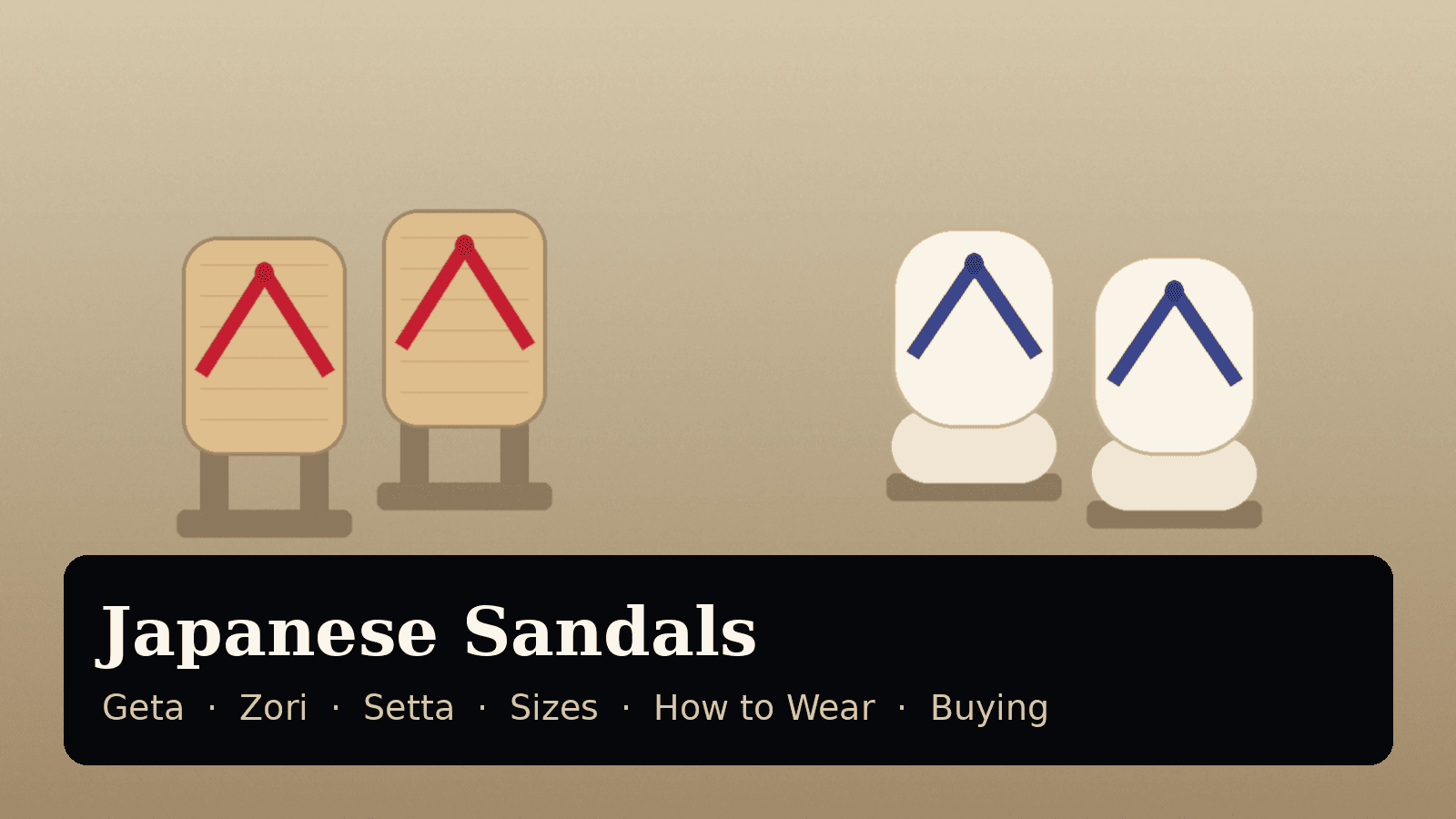
Japanese traditional sandals come in three main kinds. Geta (下駄) are wooden sandals raised on teeth — casual, worn with yukata and in summer, and famous for their “karan-koron” sound. Zōri (草履, often written zori) are flat thonged sandals and the formal choice with kimono. Setta (雪駄) are flat bamboo-sheath sandals with a leather sole, worn mostly by men. All three are held on by a hanao thong strap between the big toe and second toe, and they are worn a little smaller than your foot — Japanese shops suggest letting the heel extend roughly 1–3 cm past the back.[1][2]
- With a yukata: geta (ukon geta are the easiest to walk in).
- With formal kimono: zori (women) or tatami-omote setta / zori (men).
- Size: pick by the size tables below, not your sneaker size.
As of October 2026, this guide covers what Japanese sandals are called, geta vs zori vs setta, the types of geta (including one-tooth geta), history and wood, sizing with men’s, women’s and kids’ charts, how to wear and walk in geta, tabi and socks, maiko okobo, care and repair, prices, and how to buy Japanese sandals from Japan.
What Are Japanese Sandals Called?
Pronunciation: geta is GEH-tah, zōri ZOH-ree, setta SET-tah. In English, geta are often described as Japanese wooden clogs. The Japanese wooden sandals called geta have a wooden base (dai), usually two teeth (ha), and three holes for the hanao.[3] The flat ones are zōri — made from woven straw, rush or bamboo sheath, or today from vinyl, cork, rubber and leather — and setta, a bamboo-sheath zori with leather on the sole.[4][5] The ancient Japanese straw (grass) sandals tied around the foot with rope-like cords are waraji (草鞋): zori were for short distances around home, waraji for travel.[6] Japanese kimono sandals in general are wasō hakimono (和装履物, “Japanese-dress footwear”). Japanese slippers worn indoors — surippa: house slippers, guest slippers, onsen and inside slippers — are a separate thing; see etiquette below. Zori vs flip-flops: both are thong sandals (zori thongs), but zori have a firmer flat base and a cloth or leather hanao, and some zori are made from igusa rush.
The hanao (鼻緒) is strictly the part of the strap held between the big toe and second toe, though the word also means the whole thong; the front hole it goes through is the mae-tsubo.[7] Because the front hole sits in the center, geta have no left or right foot; swapping them now and then evens out wear.[8]
Geta vs Zori vs Setta
| Geta 下駄 | Zōri 草履 | Setta 雪駄 | |
|---|---|---|---|
| Base | Wood, raised on teeth (or a rubber-soled wedge) | Flat, often a cork or EVA core | Flat, no raised core; leather sole |
| Upper | Bare wood, lacquer or veneer | Enamel leather, vinyl, cloth, tatami-omote | Woven bamboo sheath or leather |
| Sound | “Karan-koron” on two-tooth geta | Quiet | Metal heel can jingle |
| Formality | Casual — yukata, summer, everyday | Formal to casual; women’s formal kimono | Men’s kimono, formal to casual |
| Typical wearer | Men and women | Mostly women (men’s zori exist) | Mostly men |
Tsujiya Honten, a footwear shop in Asakusa, draws the zori/setta line by construction: any sandal whose sole and upper are joined directly, without a raised core, is a setta — whatever the upper is made of; with a raised core it is a zori, even for men.[9] Setta soles are usually a hard vegetable-tanned cowhide.[9] Legend credits the tea master Sen no Rikyū with inventing setta; Heibonsha’s encyclopedia calls that folklore. From the Genroku era (1688–1704) it became fashionable to nail an iron plate to the heel, which made a “chara-chara” jingle.[5][10] So geta or zori? Geta for casual summer wear, zori for formal kimono — the geta and zōri sandals question mostly comes down to the outfit.
Types of Geta
Encyclopedias split geta into those carved from one block (base and teeth together) and those with separate teeth fitted into the base.[3] These are the shapes you will see in a geta shop:[11][12]
| Type | What it is | Notes |
|---|---|---|
| Koma-geta 駒下駄 | Base and two teeth carved from one block; the classic two-tooth geta | Classic “karan-koron” sound |
| Senryō-geta 千両下駄 | Front tooth slanted so the foot rolls forward (nomeri style) | Long favored by actors |
| Atomaru-geta 後丸下駄 | Nomeri type with a thick, rounded back tooth | Stable and slow to wear; cooks use it |
| Ukon-geta 右近下駄 | Curved oval base, no teeth, rubber sole | Non-slip, quiet; most yukata-set geta |
| Funagata-geta 舟形下駄 | Zori-shaped, light | Worn like a casual zori |
| Hiyori-geta 日和下駄 | Two thin fitted teeth; now often with a toe cover | Today mostly a rain geta |
| Taka-geta / hoba-geta 高下駄 | Tall geta with magnolia teeth | Old student style; heavy |
| Ippon-ba geta 一本歯下駄 | One-tooth geta | First worn by yamabushi mountain ascetics; now for balance training |
| Pokkuri / koppori ぽっくり | Hollowed, toe sloping forward | Children’s Shichi-Go-San footwear; maiko okobo |
One-tooth geta: purpose, use and benefits
The one-tooth (ippon-ba) geta was first worn by yamabushi mountain ascetics for training; today people buy it for balance and core training, including musicians working on posture.[11] It is a training tool, not everyday footwear — you balance on a single tooth. If you are searching for “tengu geta”, the name Japanese shops use for the single-tooth style is ippon-ba geta (一本歯下駄).
Two-tooth geta, three-tooth geta and oiran
Two-tooth geta are the standard; the two teeth keep your weight in the right place so you stand up straight — the benefit Japanese shops point to most for geta sandals and shoes.[11] Raised, elevated geta like these — lifted on wooden blocks or plank-like teeth — are what people mean by Japanese platform sandals, sandals with stilts or sandals with blocks.[11] The towering three-tooth geta belong to the oiran, high-ranking Edo-period courtesans, worn in their procession.[3]
Geta History and Origin
The oldest geta-like finds are Yayoi-period “paddy-field geta” from the Toro site in Shizuoka. The word geta itself only dates from the end of the medieval period; before that they were ashida or bokuri.[3] From the Edo period geta became fashion items with specialist makers, and from the mid-Meiji era cheap mass-produced geta made them everyday footwear across Japan, until shoes took over from the late 1950s.[13]
- Matsunaga, Fukuyama (Hiroshima): geta-making began in 1878 and led the country in mechanization; output peaked at 56 million pairs a year around 1955, the largest in Japan. The Matsunaga Hakimono Museum shows the old factory machines.[14][15]
- Hita (Oita): cedar geta finished by scorching the wood to bring out the grain, with roots in the Tenpō era (1830–1844); Hita is counted among Japan’s three main geta centers.[16][17]
- Shizuoka: lacquered Suruga nuri-geta began in 1887 and became a hit for women’s geta with lacquer and maki-e; it is a Shizuoka Prefecture designated local craft (1980).[18][19]
Wood and Materials
Geta bases are mostly paulownia (kiri) or cedar (sugi), with oak or magnolia for fitted teeth.[3] Tsujiya explains why kiri is prized: it absorbs and releases moisture so the surface stays dry, and it conducts heat poorly, so it doesn’t feel cold in winter; slow-grown Tohoku kiri is rated highest.[20] The more evenly spaced and straight the growth rings, the higher the price; pairs whose left and right grain match exactly (aime) are the most luxurious.[20] Maruya, an Aizu-kiri geta shop, says a premium geta shows 20–30 straight grain lines across about 10 cm.[21] Hita makers prefer cedar because it is light and strong yet cushioning.[8]
Zori: the most common today is cowhide enamel zori, and leather zori bases use cork — solid cork is light, glued cork powder is heavy.[22] Synthetic enamel can crack and peel after 5–6 years even unworn, so Tsujiya suggests real leather if you wear kimono only occasionally.[22] In footwear, tatami-omote means woven bamboo sheath, not floor-mat rush — that is what “tatami sandals” refers to.[22]
Japanese Sandal Sizes: Men, Women and Kids
Japanese footwear is held on by the hanao, so sizes are not graded finely like shoes; they were measured in sun and bu and are now shown as S / M / L / LL. Fit comes from how the hanao is set for each foot.[1][23] These are Tsujiya Honten’s size tables — geta measurements and dimensions as base length, and the shoe size each fits; the US column is our approximate conversion — for exact cm-to-US numbers see our Japanese shoe size to US chart.[1]
Men’s geta and setta size chart
| Size | Old unit | Base length | Fits shoe size | Approx. US |
|---|---|---|---|---|
| M | 8 sun – 8 sun 3 bu | ≈24.0–25.0 cm (9.4–9.8 in) | up to 25.5 cm | up to about US men’s 7.5 |
| L | 8 sun 5 bu – 7 bu | ≈25.5–26.0 cm (10.0–10.2 in) | 25.5–27.0 cm | about US men’s 7.5–9 |
| LL | 9 sun | ≈27.0 cm (10.6 in) | 27.0–28.5 cm | about US men’s 9–10.5 |
| 3L | 9 sun 5 bu | ≈28.5 cm (11.2 in) | 28.5–30.0 cm | about US men’s 10.5–12 |
| 4L | 1 shaku | ≈30.0 cm (11.8 in) | 30.0 cm and up | about US men’s 12+ |
Women’s geta and zori size chart
| Size | Old unit | Base length | Fits shoe size | Approx. US |
|---|---|---|---|---|
| S | 7 sun 3 bu | ≈21.5 cm (8.5 in) | up to 22.5 cm | up to about US women’s 5.5 |
| M | 7 sun 8 bu | ≈23.5 cm (9.3 in) | 22.5–24.0 cm | about US women’s 5.5–7 |
| L | 8 sun | ≈24.0 cm (9.4 in) | 24.0–25.0 cm | about US women’s 7–8 |
| LL | 8 sun 5 bu | ≈25.5 cm (10.0 in) | 25.0 cm and up | about US women’s 8+ |
Large sizes: men with feet over 28.5 cm (about US 10.5+) need 3L or 4L; many geta are sold “one size”, with men’s bases fitting about 25–27 cm feet and extra-large bases for 27–29 cm, according to Hita maker Motono — so US men’s size 12, 13 or 14 means looking for 4L or made-to-order.[8][1] Women with larger feet can wear a men’s base with a different hanao.[8]
Kids’ geta and zori sizes
| Age | Footwear size | Child's foot length |
|---|---|---|
| 1–2 | 15.0 cm | 14 cm or less |
| 3–4 | 16.5 cm | about 14–16 cm |
| 5–6 | 18.0–18.5 cm | about 16.5–17.5 cm |
| 7–8 | 19.5–20 cm | about 17.5–19 cm |
| 9–10 | 21.0 cm | about 19–21 cm |
| 11–12 | 22.5 cm | about 21–22.5 cm |
| 13+ | 23.0 cm+ | adult sizes |
From Gendaiya, a footwear shop; it suggests children new to geta wear a slightly larger pair with a looser hanao.[24]
How should geta fit? Heel overhang
Japanese footwear is worn so the heel extends past the back of the base — shops differ on how much, so treat 1–3 cm as the range:[1][8][2][25]
| Shop | Recommended heel overhang |
|---|---|
| Tsujiya Honten (Asakusa) | Heel 2–3 cm off the back |
| Motono (Hita geta maker) | Heel out by 2–3 cm |
| Zourihonpo | Heel out by 1–1.5 cm |
| Hanaichi (hanao maker) | Heel out by 1–2 cm, little toe outside |
Pick slightly smaller than your shoe size.[2] The little toe (and for some people the fourth toe) naturally sticks out over the edge of a geta.[26]
How to Wear Geta and Zori
Formality: which sandals with which outfit
- Men’s formal wear (crested black haori and hakama): tatami-omote setta or zori with a plain white hanao.[27]
- Women’s formal kimono (tomesode, hōmongi, furisode): zori with gold or silver thread or gold-leaf designs; for semi-formal kimono Tsujiya suggests leather zori in white, pale pink or cream.[27]
- Geta are more casual than zori — avoid them where noise matters, such as museums and theaters.[27] Tsujiya also says base height has no bearing on formality, though a taller base often suits formal outfits.[27]
- Yukata: geta, either sex. See our yukata and jinbei guide.
Geta with socks or tabi?
Geta can be worn barefoot or with tabi (split-toe socks). Barefoot looks cool with a light yukata in midsummer, but Tsujiya says the idea that geta must be worn barefoot is wrong — tabi with a yukata is fine, and glossy black lacquered geta look neat with white tabi.[28][29] At formal events, white cotton tabi are the norm.[30] Ordinary socks don’t fit a thong strap; use tabi or tabi socks — see our tabi socks guide.
How to walk in geta
- Don’t push your foot all the way in. Leave a little room between the front cord and the base of your toes.[8]
- Lift from the thigh and set each foot down lightly — two-tooth geta then make a clean “karan-koron”.[8]
- Break them in: new geta feel tight; walk near home for 2–3 days. A hanao that hugs the instep without hurting is the right fit; one that is loose from the start rubs.[8]
- If they hurt: Tsujiya says many “painful” geta are actually too loose. Don’t knead or bend the hanao — its core deforms — have a shop adjust it.[26]
Are geta sandals comfortable, or uncomfortable? New pairs can feel tight, until the hanao is broken in or adjusted. Walking in geta gets easier with rubber-soled pairs: rubber-soled ukon and funagata geta don’t slip and make no noise, which is why most yukata-set geta use them and why they are easiest for beginners.[29][11]
Footwear etiquette and indoor slippers
JNTO’s advice: take off your shoes at the entrance (the genkan), put on the slippers provided for guests, place your shoes neatly to the side, and take slippers off on tatami. Many Japanese-style restaurants, temples and hot springs have no-shoe rules.[31][32] How your footwear looks when taken off and lined up has long mattered in Japan — another reason geta and zori are chosen to look neat.
Maiko Okobo, Pokkuri and Geisha Footwear
Pokkuri are toothless geta with a hollowed sole and a forward-sloping toe, worn by girls in festive dress and by maiko in Gion; eastern Japan says pokkuri, Kansai says koppori — both imitate the sound.[33] Chobo-ya, a footwear shop in Gion, says maiko wear okobo only in their maiko years: first-year maiko have red hanao with a bell, and once a maiko becomes a geiko she switches to geta or zori.[34] The Gion Kagai Art Museum describes okobo as more than 10 cm thick.[35] Pokkuri for Shichi-Go-San are also sold in adult sizes for coming-of-age ceremonies and weddings.[11]
Modern Japanese Sandals
- Calen Blosso (Hishiya, Osaka): Hishiya began in 1926 as a hanao maker and launched the Calen Blosso brand in 1998; its “cafe zori” use EVA instead of a cork core for light, cushioned everyday zori.[36][37]
- Pondals (Hanaichi, Asakusa hanao maker since 1924): a town sandal with a replaceable hanao, an EVA base of about 280–300 g, sized like normal sandals in six sizes from 18 to 27.5 cm.[25]
- Heel geta and mule geta — geta-inspired sandals with heels — from Hita makers bring cedar geta into Western-style outfits.[17][8]
Care and Repair
- Bamboo-sheath setta: never get them wet — the weave swells and warps. Dry in the shade and store in a paper box; clean dirt with an eraser.[38]
- Plain-wood geta: wipe with a well-wrung cloth; dry-wipe lacquered geta; air-dry wet hanao in the shade.[8]
- Hanao replacement (sugekae): Tsujiya from ¥3,300 (hanao extra; free for pairs bought there); Maruya ¥1,500 fitting fee plus the hanao, about 5–10 minutes, pairs from other shops accepted.[39][40]
- Other repairs at Tsujiya: heel replacement from ¥550, geta tooth rubber from ¥1,650. It cannot repair urethane zori, discolored vinyl tops or imported geta with full rubber soles.[39]
Prices: How Much Are Geta, Zori and Setta?
Price ranges on the first page of each category at Tsujiya Honten’s web shop, tax included, checked 2026-10-28:[41][42][43][44][45][46][47][48]
| Category | Price range |
|---|---|
| Women’s traditional geta (koma, senryō) | ¥9,680–¥43,670 |
| Women’s ukon / funagata geta | ¥13,200–¥34,100 |
| Men’s traditional geta | ¥9,900–¥59,400 |
| Men’s ukon geta | ¥9,900–¥35,200 |
| Men’s tatami-omote / rattan setta | ¥10,780–¥74,800 |
| Women’s leather zori | ¥9,900–¥132,000 |
| Women’s zori and bag sets | ¥39,930–¥101,750 |
These are handmade specialist-shop prices; vintage geta and zori, mass-produced yukata-set geta and secondhand pairs on Mercari and Yahoo Auctions cost far less. Zori-and-bag sets (草履バッグセット) are the usual buy for formal kimono. Nanbu-omote setta cost more than the simpler nozaki-omote weave.[10]
Where to Buy Japanese Sandals
- Tokyo: Asakusa has traditional footwear shops such as Tsujiya Honten, which sets the hanao to your foot in about 10–15 minutes.[23]
- Kyoto: Gion footwear shops for okobo and kimono zori.[34]
- Online from Japan: specialist web shops (most ship within Japan and ask for your shoe size and instep height), plus Rakuten, Amazon Japan, Mercari and Yahoo Auctions for everyday and secondhand pairs.[23]
Pair them with a furoshiki or tenugui and a lacquerware gift for a full Japanese set.
Japanese Words for Shopping
| Japanese | Romaji | Meaning |
|---|---|---|
| 下駄 | geta | wooden sandals with teeth |
| 草履 | zōri | flat thonged sandals |
| 雪駄 | setta | bamboo-sheath sandals with a leather sole |
| 草鞋 | waraji | tied straw sandals |
| 鼻緒 | hanao | thong strap |
| 前壺 | mae-tsubo | front hole / toe cord |
| 歯 | ha | geta tooth |
| 台 | dai | base |
| 桐 | kiri | paulownia wood |
| 畳表 | tatami-omote | woven bamboo-sheath upper |
| 右近 | ukon | toothless rubber-soled geta |
| 一本歯 | ippon-ba | one-tooth geta |
| おこぼ | okobo | maiko platform geta |
| 足袋 | tabi | split-toe socks |
| すげ替え | sugekae | hanao replacement |
| 草履バッグセット | zōri bag set | matching zori and handbag |
How to Buy Geta, Zori and Setta From Japan
- Search in Japanese: 下駄 メンズ / 下駄 レディース, 右近下駄, 桐下駄, 一本歯下駄, 雪駄, 草履 バッグ セット, おこぼ. Add a size (M, L, LL) or 大きいサイズ for large sizes.
- Check the listing: base length in cm (台の長さ), whether the hanao is pre-set or set to order, material (kiri, sugi, enamel, tatami-omote), and photos of the teeth and sole for secondhand pairs.
- Size down, not up: compare your foot length in cm with the tables above.
- Before it ships: add unboxing photos (¥500 / ¥700) or a wrong/missing-item check (¥200) at the Tokyo warehouse to see the pair before international shipping, and package reinforcement (from ¥100) for lacquered geta. Under OneMall’s policy, damage in international transit is compensated up to the international shipping fee paid and must be reported within 24 hours with the order number, photos and a full unboxing video.
OneMall buys from Japanese marketplaces such as Mercari, Yahoo Auctions, Rakuten and Amazon Japan, and from other Japanese online stores (including maker web shops) through LinkBuy. Items that need a lottery entry, purchase limit, Japanese identity verification or a merchant account cannot be purchased. International shipping is charged on the greater of actual weight and volumetric weight (length × width × height ÷ 5,000) of the box the warehouse uses.
Service fees are ¥300 per item on most marketplaces; from ¥200 per item on Yahoo Auctions and LinkBuy. The first six orders consolidate free; each additional order costs ¥100. Storage is free for 90 days after arrival (30 days after consolidation). Payment is by Visa, Mastercard or PayPal, settled in USD.
US buyers: since August 29, 2025, US-bound parcels of any value go through customs and pay applicable duties, taxes and fees — the $800 de minimis exemption no longer applies. OneMall currently ships to the United States by ECMS, DHL and Japan Post EMS (DDP — declared value up to USD 2,500, duties prepaid with the shipping fee); the live quote at checkout shows which lines accept your parcel.
Browse geta, setta or zori and bag sets, and compare the best Japan proxy services and proxy costs by total landed cost.
Frequently Asked Questions
What is the difference between geta and zori?
Geta are wooden sandals raised on teeth and are casual; zori are flat, often leather or enamel, and are the formal choice with kimono.
Should geta be smaller than your foot?
Yes — Japanese shops suggest your heel extend roughly 1–3 cm past the back of the base.
What is a one-tooth geta for?
Originally training for mountain ascetics; today mainly balance and posture training.
Can you wear socks with geta?
Use tabi or tabi socks — the split toe fits the hanao. Barefoot is also normal with a yukata.
Are geta for men or women?
Both. Men’s and women’s geta differ in base size and hanao; zori are mostly worn by women and setta mostly by men.
What are Japanese wooden sandals made of?
Mostly paulownia (kiri) or cedar (sugi), with oak or magnolia for fitted teeth.
References
- Tsujiya Honten, Japanese footwear sizes. https://getaya.jp/knowledge/knowledge_size/
- Zourihonpo, Footwear sizes. https://www.zourihonpo.com/?mode=f2
- Kotobank, Geta (encyclopedia entries). https://kotobank.jp/word/%E4%B8%8B%E9%A7%84-59469
- Kotobank, Zori. https://kotobank.jp/word/%E8%8D%89%E5%B1%A5-89748
- Kotobank, Setta. https://kotobank.jp/word/%E9%9B%AA%E9%A7%84-87312
- Kotobank, Waraji. https://kotobank.jp/word/%E8%8D%89%E9%9E%8B-551772
- Kotobank, Hanao. https://kotobank.jp/word/%E9%BC%BB%E7%B7%92-115600
- Motono Hakimono Kogyo (Hita), Geta tips. http://shop-motono.com/?mode=f5
- Tsujiya Honten, Setta vs zori. https://getaya.jp/knowledge/knowledge_setta_zori/
- Tsujiya Honten, What is setta. https://getaya.jp/knowledge/knowledge_setta/
- Tsujiya Honten, Types of geta. https://getaya.jp/knowledge/geta_type/
- Kotobank, Koma-geta. https://kotobank.jp/word/%E9%A7%92%E4%B8%8B%E9%A7%84-504366
- Tsujiya Honten, History of geta. https://getaya.jp/knowledge/geta_history/
- Fukuyama City, Matsunaga geta. https://www.city.fukuyama.hiroshima.jp/site/miryoku2023/288034.html
- Fukuyama City, Matsunaga Hakimono Museum (Traditional Industry Hall). https://www.city.fukuyama.hiroshima.jp/soshiki/matsunaga-hakimono/332354.html
- Oita Prefecture, Hita geta (archive). https://www.pref.oita.jp/site/archive/201106.html
- Oita Prefecture, Oita Katete: Hita geta (2017). https://oita-katete.pref.oita.jp/web_magazine/geta/
- Shizuoka City, Suruga nuri-geta. https://www.city.shizuoka.lg.jp/000_004109.html
- Shizuoka Prefecture, List of traditional crafts. https://www.pref.shizuoka.jp/sangyoshigoto/shokogyoservice/chiikisangyo/1047498/1028518.html
- Tsujiya Honten, Paulownia geta. https://getaya.jp/knowledge/geta_kirigeta/
- Maruya Hakimono-ten, Aizu paulownia geta. https://www.getaya.org/geta.html
- Tsujiya Honten, Zori and setta materials. https://getaya.jp/knowledge/zori_material/
- Tsujiya Honten, Size guide for geta, zori and setta. https://getaya.jp/size/
- Gendaiya, Children’s zori and geta sizes. http://www.gendaiya.co.jp/s_kohaki.htm
- Hanaichi, Pondals. http://hanao-hanaichi.com/pondals/
- Tsujiya Honten, Five things to know before buying geta. https://getaya.jp/knowledge/common-sense/
- Tsujiya Honten, Footwear formality (TPO). https://getaya.jp/knowledge/knowledge_tpo/
- Tsujiya Honten, Men’s summer footwear. https://getaya.jp/feature/mens_summer/
- Tsujiya Honten, Geta for yukata. https://getaya.jp/feature/2023yukata_geta/
- Ebisu Tabi Honpo, Choosing tabi. https://www.ebisutabi.co.jp/?mode=f3
- JNTO, Understanding and Mastering Japanese Manners and Etiquette. https://www.japan.travel/en/guide/understanding-and-mastering-japanese-manners-and-etiquette/
- JNTO, Japanese Manners Do’s and Don’ts. https://www.japan.travel/en/guide/japanese-manners-dos-and-donts/
- Kotobank, Pokkuri. https://kotobank.jp/word/%E3%81%BD%E3%81%A4%E3%81%8F%E3%82%8A-3170618
- Kyoto Love. Kyoto, Maiko okobo (Chobo-ya, Gion). https://kyotolove.kyoto/I0000027/
- Gion Kagai Art Museum, For aspiring maiko. https://gion-museum.com/sp_recruit
- Hishiya, About Hishiya. https://hishiya1926.jp/about
- Hishiya, Brands. https://hishiya1926.jp/product/
- Tsujiya Honten, Setta care. https://getaya.jp/knowledge/knowledge_setta_aftercare/
- Tsujiya Honten, Repair workshop. https://getaya.jp/onaoshi/
- Maruya Hakimono-ten, Hanao replacement and adjustment. https://www.getaya.org/getasuge.html
- Tsujiya Honten, Legal notice (prices incl. tax). https://getaya.jp/tokusho/
- Tsujiya Honten shop, Women’s traditional geta. https://getaya.jp/category/item/ladies/ladies_geta/l-tradgeta/
- Tsujiya Honten shop, Women’s ukon / funagata geta. https://getaya.jp/category/item/ladies/ladies_geta/l-moderngeta/
- Tsujiya Honten shop, Men’s traditional geta. https://getaya.jp/category/item/mens/mens_geta/m-tradgeta/
- Tsujiya Honten shop, Men’s ukon geta. https://getaya.jp/category/item/mens/mens_geta/m-moderngeta/
- Tsujiya Honten shop, Men’s tatami-omote setta. https://getaya.jp/category/item/mens/mens_setta/m-tatamisetta/
- Tsujiya Honten shop, Women’s leather zori. https://getaya.jp/category/item/ladies/ladies_setta/l-leatherzouri/
- Tsujiya Honten shop, Women’s zori and bag sets. https://getaya.jp/category/item/ladies/ladies_goods/l-bagset/