
 Shopping Guide
 HELP / FAQs



 By onemall
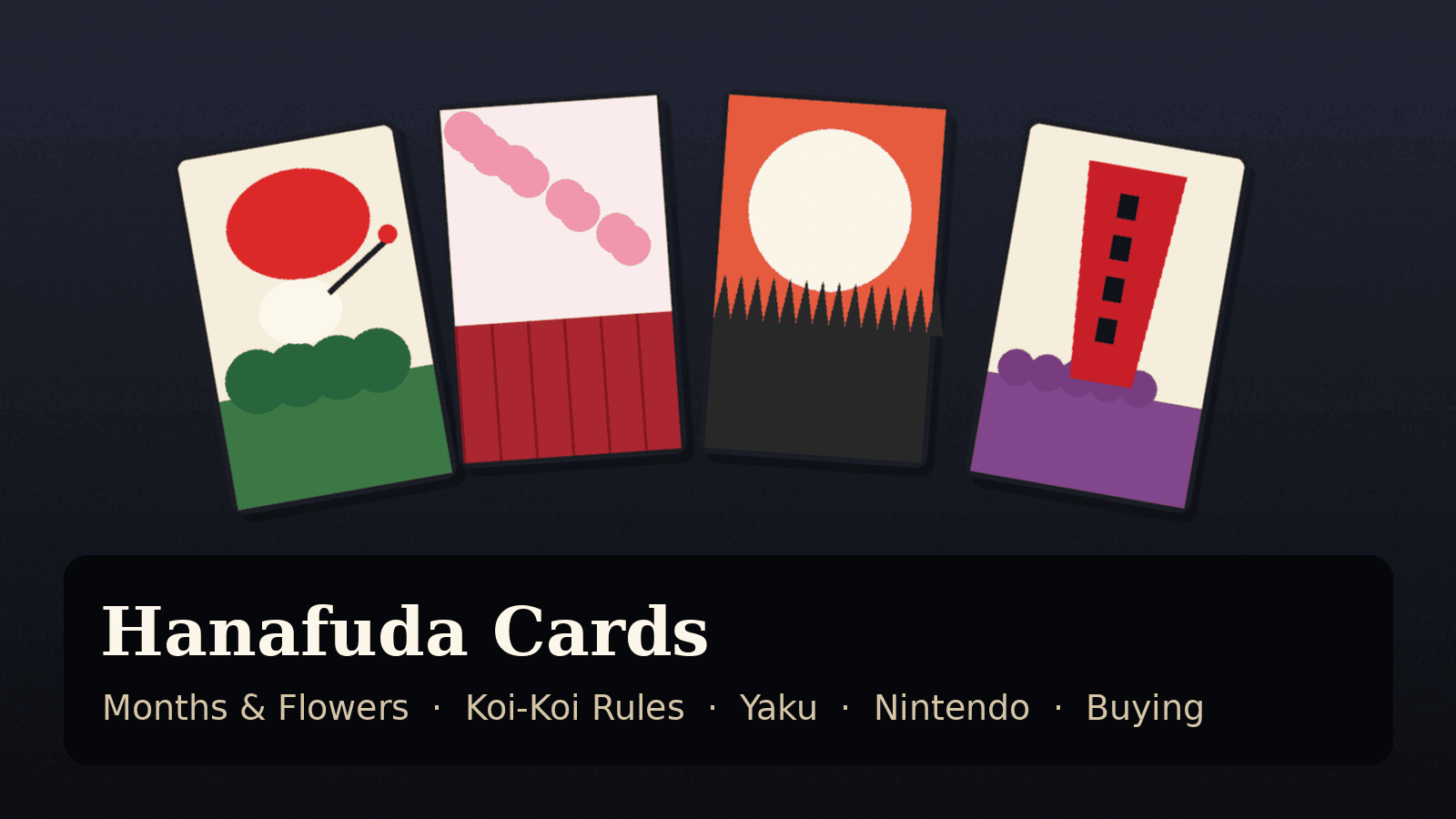
Last updated: 2026-10-28.
TL;DR
Hanafuda (花札, “flower cards”) are Japanese playing cards: a deck of 48 cards, twelve months with four cards each, every month a flower or plant. The best-known game is koi-koi (こいこい), a two-player matching game where you collect cards of the same month and score yaku — combinations such as Five Brights or Boar–Deer–Butterfly. Nintendo began as a hanafuda maker in Kyoto in 1889 and still sells hanafuda decks today.[1][2]
- Learn: the month table and the 13 koi-koi yaku below are all you need to play.
- Buy a deck: Nintendo’s Daitōryō, or Kyoto’s Ohishi Tengudo (from ¥1,320).
- Collect: Mario Hanafuda, the Spirited Away deck, reproduction regional decks and vintage Nintendo decks on Yahoo Auctions and Mercari.
As of October 2026, this guide covers what hanafuda cards are, the cards by month and their meanings, point values, how to play koi-koi with a yaku chart (a cheat sheet), hana-awase, hachi-hachi and oicho-kabu, hanafuda history and Nintendo, hanafuda vs karuta, card sizes, and how to buy hanafuda cards from Japan.
What Are Hanafuda Cards?
Hanafuda (花札; pronunciation ha-na-fu-da; the kanji are 花 hana, flower, and 札 fuda, card — also written hana fuda or hana-karuta, 花かるた, “flower karuta”) are a kind of Japanese karuta — the general Japanese word for cards.[3][4] A hanafuda deck has 48 cards: 12 months × 4 cards, and each month is shown by a plant: pine for January, cherry blossom for March, maple for October and so on. There are no numbers or suits printed on the cards — it is a Japanese card game with pictures instead of numbers; you read the month from the picture. Each card also has a point value, and sets of cards called yaku (役) score extra.[3]
It is the Japanese card game with flowers and birds on every card — and the one behind the losing numbers 8-9-3 (see oicho-kabu below). Encyclopedias list more than 30 games played with hanafuda, including hachi-hachi, koi-koi and oicho-kabu.[4] Decks are sold with a black back (黒裏) or a red/brown back (赤裏), sometimes as a pair so two games can run side by side; Nintendo and Tengudo both make red and black versions.[4][2][5] So what are Japanese playing cards called? Hanafuda for the flower deck, karuta for cards in general, and torampu (トランプ) for the Western 52-card deck.
Hanafuda Card Types and Point Values
Every card belongs to one of four types. The counts below are tallied from Nintendo’s own 12-month points table:[6][7]
| Type | Japanese | Points | Cards in deck |
|---|---|---|---|
| Bright | 光札 hikari-fuda | 20 | 5 |
| Animal / object (“seed”) | 種札 tane-fuda | 10 | 9 |
| Ribbon (poem slip) | 短冊札 tanzaku-fuda | 5 | 10 |
| Chaff / plain | カス札 kasu-fuda | 1 | 24 |
5 + 9 + 10 + 24 = 48. In Nintendo’s koi-koi rules the chrysanthemum sake cup (菊に盃) is a 10-point card that can also count as a chaff card.[8] The hanafuda bright cards (the “brights”, hikari) are the crane, the cherry curtain, the full moon, the rain man and the phoenix.
Hanafuda Cards by Month (Names and Meanings)
Here is the full hanafuda card chart — all cards by month, with the plant names in English and Japanese and the special card in each month, following Nintendo’s card table:[6][7]
| Month | Plant | 20-pt bright | 10-pt card | 5-pt ribbon | 1-pt chaff cards |
|---|---|---|---|---|---|
| 1 January | Pine 松 (matsu) | Crane and sun | — | Red poem ribbon (akayoroshi) | 2 |
| 2 February | Plum blossom 梅 (ume) | — | Bush warbler | Red poem ribbon (akayoroshi) | 2 |
| 3 March | Cherry blossom 桜 (sakura) | Curtain | — | Red poem ribbon (Miyoshino) | 2 |
| 4 April | Wisteria 藤 (fuji) | — | Lesser cuckoo | Plain red ribbon | 2 |
| 5 May | Iris 杜若 (kakitsubata) | — | Eight-plank bridge | Plain red ribbon | 2 |
| 6 June | Peony 牡丹 (botan) | — | Butterflies | Blue ribbon | 2 |
| 7 July | Bush clover 萩 (hagi) | — | Boar | Plain red ribbon | 2 |
| 8 August | Pampas grass 芒 (susuki) | Full moon | Geese | — | 2 |
| 9 September | Chrysanthemum 菊 (kiku) | — | Sake cup | Blue ribbon | 2 |
| 10 October | Maple 紅葉 (momiji) | — | Deer | Blue ribbon | 2 |
| 11 November | Willow 柳 (yanagi) — “rain” | Ono no Michikaze with frog (rain man) | Swallow | Plain red ribbon | 1 |
| 12 December | Paulownia 桐 (kiri) | Phoenix | — | — | 3 |
A few cards worth knowing by name:
- Ribbons: the three red poem ribbons are January pine, February plum and March cherry; the three blue ribbons are June peony, September chrysanthemum and October maple.[6][7] The pine and plum ribbons look as if they say “あのよろし”, but the character that looks like の is a variant kana for か, so they read akayoroshi; a Nintendo designer admits its meaning is “not really clear”. The cherry ribbon reads Miyoshino, after Yoshino, a famous cherry-blossom spot.[9]
- The rain man (November): the willow bright shows Ono no Michikaze, a Heian-period calligrapher (894–966/967), with a frog — after the story of him watching a frog jump again and again at a willow branch.[10][9] Encyclopedias give the November willow the nickname ame (“rain”) and the August pampas the nickname bōzu.[4]
- Butterflies (June): the red shape on the peony card is a cloud, so the butterflies go at the top.[9]
- December paulownia has one bright (the phoenix) and three chaff cards; November willow has four different cards — a bright, an animal, a ribbon and one chaff.[7]
Hanafuda flowers and their symbolism follow the seasons of the old Japanese calendar: plum and cherry for spring, iris and peony for early summer, bush clover, pampas and the moon for autumn, maple for late autumn. Some dictionaries call the May plant ayame (iris) rather than kakitsubata; Nintendo uses kakitsubata.[4][6] Hanafuda art is also the source of the many hanafuda-style designs on clothing and prints.
How to Play Hanafuda: Koi-Koi Rules
Koi-koi is the hanafuda card game most English-language players learn first; these hanafuda instructions work as a quick tutorial to the gameplay. The rules below are Nintendo’s version; rules differ by house and region, so agree on them before you start.[8][4]
Setup and turns
- Players: 2.[8][11]
- Deal: 8 cards face up on the table and 8 face down to each player, dealt two at a time; the rest form the draw pile.[8]
- Who goes first: each player turns a card; the earlier month becomes dealer (oya). If one player’s starting hand holds all four cards of a month, or four pairs, it scores 6 points and the round ends.[8]
- Your turn: play one card from your hand. If a table card shows the same month, take both; if not, leave your card on the table. Then flip the top card of the draw pile and do the same.[8]
- Make a yaku, then decide: stop and score, or call “koi-koi” to keep playing for more. If your opponent then makes a yaku first, you score 0 and their score is doubled.[8] The name comes from calling “koi” — “come on” — to keep going.[11]
- Scoring: the winner scores the total of their yaku, doubled if it is 7 points or more. The winner deals next. Play 12 rounds (one per month); the highest total wins.[8]
Koi-koi yaku chart: winning hands and scoring guide
This is the full koi-koi yaku list — the hanafuda hands and combinations, with points, from Nintendo’s chart. English names are translations.[12]
| Yaku | Japanese | Points | Cards |
|---|---|---|---|
| Five Brights | 五光 gokō | 10 | All five 20-point cards |
| Four Brights | 四光 shikō | 8 | Four brights without the willow (rain man) card |
| Rainy Four Brights | 雨四光 ame-shikō | 7 | Four brights including the willow card |
| Three Brights | 三光 sankō | 5 | Three brights, not including the willow card |
| Flower-viewing sake | 花見で一杯 hanami-zake | 5 | Cherry curtain + sake cup |
| Moon-viewing sake | 月見で一杯 tsukimi-zake | 5 | Pampas moon + sake cup |
| Boar–Deer–Butterfly | 猪鹿蝶 inoshikachō | 5 | Boar, deer and butterflies; +1 per extra 10-point card |
| Red ribbons | 赤短 akatan | 5 | Pine, plum and cherry poem ribbons; +1 per extra ribbon |
| Blue ribbons | 青短 aotan | 5 | Peony, chrysanthemum and maple blue ribbons; +1 per extra ribbon |
| Red and blue ribbons | 赤短・青短の重複 | 10 | All six; +1 per extra ribbon |
| Tane (animals) | タネ | 1 | Any five 10-point cards; +1 per extra |
| Tan (ribbons) | タン | 1 | Any five ribbons; +1 per extra |
| Kasu (chaff) | カス | 1 | Ten 1-point cards; +1 per extra (the sake cup can count here) |
Nintendo’s chart also says the smaller sets don’t stack with the larger ones: Tane doesn’t count if you made Boar–Deer–Butterfly, Tan doesn’t count if you made red or blue ribbons, and Three or Four Brights are void once you have Five.[12] House rules elsewhere may score both — another reason to agree the rules first. As a koi-koi strategy note, the two sake-cup yaku make the chrysanthemum sake cup the card most players grab first.
Other Hanafuda Games: Hana-Awase, Hachi-Hachi, Oicho-Kabu
- Hana-awase (花合わせ): a 3-player game; each player gets 7 cards with 6 face up on the table. Each round’s score is your card points minus 88, plus yaku, so the three scores add up to zero; 12 rounds, or 3/6/9 for a short game.[13]
- Simplified hanafuda for 2–4 players: Nintendo publishes its own beginner rules, Chotto Hana-awase, for 2–4 players with 32 cards (April, May, November and December removed), plus an advanced version with all 12 months for 2–5 players — the answer if you want hanafuda for 4 players.[14][3]
- Hachi-hachi (八八, “eighty-eight”): 3 players, each starting with 60 points; 7 cards each and 6 on the table. The total of all card points is 264, which divided by three is 88 — hence the name. It is especially popular in the Kantō region.[15][16]
- Oicho-kabu (おいちょかぶ): a gambling game like baccarat. With hanafuda you use 40 cards (the willow and paulownia months removed), add up the month numbers and keep only the last digit; 9 is the best hand.[4] The dedicated deck for kabu games is kabufuda (株札): 40 cards, numbers 1–10 in four copies, used mainly in the Kansai region — a different deck from hanafuda.[17]
The word yakuza is generally said to come from a three-card kabu game: 8 (ya) + 9 (ku) + 3 (sa) totals 20, which counts as zero — the worst hand — so the word came to mean “useless”, and later gamblers and gangsters.[18] In the video game Ryu ga Gotoku Kiwami 2 (Yakuza Kiwami 2), SEGA lets you play koi-koi and oicho-kabu in the gambling den.[19]
Hanafuda Origin and History: From Portuguese Cards to Nintendo
Karuta origin first: cards reached Japan with Portuguese traders in the 16th century; the word karuta comes from Portuguese carta.[20][21] The first Japanese-made deck — the ancient Japanese card game behind hanafuda — was Tenshō karuta: 48 cards in four suits of 12 (cups, coins, clubs, swords). The oldest surviving Japanese-made card is marked as made in Miike — today’s Omuta in Fukuoka — and production later moved to Kyoto.[20][21] Because the cards were used for gambling, they were banned again and again in the Edo period; a 75-card offshoot, unsun karuta, was banned in the Kansei Reforms (1787–1793).[21][22]
Nintendo dates hanafuda in today’s form to the mid-Edo period.[3] The leading theory in Heibonsha’s encyclopedia is that hanafuda was created as a substitute after the Kansei Reforms: it kept Tenshō karuta’s 48 cards and play, regrouped as 12 × 4, and borrowed flower-and-bird matching cards for the art. Early decks even carried old poems, perhaps to pass as poetry cards — but hanafuda was banned too, with bans recorded in 1819 and 1831.[4] So was hanafuda banned? Yes, repeatedly, until the Meiji era. The exact year it became legal differs by source: Heibonsha gives no year, and Kyoto maker Ohishi Tengudo dates the decree lifting the ban to 1891, when it registered its Tengu trademark.[4][23] A card tax began in 1902 and still applies to hanafuda sold in Japan as the playing-card tax.[4]
Did Nintendo invent hanafuda?
No — hanafuda is about a century older than Nintendo. What Nintendo did was start as a hanafuda maker: in 1889, Yamauchi Fusajirō began making hanafuda in Shimogyō, Kyoto. Nintendo made Japan’s first Western playing cards in 1902, was renamed Nintendo Koppai (任天堂骨牌, Nintendo Playing Cards) in 1951 and Nintendo Co., Ltd. in 1963.[1] Nikkei Business says Yamauchi sold his highest-quality cards under the Daitōryō (“President”; also romanized Daitoryo or Daitouryou) brand with a picture of Napoleon on the box.[24]
Does Nintendo still make hanafuda cards?
Yes. Nintendo’s hanafuda page currently lists Daitōryō, Fuku Tengu and Miyako no Hana (each with a red or black back), Mario Hanafuda (release date: November 2015) and a Daitōryō kabufuda deck. All are “open price” — Nintendo sets no list price and retailers set their own.[2][25] The original Nintendo hanafuda cards of 1889 are not sold new today, but Nintendo’s current decks are still back-pasted, and each deck includes a card advertising the method.[9] Nintendo says the card designs of Daitōryō, Fuku Tengu and Miyako no Hana are identical.[26] The Nintendo Museum in Uji, Kyoto (opened 2024) runs a hanafuda workshop where you make your own cards; it needs a same-day reservation and a separate fee.[27]
Hanafuda vs Karuta
Karuta is the umbrella word. Japanese cards fall into two families: Western-derived gambling-type cards (Tenshō karuta, unsun karuta, hanafuda) and Japan’s own poetry and proverb cards.[4][28]
- Uta-garuta (歌がるた): poetry cards. The reading card has a whole waka poem and the grabbing card only its last part; of all the poem sets, the Ogura Hyakunin Isshu (100 poems) is the one that stayed popular.[28]
- Iroha karuta: proverb cards, one per syllable of the iroha alphabet plus 京, 48 in all.[29]
- Competitive karuta (競技かるた) uses the Hyakunin Isshu. Its rules were set in 1904 by journalist Kuroiwa Ruikō; the All-Japan Karuta Association was founded in 1954.[30] Matches are one-on-one with 25 cards each, 15 minutes to memorize the layout, and the first to clear their side wins.[31] The association estimates about 1 million players including school clubs and holds around 160 karuta tournaments a year — competitive karuta is played much like a sport.[32][33] The Meijin and Queen title matches are held every January at Ōmi Jingū in Ōtsu, Shiga — the karuta queen matches since 1957.[34][33] The manga Chihayafuru (2008–2022, 50 volumes) is about competitive karuta.[35]
Hanafuda Card Size, Materials and Quality
Hanafuda card size: Ohishi Tengudo’s standard decks measure 54 × 33.5 mm (about 2.1 × 1.3 in) — much smaller and thicker than a Western playing card; its large reproduction deck is 80 × 51 mm.[5][36] Nintendo does not publish dimensions. Traditional hanafuda are back-pasted (裏貼り): the printed face is wrapped from behind with another sheet, which makes each card stiff and thick — a Nintendo designer notes a full deck is too tall to shuffle in one hand.[9][5]
High-quality hanafuda — how to judge a deck: maker, back-pasted vs simply printed, red or black back, card size, and the box (plastic case or paulownia box). Tengudo sorts the cards from one production run into three grades at inspection — Kin Tengu (best), Gin Tengu and Lincoln — all made the same way.[5][37][38] The hanafuda box usually carries the brand name: on Nintendo decks that is Daitōryō, Fuku Tengu or Miyako no Hana.
Hanafuda Decks and Prices
Maker prices in Japan, tax included, checked 2026-10-28:[2][25][5][37][38][39][40][41][36]
| Deck | Maker | Price in Japan |
|---|---|---|
| Nintendo Daitōryō 大統領 (red or black back) | Nintendo | Open price (set by retailers) |
| Nintendo Fuku Tengu 福天狗 / Miyako no Hana 都の花 | Nintendo | Open price; same card designs as Daitōryō |
| Nintendo Mario Hanafuda マリオ花札 (Nov 2015) | Nintendo | Open price |
| Tengudo Kin Tengu 金天狗 | Ohishi Tengudo, Kyoto | ¥2,200 |
| Tengudo Gin Tengu 銀天狗 | Ohishi Tengudo | ¥1,650 |
| Tengudo Lincoln リンカーン | Ohishi Tengudo | ¥1,320 |
| Kyoto hanafuda 京都花札 (Kyoto sights) | Ohishi Tengudo | ¥2,200 |
| Spirited Away hanafuda (Studio Ghibli–supervised) | Ohishi Tengudo, sold by Movic | ¥3,850 |
| Reproduction regional decks (Echigo-bana etc.) | Ohishi Tengudo | ¥4,180 |
| Prime Minister’s hana-karuta (80 × 51 mm, paulownia box) | Ohishi Tengudo | ¥7,700 |
Tengudo also sells a kabufuda deck (¥4,180) and a framed hanafuda display set (¥9,350). The two Japanese playing card manufacturers you will meet most are Nintendo and Ohishi Tengudo.[42][43] Ohishi Tengudo was founded in Kyoto in 1800 and includes an English “How to play Hana-Awase” sheet with its decks.[23][5] Character and themed decks beyond Mario and Studio Ghibli — game and anime collaborations — turn up on Japanese marketplaces; check the maker named in the listing.
Vintage and antique hanafuda
Rare and unique Japanese playing cards — older Nintendo decks (Daitōryō boxes) and antique regional decks — sell on Yahoo Auctions and Mercari. Value depends on age, maker, completeness (all 48 cards, often plus a spare or blank card) and box condition — check the listing photos for a full count before you bid.
Where to Buy Hanafuda Cards
- Nintendo decks: sold through Japanese retailers, toy shops and marketplaces at “open price”.[2]
- Ohishi Tengudo (Fushimi, Kyoto): the store offers tax-free purchases to short-stay visitors; its web shop ships within Japan for a flat ¥660 and charges overseas shipping at actual cost after recalculating each order.[23][44]
- In Tokyo: toy shops and game shops in Akihabara and department-store toy floors stock Nintendo decks; specialist decks are easier to find online.
- Nintendo Museum shop, Kyoto — for the museum experience.[27]
Related Japanese Games and Collectibles
- Shogi and go sets from Japan — the other traditional table games.
- Japanese toy brands, including Nintendo’s roots.
- Kendama and Japanese jigsaw puzzles.
- Demon Slayer merchandise — Tanjiro’s earrings are often compared to hanafuda.
- Japanese lucky charms for more Japanese culture gifts.
Japanese Words for Shopping
| Japanese | Romaji | Meaning |
|---|---|---|
| 花札 | hanafuda | flower cards |
| 花かるた | hana-karuta | older name for hanafuda |
| こいこい | koi-koi | “come on” — the two-player game |
| 役 | yaku | scoring combination |
| 光札 | hikari-fuda | bright (20-point) card |
| 種札 | tane-fuda | animal (10-point) card |
| 短冊 | tanzaku | ribbon (5-point) card |
| カス | kasu | chaff (1-point) card |
| 赤短 / 青短 | akatan / aotan | red / blue ribbons |
| 親 | oya | dealer / first player |
| 花合わせ | hana-awase | three-player matching game |
| 八八 | hachi-hachi | “eighty-eight” game |
| おいちょかぶ | oicho-kabu | baccarat-like adding game |
| 株札 | kabufuda | separate 40-card deck for kabu games |
| 黒裏 / 赤裏 | kuro-ura / aka-ura | black back / red (brown) back |
| かるた | karuta | Japanese cards in general |
How to Buy Hanafuda Cards From Japan
- Search in Japanese: 花札 plus a brand (花札 大統領, 花札 天狗, マリオ花札), 花札 任天堂 for Nintendo, 花札 古い or 花札 当時物 for vintage, 株札 for kabufuda.
- Check the listing: maker, red or black back, whether all 48 cards are there, box condition.
- Maker shops: Tengudo’s web shop ships within Japan; OneMall’s LinkBuy can buy from Japanese online stores by URL.
- Before it ships: a deck is small and light. Add a wrong/missing-item check (¥200) or unboxing photos (¥500 / ¥700) at the Tokyo warehouse if you want to see the cards before international shipping, and package reinforcement (from ¥100) for a boxed collector set.
OneMall buys from Japanese marketplaces such as Mercari, Yahoo Auctions, Rakuten and Amazon Japan, and from other Japanese online stores (including maker web shops) through LinkBuy. Items that need a lottery entry, purchase limit, Japanese identity verification or a merchant account cannot be purchased. International shipping is charged on the greater of actual weight and volumetric weight (length × width × height ÷ 5,000) of the box the warehouse uses.
Service fees are ¥300 per item on most marketplaces; from ¥200 per item on Yahoo Auctions and LinkBuy. The first six orders consolidate free; each additional order costs ¥100. Storage is free for 90 days after arrival (30 days after consolidation). Payment is by Visa, Mastercard or PayPal, settled in USD.
US buyers: since August 29, 2025, US-bound parcels of any value go through customs and pay applicable duties, taxes and fees — the $800 de minimis exemption no longer applies. OneMall currently ships to the United States by ECMS, DHL and Japan Post EMS (DDP — declared value up to USD 2,500, duties prepaid with the shipping fee); the live quote at checkout shows which lines accept your parcel.
Browse Nintendo hanafuda, Mario Hanafuda or all hanafuda listings, and compare the best Japan proxy services and proxy costs by total landed cost.
Frequently Asked Questions
How many cards are in a hanafuda deck?
48 — twelve months with four cards each (5 brights, 9 animal cards, 10 ribbons and 24 chaff cards).
How do you play koi-koi?
Two players match cards of the same month from hand and draw pile, collect yaku, and choose to stop or call “koi-koi” to continue; 7+ points double, and a match is 12 rounds in Nintendo’s rules.
What is the best koi-koi yaku?
Five Brights (gokō), worth 10 points; red and blue ribbons together are also 10.
Did Nintendo make hanafuda first?
No. Hanafuda dates from the Edo period; Nintendo started as a hanafuda maker in 1889.
How big are hanafuda cards?
Tengudo’s standard cards are 54 × 33.5 mm (about 2.1 × 1.3 in) — small, thick and stiff.
Is hanafuda the same as karuta?
Hanafuda is one kind of karuta. Karuta also includes poetry cards (Hyakunin Isshu) and proverb cards.
Can you play hanafuda with 3 or 4 players?
Yes — hana-awase and hachi-hachi are three-player games, and Nintendo’s simplified rules allow 2–4 or 2–5 players.
References
- Nintendo, Corporate history. https://www.nintendo.co.jp/corporate/history/index.html
- Nintendo, Hanafuda and kabufuda. https://www.nintendo.com/jp/others/hanafuda_kabufuda/index.html
- Nintendo, Hanafuda history and how to play. https://www.nintendo.com/jp/others/hanafuda_kabufuda/howtoplay/index.html
- Kotobank, Hanafuda (encyclopedia entries). https://kotobank.jp/word/%E8%8A%B1%E6%9C%AD-115704
- Kyoto Ohishi Tengudo, Hanafuda Kin Tengu. https://www.tengudo.jp/flower/2429.html
- Nintendo, Card points January–June (image). https://www.nintendo.com/jp/others/img/pc/howto_point-01_01.jpg
- Nintendo, Card points July–December (image). https://www.nintendo.com/jp/others/img/pc/howto_point-01_02.jpg
- Nintendo, Koi-koi rules. https://www.nintendo.com/jp/others/hanafuda_kabufuda/howtoplay/koikoi/index.html
- Hobo Nikkan Itoi Shinbun, Museum: Hanafuda (interview with a Nintendo designer). https://www.1101.com/nintendo/hakubutsu1/hakubutsu4.htm
- Kotobank, Ono no Michikaze. https://kotobank.jp/word/%E5%B0%8F%E9%87%8E%E9%81%93%E9%A2%A8-40936
- Kotobank, Koi-koi. https://kotobank.jp/word/%E3%81%93%E3%81%84%E3%81%93%E3%81%84-61260
- Nintendo, Koi-koi yaku chart (image). https://www.nintendo.com/jp/others/img/pc/howto_koikoi-hand-01_01.jpg
- Nintendo, Hana-awase rules. https://www.nintendo.com/jp/others/hanafuda_kabufuda/howtoplay/hanaawase/index.html
- Nintendo, Chotto Hana-awase (simplified rules). https://www.nintendo.com/jp/others/hanafuda_kabufuda/howtoplay/chotto_hanaawase/index.html
- Nintendo, Hachi-hachi rules. https://www.nintendo.com/jp/others/hanafuda_kabufuda/howtoplay/88/index.html
- Kotobank, Hachi-hachi. https://kotobank.jp/word/%E5%85%AB%E5%85%AB-114818
- Kotobank, Kabufuda. https://kotobank.jp/word/%E6%A0%AA%E6%9C%AD-46293
- Kotobank, Yakuza (etymology). https://kotobank.jp/word/%E3%82%84%E3%81%8F%E3%81%96-647826
- SEGA, Ryu ga Gotoku Kiwami 2 play spots. https://ryu-ga-gotoku.com/kiwami2-ps4/adventure/detail.html?page=play
- Kotobank, Tensho karuta. https://kotobank.jp/word/%E5%A4%A9%E6%AD%A3%E3%81%8B%E3%82%8B%E3%81%9F-102441
- Omuta City Miike Karuta and History Museum, Karuta and Omuta history. https://karuta-rekishi.com/history_of_karuta_omuta/
- Kotobank, Unsun karuta. https://kotobank.jp/word/%E3%81%86%E3%82%93%E3%81%99%E3%82%93%E3%81%8B%E3%82%8B%E3%81%9F-35658
- Kyoto Ohishi Tengudo, Store and company history. https://www.tengudo.jp/company
- Nikkei Business, Nintendo began with hanafuda. https://business.nikkei.com/atcl/plus/00003/032900015/
- Nintendo, Mario Hanafuda. https://www.nintendo.com/jp/others/hanafuda_kabufuda/mario/index.html
- Nintendo, Daitoryo / Fuku Tengu / Miyako no Hana designs. https://www.nintendo.com/jp/others/hanafuda_kabufuda/modal.html
- Nintendo Museum. https://museum.nintendo.com/en/index.html
- Kotobank, Uta-garuta. https://kotobank.jp/word/%E6%AD%8C%E3%81%8C%E3%82%8B%E3%81%9F-34699
- Kotobank, Iroha karuta. https://kotobank.jp/word/%E3%81%84%E3%82%8D%E3%81%AF%E3%81%8C%E3%82%8B%E3%81%9F-32578
- All-Japan Karuta Association, History. https://www.karuta.or.jp/about/history/
- All-Japan Karuta Association, Competitive karuta for beginners. https://www.karuta.or.jp/karuta/first-time/
- All-Japan Karuta Association, About. https://www.karuta.or.jp/about/
- All-Japan Karuta Association, Outline. https://www.karuta.or.jp/about/outline/
- All-Japan Karuta Association, Meijin and Queen title matches. https://www.karuta.or.jp/meijin-queen/
- Kotobank, Chihayafuru. https://kotobank.jp/word/%E3%81%A1%E3%81%AF%E3%82%84%E3%81%B5%E3%82%8B-721807
- Kyoto Ohishi Tengudo, Prime Minister’s hana-karuta. https://www.tengudo.jp/flower/2449.html
- Kyoto Ohishi Tengudo, Hanafuda Gin Tengu. https://www.tengudo.jp/flower/2421.html
- Kyoto Ohishi Tengudo, Hanafuda Lincoln. https://www.tengudo.jp/flower/2417.html
- Kyoto Ohishi Tengudo, Kyoto hanafuda. https://www.tengudo.jp/flower/2441.html
- Kyoto Ohishi Tengudo, Spirited Away hanafuda. https://www.tengudo.jp/flower/2444.html
- Kyoto Ohishi Tengudo, Reproduction regional deck Echigo-bana. https://www.tengudo.jp/flower/2414.html
- Kyoto Ohishi Tengudo, Kabufuda. https://www.tengudo.jp/flower/2405.html
- Kyoto Ohishi Tengudo, Karuta and hanafuda list (page 2). https://www.tengudo.jp/flower/page/2
- Kyoto Ohishi Tengudo, Legal notice (shipping). https://www.tengudo.jp/law