
 Shopping Guide
 HELP / FAQs


 By onemall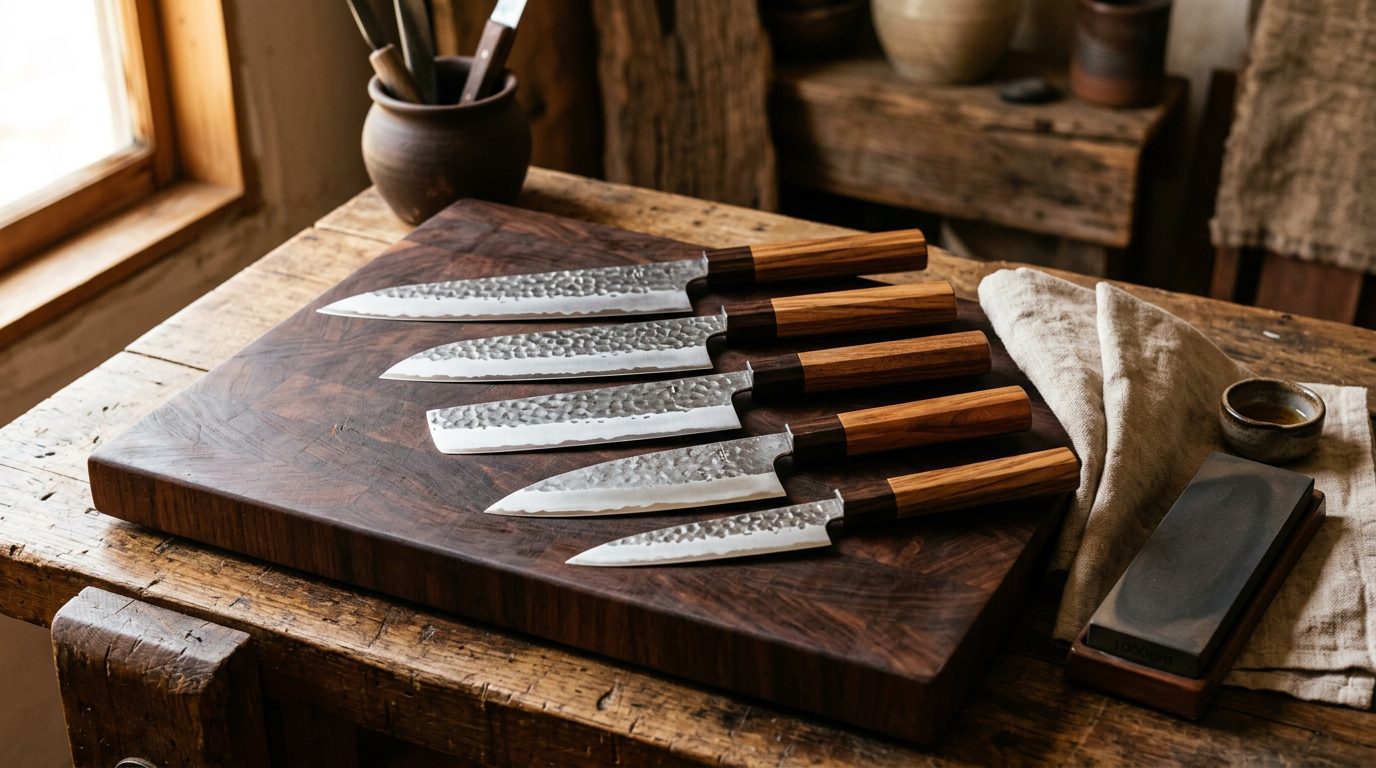
TL;DR
Japanese knife brands sort by where they are forged. Seki (Gifu) is the factory city: Kai / Shun / Seki Magoroku, Misono, MAC, Masahiro, Miyabi, Yaxell, Kasumi. Sakai (Osaka) is the professional single-bevel tradition: Sakai Takayuki, Sakai Kikumori, Ichimonji Mitsuhide, Izumimasa, Konosuke, Ashi Ginga, with the old houses Masamoto (Tokyo), Aritsugu (Kyoto), Sugimoto (Tokyo), Kikuichi (Nara). Echizen (Fukui) is the named-smith region: Takamura, Yu Kurosaki, Takeshi Saji, Ryusen, Masakage, Kato, Anryu. Tsubame-Sanjo (Niigata) gives you Tojiro, Global, Tadafusa, Yoshikane, Shigefusa; Tosa (Kochi) the rustic kurouchi knives; and Miki (Hyogo) the Higonokami pocket knife. This is the full list of Japanese knife brands, makers and companies — kitchen, folding and outdoor — ranked by region and price tier, with the steels (a steel chart with hardness), the knife types explained with the shapes and kinds, the Japanese search terms, the makers’ marks and what each brand is actually listed for in Japan on 17 September 2026.
- Cheapest good Japanese knife brands: Tojiro (a DP gyuto is ¥8,425 today), Kai Seki Magoroku (¥2,800 for a santoku), MAC, Masahiro, Fujiwara.
- The names everyone knows: Global (¥12,100 for a G-2), Shun (¥26,400 for a Classic chef’s), Misono UX10 (¥29,590).
- Named-smith knives: Takamura from ¥13,000, Yu Kurosaki ¥57,900, Takeshi Saji ¥40,400.
- Shipping knives from Japan: kitchen knives go by Japan Post to most countries and by ECMS to the US, not by DHL; the UK and Canada restrict some blade types on arrival (the rules). Not a problem for a gyuto; check before ordering a hunting knife.
Japanese knife brands by region: why the city matters
Ask a Japanese cook for a knife brand and you get a city first. The five knife regions each have a guild, a style and a price band, and the “brand” on a Japanese knife is often a retailer or wholesaler putting its mark on blades forged by a smith in that city. Echizen knives (越前打刃物) trace their history back about 700 years to the Kyoto swordsmith Chiyozuru Kuniyasu[1]; Seki is the medieval sword town turned cutlery capital[2]; Sakai’s forged-knife trade grew out of the tobacco-knife makers of the 16th century and is a registered trademark of the Sakai cutlery federation[3]; Tosa and Tsubame-Sanjo are the agricultural-blade and nail-making districts that turned to kitchen knives. That is why a “Sakai Takayuki” and a “Sakai Kikumori” can come from neighbouring forges, and why two Echizen brands can both be Yoshimi Kato’s work.
Quality, reputation and how this list is ranked
Every brand below is a genuine, reputable, legit Japanese maker — the great, highest-rated and most decent Japanese knife manufacturers and artisan makers, from fancy to plain — original brands with a factory or forge in Japan, not “Japanese-style” importers. Within each region the tables run roughly from the most popular and affordable names to the high-quality handmade and custom smiths; “best” depends on whether you want a low-maintenance stainless workhorse for everyday home cooking (Tojiro, Global, Shun, Misono) or a hand-forged carbon knife you will oil and hone (Masamoto, Takamura, Kurosaki, Shigefusa). Recommendations by use, for beginners and for the money, are in the quick-answer table near the end; deals are simply Japanese retail pricing, which is the discount.
Seki: the factory brands (Shun, Misono, MAC, Miyabi and the rest)
Seki makes the stainless, double-bevel, Western-handled knives that dominate overseas shops. If you have a Shun, a Miyabi or a Misono, it came from here.
| Brand | Where / since | Lines to search | Note |
|---|---|---|---|
| Kai / Shun (旬) / Seki Magoroku (関孫六) | Seki, Gifu (est. 1908) | Shun Classic / Premier / Kanso (VG-MAX and SG2 damascus, export-first line), Seki Magoroku (the Japanese domestic line, from ¥3,000 santoku to 10000CL), Kai disposable razors and scissors | The biggest Japanese knife company[4]. Shun is the brand you see in US and UK shops; Seki Magoroku is what Japanese homes buy, often the same factory for a third of the price. |
| Misono (ミソノ) | Seki (est. 1935) | UX10 (Swedish stainless, the professional Western-handle standard), 440, Molybdenum, Swedish Carbon (the dragon-engraved line) | The chef’s brand in Japanese restaurant kitchens; UX10 is the gyuto most culinary schools in Japan start with[7]. |
| MAC | Seki (est. 1964) | Professional / Chef / Superior series, thin molybdenum-steel blades, the Ultimate Hollow-Edge | Sold mainly overseas; in Japan MAC is a cheap and good home brand (¥2,000–¥7,000 on Mercari). |
| Masahiro (正広) | Seki | MV series, Masahiro Virgin Carbon, budget stainless | Big Seki factory brand; solid value under ¥10,000. |
| Miyabi (Zwilling) | Seki factory, German-owned | 5000MCD, 5000FCD, Birchwood, Black — SG2 and MC63 damascus with octagonal handles | Zwilling J.A. Henckels builds Miyabi in its own Seki plant; a Japanese-made knife under a German group, priced as a luxury line. |
| Yaxell | Seki (est. 1932) | Ran, Zen, Gou, Super Gou damascus (VG-10 / SG2), Mon | Export-oriented Seki maker behind many department-store damascus sets. |
| Kasumi (Sumikama) | Seki | Kasumi damascus (VG-10, 32 layers), Titanium-coated line | Sumikama Cutlery; one of the first damascus-clad stainless lines sold abroad. |
| Kanetsune (Kitasho) | Seki | Kanetsune Seki kitchen knives, outdoor and hunting knives | Seki maker with both a kitchen and an outdoor catalogue. |
| Fujiwara Kanefusa | Seki | FKM stainless, FKH carbon — the budget gyuto many Western enthusiasts start with | Tojiro-priced Seki entry point. |
| Suncraft | Seki | Senzo (damascus), Elegancia (SG2), MU | Mid-price Seki damascus with modern handles. |
| Seki Kanetsugu | Seki | Pro-M, Zuiun, Kanetsugu 21 | Old Seki family name still making mid-range stainless. |
| Mitsuboshi / Nagomi (和) | Seki | Nagomi series, 440A blades with mahogany handles | Design-led Seki line sold through Japanese department stores. |
Sakai, Tokyo, Kyoto and Nara: the traditional houses
These are the brands of the sushi and kaiseki kitchens: single-bevel yanagiba, deba and usuba in white and blue carbon steel, plus their own Western lines. Most are a century or more old.
| Brand | Where / since | Lines to search | Note |
|---|---|---|---|
| Sakai Takayuki (埘孝行) | Sakai, Osaka (Aoki Hamono, est. 1946) | 33-layer and 45-layer damascus, Grand Chef, Byakko, Kurokage, Ginsan, Aogami and Shirogami single-bevel traditional knives | The largest Sakai house and the easiest Sakai brand to find outside Japan; everything from ¥9,000 gyuto to ¥200,000 honyaki. |
| Masamoto Sohonten (正本総本店) | Tokyo (est. 1866) | Hyper-molybdenum stainless, Swedish carbon (the “purple-ebony handle” gyuto), traditional white-steel yanagiba and deba | The sushi chef’s brand for 150 years. Note the two Masamotos: Masamoto Sohonten and Tsukiji Masamoto are separate companies from one family[8]. |
| Aritsugu (有次) | Kyoto (est. 1560), Nishiki Market | Hand-engraved carbon-steel usuba, yanagiba, deba; A-type stainless | The oldest name still selling knives under it; the Kyoto shop engraves your name at the counter. |
| Sugimoto (杮本) | Tokyo, Tsukiji (19th-century, Tenpō era) | CM steel Western knives, Chinese cleavers (the No.6 and No.7 chukabocho), carbon gyuto | Tsukiji institution; the Chinese cleaver of choice in Japan. |
| Kikuichi / Kikuichimonji (菊一文字) | Nara (lineage claimed from 1267) | Elite carbon, Ginsan, molybdenum, damascus | Samurai-era sword-smith lineage turned knife maker; sold abroad as Kikuichi. (A “samurai” knife set with a black block is a Western marketing product, not a Sakai brand.) |
| Tsukiji Masamoto (築地正本) | Tokyo, Tsukiji | Carbon gyuto, single-bevel traditional knives | The other Masamoto; also excellent, also Tokyo. |
| Sakai Ichimonji Mitsuhide (埘一文字光秀) | Sakai / Osaka Dotonbori | Traditional single-bevel, Aogami Super, Ginsan; the retail shop for many Sakai smiths | Retailer-brand: sells knives forged by Sakai blacksmiths under its own mark. |
| Sakai Kikumori (埘菊守) | Sakai | Yasuki white-steel deba and yanagiba, kasumi finish | Classic Sakai professional brand at professional prices. |
| Izumimasa (源泉正) | Sakai | Home-use and white-steel honkasumi deba and yanagiba, mirror-finish Aogami honyaki | Good first single-bevel knives: a home-use yanagiba is {P(“b12c0dbb50ae37d5”)} today. |
| Yoshihiro | Sakai-made, export brand | VG-10 damascus, Aogami Super, honyaki | A brand built for Amazon US from Sakai and Seki production; genuine, priced for export. |
| Ashi Hamono (Ginga) | Sakai | Ginga (Swedish stainless and carbon) laser-thin gyuto | Cult thin-blade Western-handle line from Sakai. |
| Konosuke | Sakai | HD2, Fujiyama (white and blue steel), GS+ | Enthusiast brand; forged by Sakai smiths, sold mainly through Japanese specialist shops. |
| Mizuno Tanrenjo | Sakai | Honyaki, Aogami and Shirogami traditional knives | One of the last Sakai forges doing water-quenched honyaki in-house. |
| Kagekiyo (Baba Hamono) | Sakai | Kagekiyo Aogami, Ginsan and SG2 lines | Modern Sakai brand with Western and wa handles. |
More Sakai names you will see on listings
Sakai has dozens of smaller marks, most of them wholesaler or retailer brands over the same forges: Sakai Jikko (Sakai Jikko, VG-10 and Aogami lines with their own knife rolls and cases), Sakai Genkichi (Sakai Genkichi, the Amazon-friendly deba and yanagiba), Sakai Hokushin, Sakai Kanechika, Sakai Hidetake, Nakagawa (Nakagawa Hamono, the smith behind several enthusiast brands), Hado (Hado, Ginsan and Aogami with rustic handles), Sakai Yoshihiro. The Sakai Traditional Crafts Museum (埘伝匠館, Sakai Denshokan) sells graded knives from the whole city under one roof, and runs the forge and craft walking tours and knife-making experiences.
Echizen, Tosa, Sanjo and Miki: the forge brands and named smiths
The hammered, kurouchi and powder-steel knives of the enthusiast market come from three forge regions, and increasingly carry the blacksmith’s own name rather than a house brand.
| Brand / smith | Region | Lines to search | Note |
|---|---|---|---|
| Takamura Hamono (高村刃物) | Echizen (Takefu), Fukui | V10 Special (hammered VG-10), Chromax, Hana (SG2), Uchigumo powder-steel | The Echizen brand that made thin, laser-like stainless gyuto famous[9]; a V10 santoku is {P(“7cdeb0d4b421912c”)} used and {P(“cb8e53037ba44d36”)} new today. |
| Yu Kurosaki (黒崎優) | Echizen | Senko (SG2), Fujin (Aogami Super), Shizuku, Gekko, Raijin (cobalt special) | The best-known young Echizen smith; hand-hammered patterns, {P(“d744cd0194b02c48”)} for a 210 mm Senko gyuto today. |
| Takeshi Saji (佐治武士) | Echizen | Rainbow damascus, SRS13 powder steel, Aogami Super, hunting knives and kiridashi | Traditional-craftsman master; the colourful damascus with iron-wood handles. A santoku is {P(“bb16795fe7a277cd”)} today. |
| Ryusen Hamono (龍泉刃物) | Echizen | Bonten Unryu, Blazen (SG2), Fukakuryu | Echizen house behind many department-store damascus; also makes the Bonten steak knives. |
| Masakage | Echizen | Yuki, Koishi, Kiri, Mizu, Shimo — each line by a named smith | A brand that credits its blacksmiths (Kato, Anryu, Kurosaki) by name. |
| Yoshimi Kato | Echizen | SG2 and VG-10 hammered, Aogami Super kurouchi | Fourth-generation Echizen smith; sold through Masakage and under his own name. |
| Katsushige Anryu | Echizen | Aogami Super kurouchi hammered | Veteran Echizen smith famous for the rustic kurouchi finish. |
| Tosa knives (土佐打刃物) — Motokane, Hokiyama, Tosa Ichi | Tosa, Kochi | Aogami Super and Shirogami kurouchi, free-forged rustic knives, outdoor nata hatchets | The rustic, cheap-for-what-it-is forge region; a black-forged Aogami Super gyuto is usually under ¥25,000. |
| Moritaka Hamono (盛高鎝冶刃物) | Yatsushiro, Kumamoto | Aogami Super and Aogami #2 kurouchi | Kyushu forge with a claimed 700-year lineage; thick rustic blades. |
| Tojiro (藤次郃) | Tsubame-Sanjo, Niigata (Fujitora, 1950s) | DP cobalt-alloy (VG-10 clad) — the best-value gyuto in the world — Pro, Shirogami, Zen, Flash | A DP gyuto 180 mm is {P(“cc1c7ba168c02119”)} today. The answer to “best budget Japanese knife brand”[5]. |
| Global (Yoshikin / Yoshida Metal Industry) | Tsubame, Niigata (line launched 1985) | G-2 gyuto, G-46 santoku, GS petty, IST (2023) — one-piece CROMOVA 18 stainless | The dimpled all-steel handle; a G-2 is {P(“6d0283e460c7ad25”)} on Rakuten today. Made in Tsubame, not Seki[6]. |
| Tadafusa (忠房) | Sanjo, Niigata (est. 1948) | Hocho Kobo series (Shirogami with chestnut handles), Aogami | The Sanjo maker with the distinctive burnt-chestnut handle. |
| Yoshikane (吉金) | Sanjo | SKD, SLD and Shirogami hammered, kurouchi | Sanjo forge; the SKD tool-steel line is a sleeper favourite. |
| Shigefusa (重房) | Sanjo | Kasumi and kitaeji Shirogami | Tiny family forge with a years-long waiting list; grail tier. |
| Hinoura (Ajikataya) | Sanjo | Aogami Super and Shirogami river-jump damascus | Father-and-son Sanjo smiths. |
| Higonokami (肥後守) — Nagao Kanekoma | Miki, Hyogo | The folding friction knife, blue-paper steel in brass, from {P(“c3f76fd097550bb4”)} | Only one maker may use the name; the ¥1,000–¥4,000 Japanese pocket knife (the money-clip and folding Higonokami variants are G. Sakai and Nagao products). |
Japanese folding, pocket, hunting and outdoor knife brands
Seki also makes the world’s folding knives. The Japanese pocket-knife brands are small, and several famous American and Swedish folders are Seki-made.
| Brand | Where | What it makes | Note |
|---|---|---|---|
| Mcusta (Mcusta Zanmai) | Seki | Folding knives with damascus and VG-10, Zanmai kitchen line | The premium Japanese folding-knife brand. |
| G. Sakai | Seki | Folders, Sabi Knife, Hikari; contract maker for Spyderco’s Seki-made models | The factory behind many “Made in Seki” American brands. |
| Moki Knife | Seki | Small gentleman’s folders with pearl and wood handles | Seki family maker since the 1900s. |
| Hattori | Seki | Hattori KD (cowry-X), hunting and kitchen knives; contract maker for Bob Loveless-style knives | Ichiro Hattori’s Seki workshop. |
| Kanetsune | Seki | Hunting knives, nata, kiridashi | Kitchen and outdoor in one Seki catalogue. |
| Higonokami | Miki | Friction folder | See above; the cheapest Japanese EDC knife. |
| Rockstead | Japan | Mirror-polished ZDP-189 and YXR7 folders | The most expensive Japanese production folders. |
| Spyderco (US), Fallkniven (Sweden), Al Mar (US), Cold Steel (US) — Seki-made models | Seki contract production | Look for “Seki-City Japan” on the blade | Not Japanese brands, but the knives are Japanese. |
Japanese knife steels: what VG-10 (VG10), SG2, Aogami and Shirogami mean — steel chart, hardness and comparison
The steel name on the box is the second half of a brand, and the steel comparison chart below is what “hardest Japanese knife steel” and “steel ranking” searches want: hardness (HRC) rises from molybdenum stainless at 56–58 to Aogami Super, SG2 and ZDP-189 at 63–66, and edge retention rises with it while ease of sharpening and toughness fall. “Folded steel”, “rolled steel” and “pressed steel” are marketing words: a Japanese blade is either forged (hammered from bar stock, then tempered and hardened) or stamped from sheet, and the cladding may be layered (damascus) or plain. Finishes: kurouchi (black scale), tsuchime (hammered), nashiji (pear-skin), kasumi (misty), migaki (polished), kyomen (mirror). Edge angle: Japanese double-bevel knives are ground to about 15 degrees per side, single-bevel knives to a single steep face with a flat back — the different knife designs exist because each cut (push, pull, slice) wants a different geometry. Almost all of it comes from three Japanese mills — Takefu Special Steel in Echizen (VG-10, SG2), Hitachi / Proterial Yasuki (Shirogami, Aogami, Ginsan, ZDP-189) and Aichi Steel (AUS series) — plus imported Swedish stainless for Misono and Masamoto.
| Steel | Made by | Type / hardness | Brands that use it |
|---|---|---|---|
| VG-10 (V金10号) | Takefu Special Steel, Echizen | Stainless, ~60 HRC | The default Japanese stainless: Shun Classic, Tojiro DP, Takamura V10, Yaxell, Kasumi, most damascus. Easy to sharpen, holds an edge well. |
| VG-MAX | Kai proprietary | Stainless | Shun’s upgraded VG-10. |
| SG2 / R2 (Super Gold 2) | Takefu powder steel | Stainless, 62–64 HRC | Yu Kurosaki Senko, Miyabi 5000MCD, Takamura Hana, Ryusen Blazen. Long edge life, harder to sharpen. |
| SRS13 / SRS15 | Powder high-speed steel | Stainless, ~63–64 HRC | Takeshi Saji, Sukenari. |
| AUS-8 / AUS-10 | Aichi Steel | Stainless, 57–60 HRC | Mid-range Seki knives, Sakai Takayuki 45-layer. |
| Ginsan / Silver 3 (銀三) | Hitachi / Proterial Yasuki | Stainless, ~60 HRC | The stainless that behaves like carbon; single-bevel knives for chefs who will not oil a blade. |
| Shirogami / White #1, #2 (白紙) | Yasuki | Carbon, 61–64 HRC | Purest carbon steel: yanagiba, usuba, deba, honyaki. Sharpest edge, rusts if wet. |
| Aogami / Blue #1, #2, Super (青紙) | Yasuki | Carbon with tungsten and chromium | Kurouchi gyuto from Tosa, Echizen and Sanjo; Aogami Super holds an edge longest. |
| Swedish stainless / Swedish carbon | Sandvik / Uddeholm, imported | Stainless or carbon | Misono UX10, Misono Swedish Carbon, Masamoto Sohonten, Ashi Ginga. |
| Molybdenum-vanadium (モリブデンバナジウム) | Various | Stainless, 56–58 HRC | The ¥2,000–¥8,000 tier: MAC, Masahiro MV, Seki Magoroku, Tojiro Flash handles. |
| SKD / SLD / ZDP-189 / HAP40 | Tool and high-speed steels | Semi-stainless to stainless | Yoshikane SKD, Rockstead ZDP-189, Sukenari HAP40 — enthusiast steels. |
| Damascus (ダマスカス) / suminagashi | Cladding pattern, not a steel | — | A layered stainless jacket over a VG-10 / SG2 / Aogami core. Real damascus is forge-laminated; laser-etched “damascus” on a mono-steel blade is decoration. |
Japanese knife types and which brand to search for each (types chart)
The essential Japanese knife types for a home cook are a gyuto or santoku, a petty and a nakiri; a sushi kitchen adds the single-bevel deba, yanagiba and usuba. Which knife for what: meat and cutting meat — gyuto or sujihiki; vegetables — nakiri or usuba; filleting fish — deba; everyday cooking with small hands — a 165 mm santoku or bunka. The santoku-and-nakiri duo is the classic two-knife set. Anatomy words: the tang (中子) is the part of the blade inside the handle — Japanese wa-handles are friction-fit and replaceable, Western handles are riveted; the grip on a wa-handle is a pinch grip at the bolster.
| Knife type | What it is | Brands to search | Live listings |
|---|---|---|---|
| Gyuto (牛刀) | Chef’s knife, double-bevel, 180–270 mm | Every brand above; start at 210 mm | search gyuto |
| Santoku (三徳包丁) | All-purpose home knife, 165–180 mm | Seki Magoroku, Tojiro, Takamura, Shun, Global G-46 | search santoku |
| Nakiri (菜切包丁) | Vegetable knife, flat double-bevel | Tojiro DP, Tadafusa, Tosa kurouchi | search nakiri |
| Petty (ペティナイフ) | Paring / utility, 120–150 mm | Misono UX10, Shun, Takamura | search petty |
| Sujihiki (筋引き) | Slicer / carving, 240–300 mm | Sakai Takayuki, Misono, Masamoto | search sujihiki |
| Bunka / Kiritsuke (文化 / 切付け) | Angled-tip all-rounder | Yu Kurosaki, Kagekiyo, Tosa | search bunka |
| Deba (出刃包丁) | Fish-butchering knife, single-bevel, thick | Sakai brands, Masamoto, Izumimasa ({P(“a13e5067698f4239”)} home-use today) | search deba |
| Yanagiba (柳刃包丁) | Sashimi / sushi slicer, single-bevel, 240–330 mm | Sakai Kikumori, Masamoto, Aritsugu, Izumimasa | search yanagiba |
| Usuba (薄刃包丁) | Single-bevel vegetable knife (Kanto square / Kansai kamagata) | Aritsugu, Sakai brands | search usuba |
| Honesuki / Garasuki (骨すき) | Poultry boning | Misono, Masamoto, Tojiro | search honesuki |
| Chukabocho (中華包丁) | Chinese cleaver, Japanese-made | Sugimoto No.6 / No.7 | search cleavers |
| Pankiri (パン切り) | Bread knife | Global G-9, Tojiro, Kai | search bread knives |
| Steak knives (ステーキナイフ) | Table knives | Ryusen Bonten, Shun, Tojiro | search steak knives |
| Higonokami / folding / hunting | Pocket and outdoor | Higonokami, Mcusta, G. Sakai, Moki, Saji, Kanetsune | search Japanese outdoor knives |
What Japanese knives cost in Japan today: live listings
Every row is a listing on sale on 17 September 2026, read from the shop page the morning this article went live; asking prices in yen before proxy fees and shipping. The Rakuten rows are new knives from Japanese retailers (often the maker’s own shop); the Mercari rows are private sellers, usually unused gift knives. Prices in Japan are commonly 30–50% below the same knife in a US or UK shop, which is the point of buying at the source.
Knife sets, blocks, rolls and cases
A Japanese knife block set or steel knife block set is a Western retail idea; in Japan the brands that sell true sets are Global (GST-B2 three-piece, IST sets), Shun Classic sets, Tojiro DP sets and Kai Seki Magoroku sets, and blocks are sold separately (Kai, Global, magnetic wooden stands and racks from Rakuten). Chefs carry knives in a roll or a knife bag with a saya or blade guard on each knife — Sakai Jikko, Tojiro and Kai all sell rolls, cases and holders, and a leather sheath for a Higonokami or outdoor knife comes from the same shops.
Six of those knives
One per tier, from the ¥2,800 Seki Magoroku santoku that Japanese homes actually use to a Yu Kurosaki gyuto. Check the blade length (刃渡り) and, for single-bevel knives, the handedness before ordering.


Maintenance: patina, rust, honing and sharpening
Carbon-steel (Shirogami, Aogami, Swedish carbon) knives develop a grey-blue patina that protects the blade; orange rust is the problem, and a rust eraser (サビトール) and a wipe of camellia oil fix it. Japanese knives are sharpened on whetstones, not pulled through a sharpener; the honing rod / honing steel habit is Western and a ceramic rod is the only kind that suits a hard Japanese edge. Best grit to start: a 1000 medium stone, 3000–6000 to finish (King, Shapton, Naniwa, Suehiro are the Japanese whetstone brands). Handle replacement for wa-handles is a five-minute job and a ¥1,500–¥5,000 part; knife blanks (unhandled blades) are sold by Sanjo and Seki makers for people who fit their own. Cutting boards: hinoki, ginkgo (icho) and paulownia are the Japanese woods that are kind to a hard edge; a magnetic wooden display stand keeps blades apart.
Engraving, makers’ marks and identification
The mark (刻印 kokuin) chiselled into the blade near the handle identifies the maker or the retailer; identifying Japanese knife makers’ marks is a hobby in itself, because a Sakai retailer’s mark can sit on a blade forged by any of several smiths. Most Rakuten shops and the Kappabashi and Sakai counters engrave your name (名入れ naire) free or for ¥500–¥1,000 — the usual engraving idea is the owner’s name in katakana.
Festivals, museums, factory tours and knife-making experiences
Seki holds the Seki Cutlery Festival (関の刃物まつり, Seki Hamono Matsuri) every October, with factory-direct sales; Sakai’s federation runs the Sakai Knife Festival (埘刃物まつり) and the Denshokan museum with its forging and sharpening experiences; Takefu Knife Village in Echizen is a working shared forge with a gallery and a knife-making experience; Miki has the Hardware Festival in November. For 2025 and 2026 dates check each city’s site (references below) — festival stock does not ship overseas, but the same makers list on Rakuten year-round.
Japanese knife terms to read a listing
| Japanese | Reading | Meaning |
|---|---|---|
| 包丁 | hōchō | kitchen knife (the word to search; ナイフ naifu = knife in general, folding, outdoor) |
| 和包丁 / 洋包丁 | wabōchō / yōbōchō | Japanese-style (single-bevel, wa-handle) / Western-style (double-bevel) |
| 片刃 / 両刃 | kataba / ryōba | single-bevel / double-bevel |
| 右利き / 左利き | migi-kiki / hidari-kiki | right-handed / left-handed (matters for single-bevel; left-handed costs 20–50% more) |
| 刻準 / 刻準なし | kokuin / kokuin-nashi | engraved maker’s mark / no mark (cheaper “no-brand” from the same forge) |
| 本烧 / 霞 | honyaki / kasumi | mono-steel water-quenched (grail, expensive) / laminated soft iron over hard steel (normal) |
| 黑打 / 槒目 / 鏡面 | kurouchi / tsuchime / kyōmen | black forge-scale finish / hammered / mirror polish |
| 八角柄 / 朴柄 / 紀木柄 | hakkaku-e / ho-e / shitan-e | octagonal handle / magnolia handle / rosewood handle |
| 口金付き / ツバ付き | kuchigane-tsuki / tsuba-tsuki | with bolster |
| 刃渡り | hawatari | blade length (the mm number in every listing) |
| 研ぎ済み / 刃付け済み | togi-zumi / hatsuke-zumi | sharpened / edge set before shipping |
| 未使用 / 新品 | mishiyō / shinpin | unused / new (Mercari listings of gift knives) |
| 中古 / サビあり | chūko / sabi-ari | used / has rust |
| 砖 / 砂放し | toishi / arato | whetstone / coarse stone (King, Shapton, Naniwa are the Japanese whetstone brands) |
| 大阪埘 / 関 / 越前 / 土佐 / 燕三条 | Sakai / Seki / Echizen / Tosa / Tsubame-Sanjo | the five knife regions; つばめさんじょう is one industrial district |
Where to buy Japanese knives from Japan
- Rakuten and Yahoo! Shopping carry the makers’ official shops (Kai’s Shun shop, Tojiro, Sakai Takayuki dealers, Misono wholesalers) and the Sakai / Seki specialist retailers; new knives, often engraved free.
- Mercari Japan is where unused gift knives and lightly used professional knives go for 30–60% of new; search the brand in Japanese plus 未使用 (unused).
- Yahoo! Japan Auctions for the rare stuff: honyaki, Shigefusa, old Masamoto, hand-engraved Aritsugu.
- Amazon Japan lists Tojiro, Misono, Shun, Global, Saji and Yoshihiro with Japanese pricing; the OneMall search links in this article cover it. Reviews on the Japanese site are by Japanese cooks, which is the review pool worth reading.
- Any website that lists on Rakuten, Yahoo! Shopping, Mercari or Yahoo! Auctions is reachable through the search links in this article — the Japanese knife website you are looking for is usually one of those storefronts.
- Don Quijote and Daiso sell cheap Seki-made knives (a ¥1,000 Daiso santoku stamped Seki is real Seki stainless) — fine for a spare, not what the brand searches mean.
- Tokyo Kappabashi, Tsukiji, Kyoto Nishiki and Sakai are the shops travellers visit; most of them also list on Rakuten, so the same counter stock is reachable from home.
Buying at the source works through a proxy service (the best ones compared, the cheapest fees); our earlier guide walks through a first knife order step by step, and the woodworking-tools guide covers the Miki and Sanjo chisel and saw makers that share these forges.
Shipping and import rules for knives
- Carrier: on OneMall, kitchen knives ship by Japan Post (EMS, air, sea) to most countries and by ECMS to the United States; DHL does not carry knives or edged tools (the full prohibited-items guide).
- Destination: the UK and Canada restrict specific blade types (flick, gravity, disguised and some fixed-blade hunting knives) and can seize them; plain kitchen knives are normally fine. Australia and New Zealand allow kitchen knives; check the state rules for folding knives.
- Weight: a gyuto in its box is 300–500 g; a three-knife set 1–1.5 kg. Compare EMS and ECMS on the shipping-time guide; duty thresholds by country are in the import-tax guide.
- Packing: ask for the blade to be sheathed or boxed; a saya (wooden sheath) for a carbon knife is a ¥1,000–¥3,000 add-on worth having.
Quick answers: the Japanese knife brand questions people search
| Question people search | Answer |
|---|---|
| Best Japanese knife brand overall? | For a first knife: Tojiro (value), Global or Shun (easy care), Misono UX10 (professional). For a lifetime knife: Masamoto, Sakai Takayuki, Takamura, Yu Kurosaki. |
| Best budget / cheap / entry-level / beginner Japanese knife brand? | Tojiro DP, then Kai Seki Magoroku, MAC, Fujiwara FKM, Masahiro. All under ¥10,000 for a gyuto or santoku in Japan. |
| Best high-end / luxury / expensive Japanese knife brands? | Shigefusa, Mizuno Tanrenjo honyaki, Masamoto honyaki, Yu Kurosaki, Takeshi Saji damascus, Konosuke Fujiyama, Miyabi Birchwood, Rockstead (folders). |
| Japanese knife brand starting with K / T / M / S (brand that starts with K, starts with M)? | K: Kai, Kanetsune, Kasumi, Kikuichi, Konosuke, Kagekiyo, Kurosaki. T: Tojiro, Takamura, Tadafusa, Tsukiji Masamoto. M: Misono, Masamoto, Masahiro, MAC, Miyabi, Mcusta, Masakage, Moritaka. S: Shun, Sakai Takayuki, Sugimoto, Suncraft, Saji, Shigefusa. |
| Is Shun Japanese? Is Global Japanese? Is Miyabi Japanese? | Shun is Kai’s export brand, made in Seki. Global is Yoshida Metal, made in Tsubame. Miyabi is German-owned (Zwilling) but forged in Zwilling’s Seki factory. All three are Japanese-made. |
| Which Japanese knife brands are made in Japan? | Every brand in the tables above. The ones to check are the Amazon-only “Japanese-style” brands: if the listing does not say 日本製 (made in Japan) and name a city, it usually is not. |
| Japanese knife brands to avoid / fake Japanese knife brands? | Not a brand list — a pattern: laser-etched damascus on a mono-steel blade, a Japanese-sounding name with no factory, no city, “VG-10” at a ¥3,000 price, and a red dragon or kanji logo aimed at overseas buyers. Real forges (Seki, Sakai, Echizen, Tosa, Sanjo) put the maker and steel on the blade or box. |
| Gold-mark Japanese knife brand? | Not a brand: “gold” is a grade mark. Kai’s Seki Magoroku Kinju (金寿) line and the gold-stamped top grades of Sakai retailers are what the searches mean. |
| Best Japanese knife brands in Tokyo / Kappabashi / Kyoto / Osaka? | Tokyo Kappabashi: Kama-Asa, Tsubaya, Union Commerce. Tsukiji: Masamoto, Sugimoto, Aritsugu Tokyo. Kyoto Nishiki: Aritsugu. Osaka Dotonbori / Sakai: Ichimonji Mitsuhide, Sakai Takayuki showroom, Sakai Traditional Crafts Museum. All of them also sell online through the shops in this article. |
| Japanese damascus / carbon-steel / ceramic knife brands? | Damascus: Shun, Sakai Takayuki, Yaxell, Kasumi, Miyabi, Saji, Ryusen. Carbon: Masamoto, Misono Swedish Carbon, Aritsugu, Tosa and Sanjo kurouchi. Ceramic: Kyocera (Kyoto) — the only major Japanese ceramic-knife brand. |
FAQ
What are the best Japanese knife brands?
By use: Tojiro, Kai Seki Magoroku and MAC for a first knife; Global and Shun for easy stainless; Misono UX10 and Masamoto for professional Western knives; Sakai Takayuki, Kikumori and Aritsugu for single-bevel traditional knives; Takamura, Yu Kurosaki, Takeshi Saji, Tadafusa and Yoshikane for hand-forged enthusiast knives. The tables above list 50-plus brands by region.
Which Japanese knife brands do professional chefs use?
In Japan: Misono UX10 and Masamoto for Western knives; Sakai Takayuki, Kikumori, Ichimonji Mitsuhide and Aritsugu for traditional knives. The sushi counter’s yanagiba is almost always a Sakai or Masamoto blade.
Best Japanese knife brands in Europe, the UK, Australia and the US?
The same brands, at 30–50% more: Shun, Global, Miyabi, Tojiro and Kai are stocked by department stores and kitchen shops worldwide, and the forge brands by specialist online retailers. Buying from Japan is how you get Seki Magoroku instead of Shun, Misono UX10 at Japanese pricing, and the Echizen and Sakai smiths who do not export.
Are Japanese knife brands good on Amazon?
Tojiro, Misono, Shun, Global, Yoshihiro and Saji on Amazon Japan are the real thing. On Amazon US and UK, filter for “made in Japan” and a named city; the ¥3,000 “Japanese damascus” knives with dragon logos are usually not Japanese.
What is the best Japanese knife set brand?
Global (GST sets), Shun (Classic sets), Tojiro (DP sets) and Kai Seki Magoroku sell true sets; the forge brands sell single knives. A gyuto plus a petty from one maker beats most boxed sets.
Is a Japanese knife brand worth it under $100?
Yes: Tojiro DP, Seki Magoroku, MAC, Fujiwara FKM and Masahiro MV are all under ¥10,000 in Japan, which is under $70 at today’s rate before shipping.
What is the Japanese word for knife?
包丁 (hōchō) for a kitchen knife, ナイフ (naifu) for a knife in general, 刃物 (hamono) for cutlery and blades. Search 包丁 plus the brand for kitchen knives.
Related reading
- Best Japanese chef’s knives: where to buy the cheapest authentic kitchen knives from Japan
- What you cannot ship from Japan (knives, batteries, perfume, food)
- Japanese woodworking hand tools: chisels, planes and pull saws
- Japanese watch brands · Japanese guitar brands · Japanese stationery brands · Japanese bicycle brands — the other brand guides in this series
Last updated: 17 September 2026. Listing prices read from live Japanese listings on 17 September 2026; regional history from the makers’ and guilds’ own pages.
References
- Takefu Knife Village — 越前打刃物 700年のあゆみ (the 700-year history of Echizen forged knives). takefu-knifevillage.jp
- Seki City — official site (刃物のまち関). city.seki.lg.jp
- Sakai Cutlery Industrial Cooperative Federation (埘刃物商工業協同組合連合会). sakaihamono.or.jp
- Kai Group — corporate site (Shun, Seki Magoroku). kai-group.com
- Tojiro (Fujitora Industry) — official site. tojiro.net
- Yoshida Metal Industry (Global) — official site. yoshikin.co.jp
- Misono Cutlery — official site. misono-hamono.com
- Masamoto Sohonten — official site. masamoto-sohonten.co.jp
- Takamura Hamono — official site. takamurahamono.jp