
 Shopping Guide
 HELP / FAQs


 By onemall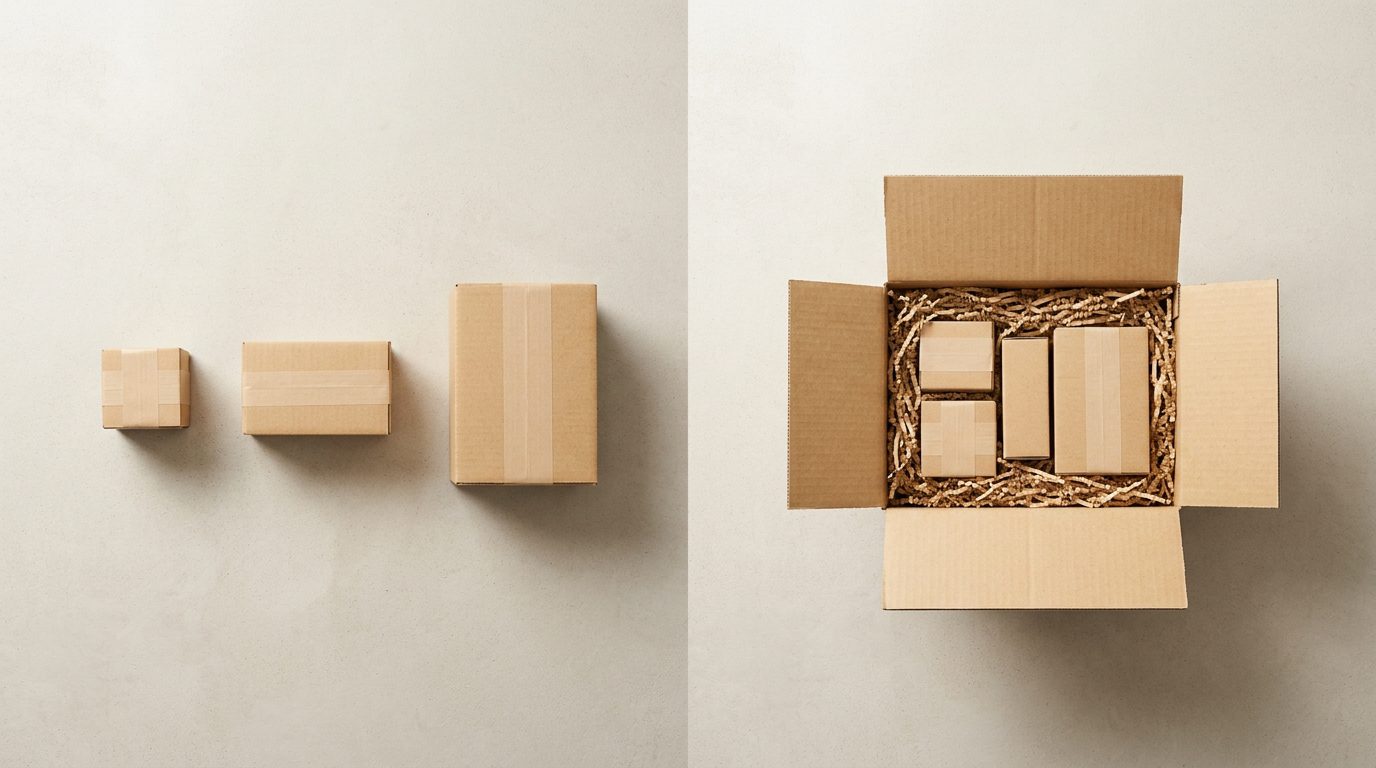
TL;DR
International shipping from Japan is priced per parcel, and every parcel starts at a minimum charge. A 150 g keychain and a 500 g parcel cost exactly the same to send. So the cheapest way to buy small items is to buy several, park them in the warehouse for up to 90 days free after arrival (30 days after consolidation), and ship them as one consolidated parcel — which in our 28 August 2026 quotes cut the bill by 53–67%.
- The minimum charge is the whole problem — economy air to the US quoted US$17.44 for 100 g, 200 g, 300 g and 500 g. Ship three small parcels separately and you pay it three times.
- Three small orders, one box — US$52.31 → US$24.55 to the United States; US$76.68 → US$31.95 to the United Kingdom (quoted 28 August 2026).
- Consolidating is free for your first 6 orders, then ¥100 per additional order. Storage is free for 90 days, so there is no rush to ship.
- Light and small beats light and bulky — trading cards and anime goods ride along for almost nothing; figures and dolls get charged on volumetric weight, so pair one with small items instead of stacking boxes.
- Customs does not consolidate — one bigger parcel means one bigger declared value. US parcels have been dutiable regardless of value since 29 August 2025, and the EU’s flat low-value fee is charged per item, not per parcel.
As of August 2026. Every dollar figure below is a live quote pulled from OneMall’s shipping calculator on 28 August 2026 for the same three-item basket. Your own numbers will differ with weight, size and destination — the shipping fee calculator quotes your real basket in a few seconds.
Why a ¥1,000 Keychain Can Cost US$17 to Ship
Here is the thing almost every first-time buyer gets wrong, and it has nothing to do with your item being expensive to move. International shipping is priced per parcel, and every carrier’s rate card opens with a first weight band — a minimum charge that applies whether the box holds 40 grams or 500.
We quoted the same small box to Los Angeles at eight different weights on 28 August 2026. Look at where the price actually moves:
| Parcel weight | Economy air (ECMS) to US | Express courier (DHL) to US |
|---|---|---|
| 100 g | US$17.44 | US$31.59 |
| 200 g | US$17.44 | US$31.59 |
| 300 g | US$17.44 | US$31.59 |
| 500 g | US$17.44 | US$31.59 |
| 1,000 g | US$20.99 | US$33.12 |
| 1,500 g | US$24.55 | US$36.22 |
| 2,000 g | US$28.10 | US$39.90 |
| 3,000 g | US$33.28 | US$48.61 |
Read the first four rows again. Going from 100 g to 500 g — five times the weight — costs nothing extra. Then each additional 500 g adds about US$3.55 — US$17.44 to US$20.99 to US$24.55 to US$28.10.
That is the entire economics of small-item shipping in one table. The first 500 grams are expensive; every gram after that is cheap. A single acrylic keychain does not cost US$17.44 to fly across the Pacific — it costs US$17.44 to open a parcel, and then you throw away the other 460 grams you already paid for.
Three Small Orders, One Box: The Real Numbers
We priced a realistic small-item basket — the kind of thing people actually feel overcharged on:
- An acrylic keychain or capsule-toy figure — 150 g, 12 × 8 × 4 cm
- One manga volume — 250 g, 19 × 13 × 2 cm
- A small blind-box figure — 400 g, 20 × 15 × 8 cm
800 grams in total. Shipped separately, that is three minimum charges. Shipped as one consolidated parcel, it is one. Quoted on 28 August 2026:
| Destination | Method | 3 parcels, shipped separately | 1 consolidated parcel | You save |
|---|---|---|---|---|
| United States | ECMS economy air | US$52.31 | US$24.55 | US$27.76 (53%) |
| United States | DHL express | US$94.76 | US$36.22 | US$58.55 (62%) |
| United Kingdom | Japan Post EMS | US$76.68 | US$31.95 | US$44.73 (58%) |
| Germany | Japan Post EMS | US$67.10 | US$27.69 | US$39.41 (59%) |
| Australia | Japan Post EMS | US$67.10 | US$27.69 | US$39.41 (59%) |
| Canada | Japan Post EMS | US$83.07 | US$33.65 | US$49.42 (59%) |
| Singapore | Japan Post EMS | US$40.47 | US$18.82 | US$21.66 (54%) |
| United Kingdom | Japan Post Seamail | US$57.51 | US$19.17 | US$38.34 (67%) |
The pattern holds on every route we tested: roughly half the bill disappears at three orders, and the slower the service, the bigger the proportional win — sea mail hit the theoretical maximum of two-thirds, because 800 g still sits inside the same opening weight band as 150 g.
The savings curve keeps climbing, with diminishing returns: across OneMall’s own shipping data, combining 2 orders saves about 35%, 3 orders about 50%, 4 about 58%, 5 about 62%, and 6 about 66%. Past the sixth order a small per-order consolidation fee starts eating into it.
Volumetric Weight: The Trap That Undoes All of This
Carriers charge on whichever is greater — the actual weight, or the space the box occupies. That second number is the volumetric weight:
volumetric weight (g) = length × width × height in cm ÷ 5,000 × 1,000
A 30 × 22 × 22 cm figure box weighing 1.8 kg has a volumetric weight of 2,904 g. You are billed for 2.9 kg of air.
One nuance worth knowing, because it changes what you should combine. In our 28 August 2026 quotes, the Japan Post services returned the same price for an 800 g parcel whether we declared a 15 × 10 × 5 cm box or a 40 × 35 × 30 cm box — while the same size change took ECMS from US$20.99 to US$71.26 and DHL from US$31.59 to US$103.65. If your consolidated box is bulky but light, compare the postal options carefully before defaulting to a courier. (Japan Post applies its own separate size and weight limits — EMS tops out at 30 kg[1].)
What Combines Well — and What Doesn’t
| Category | Benefit from consolidating | How to pair it |
|---|---|---|
| Trading cards (TCG) | Highest | Ultra-light and flat. Rides along with literally anything for almost nothing. |
| Anime goods, badges, keychains | Highest | Lightweight. Pairs with anything, including one bulky item. |
| Model kits | High | Light for their size, but watch box dimensions. Pair with cards, badges, small goods. |
| Clothing | Medium | Compressible. Fine with anything, but the weight adds up faster than you expect. |
| Figures | Medium | Pair one figure with cards or small goods to fill the empty space. Do not stack several figure boxes. |
| Dolls | Medium-low | Bulky. One doll plus light items; never two dolls. |
| Manga and books | Low, but reliable | Heavy and dense, so volumetric weight never penalises them. Combine books with books. |
The counter-intuitive one is figures. A large figure box has a volumetric weight you are already paying for, and dead air inside it. Filling that air with cards and badges is close to free. Stacking a second figure box next to it doubles the volume and jumps you several price bands — the one case where consolidating two orders can genuinely be a bad trade.
How to Consolidate — Step by Step
- Step 1 — Stop shipping one thing at a time. The moment you have one order sitting in the warehouse, its minimum charge is already committed. Anything light you add now ships at the incremental rate, not the opening rate.
- Step 2 — Buy across stores freely. Orders from different Japanese marketplaces all land in the same Tokyo warehouse and can be combined into one parcel.
- Step 3 — Let them pile up. Storage is free for 90 days from warehouse receipt, so waiting for a preorder or a payday costs you nothing.
- Step 4 — Aim for 2 to 6 orders. Consolidation is free for the first 6 orders; from the 7th on it is ¥100 per additional order. Ten orders would cost (10 − 6) × ¥100 = ¥400 — still small against the freight saved, but the sweet spot is 6.
- Step 5 — Open My Orders, select the ones you want together, and tap Combine Orders. Submit the request and we pack them into one parcel.
- Step 6 — Compare methods on the real parcel, not the estimate. Once the box exists, its actual weight and dimensions are known and the quotes are exact. Economy air is usually the cheapest air option; express is for when you need it fast; sea mail is the cheapest of all if you can wait a month or more.
- Step 7 — Ship within 30 days. Consolidating resets the storage clock: a combined parcel is held for 30 days, not another 90. Do the combining when you are close to ready.
The Part Nobody Mentions: Customs Doesn’t Consolidate
One consolidated parcel means one customs declaration with a bigger total value. Freight savings are real, but check your own country’s thresholds before assuming the whole saving lands in your pocket:
| Destination | Position as of August 2026 |
|---|---|
| United States | The US$800 de minimis exemption was suspended for all countries with effect from 29 August 2025[2][3]. Parcels are dutiable regardless of value, so consolidating does not create a new duty exposure — it was already there. |
| United Kingdom | Customs duty applies to non-excise goods worth more than £135; import VAT applies more broadly, and gifts are only VAT-free up to £39[4]. Combining several small orders can push you over £135. |
| European Union | From 1 July 2026 a temporary flat customs duty of €3 applies to low-value consignments up to €150, charged per item based on tariff classification, and running until 1 July 2028[5]. Because it is per item, consolidating neither increases nor avoids it. Import VAT applies from the first euro[6]. |
For most small-item buyers the arithmetic still lands firmly on the side of consolidating — you are comparing a possible duty band against roughly US$22 to US$59 of guaranteed freight savings. But work it out on your own basket rather than assuming.
Related guides (2026): delivery times and tracking, import tax and customs by country, shipping to the UK, shipping to Australia, shipping to Canada.
Frequently Asked Questions
What is the cheapest way to ship small items from Japan?
Buy several small things, keep them in the warehouse under the 90-day free storage (30 days after consolidation), then consolidate them into a single parcel and pick the slowest service you can tolerate. In our 28 August 2026 quotes that combination took a three-order basket from US$57.51 down to US$19.17 to the UK by sea mail — a 67% cut.
Does consolidation cost anything?
Combining your first 6 orders is free. From the 7th order onward it is ¥100 per additional order — so consolidating 10 orders costs ¥400 in total. Repacking and the packaging materials themselves are included in the shipping quote.
How long can I leave items in the warehouse before consolidating?
90 days of free storage after arrival (30 days after consolidation) from the day the item is received. That is what makes the strategy work: you are not racing a clock, so you can wait for a preorder, a restock or a sale. After you consolidate, the combined parcel is held for 30 days.
Is it cheaper to combine two figures, or a figure with cards?
A figure with cards, almost always. Figure boxes are charged on volumetric weight, so a second box adds its full volume to the bill. Cards and small goods fill space you are already paying for and add close to nothing.
Which shipping method should I choose for a consolidated parcel?
Economy air (ECMS) is the low-cost air option where it is available; Japan Post EMS is the fast postal option and carries up to 30 kg[1]; DHL is the fastest and dearest; sea mail is the cheapest if you can wait 30–90 days. Availability varies by country — on our US quotes the Japan Post lines were unavailable and ECMS or DHL were the options, while on our UK, German, Australian, Canadian and Singaporean quotes the postal services were available and ECMS was not.
My items are tiny. Is the shipping fee really worth it at all?
On one item, often not — that is the honest answer, and it is exactly why the minimum charge feels so unfair. On four or five items in one box, the per-item shipping cost falls to a few dollars. The fee is not a tax on your small item; it is the price of opening a parcel, and it is meant to be shared.
The Bottom Line
If a shipping quote for one small item looks absurd, it is because you are paying to open a box rather than to move a keychain. The fix is not a discount code — it is filling the box. Buy the other things you were going to buy anyway, let them sit in the warehouse for free, and send them together.
Ready to work out your own numbers? Run your basket through the OneMall shipping calculator, or read the full order consolidation guide. When you are ready, start shopping across every Japanese marketplace on OneMall — and let the warehouse do the saving.
References
- Japan Post, EMS service overview — up to 30 kg to over 120 countries and territories. https://www.post.japanpost.jp/service/send/oversea/list/delivery/ems/index_en.html
- U.S. Customs and Border Protection, guidance on Executive Order 14324 and duties on international mail. https://www.help.cbp.gov/s/article/Article-1919
- The White House, “Suspending Duty-Free De Minimis Treatment for All Countries” (Executive Order 14324, 30 July 2025). https://www.whitehouse.gov/presidential-actions/2025/07/suspending-duty-free-de-minimis-treatment-for-all-countries/
- GOV.UK, “Tax and customs for goods sent from abroad” — duty and VAT thresholds. https://www.gov.uk/goods-sent-from-abroad/tax-and-duty
- European Commission, Taxation and Customs Union — guidance and legal text on the temporary flat fee on low-value imports. https://taxation-customs.ec.europa.eu/news/guidance-and-legal-text-temporary-flat-fee-low-value-imports-which-will-apply-until-1-july-2028-2026-06-08_en
- Your Europe (European Commission), VAT rules for consumers. https://europa.eu/youreurope/citizens/consumers/shopping/vat/index_en.htm
Last updated: 2026-10-05.