
 Shopping Guide
 HELP / FAQs



 By onemall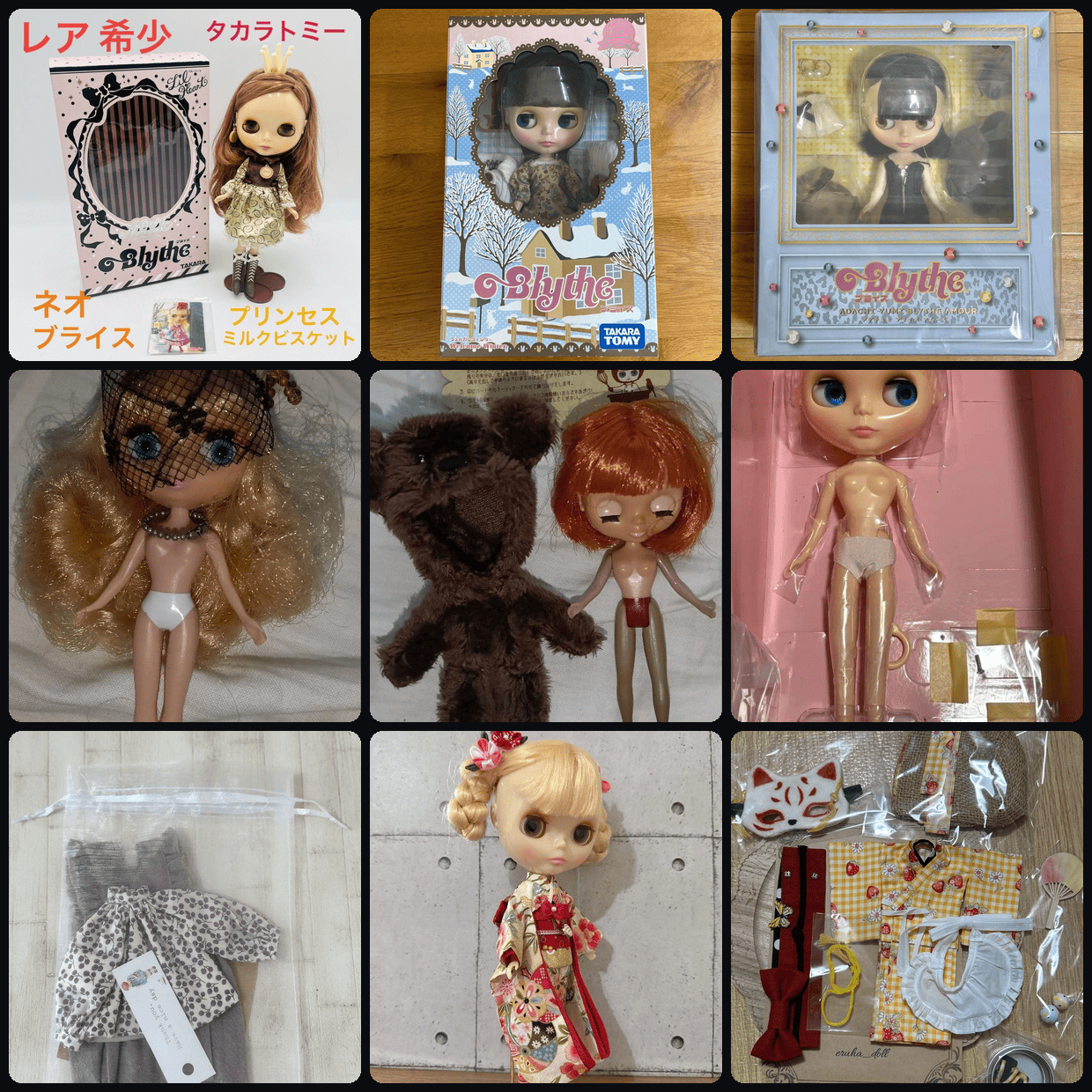
TL;DR
Blythe is an American doll from 1972 that failed, disappeared, and was brought back to life in Japan in 2001[1]. Everything that matters about the doll now — the releases, the customising scene, the handmade clothing economy — happens in Japan. The official shop does ship abroad, but the dolls people actually want are allocated by lottery and gone within the hour[2]. The Japanese second-hand market is not the budget option here; it is the main door.
- Neo Blythe is a Japanese product. Kenner sold the original for a single year in 1972; Takara — now Takara Tomy — relaunched it in June 2001 under licence from Hasbro, produced by CWC[1].
- New retail runs roughly ¥23,500–¥28,300 at the official CWC shop[2]. Second-hand Neo Blythe dolls in the listings below sit at ¥23,000–¥35,000, so this is not a category where used means cheap.
- Hot releases are lottery-allocated, including for overseas buyers — one doll per person, two per address[2]. If you did not win, resale is the only route.
- Petite Blythe is the cheap way in. The small version, about 11 cm against Neo’s 28 cm[1], starts at about ¥3,000 + a few hundred yen.
- The clothes are a market of their own. Japanese makers sell handmade outfits from about ¥2,280, and they exist almost exclusively on Japanese resale platforms.
How an American doll became a Japanese one
Kenner Products released Blythe in 1972, designed by Allison Katzman, and pulled it after a year[1]. The oversized head and the colour-changing eyes did not sell. The doll would be a footnote except that it was rediscovered decades later by Japanese stylists and photographers, and in June 2001 Takara — now Takara Tomy — began producing a new version under licence from Hasbro, with Cross World Connections as producer[1]. The first release was a Parco-limited edition, followed by the first general model, BL1 Mondrian[1].
That lineage is why the market looks the way it does. Twenty-five years of Neo Blythe releases were designed, produced, marketed and sold in Japan. The collector culture, the customising community and the entire cottage industry of handmade clothing grew up around Japanese release cycles.
The official shop ships abroad — and it still is not enough
Being straight about this: the CWC shop does take overseas orders, and current Neo Blythe dolls are listed there from about ¥23,595 to ¥28,270[2]. If the doll you want is in stock, buy it there.
The problem is that desirable releases are not sold on a first-come basis. They are allocated by lottery — a separate overseas lottery, capped at one doll per person and two per shipping address, requiring a registered account with an English address before applications open[2]. Enter, wait, and most people lose. Once a release has been through that process the only remaining supply is in the hands of Japanese collectors.


Look at what those three listings are. The shop-exclusive Welcome Winter at ¥23,000 is unused — somebody won it, never opened it, and is now selling. The CWC-exclusive 19th-anniversary Charming Crystalline at ¥35,000 was a limited anniversary release that was never going to be restocked. The 2004 Blythe Shop limited Silver Snow at ¥22,800 is still 未開封 (unopened) — a retired release nobody is making again.
None of these is cheaper than retail. They are simply available, which retail is not.
The cheap ways in
If ¥20,000-plus for a doll is not where you want to start, there are two honest routes.


Petite Blythe. The small format — about 11 cm, against roughly 28 cm for a Neo[1] — carries the same face design at a fraction of the price. The two above are ¥3,000 and ¥4,780. For a first doll, or for someone who wants the look without the collecting, this is the sensible purchase.
Incomplete Neos. The third listing is a Neo Blythe at ¥9,222 — roughly a third of a shop price — because it is missing its scalp part. In most collecting categories that would be a ruined item. In this one it is a starting point: replacing hair and scalps is the single most common customising job there is, and a doll bought specifically to be customised does not need the original scalp. Japanese sellers know this, price accordingly, and say so in the title.
Vocabulary that changes what you are buying: カスタム means the doll has been modified — face repainted, eyes changed, hair rerooted — usually by a named artist, and it is not a defect. 作家様 refers to that artist. 未開封 is a doll still sealed in its box. A カスタム doll can cost more or less than a factory one; it is a different object.
The clothes, which are the part nobody expects
Japanese makers produce Blythe outfits in small numbers and sell them directly on domestic resale platforms. Not licensed products — individual sewers with a following.


A dress-and-blouse set is ¥2,280, a long-sleeved kimono ¥1,300, and a complete artist-made yukata set with accessories is ¥9,500. There is no international storefront for any of this. It is made by one person, listed in Japanese, and bought by Japanese collectors, and the whole category is invisible from outside the country unless you are searching in Japanese.
It is also the cheapest way to make an inexpensive doll look expensive. A ¥3,000 Petite in a ¥1,300 handmade outfit photographs better than a factory doll in its stock clothes, which is the entire aesthetic the Japanese revival was built on.
Reading a Japanese Blythe listing
| Japanese term | What it means | Why it matters |
|---|---|---|
| ネオブライス | Neo Blythe — the full-size doll, about 28 cm[1] | The main line; the expensive one |
| プチブライス | Petite Blythe — about 11 cm[1] | The affordable entry point |
| カスタム | Customised — repainted, rehaired or re-eyed | Not a defect; a different product |
| 作家様 | By a named individual maker | Applies to both dolls and outfits |
| CWC限定 / Shop限定 | CWC or shop exclusive release | Never restocked; resale-only after launch |
| 本体のみ | Doll only — no stand, box or stock outfit | Cheaper, and fine if you are dressing it yourself |
| アウトフィット | Outfit — clothing sold without a doll | The handmade market above |
How to buy a Blythe from Japan, step by step
- Check the official shop first. If the doll you want is in stock at CWC’s shop, that is the cleanest purchase[2]. Only move to resale when it is sold out or lottery-only.
- Search in Japanese. ネオブライス and プチブライス return the Japanese market; “Blythe” alone returns a thin slice of it, mostly export-facing listings.
- Decide factory or custom before you compare prices. A カスタム doll and a boxed factory doll are different goods, and mixing them in one sorted list makes the pricing look arbitrary.
- Read what is included. 本体のみ (doll only) and missing-part listings are cheap for stated reasons. If you intend to customise, those reasons may not be problems.
- Buy the outfits in the same order. Clothing is nearly weightless and adds almost nothing to the parcel, and it is the part with no overseas equivalent at all.
- Pack the doll properly. Blythe heads are large, hollow and eye-mechanism-loaded; ask for the original box where it exists. Our shipping-method guide covers volumetric weight, which is what a boxed doll actually costs you.
- Budget duty. The United States revoked its US$800 de minimis exemption with effect from 29 August 2025[5]; at ¥23,000 a doll this is a real line item, not a rounding error.
If you are new to Japanese resale platforms, our guide to buying from Mercari Japan from overseas explains the mechanics, and what Japanese proxy shopping costs in 2026 covers the fees. Collectors of other Japanese doll lines may also want our Azone EX☆CUTE guide, and the doll shipping guide covers packing a large-headed doll safely.
The honest verdict
Blythe is an unusual category because the second-hand market is not a discount channel. Prices there are at or above retail, and that is the correct price — the alternative is not a cheaper doll, it is no doll. What Japan gives you is availability: sold-out shop exclusives, collaboration releases, twenty-five years of back catalogue, and a handmade clothing scene that has no counterpart anywhere else.
If you want a first doll cheaply, buy a Petite and a handmade outfit and you will have spent under ¥10,000. If you want a specific Neo Blythe that has already sold out, accept that you are paying collector prices and buy it from someone who has one. What does not work is waiting for the official shop to restock a limited release, because that is not how this market has ever operated.
When you are ready, OneMall buys, inspects and forwards on the Japanese side — or start with every live Neo Blythe listing.
Frequently Asked Questions
Is Blythe a Japanese doll?
It is American by origin and Japanese by revival. Kenner Products released it in the United States in 1972 for a single year; Takara — now Takara Tomy — relaunched it in June 2001 under licence from Hasbro with CWC as producer, and every Neo Blythe release since has come out of Japan[1].
How much does a Neo Blythe cost?
New, roughly ¥23,500–¥28,300 at the official CWC shop[2]. Second-hand, the dolls above run ¥23,000 to ¥35,000, and incomplete or custom-base dolls start under ¥10,000.
Can you buy Blythe dolls from Japan if you live abroad?
Yes. The official shop accepts overseas orders and runs a separate overseas lottery for limited releases, capped at one doll per person and two per address[2]. For anything sold out or lottery-only, a proxy buying from the Japanese second-hand market is the practical route.
What is the difference between Neo Blythe, Middie and Petite?
Size, chiefly. Neo Blythe is about 28 cm and Petite about 11 cm[1], with Middie in between. Only Neo has the pull-string eye-colour mechanism the doll is known for, which is why Petite is so much cheaper.
What does カスタム mean on a Blythe listing?
The doll has been modified — typically a repainted face, replaced eye chips or rerooted hair, often by a known artist (作家様). It is a normal and respected part of this hobby, not damage, and such dolls are priced on the artist’s reputation rather than on the original release.
Why do some cheap Neo Blythe listings say the scalp is missing?
Because customisers buy dolls specifically to rehair them, so a doll without its scalp still has a buyer. It is stated openly in the title and reflected in the price — the example above is ¥9,222. If you plan to keep the original hair, avoid these; if you plan to customise, they are the sensible base.
Related guides
References
- Blythe (doll) — Kenner Products 1972 release designed by Allison Katzman; June 2001 relaunch by Takara (now Takara Tomy) under licence from Hasbro, produced by Cross World Connections; Parco Limited first release followed by BL1 Mondrian; Neo Blythe approx. 28 cm, Petite Blythe approx. 11.2 cm. https://ja.wikipedia.org/wiki/ブライス_(人形)
- Junie Moon (CWC official Blythe shop) — current Neo Blythe listings and overseas lottery terms (one item per person, maximum two per address; English address registration required). https://shop.juniemoon.jp/collections/neoblythe; overseas lottery notes
- Mercari, official corporate site — the Japanese resale marketplace most of these listings come from. https://about.mercari.com/en/
- Japan Post, international mail services (EMS, airmail, sea mail). https://www.post.japanpost.jp/int/ems/index_en.html
- Federal Register, “Suspending Duty-Free De Minimis Treatment for All Countries” (Executive Order 14324; effective 29 August 2025). https://www.federalregister.gov/documents/2025/08/05/2025-14897/suspending-duty-free-de-minimis-treatment-for-all-countries
Last updated: 2026-10-20.