
 Shopping Guide
 HELP / FAQs


 By onemall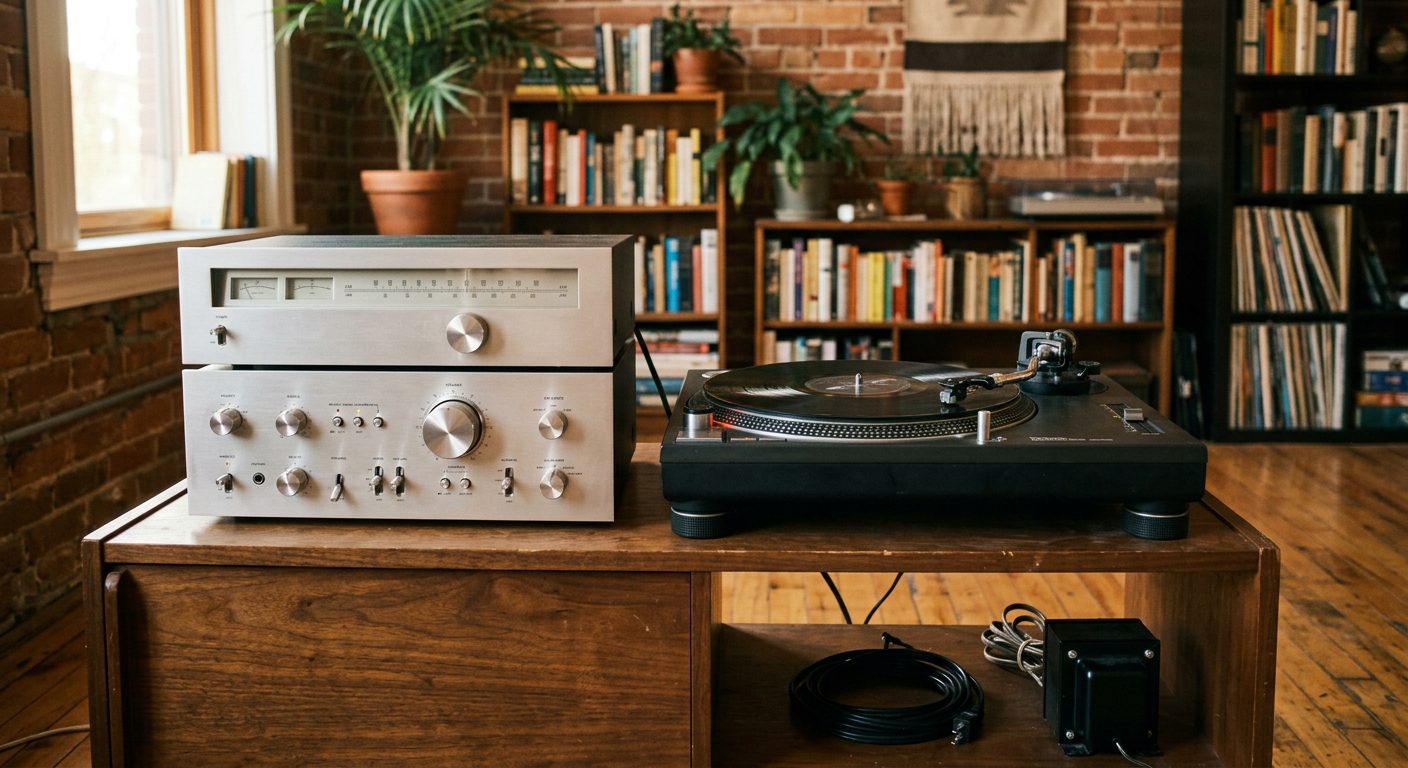
TL;DR
Japan’s domestic secondhand market is the deepest source of 1970s–1990s hi-fi on earth, and prices are a fraction of Western dealer prices. Two things decide whether it is worth it for you: every unit is built for 100 volts, and amplifiers and turntables are heavy enough that shipping can cost more than the gear. Get both right and it is one of the best-value imports going.
- Japan is 100 V, 50 Hz in the east and 60 Hz in the west[1]. A 120 V outlet runs a 100 V amp 20% over rated; 220–240 V destroys it instantly. Budget for a step-down transformer.
- The prices are the point. Live on 18 September 2026: a Sansui AU-D607 Fextra integrated amp at ¥21,700 (US$149.73) and a Technics SL-1200MK3D at ¥46,000 (US$317.40).
- Weight is the tax. A ~14 kg amplifier quoted US$102.55 economy air to the United States; a boxed SL-1200 at ~15 kg and 60×50×25 cm returned only express courier at US$164.28 — the economy lane refused it.
- Turntables care about frequency, most amps do not. Direct-drive decks with quartz speed control are electronically regulated[2]; belt drives with AC synchronous motors follow the mains frequency and will run at the wrong speed on the wrong grid.
- Do not consolidate heavy gear with everything else. One 15 kg parcel is fine; one 30 kg parcel exceeds the EMS ceiling[3] and forces courier pricing on the whole lot.
As of August 2026. This is a guide written to talk some readers out of a purchase. Vintage Japanese hi-fi is genuinely underpriced in Japan and genuinely expensive to move, and the voltage question has exactly one correct answer per reader. Below are the real numbers, quoted the day this was written.
Why Japanese Domestic Hi-Fi Is Priced the Way It Is
Between the mid-1970s and the early 1990s, Sansui, Technics, Denon, Pioneer, Marantz Japan, Luxman, Kenwood and Yamaha fought a domestic specification war that produced enormous quantities of over-engineered gear for the Japanese market alone. Model designations with a シリーズ suffix — AU-α607, AU-D907, T-α7 — frequently never had an export counterpart.
Forty years later those units sit in Japanese homes, get traded in at recycle chains, and appear on Mercari, Yahoo! auctions, Suruga-ya and 2nd STREET at Japanese domestic prices. In the West the same models pass through specialist dealers who have restored them and priced them accordingly. The arbitrage is real; so is the risk, because you are buying condition sight-unseen.
Technics SL-1200: the one model everyone recognises
Technics introduced the SL-1200 in 1972, using a direct-drive system in which a low-speed motor is coupled straight to the platter, with no belt or idler in between[2]. The MK2 (1979) added quartz lock for more accurate rotation control and was the first hi-fi turntable designed with disco and club DJs in mind; the MK3 (1989) brought heavier vibration damping and the black finish everyone pictures[2]. By 1995 the line had passed two million units sold[2].
That production volume is why used MK2/MK3/MK3D decks are still findable in Japan at four-figure yen-thousands rather than dealer prices. On 29 August 2026 we saw the spread run from ¥49,390 for a graded MK3D up to ¥59,800 for an MK3 sold as “no obvious damage or stains” — two listings, same era, 21% apart, on condition description alone.
The 100 V Problem, Stated Precisely
Japan runs on 100 volts AC nationwide, with two frequencies: 50 Hz in eastern Japan and 60 Hz in western Japan (including Nagoya, Kyoto and Osaka)[1]. Domestic-market audio gear from this era has no voltage selector.
| Your mains | Plugging a 100 V unit in directly | What you need |
|---|---|---|
| 100 V (Japan) | Correct | Nothing |
| 110–120 V (US, Canada, Taiwan) | Runs, but 10–20% over rated voltage — heat, stress on capacitors, shortened life | Step-down transformer 120→100 V, rated above the unit’s draw |
| 220–240 V (UK, EU, Australia, Singapore) | Immediate damage | Step-down transformer 230→100 V, mandatory, never optional |
Two practical notes. First, size the transformer to the amplifier’s actual draw with headroom — a power amp’s peak demand is far above its idle draw. Second, frequency: a direct-drive turntable that regulates platter speed electronically, as the quartz-locked SL-1200 series does[2], is indifferent to whether your grid is 50 or 60 Hz. A belt-drive deck using an AC synchronous motor is not — that motor’s speed is derived from the mains frequency, so a 60 Hz-market deck will run slow on a 50 Hz supply unless it has a pulley or a speed control for it. Check which type you are buying before you buy.
Live Japanese Listings Right Now
Stock-checked on 24 September 2026. All three are single-unit used listings from different Japanese platforms, which is exactly how this market works — there is no “in stock” for vintage gear.


Read the condition wording carefully, because Japanese sellers are unusually literal about it. The Sansui amp above is described with damage or staining noted; the SL-1200MK3D on Mercari is described as showing its age cosmetically after several years in storage. Neither is a fault in the listing — it is disclosure, and it is priced in.
What Shipping Actually Costs
This is where the maths gets decided. We quoted two realistic boxed parcels on 29 August 2026: an integrated amplifier at 14 kg in a 55×45×25 cm carton, and a turntable at 15 kg in 60×50×25 cm.
| Destination | Amplifier, 14 kg — cheapest available | SL-1200, 15 kg — cheapest available |
|---|---|---|
| United States | US$102.55 economy air (10–20 d) | US$164.28 courier only (3–7 d) |
| United Kingdom | US$80.94 sea mail (30–90 d) | US$138.59 courier (3–7 d) |
| Germany | US$67.45 sea mail (30–90 d) | US$138.59 courier (3–7 d) |
| Australia | US$67.45 sea mail (30–90 d) | US$156.23 courier only (3–7 d) |
| Canada | US$80.23 sea mail (30–90 d) | US$164.28 courier (3–7 d) |
| Singapore | US$58.22 sea mail (30–90 d) | US$86.66 courier (3–7 d) |
Three things jump out of that table, and they should change how you shop:
- One extra centimetre can remove your cheap option. The 14 kg amp had an economy air quote to the US at US$102.55. The 15 kg turntable in a slightly larger carton had no economy or postal quote at all to the US or Australia — only express courier. Turntables are wide and flat, and that is what pushes them past lane limits.
- Sea mail is the vintage-audio lane. To Europe and Australia it was roughly 40–50% of the courier price for the amplifier. A 40-year-old amplifier that has sat in a Japanese living room since 1985 does not mind another eight weeks in a container.
- EMS is not always the cheap one. For the 14 kg amp to the UK, Japan Post EMS quoted US$279.03 — more than double DHL’s US$129.39. On heavy parcels the postal rate card stops being competitive; check all lanes rather than assuming.
EMS also caps at 30 kg per parcel[3], which matters if you were planning to consolidate an amp, a deck and a pair of speakers into one box. Do not. Heavy items should ship as their own parcels, each in the cheapest lane that will actually accept them.
How to Buy Vintage Japanese Hi-Fi: The Actual Steps
- Step 1 — Fix your voltage plan first. Decide on the transformer and its VA rating before you bid on anything. If you are not willing to run a transformer, stop here; this category is not for you.
- Step 2 — Search the Japanese model string. "サンスイ AU-D607" and "Technics SL-1200MK3" return listings that English searches miss entirely. One OneMall query covers Mercari, Yahoo! auctions, Rakuten, Suruga-ya, ZOZOTOWN, Rakuma, Amazon Japan and 2nd STREET.
- Step 3 — Read the condition Japanese. 動作確認済 (function confirmed), 現状品 (sold as-is, no guarantee), ジャンク (junk / for parts), 傷め・汚れあり (marks or staining). 現状品 and ジャンク are the two that should change your price.
- Step 4 — Order and pay stage one. Item price plus service fees are ¥300 per item on most marketplaces; from ¥200 per item on Yahoo Auctions and LinkBuy; on Mercari and Yahoo! auctions it is capped at ¥300 even on a ¥60,000 turntable.
- Step 5 — Use the inspection photos. Before anything ships, request photographs of the actual unit — rear panel, model plate, knobs, platter, any described damage. This is the only look you get, and it is far more useful here than on a sealed toy.
- Step 6 — Ship each heavy item on its own. Quote every lane for that exact box. Do not assume the postal option is cheapest; on 14 kg it frequently is not.
Customs and Duty in 2026
The United States revoked the US$800 de minimis exemption on 29 August 2025 under Executive Order 14324[4][5]; US-bound parcels are dutiable regardless of value. Japan Post resumed accepting US-bound mail on 14 April 2026 after the suspension that followed[3], though as the table above shows, postal lanes are not offered for every parcel size on every route. UK buyers pay VAT above the low-value threshold and duty above a higher one[6].
On a US$340 turntable plus US$164 shipping, duty and import VAT are a real line item, not a rounding error. Price the landed total before you decide the Japanese listing is cheap — it usually still is, but by less than the sticker suggests.
Frequently Asked Questions
Can I run a 100 V Japanese amplifier on 120 V without a transformer?
It will power on, and that is what makes it tempting. You are running the unit 20% over its rated voltage, which raises heat and stress on 40-year-old capacitors. For gear you intend to keep, use a step-down transformer rated comfortably above the amplifier’s draw. On 220–240 V mains it is not a debate — direct connection destroys the unit.
Does 50 Hz versus 60 Hz matter?
It depends entirely on the motor. Quartz-locked direct-drive turntables like the SL-1200 series regulate platter speed electronically[2] and do not care. Belt-drive decks with AC synchronous motors derive speed from mains frequency and will run at the wrong speed on a mismatched grid. Amplifiers, tuners and CD players are generally unaffected by frequency; some older turntables and tape decks are not.
Why did my turntable only get a courier quote?
Carriers apply both weight and dimensional limits per lane. Our 15 kg deck in a 60×50×25 cm carton returned only express courier to the United States and Australia, while a slightly smaller 14 kg amplifier carton got economy air. Flat, wide boxes hit size limits before they hit weight limits.
Is it cheaper to buy several pieces and consolidate?
For light items, always. For hi-fi, only partly. Consolidation is free for your first 6 orders and saves you repeated minimum charges, but EMS caps at 30 kg per parcel[3] and a single very heavy box can push the whole shipment into courier pricing. Consolidate the cables, mats and cartridges; ship the amplifier and the deck separately.
What condition wording should make me walk away?
ジャンク (junk) means the seller is explicitly not claiming it works — fine if you repair, otherwise no. 現状品 (as-is) means no functional guarantee even if it powered on for the seller. Treat both as parts prices, and factor in that shipping a 14 kg parcel back is not realistic.
Ready to Start?
If your voltage plan is sorted and you are shopping one heavy item rather than a system, Japanese vintage hi-fi is among the best value available anywhere. Search the Japanese model string on OneMall, request inspection photos before it ships, and quote your exact carton in the shipping calculator before you commit — on this category the freight decides the deal. Our guides to the cheapest Japan proxy services and how the shipping lanes differ cover the rest.
References
- Japan National Tourism Organization (JNTO), "Electrical Outlets" — 100 V nationwide; 50 Hz eastern Japan, 60 Hz western Japan. https://www.japan.travel/en/plan/plug-and-electricity/
- Technics, SL-1200 Heritage — 1972 introduction, direct drive without belt or idler, MK2 (1979) quartz lock, MK3 (1989), two million units by 1995. https://us.technics.com/pages/technics-sl-1200-heritage
- Japan Post, EMS service overview — up to 30 kg; US-bound acceptance resumed 14 April 2026. https://www.post.japanpost.jp/service/send/oversea/list/delivery/ems/index_en.html
- The White House, "Suspending Duty-Free De Minimis Treatment for All Countries" (Executive Order 14324, 30 July 2025). https://www.whitehouse.gov/presidential-actions/2025/07/suspending-duty-free-de-minimis-treatment-for-all-countries/
- U.S. Customs and Border Protection, guidance on Executive Order 14324 and duties on international mail. https://www.help.cbp.gov/s/article/Article-1919
- GOV.UK, "Tax and customs for goods sent from abroad". https://www.gov.uk/goods-sent-from-abroad/tax-and-duty
Last updated: 2026-09-24.