
 Shopping Guide
 HELP / FAQs



 By onemall
For US buyers comparing Japanese vs English Pokémon cards, English is the practical choice for readable text and standard US tournament needs. Japanese cards suit collecting specific artwork or finishes. Before you buy Japanese Pokémon cards, compare the exact printing, condition, and full cost of getting it home.
We understand the hesitation when the artwork you want stretches your English-card budget. A binder purchase should answer to your collecting goal, not pressure to stick with one language. We’ll separate play rules from collecting preferences, then work through prices, condition, packaging, and the checks available before a purchase leaves Japan.
Choose Japanese or English for Collecting or US Play
Choose English if reading the card or building a deck for US Championship Series events is your priority. Choose Japanese when a particular printing, artwork, or finish fits your collection and budget; event use requires a separate rules check.
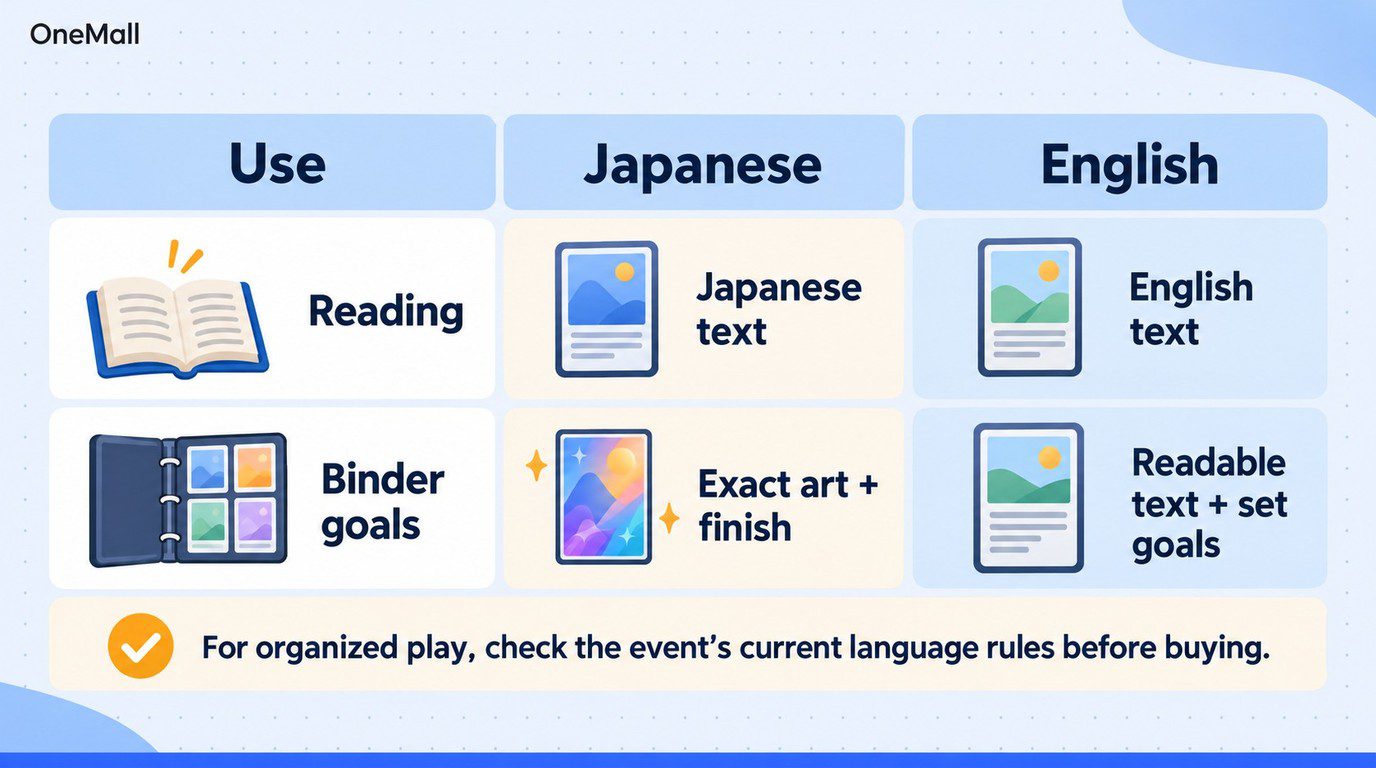
| Decision point | Japanese cards | English cards |
|---|---|---|
| Card text | Japanese | English |
| US/Canada Championship Series | Not the default; exceptions apply | Listed language |
| Other tournaments and League sessions | Organizer decides | Organizer decides |
| Binder collecting | Specific artwork and finish | Readable text and English set goals |
| Booster contents | Specific Japanese product’s listed contents | 10 game cards + 1 Energy + 1 Live code |
| Price comparison | Match condition; include import costs when buying abroad | Match condition; include seller charges |
Rules and US booster contents: Pokémon TCG Tournament Handbook, September 2026 revision, and Pokémon Support’s booster guidance, read October 27, 2026; linked in References. The booster description includes a pre–Scarlet & Violet foil exception.
We would keep your deck needs separate from your binder budget. A Japanese card that fills the right binder slot does not need to double as a tournament card.
The social pressure is real enough to prompt this question from a collector in r/PokemonTCG: “As prices go up I’m finding the cards I really want, I can’t really afford in English but can in other languages. Is this frowned upon in the collecting community?” That is a collecting preference, not a requirement to buy the English printing.
Playing in the US: Check the Event’s Language Rules
The Play! Pokémon rules and resources page links the TCG Tournament Handbook. Section 2.3.1 lists English for US and Canada Championship Series events; other tournaments and League sessions leave language decisions to the organizer or League staff.
Section 2.3.3 also allows English and languages legal in a competitor’s home country at Worlds, International, Regional, and Special Championships and their side events. Exceptional organizer or Head Judge discretion is separate. Those provisions do not give a US player blanket permission to use Japanese cards. Ask your organizer about your circumstances before entering; format legality still applies independently.
Compare the Same Card’s Price and US Acquisition Costs
Japanese Pokémon cards are not uniformly cheaper or worth more than English cards. Compare the matching artwork and printing in comparable condition, then include the costs attached to the seller’s location and delivery route.
For a binder buyer, we would favor the edition that delivers the wanted card within budget. A lower listing price is useful only if the remaining charges leave the purchase worthwhile.
Match the Printing, Condition, and Recent Sold Listings
A translated name is not enough to match a card. Compare the artwork, set identifier, collector number, language, finish, and edition details. The collector numbers themselves need not match across languages; each should identify the intended printing within its own set.
Keep raw and graded comparisons separate. “Raw” means a card outside a grading holder. A raw Japanese single and an English card in a PSA or BGS holder are different purchase propositions, even when the artwork matches. For graded comparisons, use the same grading company and grade, then inspect the photographed card and label.
Sold listings are more useful than ambitious asking prices. Look for recent completed sales of the matching edition, note their dates, and account for shipping charges. A listing that remains unsold tells you what the seller wants, not what a buyer paid. For vintage Japanese Pokémon cards, confirm the exact printing rather than grouping together cards described merely as “old” or “first edition.”
The question of are Japanese Pokémon cards worth more has a card-specific answer. Pokémon’s card-value guidance explains that secondary-market value comes from community wants and needs, rather than a company price list. That also explains why Japanese Pokémon cards are cheaper in some comparisons without establishing a discount across the language as a whole.
Include the Cost of Getting the Card to the US
A Japan-based listing and a US-based listing carry different costs. When a proxy purchase is involved, allow for:
- The item price.
- The applicable service fee per item.
- The seller’s domestic shipping within Japan.
- International shipping to the United States.
- Applicable import duties, taxes, and selected extra services.
That is the comparison we would put beside a domestic seller’s delivered price. Japanese-language cards already located in the US do not require you to arrange a new shipment from Japan, so seller location matters alongside language.
For a proxy shipment, international freight is determined after the warehouse has the parcel’s packed measurements and weight. Several inexpensive singles bought separately also bring several item-level fees and potentially separate domestic shipping charges. Combining parcels changes the shipping arrangement; it does not erase purchasing costs. Keep the quotes for those charges visible instead of treating the card’s sticker price as your whole budget.
Compare Print Finish and Individual Card Condition
A Japanese card’s finish does not establish that it is in better condition than its English counterpart. Texture and foil appearance are collecting preferences; scratches, edge wear, bends, and centering belong to the particular card you are buying.
Collectors do not describe a uniform visual difference. One r/PokemonTCG poster comparing Golett cards wrote: “Doing a quick quality check between all three, there isn’t much of a difference in printing quality that I can see.” That is one collector’s observation, not a defect-rate study. We would choose the finish you enjoy, then inspect the actual copy.
Inspect the Card, Not Just the Language
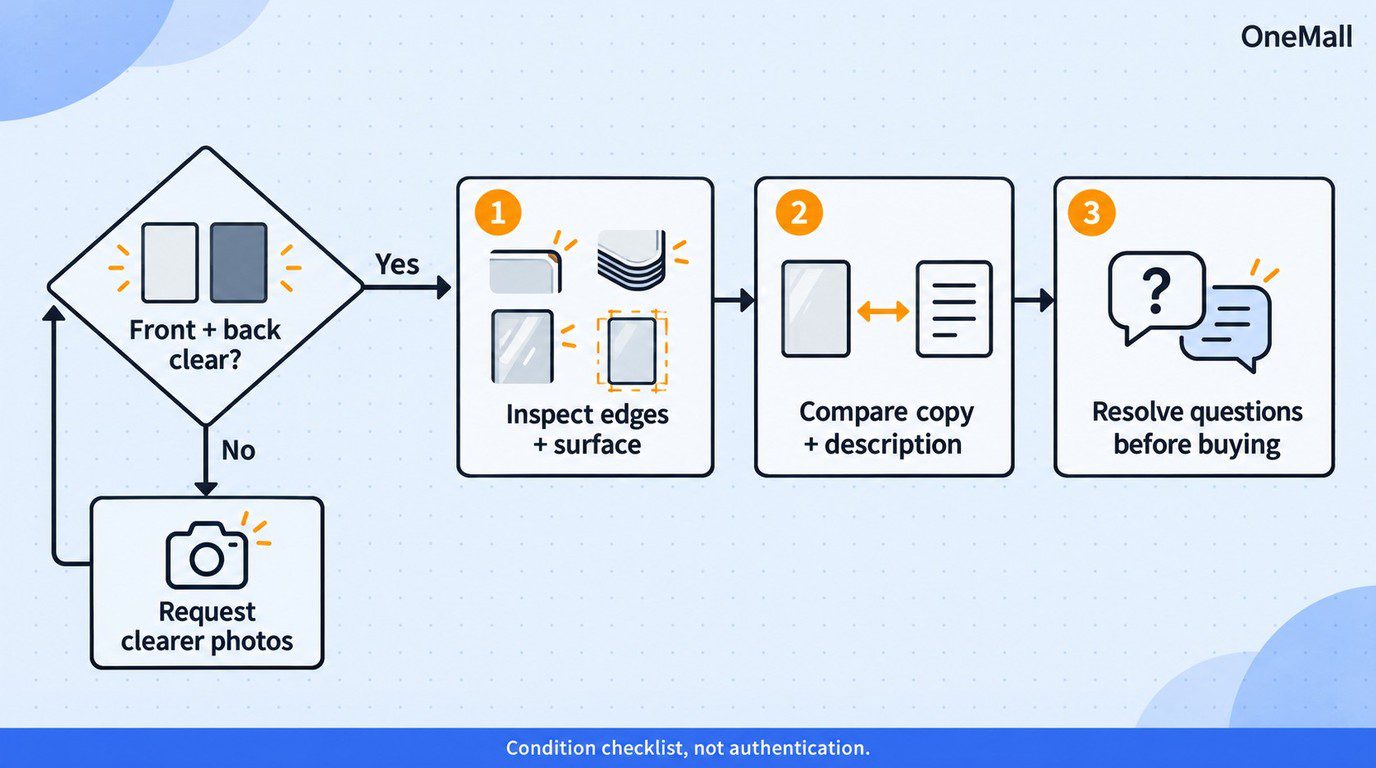
Clear front-and-back photos matter more than a language-wide quality claim. Ask for images of the card itself, including corners and edges, plus angled light across a foil surface. Straight-on photography helps with centering; angled views help reveal surface marks. A bright reflection also hides detail, so ask for another angle when necessary.
Read the condition description alongside the photos. “Near mint” is not a grading result, and a flattering front image does not show wear on the reverse. If a defect matters to your binder or display, resolve the question before committing to the listing.
Japanese Pokémon cards sometimes feel different to a collector, but feel alone does not establish a thickness measurement or card identity. Do not use a supposed language-wide thinness rule as a buying test. For a costly card, request clearer images or consider a graded example whose label, certification record, and pictured card agree.
Graded Japanese Pokémon cards still need a listing check. Compare the company, grade, card number, and holder shown, rather than treating a grade in the title as sufficient information. Our preference is simple: pay for the condition you can assess, not the assumption that one language removes condition concerns.
Card backs and size
Modern Japanese and English Pokémon cards have different back designs, but regular cards use the same standard trading-card sleeve category. Japanese-language Pokémon cards do not require the smaller sleeves sometimes sold as “Japanese size.”
The familiar English back has a blue border, a central Poké Ball, and Pokémon lettering above and below it. Modern Japanese backs use a different, multicolored design around the central Poké Ball. Older Japanese printings have another back design, so compare a vintage card with its own era rather than a current card.
For sleeve shopping, select standard-size sleeves made for Pokémon cards. Sleeve outer dimensions are larger than the card they hold; do not confuse the two measurements. Oversize promotional cards need separate storage.
Matching sleeve fit does not settle deck legality. Handbook §2 says mixed-language decks require consistent backs; §2.1 treats Japanese backs as marked for that rule, and §2.2 strongly recommends opaque sleeves while setting matching-sleeve requirements. We would ask the organizer how those provisions apply before mixing Japanese and English cards in an event deck. Opaque sleeves do not replace language approval or the remaining card-legality rules.
Check Set Matches and Pack Contents Before Buying Sealed
Japanese and English set names, collector numbers, rarity marks, and sealed contents should not be treated as interchangeable. Match the wanted artwork to its particular product, then read that pack or box’s contents instead of carrying an English packaging assumption across languages.
We would buy a single when the goal is a specific card. A sealed product suits the experience of opening packs, with the uncertainty that comes with it. A cheaper pack is not the same purchase as the card you hope it contains.
Match the Set, Card Number, and Artwork
A Pokémon’s name identifies the character, not the printing. Check the artwork, set code, collector number, and finish against the language edition you want. Do not assume an English expansion title is also the name of the Japanese product containing the matching art, or that a promo follows a booster-set checklist.
One collector in r/PokemonTCG put the goal plainly: “For me I care much more about artwork and building a fun binder than I do resell value.” For that goal, finding the desired Japanese full-art card matters more than buying a box with a similar-looking name.
Rarity marks help identify a printing within its set. A resource titled “Japanese Pokémon card rarity symbols explained” should match the release you are buying; a symbol or letter alone is not a cross-language price comparison. Keep the exact card identifier with your search so a similarly named rarity does not lead you to the wrong artwork.
Read the Exact Pack or Box Contents
The US Pokémon Support page describes a booster containing 10 game cards: four commons, three uncommons, and three foils, at least one rare or higher. It separately lists one Energy card and one Pokémon TCG Live code card. Its pre–Scarlet & Violet note specifies at least one reverse foil rather than the newer foil arrangement.
That description does not supply the contents of a Japanese booster. Japanese pack and box formats must be read from the named product: cards per pack, packs per box, and any stated distribution terms. A smaller advertised pack count describes that product’s format, not a missing portion of an English pack.
For a Japanese Pokémon booster box, also confirm whether the listing sells a full box or loose packs. Record what the packaging actually promises. Pokémon’s US guidance does not promise a specific Pokémon or card type in a particular booster, and neither a rarity label nor a seller’s “hit” language identifies your next pull. If missing one specific artwork would make opening the box disappointing, a clearly identified single better matches that purchase goal.
Buy a Japanese Card Through OneMall: Steps and Limits
OneMall fits you when you have chosen a Japanese card and need us to purchase it from a Japanese marketplace and forward it to the US. Before submitting it, have an account, a payment method, and the card’s language, printing, seller photos, and condition description ready.
- Find an eligible listing through us. Search Mercari, Yahoo Auctions, or Suruga-ya, or submit a Japanese store link through LinkBuy, our service for purchasing by URL. Confirm the exact card and whether the listing is eligible for purchase.
- Review the item charge and per-item service fee. OneMall purchases Japanese Pokémon cards on Mercari and Suruga-ya for a ¥300 service fee per item (fee schedule confirmed September 23, 2026). Yahoo Auctions calculates its fee from the winning bid plus consumption tax, with minimum and maximum fees. LinkBuy charges 5% of the item price, with a ¥200 minimum and ¥1,000 maximum per item. Our system calculates the exact charge at checkout.
- Arrange checks, packing, and US shipping after arrival. At our Tokyo warehouse, select any needed photos, checks, and reinforcement, then pay the calculated domestic and international shipping charges. Japan Post EMS (DDP) and ECMS collect US duties and taxes with international freight; DHL contacts you after arrival to pay any duties due. Available routes appear at checkout.
Marketplace terms and purchase restrictions apply to the submitted listing. Combining warehouse parcels is called consolidation: storage is free for 90 days after arrival, resetting to 30 days after consolidation, which gives you time to coordinate arrivals before export.
What Photos, Checks, and Packing Services Can Do
We handle purchasing and forwarding; specialist card assessment and protection require separate attention. OneMall does not authenticate cards. Request clearer seller photos, compare graded-card records when relevant, and use warehouse unboxing photos to document received condition. A wrong- or missing-item check addresses what arrived, not a grade. Eligible Mercari listings offer assessment by Mercari; Mercari issues the conclusion, without a separate guarantee from us.
Cards use general reinforcement rather than dedicated card packaging. Select replacement-box packing with filling or external bubble-wrap reinforcement as appropriate. For high-value purchases, account for the absence of separately purchasable declared-value insurance: warehouse damage caused by us is refunded at the item purchase price, while international-transit damage compensation is capped at international shipping fees paid. Keep a complete unboxing video and photos, and report transit damage within 24 hours with your order number.
We favor resolving listing questions before export, while photos and packing choices are still actionable. Our guide to buying Pokémon cards from Japan explains the broader purchasing route. Bring your matched card details to OneMall to find or submit a listing and review its purchasing charges.
Frequently Asked Questions
Your binder’s language mix is a personal choice; resale and limited-release purchases involve different practical questions. We would keep those decisions tied to the exact card and your intended use.
Can I Mix Japanese and English Cards in One Collection?
Yes. Arrange a private collection by Pokémon, artist, scene, or set, with whichever language fits each space. Matching artwork side by side is another option. Keep a record of the language, set, and collector number so you know which printing you own or still need. A mixed binder does not have to follow an event deck’s restrictions.
Are Japanese Singles Easy to Resell in the US?
Do not assume a listed value means a quick sale. Check how many matching Japanese singles have recently sold on the marketplace where you intend to sell, alongside their condition and asking prices for unsold copies. A high-priced listing with few comparable sales gives little guidance about finding a buyer. We would collect the edition you want to own rather than make the purchase depend on a fast resale.
Can I Buy an Event-Only Japanese Promo From a Reseller?
An eligible resale listing is a separate purchasing route. We do not collect event or store-distributed promo packs for you, enter Pokémon Center lotteries, or purchase restricted items requiring Japanese identity verification or a merchant account. If the item is resold on a supported marketplace, submit that listing for an eligibility check. Inspect what is included, its condition, and the seller’s photos; the promo’s name alone does not establish those details.
Choose the Edition That Fits Your Goal
Choose English for readable text and the standard US tournament route; choose Japanese when its particular artwork, finish, condition, and acquisition cost fit your collection. We would compare the exact printing and the costs attached to the seller before choosing between them. For sealed purchases, read the named product’s contents; for event play, settle language and deck legality with the organizer. One language does not decide the quality or value of an individual card.
References
Rules and product pages consulted October 27, 2026:
- The Play! Pokémon rules and resources directory provides tournament documents.
- The Pokémon TCG Tournament Handbook, revised September 1, 2026, covers card backs, sleeves, and legal languages in §§2–2.3.3.
- Pokémon Support describes US booster-pack contents, including the earlier-set foil exception.
- Pokémon Support explains how secondary-market card values are determined.
- The collecting-budget quotation appears in r/PokemonTCG’s “English vs Japanese” discussion: reddit.com/r/PokemonTCG/comments/1tizgd9/english_vs_japanese/.
- The Golett observation appears in r/PokemonTCG’s “Card quality comparison Japanese, English, and Korean”: reddit.com/r/PokemonTCG/comments/1tuucrp/card_quality_comparison_japanese_english_and/.
- The artwork quotation appears in r/PokemonTCG’s “Fairly new to the hobby” discussion: reddit.com/r/PokemonTCG/comments/1u42a95/fairly_new_to_the_hobby_can_someone_help_me/.