 Shopping Guide
 HELP / FAQs


 By onemall
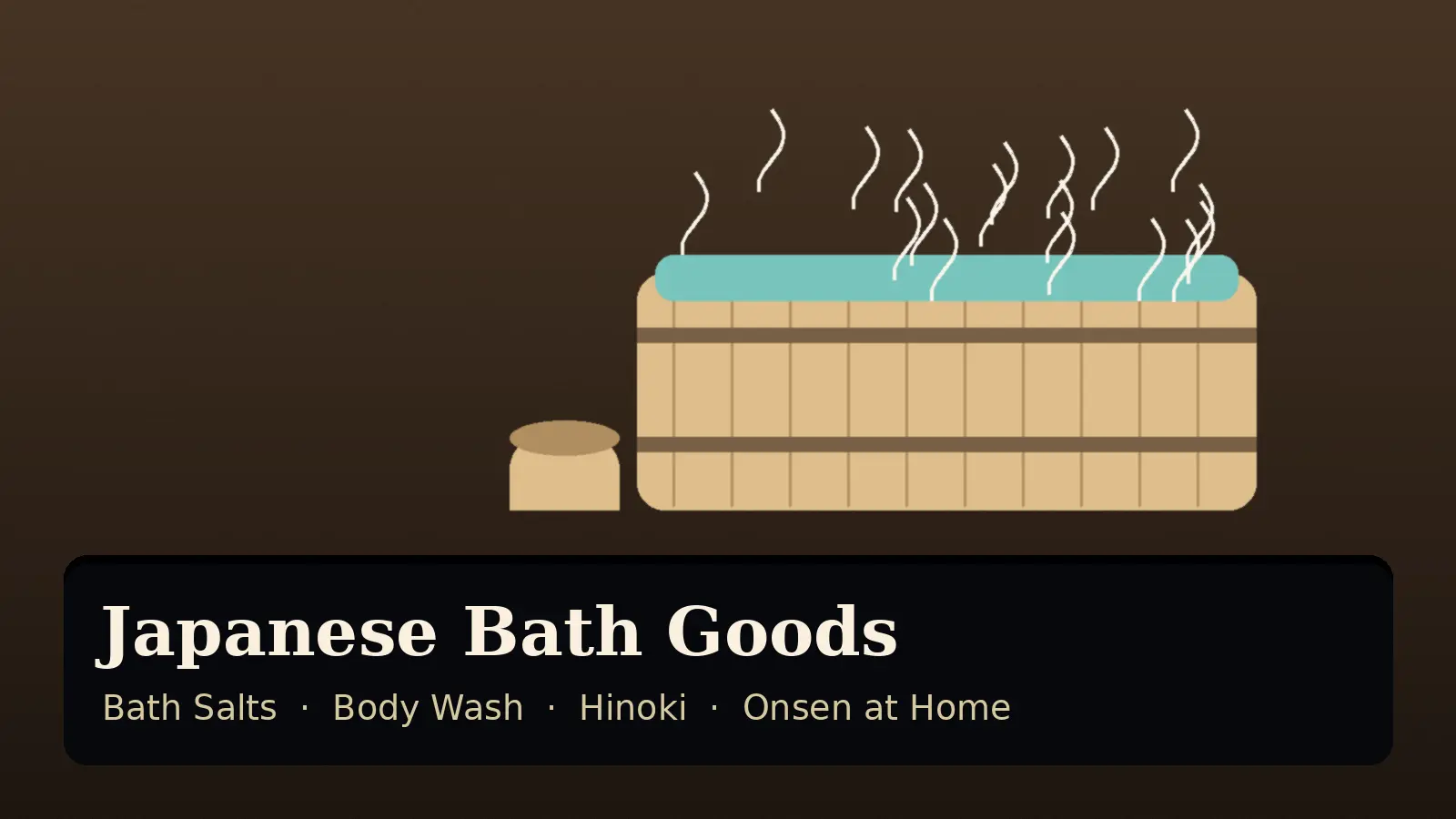
A Japanese bath is a soak, not a wash: you scrub and rinse first, then sink into a deep tub of hot water, often tinted with a packet of Japanese bath salts. This guide covers what Japanese bath salts are called (入浴剤, nyuyokuzai), how Bathclin, Kikiyu, Kao Bub, Tabi no Yado and onsen-themed packets differ, how to read the 医薬部外品 (quasi-drug) label, Japanese body wash brands, body scrub towels, hinoki bath stools, buckets, mats and bath essence, the Japanese bathing order and etiquette at home and at an onsen, and how to buy Japanese bath products and ship them from Japan (prices as listed in November 2026).
What Are Japanese Bath Salts Called?
In Japanese, bath salts, bath powders, bath tablets and bath soaks all fall under one word: 入浴剤 (nyuyokuzai, “bath additive”). The industry also says 浴用剤 (yokuyozai). On a label you may also see バスソルト (bath salt), 炭酸入浴剤 (carbonated bath tablets), 薬用入浴剤 (medicated bath additive) or 温泉タイプ (onsen type).[1][14] The Japanese bath itself is ofuro (お風呂), and the tub is the yubune (湯船). Interestingly, 風呂 originally meant a steam bath; the soaking style Japanese people use today became established from the middle of the Edo period, and the word yubune comes from Edo-era boats that carried a bathtub around the harbor.[20][21] A public bath house is a sento (銭湯), and a natural hot spring is an onsen (温泉). So what is the Japanese bath called, and what is the Japanese word for bath? Ofuro for the bath at home, yubune for the tub, sento and onsen for the public kind. A “bath bomb” in Japanese is usually バスボム or simply a fizzing 入浴剤 such as Bub; another word for bath bomb in Japan is バスボール (bath ball).
Do Japanese people use bath salts? Very much so. Japan’s bath additive association traces them to two older habits: soaking in onsen water, and herbal baths such as shobu-yu (iris leaves on May 5) and yuzu-yu (whole yuzu citrus on the winter solstice).[22][23][24] The first bath additive product was 浴用中将湯, sold to public baths in 1897. Inorganic-salt additives such as Bathclin followed in the early Showa period, home baths spread from the 1960s, and carbonated tablets took off in the 1980s.[25][22]
Types of Japanese Bath Salts and Bath Powders
The Japan Bath Additive Industry Association (日本浴用剤工業会, JBIA) sorts bath additives by what is in them. Most products now mix several types, and they come as powder, granules, tablets or liquid.[1]
| Type | Main ingredients | Forms | Examples | Source |
|---|---|---|---|---|
| Inorganic salt type (無機塩類系) | Sodium bicarbonate, sodium sulfate (bosho), magnesium sulfate, sodium chloride and other salts | Powder, granules | Onsen-named “hot spring” bath salts such as Nihon no Meito; Bathclin | [1][2] |
| Carbonated type (炭酸ガス系) | Carbonate salts plus an organic acid (fumaric, succinic, citric) that release CO2 bubbles | Tablets, granules | Kao Bub, Kikiyu, Onpo | [1][3] |
| Herbal / crude-drug type (薬用植物系, 生薬系) | Chopped crude drugs or extracts: yuzu, mugwort, ginger, chamomile, angelica and others | Powder, granules, liquid, chopped herbs | Bath Roman 薬泉, Bathclin Wakan | [1][4] |
| Enzyme type (酵素系) | Protein-digesting enzymes such as papain, usually combined with salts | Powder, granules | — | [1] |
| Cooling type (清涼系) | Salts or carbonated base with menthol for a cool feel after bathing | Powder, tablets | Bub Cool, Bath Roman Cool | [1][5][4] |
| Skin-care type (スキンケア系) | Moisturizing ingredients; often milky (white, cloudy) water | Liquid, powder | Bath Roman Skin Care type | [1][4] |
JBIA’s own explanation is that inorganic salts form a thin film on the skin that slows heat loss after the bath, which is why salt-type products are sold for “staying warm”; it classes the onsen-named products as this salt type. For carbonated tablets it says CO2 in the water is absorbed through the skin and widens blood vessels. These are the association’s statements, and the claims a product may print are fixed by Japanese law (see the label section below).[2][26]
- Japanese bath salts vs Epsom salt: Epsom salt is magnesium sulfate. Japanese bath powders often contain magnesium sulfate or sodium sulfate too, but blended with other salts, scent and color, and dosed for a full tub. Kikiyu’s magnesium carbonated bath lists magnesium sulfate as an “onsen mineral” active ingredient, and there is a matching Japanese magnesium bath salt in calcium, potassium and salt versions.[8]
- Milky bath salts: “nigori” (にごり) means cloudy or milky water, like many sulfur onsen. Tabi no Yado sells a にごり assortment, and Nihon no Meito Noboribetsu Karurusu turns the water milk-white. Japanese milk bath salts (ミルク) usually mean the same milky look plus moisturizing ingredients.[14][11][1]
- Green, blue and yuzu colors: the classic green Japanese bath salts are Bathclin; the yuzu version turns the water light green.[7]
- Bath salts that make you sweat: Tabi no Yado’s 発汗温浴 (“sweating warm bath”) bath salt is the product people mean when they search for Japanese sweating bath salts or “hot bath salts”.[14]
- Cooling (cool) Bathclin and Bub Cool: summer products with menthol for a cool feel after the bath.[1][5]
Japanese Bath Salt Brands: Bathclin, Kikiyu, Bub, Tabi no Yado and Onsen Packets
Here are the brands you will meet in any Japanese drugstore, on Don Quijote shelves or on Rakuten and Amazon Japan, with what each maker says about them (as of November 2026):
| Brand | Maker | What it is | Source |
|---|---|---|---|
| Bathclin (バスクリン) | Earth Corporation (Bathclin Co. merged into Earth on Jan 1, 2026) | The classic powder bath salt: yuzu, forest and lemon scents; quasi-drug; 20–30 g per 200 L | [6][7] |
| Kikiyu (きき湯) | Earth Corporation (ex-Bathclin) | Carbonated granules with onsen minerals: magnesium, calcium, potassium sulfate, salt, clay types; 360 g bottles and 30 g packets | [8] |
| Kikiyu Fine Heat (きき湯ファインヒート) | Earth Corporation | About 2.4 times the carbonic concentration of regular Kikiyu, with ginger powder; 400 g bottles, 50 g packets | [9] |
| Nihon no Meito (日本の名湯) | Earth Corporation (ex-Bathclin) | Onsen-themed packets for Noboribetsu Karurusu, Beppu, Atami, Nyuto and more, checked by each onsen area | [10][11] |
| Bath Roman (バスロマン) | Earth Corporation | Warming bath salts; Skin Care, 薬泉 (herbal + onsen ingredients) and Cool types | [4] |
| Onpo (温泡) | Earth Corporation | Carbonated tablets in 20-tablet boxes; the Kodawari Yuzu box uses Kito yuzu oil from Tokushima | [12] |
| Aroma Sparkling | Earth Corporation | Fizzing beads with natural rose, lavender and grapefruit oils; sold as a bath cosmetic, not a quasi-drug | [13] |
| Bub (バブ) | Kao | Fizzing carbonated tablets; yuzu, forest, hinoki, milky, Cool and Medicure lines | [3][5] |
| Tabi no Yado (旅の宿) | Kracie | Onsen-type medicated bath salts: milky (nigori) and clear assortments, plus 発汗温浴 “sweat bath” salts | [14] |
Bathclin company news: Bathclin Co., Ltd. (株式会社バスクリン) merged into its parent, Earth Corporation (アース製薬), on January 1, 2026. Bathclin, Kikiyu, Nihon no Meito, Sofre and Ayur Time continue under Earth, and bathclin.co.jp now points to earth.jp product pages.[6] So “Bathclin Japan”, “bathclin co jp”, “shop bathclin jp” and “bathclin corporation” searches all lead to Earth’s site today. Ayur Time (Bathclin Ayurtime) is the aroma line. The Bathclin product lineup at Earth includes Bathclin itself, Kikiyu, Kikiyu Fine Heat, Nihon no Meito, Bath Roman, Onpo, Ayur Time, Sofre and Aroma Sparkling.[27] For Bathclin body wash, body soap or shower gel today, check Earth’s body care list, since product names change after the merger.
Kikiyu (きき湯) and Kikiyu Fine Heat
Kikiyu is a carbonated granule bath additive with “onsen science” minerals. The magnesium version (kabosu scent, blue-green clear water) lists carbon dioxide and magnesium sulfate as active ingredients and is labeled for relief of lower back pain and stiff shoulders through warming. One scoop (about 30 g) goes in 200 L of water, and the maker says it can be used with babies from 3 months.[8] (Kikuyu is a common misspelling; the brand is Kikiyu.) Kikiyu Fine Heat is the stronger line: Earth says it is about 2.4 times as carbonated as regular Kikiyu and adds ginger powder. Its Reset Night version comes with a maker tip on how to use Bathclin Fine Heat: soak in 39–40 °C (102–104 °F) water 1.5 to 2 hours before bed.[9] Fine Heat comes as a 400 g bottle, a 500 g refill and 50 g packets.
Nihon no Meito (日本の名湯): onsen bath salt packets
Nihon no Meito (“Japan’s famous hot springs”) is the onsen-themed packet series people mean by “Bathclin onsen bath salts”, “nihon onsen bath salts” or “Japan’s famous hot spring bath salt set”. Earth says its developers visited each hot spring town, studied the onsen analysis sheet and matched the water’s feel, color and scent, and that each product is checked by a local onsen body (温泉地公認). It also states plainly that the product is not the same as the real onsen.[10] The Noboribetsu Karurusu version, for example, is a sodium sulfate-bicarbonate type that turns the water milky white, at 30 g per 200 L.[11] Variations include Beppu, Atami and Nyuto, and assortment boxes of 30 g sachets are the usual gift set. Searches for Kusatsu, Hakone, Beppu or Arima onsen bath salts often lead to these packets. There are also souvenir 湯の花 (yu-no-hana) mineral deposits sold in onsen towns, which are a different product.
Kao Bub (バブ): the Japanese bath bomb
Bub (sometimes spelled Babu) is the fizzing tablet, or bath fizz, most people picture as a Japanese bath bomb. Kao explains that each tablet contains fumaric acid and sodium bicarbonate, which react in water to release carbon dioxide; the packaging keeps them apart until then.[3] How to use a Japanese bath bomb like Bub: drop one tablet in the tub and wait until it has fully dissolved before you get in. Kao notes that bringing your face close to a fizzing tablet can make you cough, and that the CO2 is spread more evenly once it has dissolved. Unopened, Bub is made to stay stable for three years.[3] Kao also asks that Bub be used only as a bath additive, not as a toy. The lineup includes yuzu, forest, hinoki, milky and lavender scents, Bub Cool for summer and the stronger Medicure line.[5]
Tabi no Yado (旅の宿), Bath Roman, Onpo and Aroma Sparkling
- Tabi no Yado (Kracie) is a medicated onsen-type bath additive brand built around the idea of touring hot springs at home: milky (にごり) and clear assortments, plus 薬用バスソルト 発汗温浴 medicated bath salt.[14] Kracie Japanese bath salts are mostly this brand; you will also see it romanized as Tabino Yado.
- Bath Roman (Earth) is a warming bath salt with Skin Care, Cool and 薬泉 versions, the last mixing crude drugs with onsen ingredients.[4]
- Onpo (温泡) is Earth’s carbonated tablet line; the Kodawari Yuzu box holds 20 tablets in four yuzu scents with Kito yuzu oil from Tokushima.[12]
- Aroma Sparkling uses fizzing beads and natural rose, lavender and grapefruit oils. It is labeled 浴用化粧料 (bath cosmetic), not a quasi-drug.[13]
How to Read a Japanese Bath Salt Label: 医薬部外品 vs Cosmetic
Every Japanese bath additive is regulated under Japan’s Pharmaceuticals and Medical Devices Act as either a cosmetic or a quasi-drug (医薬部外品, iyaku-bugaihin).[26] A quasi-drug sits between cosmetics and medicines: it contains ingredients with a recognized effect, but its action is mild, and products marked 薬用 (“medicated”) are quasi-drugs too. Bath additives are one of the listed quasi-drug categories.[28]
- The words 医薬部外品 must be printed on a quasi-drug bath additive, along with the maker, product name, lot number and contents.[26]
- What the claims mean: quasi-drug bath additives are approved to say they relieve certain symptoms through the warming and cleansing effect of the bath. The approved range covers things like fatigue recovery, stiff shoulders, lower back pain, poor circulation and cold sensitivity (冷え症), chapped or rough skin and prickly heat.[26] When a Japanese medicated or medicinal bath salt says it is “for pain”, “for stiff shoulders” or “for fatigue”, that is this labeled claim, not a medical promise.
- Cosmetic bath additives (浴用化粧料) may only make cosmetic claims such as cleansing the skin or keeping it moisturized.[26][13]
- Useful words on the pack: 湯色 (water color), 香り (scent), にごり (milky) vs 透明 (clear), 分包 (single packets), つめかえ (refill), 錠 (tablets), 使用方法 (directions) and 使用上の注意 (cautions).[8][7]
How to Use Japanese Bath Salts
- Fill the tub and check the label dose. Japanese packs are dosed per tub, usually 20–30 g of powder (or one tablet) for 200 L of water.[7][8] JBIA says you can adjust the amount to your tub size, so a smaller tub takes less.[29]
- Dissolve it. Stir powder until it dissolves; let a carbonated tablet finish fizzing before you get in.[7][3]
- Water temperature: JBIA suggests about 40 °C (104 °F) in winter and about 38 °C (100 °F) in summer, soaking slowly.[29]
- Do not mix brands in one bath; JBIA warns it can spoil each product.[29]
- Reheating: reheating the same water the next day is fine, and you may top up with the same product for the added water.[29]
- After the bath: many Japanese products say you need not rinse off with clean water. Don’t pour leftover bath water on plants.[8][29]
Can you use bath salts in a jetted tub, spa bath or jacuzzi? Japanese makers write their directions for ordinary home tubs and some water heaters (several Earth products say they are fine with EcoCute systems), so for a jetted tub follow the tub maker’s rules. Bath salts without a bathtub? Use them as a foot bath in a bucket at a matching ratio. With bubble bath? JBIA’s advice not to combine products applies.[8][29]
Are Japanese bath salts safe and good for you?
JBIA says quasi-drug bath additives approved in Japan have shown no problematic skin irritation in testing, but that a very small number of people are allergic: check the ingredient list, and stop if your skin reacts. Bath water with a normal dose of additive is not a problem if swallowed by accident or splashed in the eyes; keep the product itself away from small children. Babies can share the bath from about 3 months.[30][29] Are bath bombs poisonous? JBIA’s answer for the product itself is that a small amount licked is not a problem, but a large amount needs water and a doctor.[30] Are there healthy bath salts? The purpose of bath bombs like Bub is the CO2 fizz plus scent and water color. Benefits are what each maker’s label states; treat them as the labeled claims described above.
Yuzu Bath, Hinoki Bath and Other Seasonal Baths
- Yuzu bath (柚子湯, yuzu-yu): on the winter solstice, around December 22, people float whole yuzu fruit in the bath; Kotobank notes the custom is still kept at sento. That is the Japanese bath with oranges you may have seen in photos.[24] Japanese yuzu bath salt and yuzu bath powder recreate it with yuzu oil: Bathclin yuzu, Onpo Kodawari Yuzu and Bath Roman yuzu.[7][12][4]
- Iris bath (菖蒲湯, shobu-yu): iris leaves and roots in the bath on May 5, Children’s Day, to ward off bad luck.[23]
- Hinoki bath: hinoki (檜, Chamaecyparis obtusa, Japanese cypress) is an evergreen up to 30–40 m tall whose pale yellow wood is lustrous and strongly water-resistant.[31] That is why it is the classic wood for bathtubs, buckets and stools, and its scent is the “hinoki bath” smell people try to bring home with bath salts, oil and wood goods. Hinoki meaning: “fire tree” is one traditional reading of the name, and the old short name was simply 檜 (hi).[31]
Hinoki Bath Products: Stools, Buckets, Mats, Balls and Bath Essence
Hinoki bath accessories are some of the most searched Japanese bath items. Here is what each one is and the Japanese search term to use:
| Item | What it is for | Japanese search term |
|---|---|---|
| Bath stool (風呂椅子, furo-isu) | Low seat for washing at the tap before you soak; hinoki versions in small, large and tall sizes | 檜 風呂椅子 |
| Bath bucket / pail (湯桶, yuoke; 風呂桶) | For scooping water to rinse; buckets with a handle (手桶) are common | 檜 湯桶 / 檜 手桶 |
| Bath mat / runner (すのこ, バスマット) | Slatted duckboard for the washing area or the floor beside the tub | 檜 すのこ / 檜 バスマット |
| Bathtub tray / caddy (バストレー) | Bridges the tub for a book, a drink or a phone | 檜 バストレー |
| Hinoki balls, cubes, blocks, chips (檜 ボール, キューブ, チップ) | Small pieces that float in the bath or sit in a dish for scent; refreshed with a few drops of hinoki oil | 檜 ボール / 檜 チップ |
| Ladle, stirring rod, soap dish, brush | Small hinoki tools; a 湯かき棒 (stirring rod) mixes hot and cool layers in a deep tub | 檜 湯かき棒 |
| Hinoki bathtub (檜風呂, hinoki-buro) | Full wooden tub, indoor or outdoor; made to order and very bulky | 檜風呂 浴槽 |
Hinoki bath goods for sale in Japan range from a single hinoki ball to made-to-order hinoki bathtubs; the wood is also used for bathroom furniture such as a vanity top, a bathroom chair or shelves. Reading a hinoki bath mat review? Check the wood (国産檜, Japanese-grown hinoki), the size and whether the slats are fixed or roll up. A 風呂桶 (furo-oke) can mean both a wooden bathtub and the small bucket used for rinsing, so add 手桶 or 湯桶 when you want the small one.[32] A hinoki bath stool and bucket set (風呂椅子 湯桶 セット) is a popular gift, and some shops add a matching hinoki bath bowl, a small bench or a low bath table; plastic Japanese bath stools and buckets are the everyday version. Hinoki bath mats come in small, large and long runner sizes in natural wood; a slatted wooden mat drains and dries quickly (a natural quick-dry mat), unlike a cloth bath rug. A hinoki bath chair is the same thing as the stool, and a nugget-sized hinoki block is sold as a scent piece. Wood needs drying between uses: stand it up somewhere airy after the bath.
For scent, look for hinoki bath oil and bath essence. KITOWA sells a 200 ml hinoki bath essence (also hiba, bois de yuzu and sandalwood) at a listed ¥6,600, and a hinoki and yuzu bath essence gift set at ¥13,200 (November 2026).[19] Kao Bub also makes a hinoki scent tablet, so a hinoki bath bomb is easy to find.[5] Luxury Japanese bath salts and hinoki onsen bath salts are mostly gift boxes of onsen packets or wood-scented salts. Hinoki bath salts, hinoki bath flakes and hinoki chips are sold by small Japanese wood shops; search 檜 入浴剤 or ヒノキ チップ.
About “fermented hinoki powder bath” in Kyoto: searches for a fermented hinoki powder bath or hinoki enzyme bath point to a spa experience in which you are buried in warm fermented cypress powder. We could not confirm details on a page we read, so check each venue directly. JBIA’s “enzyme type” bath additive is a different thing: a powder with enzymes added to bath water.[1]
Hinoki bathtubs: a hinoki bathtub (檜風呂) or outdoor hinoki tub is made to order in Japan. It is very large for shipping. International shipping is charged on the greater of actual weight and volumetric weight, so a hinoki hot tub or bathtub is usually far more expensive to ship than its price suggests. Ask for a quote before ordering anything bulky.
Japanese Body Wash Brands
Body wash in the Japanese language is ボディソープ (bodii soopu, body soap); bar soap is 石けん (sekken). Here are Japanese body wash and body soap brands whose makers we checked:
| Brand | Maker | What it is | Source |
|---|---|---|---|
| Biore u (ビオレu) | Kao | Family body wash for “babies to adults”; the foam-pump 泡で出てくるボディウォッシュ comes in moist and Angel Rose versions | [15] |
| naive / naive pure (ナイーブ) | Kracie | Cleansing ingredients 100% plant-derived; naive pure is additive-free (no colorants, fragrance, mineral oil, silicone, parabens, ethanol or sulfates) and sold for use with babies | [16] |
| Bouncia (バウンシア) and Cow Brand Mutenka | Cow Brand Soap (牛乳石鹸) | The “cow brand” body soap people search for; Mutenka is the additive-free line | [17] |
| M-mark series and Leaf & Botanics | Matsuyama Yushi (松山油脂) | Simple body, hair and skin care; yuzu peel essential oil in the M-mark range since 2004; Leaf & Botanics plant-oil line | [18] |
| KITOWA Fragrance Soap Hinoki | KITOWA | Hinoki-scented soap from a brand built around Japanese woods | [19] |
- Japanese body wash for kids and sensitive skin: Biore u is sold as a family brand from babies to adults, and naive pure foam body soap is additive-free and made for use with babies.[15][16] Japanese unscented body wash: naive pure lists no fragrance.[16]
- Japanese body wash for dry skin, eczema or keratosis pilaris (KP): choose by the label. Moisturizing (うるおい, しっとり) versions and additive-free lines are what Japanese makers offer for dry and sensitive skin; for eczema, back acne or KP, a Japanese 薬用 (medicated) body wash shows its approved claim on the pack. We do not rank them, and anyone with a skin condition should ask a doctor.[28][15]
- Japanese body wash for acne: look for 薬用 and the active ingredient on the label; if you are searching for a body wash with salicylic acid, read each pack’s ingredient list.
- Whitening body wash and soap: in Japan, 美白 claims belong to medicated (quasi-drug) products, so read the approved claim printed on the pack rather than the marketing name.[28]
- Japanese body wash for men and for women: the big brands make both; men’s lines usually add menthol or deodorant (デオドラント) claims. For oily skin, refreshing (さっぱり) types are the usual pick. Many brands pair a body wash and lotion (ボディミルク) in the same scent. Japanese body odor soap and deodorant body wash are labeled 薬用 when they make that claim.[28]
- Scents: popular Japanese body wash scents include peach, sakura (cherry blossom), yuzu, hinoki, green tea, honey, milk, rose, jasmine and lavender. Japanese peach body soap and Japanese cherry blossom body wash (often a pink bottle) are the most searched, and pink body scrub towels are common too. For Japanese milk body wash, Cow Brand Soap (牛乳石鹸, literally “milk soap”) is the name to know.[17]
- Refills: almost every Japanese body wash is sold in a refill pouch (つめかえ), which is lighter to ship than a bottle.[7]
Other Japanese body wash searches are really ingredient or product names: strawberry, vanilla, honeysuckle, royal jelly, horse oil (馬油), goat milk, Hokkaido milk, rice, silver ion, vitamin C, hydrating (保湿) or skin lightening. Type them into a Japanese search and read the full ingredient list (全成分) and any 薬用 claim rather than relying on the name.[28] Hotel-style body wash is sold as small amenity bottles (アメニティ ボディソープ). If you want the cleanest label, additive-free (無添加) lines such as naive pure and Cow Brand Mutenka are what Japanese makers offer; no soap is “chemical-free”, since soap itself is chemistry.[16][17] Looking for recommendations on a viral or luxury Japanese body wash? What to check before trusting any review: the maker, whether it is 薬用 (quasi-drug) or cosmetic, the full ingredient list, the volume, and whether the version sold in Japan matches the one in the review. For luxury bath goods, KITOWA’s hinoki bath essence and fragrance soap sit at the top of the price range in this guide.[19]
Some Japanese-themed body washes sold in the US, India and elsewhere (Japanese cherry blossom, Japanese yuzu or Japanese persimmon extract body wash from Western brands) are not made by Japanese companies; check the maker if you want a Japanese drugstore body wash. Hair care is in our Japanese shampoo and hair care guide, face care in our Japanese skincare brands guide, and toothpaste and oral care will have their own guide on Japanese toothpaste soon.
Japanese Body Scrub Towels, Wash Cloths and Sponges
A Japanese body scrub is usually a cloth, not a jar of scrub. The Japanese body towel (ボディタオル, 浴用タオル) is a long nylon or similar cloth that you lather with soap and pull across your back. Salux (サラックス) in Edogawa, Tokyo, has made bath body towels since 1956 in its own factory using special yarn, and says its weave gives rich lather and a crisp “shari” feel.[33] That is the Japanese exfoliating body towel or Japanese body scrub cloth people mean: a Japanese bath exfoliator you use with soap. The difference between a body scrub and an exfoliator is mostly form; a scrub is a paste with grains, an exfoliator can be any tool or product that removes dead skin.
- How to use a Japanese body towel: wet it, add body wash or soap, scrunch for lather, then hold both ends and scrub your back and limbs. Rinse it and hang it to dry.
- How do body scrubs work, and is a body scrub worth it? A scrub towel or paste removes dead skin by friction; whether it is necessary is personal, and plain washing is enough for many people. Japanese rice body scrub and creamy cherry blossom scrub are paste-type products sold in jars.
- Hardness: towels come in soft (やわらかめ), regular (ふつう) and firm (かため) textures; start soft if you have sensitive skin. Is a body scrub good for the body every day? Firm towels used daily can be harsh, so many people keep a firm one for once or twice a week.
- Other types: a body scrubber of any kind is a あかすり (akasuri) tool: body scrub gloves and mitts, a long-handled body brush, a bath sponge, a mesh net for lather (泡立てネット) and a loofah. A cotton tenugui works as a gentle wash cloth; see our furoshiki and tenugui guide.
- Japanese body scrub salt: Matsuyama Yushi’s Leaf & Botanics line is one of the Japanese brands that makes body scrub salt and sugar.[18]
- Japanese bath towels: for drying, Imabari towels are the famous Japanese bath towel; see our Imabari towels guide.
What is a Japanese body scrub at a spa? In Japan and overseas, spas sell a “Japanese body scrub” or “Japanese body wash massage” service that copies the towel scrub. A Korean body scrub (seshin, with an Italy towel) is a similar idea; the Japanese home version is a daily wash with a body towel rather than a treatment.
How Do Japanese People Bathe? The Bathing Order
Japanese bath culture and tradition rest on one wash technique: clean yourself first, soak second. The Japanese bath ritual is the same at home, at a sento and at an onsen:
- Rinse first. Before you soak, pour water over your body from the feet and hands toward the heart to get used to the heat and rinse off dirt. Japan’s Ministry of the Environment recommends exactly this.[34]
- Wash outside the tub. Sit on the low bath stool at the tap, wash your hair and body with soap and a body towel, and rinse completely with the bucket or shower. The tub is for soaking only.
- Soak. Sink in up to the shoulders. At home, the same tub water is shared by the whole family, which is why everyone washes first, and why a lid (風呂ふた) keeps it warm between people. Japanese bath water is often kept warm by the water heater’s reheat (追い焚き) controls.
- Keep towels out of the water. At an onsen, a small towel stays on your head or at the edge, never in the bath.[34]
- After the bath: at an onsen the Ministry suggests not rinsing the onsen water off your skin, just wiping with a towel.[34]
Is a Japanese bath sanitary if the family shares the water? Because everyone washes before getting in, the water stays clean enough to reuse, and JBIA says reheating bath water with an additive the next day is fine.[29] The Japanese bath routine is everyday: many people soak every evening, especially in winter.
Onsen and Japanese bath house etiquette
- Wash and rinse before entering the bath; keep your small towel out of the water.[34]
- Avoid bathing right after drinking alcohol, right before or after a meal, or when exhausted, and drink water before and after. People with high blood pressure or heart disease should avoid water of 42 °C (108 °F) or hotter.[34]
- Bathing is nude and separated by gender in most public baths; swimsuits are not worn. Tattoo rules vary by facility, so check before you go.
- What makes an onsen an onsen? Under Japan’s 1948 Hot Springs Act, water from underground counts if it is at least 25 °C at the source or contains enough of one listed substance, such as 1,000 mg of dissolved minerals per kg.[35] That is why bath salts can only be “onsen-like”.[10]
- Sento history: public baths are recorded in Kyoto by the end of the Kamakura period, and Edo’s first sento is said to have opened in 1591.[20] After the bath, people wore the yukata, which began as the robe once worn in the bath; it is still the Japanese bath robe (bath kimono or bath gown) handed out at onsen inns.[25]
Japanese Bathtubs, Unit Baths and Bath Accessories
A Japanese bathtub (ofuro style) is deep enough to sit in up to the shoulders, and many homes have a “unit bath” (ユニットバス): a factory-made bathroom with a tub, a separate washing area with a shower, a drain in the floor and a door. Exact Japanese bathtub sizes, depth and dimensions vary by maker and model, so check the spec sheet. In a Japanese home, a wall control panel usually sets the water temperature, runs the automatic filler and reheats the tub, and the faucet and shower sit over the washing area rather than over the tub (a bath and shower combo in one wet room). Outside Japan, freestanding, portable or pod-style “Japanese soaking tubs” for sale copy the deep, short shape. In kanji, the bathroom with a tub is 浴室 (yokushitsu) or お風呂場 (ofuroba). Bath additive labels assume about 200 L of water for a full home tub, and JBIA suggests you learn your tub’s volume and scale the dose.[7][29] Japanese bath essentials, utensils and equipment for a home “ofuro corner” (a simple Japanese bath kit for any bath room): a stool and bucket, a body towel or bath rag, a bath lid, a slatted mat, bath linens, bath salts and a bathrobe or yukata. Japanese bath accessories make good gifts, too; see Christmas gifts from Japan.
Where to Buy Japanese Bath Salts and Bath Products
In Japan, bath salts and body wash are sold in drugstores, supermarkets, discount stores such as Don Quijote and variety stores. Because quasi-drugs are not medicines, they can be sold outside pharmacies.[26] Onsen towns sell local bath powders and yu-no-hana as souvenirs. Online, Rakuten, Amazon Japan and makers’ web shops carry the full lineups, refills and gift sets. Japanese search terms on OneMall: 入浴剤 バスクリン (Bathclin bath salts), バブ 入浴剤 (Kao Bub), きき湯 (Kikiyu), 日本の名湯 (onsen packets), 檜 風呂椅子 (hinoki bath stool), ボディタオル 日本製 (Japanese body towel) and also 旅の宿 入浴剤, 薬用入浴剤, 檜 湯桶, 檜 すのこ and ボディソープ つめかえ.
Can Japanese bath products be shipped abroad? Check the form first
OneMall cannot ship flammable liquids such as oils, lighter fluid and paint, or any aerosol or spray, and items it cannot handle are blocked from purchase.[36] What that means for bath products:
- Easier: powder bath salts, carbonated tablets in sealed packets, bar soap, body towels, sponges and solid hinoki wood goods (stools, buckets, mats, balls).
- Check first: essential oils, hinoki bath oil, alcohol-containing bath essences, liquid body wash in large volumes and anything in a spray can. These may be refused or blocked, and carriers and your country’s customs have their own rules. We cannot promise that any particular item will ship.
- Bulky items: large hinoki bathtubs and long mats are charged on volumetric weight; see what you cannot ship from Japan.
- Weight: a 400 g bottle or a refill pouch is light; buying assortments of 30 g packets is an easy way to try several onsen types.[9][11]
For other Japanese scents for the bathroom, see our Japanese incense guide.
OneMall buys from Japanese marketplaces such as Mercari, Yahoo Auctions, Rakuten and Amazon Japan, and from other Japanese online stores (including maker web shops) through LinkBuy. Items that need a lottery entry, purchase limit, Japanese identity verification or a merchant account cannot be purchased. International shipping is charged on the greater of actual weight and volumetric weight (length × width × height ÷ 5,000) of the box the warehouse uses.
Service fees are ¥300 per item on most marketplaces; from ¥200 per item on Yahoo Auctions and LinkBuy. The first six orders consolidate free; each additional order costs ¥100. Storage is free for 90 days after arrival (30 days after consolidation). Payment is by Visa, Mastercard or PayPal, settled in USD.
US buyers: since August 29, 2025, US-bound parcels of any value go through customs and pay applicable duties, taxes and fees — the $800 de minimis exemption no longer applies. OneMall currently ships to the United States by ECMS, DHL and Japan Post EMS (DDP — declared value up to USD 2,500, duties prepaid with the shipping fee); the live quote at checkout shows which lines accept your parcel.
If something breaks: damage caused inside the warehouse by OneMall is refunded at the item’s purchase price; damage in international transit is compensated up to the international shipping fee paid, and must be reported within 24 hours with the order number, photos and a full unboxing video. Loss in transit is handled by the carrier, and OneMall helps confirm with the carrier and file the claim within 72 hours. Duties and customs fees are paid by the buyer.
Compare the best Japan proxy services and proxy costs by total landed cost, and use our LinkBuy guide to order from a Japanese maker’s web shop.
Frequently Asked Questions
What are Japanese bath salts called?
入浴剤 (nyuyokuzai), “bath additive”. Medicated ones are 薬用入浴剤, and onsen-themed ones are often called 温泉タイプ.
What are the most popular Japanese bath salt brands?
Bathclin, Kikiyu, Nihon no Meito and Bath Roman (all now Earth Corporation), Kao Bub, and Kracie Tabi no Yado. Bathclin Co. merged into Earth on January 1, 2026.
How do you use Japanese bath salts?
Dissolve the label dose (often 20–30 g or one tablet per 200 L) in the tub, wait until carbonated tablets finish fizzing, and soak in about 38–40 °C water. Wash before you get in.
What does 医薬部外品 mean on a bath salt?
Quasi-drug: a mild product approved to claim relief of things like fatigue, stiff shoulders, lower back pain or cold sensitivity through the bath’s warming and cleansing effect. Bath cosmetics (浴用化粧料) make only cosmetic claims.
Are onsen bath salts the same as a real onsen?
No. Makers such as Earth say their onsen packets recreate the feel, color and scent of a hot spring but are not identical to it. A real onsen is defined by Japan’s Hot Springs Act.
What is the Japanese bathing order?
Rinse, wash and rinse outside the tub on a stool, then soak. Towels stay out of the water.
What is a hinoki bath?
A bath in a tub of hinoki (Japanese cypress), a water-resistant, fragrant wood. At home you can add hinoki bath goods, hinoki-scented tablets or bath essence.
Which Japanese body wash is gentle for kids and sensitive skin?
Biore u is sold as a family brand from babies to adults, and naive pure foam body soap is additive-free and made for use with babies. Check each label.
What is a Japanese body towel?
A long nylon-type scrub cloth that you lather with soap to wash and exfoliate; Salux has made them in Tokyo since 1956.
Can I ship Japanese bath salts to the US?
Powder bath salts, tablets, bar soap, body towels and wooden goods are the easier categories. Oils, alcohol-containing essences and sprays may be refused. Check before ordering.
References
- JBIA: ingredients and types of bath additives. https://www.jbia.org/knowledge2.html
- JBIA: effects and mechanisms. https://www.jbia.org/knowledge3.html
- Kao: Bub FAQ. https://www.kao.co.jp/bub/faq/
- Earth Corporation: Bath Roman brand page. https://www.earth.jp/bathroman/
- Kao My Kao Mall: Bub product list. https://www.kao.com/jp/products/bub/
- Bathclin Co.: notice of merger into Earth Corporation. https://www.bathclin.co.jp/
- Earth Corporation: Bathclin yuzu scent. https://www.earth.jp/products/bathclin-yuzu/index.html
- Earth Corporation: Kikiyu magnesium carbonated bath 360 g. https://www.earth.jp/products/kikiyu-magnesium-360/index.html
- Earth Corporation: Kikiyu Fine Heat brand page. https://www.earth.jp/kikiyu/fineheat/index.html
- Earth Corporation: Nihon no Meito brand page. https://www.earth.jp/meito/index.html
- Earth Corporation: Nihon no Meito Noboribetsu Karurusu 450 g. https://www.earth.jp/products/meito-noboribetsu-450/index.html
- Earth Corporation: Onpo Kodawari Yuzu 20 tablets. https://www.earth.jp/products/onpo-20-yuzu/index.html
- Earth Corporation: Aroma Sparkling Happiness Time. https://www.earth.jp/products/aroma-sparkling-happiness/index.html
- Kracie: Tabi no Yado products. https://www.kracie.co.jp/products/tabinoyado/
- Kao My Kao Mall: Biore u product list. https://www.kao.com/jp/products/bioreu/
- Kracie: naive brand site. https://www.kracie.co.jp/naive/
- Cow Brand Soap Kyoshinsha (Gyunyu Sekken). https://www.cow-soap.co.jp/
- Matsuyama Yushi: brand introduction. https://www.matsuyama.co.jp/brand/
- KITOWA online store (bath essence). https://kitowa.jp/
- JBIA: bath trivia (furo, sento, yubune). https://www.jbia.org/tips01.html
- Kotobank: 湯船 (yubune). https://kotobank.jp/word/%E6%B9%AF%E8%88%B9
- Japan Bath Additive Industry Association (JBIA): history of bath additives. https://www.jbia.org/knowledge1.html
- Kotobank: 菖蒲湯 (shobu-yu). https://kotobank.jp/word/%E8%8F%96%E8%92%B2%E6%B9%AF
- Kotobank: 柚子湯 (yuzu-yu). https://kotobank.jp/word/%E6%9F%9A%E5%AD%90%E6%B9%AF
- JBIA: supporting cast of the bath (yukata, furoshiki, first bath additive). https://www.jbia.org/tips02.html
- JBIA: laws and labeling. https://www.jbia.org/safety7.html
- Earth Corporation: bath additives product list. https://www.earth.jp/bath/bath-agent/index.html
- Kotobank: 医薬部外品 (quasi-drug). https://kotobank.jp/word/%E5%8C%BB%E8%96%AC%E9%83%A8%E5%A4%96%E5%93%81
- JBIA: how to use bath additives Q&A. https://www.jbia.org/faq01.html
- JBIA: effects on the body (safety). https://www.jbia.org/safety1.html
- Kotobank: 檜 (hinoki). https://kotobank.jp/word/%E6%AA%9C-121057
- Kotobank: 風呂桶 (furo-oke). https://kotobank.jp/word/%E9%A2%A8%E5%91%82%E6%A1%B6
- Salux: body towel maker. https://www.salux.co.jp/
- Ministry of the Environment: The ABCs for the Safe and Secure Use of Onsen (English PDF). https://www.env.go.jp/nature/onsen/pdf/top_en.pdf
- Ministry of the Environment: definition of onsen. https://www.env.go.jp/nature/onsen/point/index.html
- OneMall: prohibited items list for Japan. https://support.onemall.jp/prohibited-items-list-for-japan