 Shopping Guide
 HELP / FAQs


 By onemall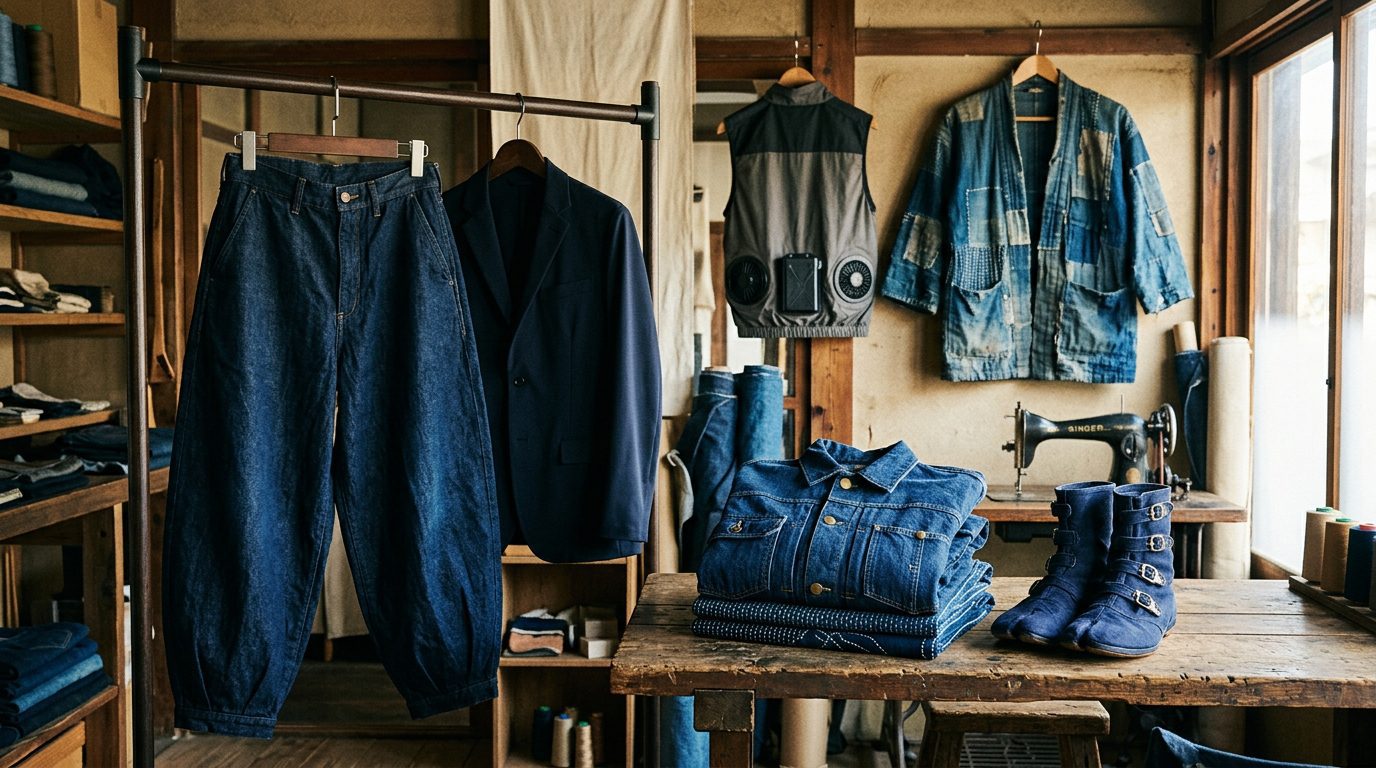
TL;DR
“Japanese workwear brands” means three different markets. Job-site uniforms — Toraichi’s balloon-leg tobi trousers, BURTLE, Jichodo, XEBEC, Sun-S fan jackets, TS DESIGN, CO-COS, AITOZ, SOWA and the Workman chain — are made around Fukuyama and Okayama, cost ¥3,000–15,000, and are not exported. Heritage and fashion workwear — Kapital, Warehouse, Studio D’Artisan, Full Count, Sugar Cane, orSlow, Engineered Garments, Post O’Alls, Jelado, TCB — reproduces 1930s–50s American work clothes in Japanese fabric at ¥20,000–60,000. And the traditional work clothes — noragi, hanten, samue, monpe, jika-tabi from Marugo and Rikio — are the folk layer both of the others borrow from.
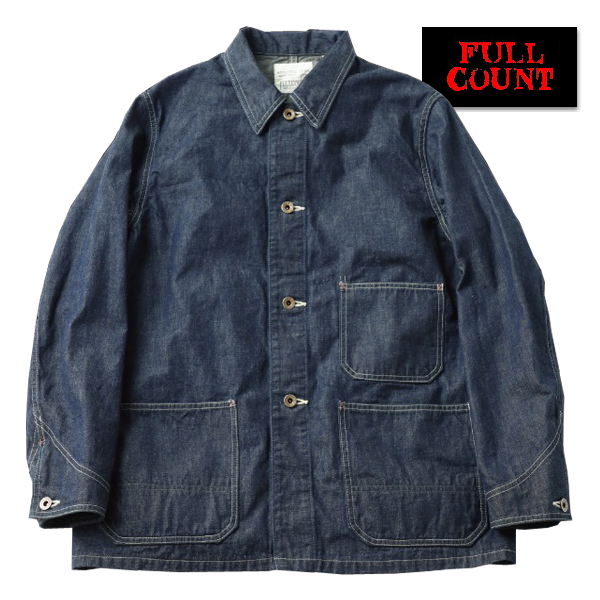
- If you want one name per layer: Toraichi for the tobi trousers (¥2,850 today), Full Count for a chore jacket (¥38,280), Marugo for jika-tabi (¥4,400).
- Cheapest way in: a SOWA shirt-and-cargo set ¥4,488, a used Toraichi pair ¥3,999, a BURTLE jacket ¥4,812, Workman’s trek hoodie ¥4,980.
- The fan jacket: Sun-S full set ¥13,910; buy garment, fan and battery from one maker.
- Sizes: trousers are waist in cm (W85 = 33.5 in); jackets run one size smaller than US; tabi and boots in cm. Conversion table below.
- Shipping: clothes ship without restrictions; fan-jacket batteries are lithium and go by Japan Post or DHL with the usual limits (the rules).
How Japanese workwear is organised
Most Japanese work uniforms come from one place: the Bingo district around Fukuyama in Hiroshima and the neighbouring Okayama towns, the same cotton-weaving belt that produces Kojima denim. Jichodo, XEBEC, CO-COS, SOWA and Sun-S are Fukuyama and Onomichi companies; Toraichi, TS DESIGN, Kanto-Tobi’s maker Okawa and the jika-tabi firm Marugo are in Kurashiki. They sell through uniform dealers and Rakuten, not through fashion shops, and none of them ship abroad. The heritage labels are a different world — Osaka’s reproduction houses, Kojima’s denim brands and two New York studios owned by Japanese companies — and they are what most “japanese workwear” articles in English are about. This guide lists both, plus the shoes and the folk clothes underneath.
Job-site workwear brands: uniforms, tobi trousers and fan jackets
| Brand | Where / since | What to search | Note |
|---|---|---|---|
| Toraichi (寅壱) | Kurashiki, Okayama | Nikkapokka and cho-cho-long hachibu (the balloon-leg tobi trousers), ropes-and-belt (胸当て) sets, open shirts, tekko wrist guards, safety shoes, the 9309 / 2530 / 8922 series numbers people search | The brand of the tobi (鳶, scaffolders)[1] — the baggy trousers that foreign visitors photograph on Japanese building sites. A pair of 9309 nikka-zubon is ¥2,850 today, the slim denim cho-cho-long 8922 ¥5,610, a used pair on Mercari ¥3,999. Toraichi is a work uniform maker, not a fashion label; the “japanese worker pants” searches almost always mean these. |
| BURTLE (バートル) | Fuchu, Hiroshima | Slim stretch work jackets and cargo pants (the 6201 series, ¥4,812 today; a used 480 hoodie jacket ¥2,500 on Mercari), AirCraft fan jackets, Thermocraft heated vests, winter Kanetan lines | The workwear brand that made Japanese job-site clothes look like streetwear[2]; the one young tradesmen and the fashion press both pick. |
| Jichodo (自重堂) | Fukuyama, Hiroshima (est. 1924) | Jawin (fashion workwear), Z-DRAGON (fan jackets), Mr.JIC, WHISeL (medical), the classic 41600 blousons (¥4,310 today) | The old firm of the Bingo (Fukuyama) workwear district[3], where most Japanese work uniforms are designed. |
| XEBEC (ジーベック) | Fukuyama, Hiroshima | Stretch work suits (a 2170-series jacket and cargo pair is ¥10,281 today), security and traffic-control uniforms, cold-weather gear | Another Fukuyama house; the uniforms on car-park attendants and security guards are often XEBEC. |
| SUN-S (サンエス) | Onomichi, Hiroshima | Kuchofukushin (空調風神服) fan-cooled jackets and vests — a full 11.4 V set is ¥13,910 today — plus regular work uniforms | The brand most associated with fan jackets after the original Kuchofuku company; the fans, batteries and cables are sold separately on Mercari. |
| TS DESIGN (藤和, Towa) | Kurashiki, Okayama | Nikkers cargo pants (ニッカーズ, the 5134 at ¥6,751 today), stretch work suits, cooling and heated wear | Okayama’s design-led workwear maker; the “ninja pants” nickname belongs to its nikkers cargo. |
| CO-COS Nobuoka (コーコス信岡) | Fukuyama, Hiroshima | Gladiator, Andare Schietti, the A-4176 cargo pants (¥4,200 today), compression base layers | One of the Fukuyama big four; Gladiator is its fashion-work sub-brand. |
| AITOZ (アイトス) | Osaka | AZ-series unisex blousons (¥6,190 today) and stretch pants, chef and medical wear, TULTEX | The Osaka uniform house; TULTEX polo shirts are AITOZ. |
| SOWA (桑和) | Fukuyama, Hiroshima | Budget work suits — a long-sleeve shirt and cargo pants pair is ¥4,488 today — coveralls (tsunagi), the G.GROUND line | The cheapest of the Fukuyama makers; where the ¥4,000 set comes from. |
| Kanto-Tobi (関東鳶, Okawa Hifuku) | Kurashiki, Okayama | Karajishi-botan (lion-and-peony) embroidered tobi trousers, super-long nikka, the 990 series; Okawa also makes KANSAI Uniform | The other tobi brand; used pairs are a few thousand yen on Mercari. |
| Warabi Ueda (蕨上田) | Warabi, Saitama | Tobi-shozoku (鳶装束) three-button cho-cho-long in Edo colours — a jacket-and-trouser set is ¥15,400 today | The Edo-style scaffolder outfit maker; low-rise slim cuts, named colours (enji, kon-peki). |
| Workman (ワークマン) | Isesaki, Gunma (est. 1982) | FieldCore, Find-Out, Aegis rainwear, Workman Plus / Workman Joshi stores; a soft-shell trek hoodie is ¥4,980 on Amazon Japan today | Japan’s 1,000-store workwear chain[6] that became an outdoor and techwear brand; it has no export site, so it is bought through a proxy. Full buying guide: Workman Japan. |
| Kuchofuku (空調服) — the original fan jacket company, Makita, Jichodo Z-DRAGON | Tokyo / Anjo, Aichi | The registered Kuchofuku® jackets and coveralls (¥12,320 for the official-shop fan coverall today), Makita’s battery-compatible fan jackets and fan units, Z-DRAGON | Fan-cooled workwear was invented in Japan in 2004 by Kuchofuku Co.[4]; Sun-S, BURTLE AirCraft, Jichodo and Makita are the other big systems, and their batteries are not cross-compatible. |
Heritage, reproduction and fashion workwear brands
| Brand | Where / since | What to search | Note |
|---|---|---|---|
| KAPITAL (キャピタル) | Kojima, Okayama (est. 1985) | Century denim, boro and sashiko patchwork jackets, Kountry line, ring coats, smiley knits | The Kojima label that turned Japanese folk workwear (boro, noragi, sashiko) into a fashion vocabulary; Beams and Nepenthes carry it, resale runs on Mercari. |
| Warehouse & Co. (ウエアハウス) | Osaka (est. 1995) | Lot 1001 jeans, Lot 2195 pincheck coverall (¥41,800 on Amazon Japan today), Lot 2211 pullover work shirts, DubbleWorks, Duck Digger | The most literal reproduction house; coveralls and chore jackets are copied from 1930s–50s American originals down to the change buttons. |
| Studio D’Artisan (ステュディオダルチザン) | Osaka (est. 1979) | GL3 denim coveralls (the D4620), Fox Fibre coveralls, the SD-series jeans; a used denim coverall is ¥23,000 on Mercari today | The first of the Osaka Five and the first modern Japanese reproduction brand. |
| Full Count (フルカウント) | Osaka (est. 1992) | 2015-1 denim chore jacket (¥38,280 today), 2015HW heavyweight, Zimbabwe-cotton jeans, painter and chore variants (¥50,000 for a 2026AW chore jacket on Mercari) | Softest of the Osaka Five; its chore jacket is the one most often recommended as a first Japanese coverall. |
| Sugar Cane (Toyo Enterprise) | Tokyo (est. 1975) | Jean-cord and chambray work shirts (¥19,580 for a jean-cord work shirt today), fiction-romance sugarcane-fibre denim, hickory coveralls; sister brands Buzz Rickson’s, Sun Surf, Whitesville | Toyo’s workwear label; the work shirts are the reason people search “japanese work shirt”. |
| orSlow (オアスロウ) | Hyogo (est. 2005) | 1940s and 50s denim coveralls (¥39,600 for the 1940s 01-6150 today, a used 50s coverall ¥19,800 on Mercari), 105 and 107 jeans, fatigue pants, chambray shirts | Ichiro Nakatsu’s label: reproduction cuts with modern proportions; the “japanese chore jacket” searches usually land here or at Full Count. |
| Engineered Garments (Nepenthes) | New York / Tokyo (est. 1999) | Bedford and Loiter jackets, coverall jackets (¥4,000 for a used one on Mercari today), fatigue pants, made in New York for a Japanese company | Daiki Suzuki’s brand; Japanese-owned, American-made, and the reason “japanese workwear brands” lists always include a New York address. |
| Post O’Alls (Post Overalls) | New York / made in Japan (est. 1993) | Engineer jackets, No. 1 coverall, E-Z Lax pants, band-collar shirts; a used blouson is ¥11,400 on Rakuten today | Takeshi Ohfuchi’s label: American workwear archetypes redrawn and sewn in Japan. |
| Jelado, The Real McCoy’s, Freewheelers, Buzz Rickson’s, Trophy Clothing, HEADLIGHT | Tokyo / Kobe / Osaka | 491J coveralls (Jelado), 8HU work chinos (McCoy’s), 1930s overalls and bib overalls (HEADLIGHT high-back overalls ¥37,400 today), Trophy’s Dirt Denim | The vintage-reproduction tier above the Osaka Five; small runs, sold through their own shops and Rakuten dealers. |
| TCB Jeans, Momotaro, Japan Blue, Kojima Genes, Big John, Johnbull | Kojima and Kurashiki, Okayama | TCB Cat Head jackets and Cat-a-Log painter pants, Momotaro coveralls and herringbone work shirts (¥12,900 used on Mercari today), Kojima Genes hickory coveralls (¥24,200 on Amazon Japan), Johnbull baker pants (¥4,500 used) and Private Labo hard-worker denim (¥30,800) | The Kojima denim town does workwear as a side line; the jeans side is in the Japanese denim brands guide. |
| Samurai Jeans, Iron Heart, The Flat Head, Eight-G | Osaka / Kyoto | Heavyweight denim coveralls (¥37,900 for a Samurai denim coverall on Mercari), Iron Heart 21 oz work shirts, Flat Head wabash and hickory | Heavyweight workwear for people who want 18–25 oz denim in a chore-jacket shape. |
| Noragi, hanten, samue and monpe makers — Unagi no Nedoko, Waseian, Beams Japan × Kinosuke Konya, SOU·SOU | Yame / Gunma / Kyoto | Kurume-kasuri monpe (Unagi no Nedoko), samue temple workwear (Waseian), indigo noragi trousers (¥15,400 for the Beams Japan × Kinosuke Konya pair today), Kyoto SOU·SOU jika-tabi shoes; antique noragi (¥5,128 for a Showa-era indigo stripe one) and shop hanten (¥7,300) on Mercari, a woven hanten ¥13,640 new | The pre-industrial Japanese work clothes — farm jackets (noragi), shop coats (hanten / happi), monk and craftsman suits (samue), farm trousers (monpe) — that boro and sashiko fashion quotes. |
Six of those
Two Toraichi-and-BURTLE job-site pieces, the fan jacket, a pair of jika-tabi and the two chore jackets most often imported.


Japanese work boots, safety shoes and jika-tabi
| Brand | Where / since | What to search | Note |
|---|---|---|---|
| Marugo (丸五) | Kurashiki, Okayama (est. 1919) | Jika-tabi (split-toe rubber-soled boots) for festivals (¥4,400 today), work jika-tabi with steel toes and 12-kohaze closures (¥3,850), Matsuri Jog air-cushion tabi, Hyper-V slip-resistant work shoes | The jika-tabi company[5]; Marugo’s Hyper-V soles are also on kitchen shoes. |
| Rikio (力王) | Japan | Sewn-sole work tabi in 5 / 7 / 10 / 12 kohaze (¥2,980 for the 12-clasp Rikio Power today), Air Tabi Fit festival tabi, hadashi (barefoot) tabi | The other tabi brand; the one sold as “Rikio festival tabi” abroad. |
| Midori Anzen (ミドリ安全) | Tokyo (est. 1952) | JIS-standard safety shoes (the CJ010 is ¥5,236 today), anti-static and kitchen shoes, helmets and gloves | The default Japanese safety-shoe brand; JIS T 8101 is the standard to look for on the box. |
| ASICS Winjob | Kobe | CP-series safety sneakers (CP308 ¥10,850 on Mercari today, CP113, CP221, BOA-dial CP229 / CP311), JSAA-certified | The safety shoe that looks like a running shoe; the most-searched Japanese work boot outside Japan. |
| DONKEL (ドンケル), Simon, Moonstar | Tokyo / Kurume | Leather steel-toe work boots (DONKEL 603T ¥7,546 today), Dynasty series; Simon’s welding boots; Moonstar’s Kurume rubber-sole work shoes | The leather end of Japanese safety footwear. |
Japanese workwear sizes to US
| Garment | Japanese sizing | US equivalent | Note |
|---|---|---|---|
| Trousers | Waist in cm: 70 / 73 / 76 / 79 / 82 / 85 / 88 / 91 / 95 / 100 / 105 / 110 / 120 | US 28 / 29 / 30 / 31 / 32 / 33 / 35 / 36 / 37 / 39 / 41 / 43 / 47 in | Toraichi and tobi trousers list W in cm (W85 = 85 cm); length is fixed by style (cho-cho-long is extra long and blousy). |
| Jackets and shirts | SS / S / M / L / LL / 3L / 4L / 5L (chest cm on the tag) | XS / S / M / L / XL / XXL / 3XL / 4XL, roughly one size smaller than US | A Japanese L is about a US M; Fukuyama makers publish chest and length in cm on every listing. |
| Coveralls (tsunagi) | S–5L, or a chest–height pair | Same rule: go up one from your US size | Check 股下 (inseam) in cm. |
| Tabi and safety shoes | cm: 22.5 … 28 (some 29–30) | cm × 0.39 = inches; US men’s ≈ cm − 18 (26 cm ≈ US 8) | Tabi run narrow; the shoe-size chart has the full table. |
| Heritage brands | Sizes 34–44 (Warehouse, Full Count), 0–5 (Kapital, orSlow), S–XL | Vintage-style sizing runs true to chest in inches on the Osaka labels | Body measurements are in the listing in cm; convert with the clothing-size guide. |
What Japanese workwear costs in Japan today: live listings
Every row is a listing on sale on 20 September 2026, read from the shop page the morning this article went live; asking prices in yen before proxy fees and shipping. Rakuten rows are new stock from uniform dealers and brand shops; Mercari rows are private sellers, marked used or unused.
Japanese workwear terms to read a listing
| Japanese | Reading | Meaning |
|---|---|---|
| 作業服 / 作業着 / ワークウェア | sagyofuku / sagyogi / wakuwea | work clothes (the two Japanese words) / workwear (the fashion word) |
| 鳶服 / 鳶装束 / ニッカポッカ / 超超ロング | tobifuku / tobi-shozoku / nikkapokka / cho-cho-long | scaffolder clothes / scaffolder outfit / knickerbocker-style trousers / the extra-long balloon cut |
| 八分 / 胴付き / 細身 | hachibu / dotsuki / hosomi | eight-tenths length / high-waisted with a bib / slim cut (the words in a Toraichi model name) |
| ツナギ / カバーオール / ブルゾン / カーゴパンツ | tsunagi / kaba-oru / buruzon / kago-pantsu | coverall (one-piece) / coverall (chore jacket, in fashion use) / work blouson / cargo pants |
| 空調服 / ファン / バッテリー / 服のみ | kuchofuku / fan / batteri / fuku-nomi | fan-cooled jacket / fan unit / battery / garment only (no fan or battery included) |
| 帯電防止 / JIS T8118 / 難燃 | taiden-boshi / JIS T8118 / nannen | anti-static / the anti-static standard / flame-retardant |
| 安全靴 / 先芯 / JIS T8101 / JSAA | anzen-gutsu / sakishin / JIS / JSAA | safety shoes / toe cap / the leather safety-shoe standard / the sneaker-type certification |
| 地下足袋 / コハゼ / 祭り | jika-tabi / kohaze / matsuri | rubber-soled split-toe boots / the metal clasps up the back (5 to 12) / festival |
| 野良着 / 印半纏 / 法被 / 作務衣 / もんぺ | noragi / shirushi-banten / happi / samue / monpe | farm jacket / shop coat with a crest / festival coat / temple work suit / farm trousers |
| 藍染 / 刺し子 / 襤褸 / 絣 | aizome / sashiko / boro / kasuri | indigo-dyed / running-stitch reinforcement / patched rag textiles / ikat weave |
| 上下セット / 単品 / 廃番 | jouge-setto / tanpin / haiban | jacket-and-trouser set / single item / discontinued model (Rakuten clears them cheap) |
| 新品 / 未使用 / 美品 / タグ付き | shinpin / mishiyo / bihin / tagu-tsuki | new / unused / excellent condition / tags attached (Mercari condition words) |
Where to buy Japanese workwear from Japan
- Rakuten and Yahoo! Shopping carry the uniform dealers (Musashino Uniform, Kanamono-ya, the Fukuyama makers’ own shops) with every series number and size in stock; heritage brands sell through their Rakuten dealers and the Beams / Nepenthes shops.
- Mercari Japan for used Toraichi and Kanto-Tobi, unused heritage pieces at half price, antique noragi and hanten; search the brand in Japanese plus 未使用 (unused) or タグ付き (tags attached).
- Amazon Japan lists Toraichi, BURTLE, Sun-S, Marugo, Rikio, Midori Anzen and Warehouse under English titles at close to Rakuten prices.
- Yahoo! Japan Auctions for antique boro, sashiko and indigo textiles and for vintage American-import workwear that the reproduction brands copy.
Buying at the source works through a proxy service (the best ones compared, the cheapest fees). The denim brands, selvedge denim buying, Workman and yukata and jinbei guides cover the neighbouring categories; clothing sizes and shoe sizes have the full conversion charts.
Shipping workwear from Japan
- Weight: a jacket-and-trouser set is about 1.2 kg, a pair of tabi 600 g, a denim coverall 1 kg. Two or three pieces fit a 2–3 kg box by Japan Post air or DHL (times and tracking).
- Batteries: fan-jacket batteries are lithium-ion; they ship inside the garment set by Japan Post and DHL under the usual battery rules[7], not by sea (the prohibited-items guide). Garment-only (服のみ) listings avoid the issue.
- Customs: clothing attracts duty above your country’s threshold (the import-tax guide); workwear is classed as clothing, not tools, and safety shoes as footwear.
Quick answers: the Japanese workwear questions people search
| Question people search | Answer |
|---|---|
| Best / top Japanese workwear brands? | Job-site: Toraichi, BURTLE, Jichodo, XEBEC, Sun-S, TS DESIGN, CO-COS, AITOZ, SOWA, Workman. Heritage and fashion: Kapital, Warehouse, Studio D’Artisan, Full Count, Sugar Cane, orSlow, Engineered Garments, Post O’Alls, Jelado, The Real McCoy’s, TCB, Momotaro, Samurai, Iron Heart. Footwear: Marugo, Rikio, Midori Anzen, ASICS Winjob, DONKEL. The tables above cover thirty-plus. |
| What are the baggy Japanese worker pants called? Japanese construction / carpenter / factory worker pants? | Nikkapokka (from “knickerbockers”), or by cut: cho-cho-long, super-long, dotsuki (bib). Toraichi, Kanto-Tobi and Warabi Ueda make them. They are worn by tobi (scaffolders); carpenters and factory workers wear straight cargo pants from BURTLE, Jichodo or XEBEC. |
| Japanese work jacket / chore jacket / coverall / canvas work jacket / twill chore jacket? | Heritage: Full Count 2015, orSlow 1940s and 50s coveralls, Warehouse Lot 2195, SDA GL3, Sugar Cane hickory, Kapital. Job-site: BURTLE 6201, Jichodo 41600, XEBEC blousons. “Coverall” in Japanese fashion means a chore jacket; a one-piece boiler suit is a tsunagi. |
| Japanese workwear style name? Japanese workwear fashion / lookbook / aesthetic? | There is no single word; Japanese magazines say “work style” or “Ame-kaji” (American casual) for the heritage look and “tobi style” for the balloon-pant look. Boro and sashiko patchwork is the folk-textile end (Kapital, Kuon, Visvim). |
| Workman Japan: what is it, is it in the UK / US, tax-free, online, English? | A 1,000-store Japanese chain (Gunma) that sells work and outdoor gear at ¥1,000–5,000; no stores or shipping outside Japan, Japanese-only site, tax-free counters in some stores. Buying from abroad goes through a proxy — see the Workman guide. |
| Japanese cooling work jacket / fan jacket brands? | Kuchofuku (the original, 2004), Sun-S Kuchofukushin, BURTLE AirCraft, Jichodo Z-DRAGON, Makita. Buy the garment, fan and battery as one maker’s set; batteries are not cross-compatible, and lithium batteries ship by air only with restrictions. |
| Japanese work boots / steel-cap / construction boots? | ASICS Winjob (JSAA sneakers), Midori Anzen (JIS leather and sneakers), DONKEL, Simon, Moonstar, and jika-tabi from Marugo and Rikio for the traditional split-toe boot. |
| Japanese noragi / hanten / boro jacket / traditional worker pants? | Noragi is the farm jacket, hanten and happi the shop and festival coats, samue the temple work suit, monpe the farm trousers. Antique pieces are on Mercari and Yahoo! Auctions in indigo cotton; new ones come from Unagi no Nedoko (monpe), Waseian (samue), Beams Japan collaborations and Kyoto SOU·SOU. |
| Japanese workwear in London / US / NZ / Australia / eBay? | Heritage brands (Kapital, orSlow, EG, Warehouse) have stockists abroad at a markup; the job-site makers (Toraichi, BURTLE, Jichodo) and Workman do not export at all, which is what the proxy links on this page are for. eBay resellers are buying the same Rakuten and Mercari listings. |
| Japanese denim workwear brands? Denim coveralls / work pants / jeans? | Full Count, orSlow, Warehouse, SDA, TCB, Momotaro, Kojima Genes, Samurai, Iron Heart for coveralls and work pants in Japanese denim; Toraichi’s 8922 is the job-site denim cho-cho-long. Jeans by brand are in the Japanese denim brands guide. |
| Japanese school uniform brands? Work uniform jacket? | School uniforms are a separate industry (Kanko, Tombow, Fuji Yakko); work uniforms are the Fukuyama and Okayama makers in the first table. |
| Toraichi: series numbers, shirts, belts, safety shoes, tekko, online shop, Kanda? | Model numbers are series-item (9309-406, 2530-418, 8922-448); Toraichi also sells open shirts, polo shirts, belts, tekko wrist guards, welding hoods and safety shoes. Its own online shop is Japan-only; Rakuten dealers carry the full range. |
| Japanese workwear for women? | BURTLE, Jichodo and XEBEC list unisex sizes from SS; Workman Joshi is the women’s chain; heritage labels are mostly men’s cuts sized 0–1 or S for women, and Kapital and 45R design for both. |
FAQ
What is the most famous Japanese workwear brand?
Inside Japan, Workman by store count and Toraichi by silhouette. Abroad, Kapital, Engineered Garments and orSlow, because those are the ones fashion shops stock.
Why are the trousers so baggy?
Tobi (scaffolders) say the wide leg brushes obstacles before the body does and lets them feel wind on a high frame; the cho-cho-long cut is the extreme version. The look started with knickerbockers imported in the Meiji era, hence nikkapokka.
Are Japanese job-site brands good quality for fashion use?
Yes, and cheap: BURTLE and Jichodo jackets are stretch polyester-cotton with anti-static finishes at ¥4,000–6,000. They are cut for work (longer bodies, action backs), so size carefully; the heritage brands are the ones cut for the street.
Can I buy Toraichi or Workman outside Japan?
Not directly: neither ships abroad and neither has an English site. Both are on Rakuten and Amazon Japan, which a proxy can buy from; Workman’s own site is Japan-only.
What is the difference between noragi, hanten, happi and samue?
Noragi is a farm jacket (often patched and indigo), hanten a padded or shop coat (shirushi-banten carries a crest), happi the light festival coat, samue the two-piece suit monks and craftsmen work in. Monpe are the farm trousers. All of them are being made new again, and antiques are cheap on Mercari.
Related reading
- Workman Japan: buying the affordable techwear chain from overseas · Japanese denim brands · How to buy Japanese selvedge denim · Yukata and jinbei from Japan
- Japanese clothing size conversion · Japanese shoe size conversion
- Japanese knife brands · Japanese camera brands · Japanese watch brands · Japanese bicycle brands — the other brand guides in this series
- Import tax and customs when buying from Japan · What you cannot ship from Japan
Last updated: 20 September 2026. Listing prices read from live Japanese listings on 20 September 2026; company locations from the makers’ own pages.
References
- Toraichi Co. — official site (Kurashiki, Okayama). toraichi.co.jp
- BURTLE Co. — official site (Fuchu, Hiroshima). burtle.jp
- Jichodo Co. — official site (Fukuyama, Hiroshima). jichodo.co.jp
- Kuchofuku Co. — official site (fan-cooled workwear). 9229.co.jp
- Marugo Co. — official site (Kurashiki, jika-tabi). marugo.ne.jp
- Workman Co. — corporate site (Isesaki, Gunma). workman.co.jp
- OneMall Support — international shipping and prohibited items (batteries). support.onemall.jp