
 Shopping Guide
 HELP / FAQs



 By onemall
 TL;DR
A Japanese shoe size is your foot length in centimetres — there is no code to crack. To convert a Japanese shoe size to US, subtract about 18 for men’s sizing and about 17 for women’s sizing: 27 cm is roughly a US men’s 9, and 24 cm is roughly a US women’s 7. UK sizing is the cm number minus about 19.
- Japan sizes shoes in cm — under JIS S 5037 the label is the foot length, in 0.5 cm steps[1].
- Men’s US ≈ cm − 18, women’s US ≈ cm − 17, UK ≈ cm − 19.
- Width is a separate letter — D, E, EE, EEE, 4E. Most Japanese lasts run narrow, so width is where imports actually go wrong.
- “Japanese shoe size 35” is not Japanese — that is an EU number, roughly 22.5 cm.
- Kids’ sizes are still cm, but US kid labels (K4–K13, then 1–7) don’t line up neatly. Trust the centimetre.
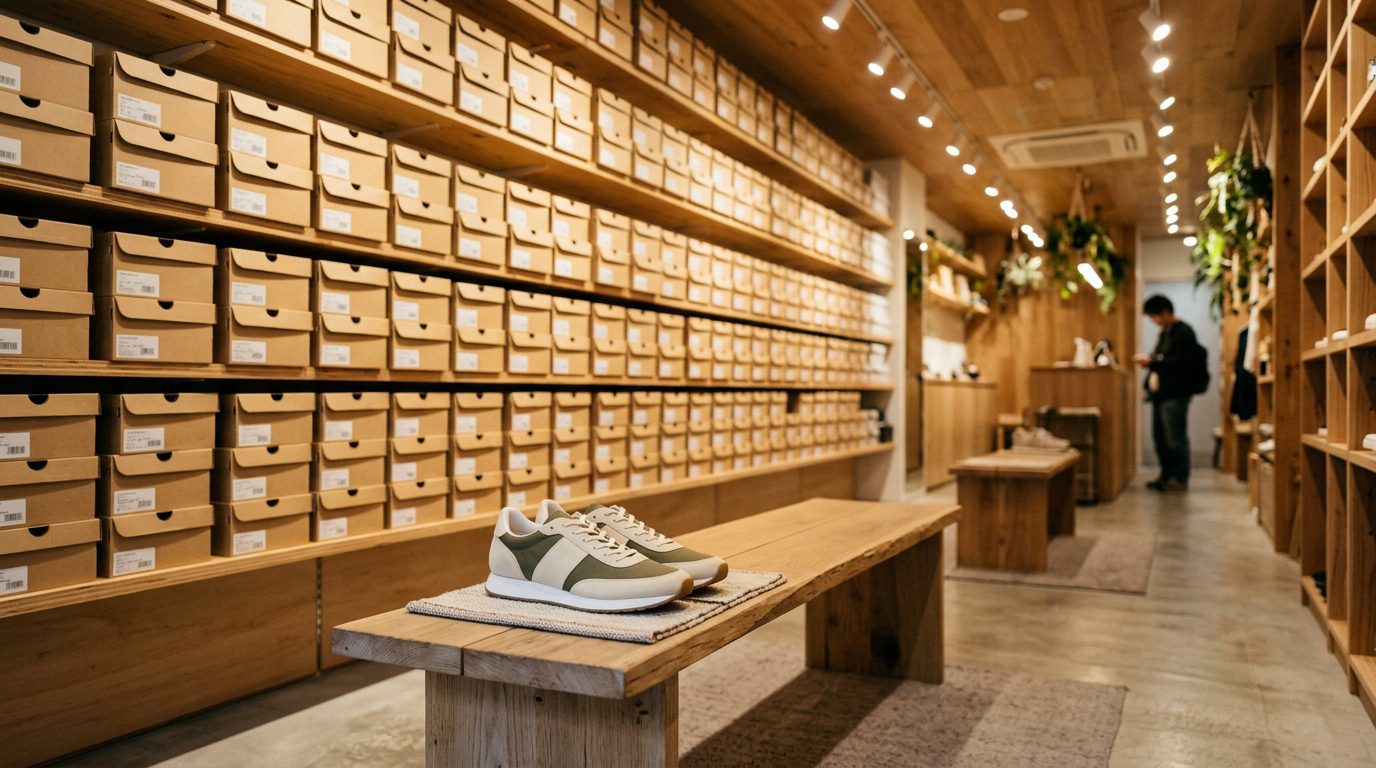
As of September 2026, the single biggest reason a Japan-bought sneaker doesn’t fit isn’t the length — buyers convert that correctly most of the time. It’s the width letter, which Western size charts simply don’t have. Japanese domestic models of the same silhouette are frequently cut on a narrower last than the US release, so a “correct” 27 cm can still pinch. This guide gives you the full length chart first, then the part nobody writes down.
Japanese shoe sizes explained: what the number means
Japan does not use an abstract size scale, so “JP 25.5” needs no converter at all — the meaning is literal. The number printed on the box is the length of the foot the shoe is built for, in centimetres, and Japanese Industrial Standard JIS S 5037:1998 fixes the increment at 5 mm[1]. The standard is maintained by the Japanese Industrial Standards Committee[2]. So 25.5 means 25.5 cm. Some boxes print it as 255 — same thing, in millimetres.
That makes Japan the easiest sizing system in the world to use, provided you do one thing first: measure your foot. Stand on a sheet of paper against a wall, mark the tip of your longest toe, measure heel-to-mark in centimetres, and do it in the evening when your foot is at its largest. The number you get is, near enough, your Japanese size.
Japanese shoe size to US conversion chart
This chart covers 21.0 cm to 31.0 cm, which spans essentially everything sold in Japan for adults. US men’s and US women’s are shown separately because they are two different scales roughly one size apart.
| Japanese size (cm) | US men | US women | UK | EU men | EU women |
|---|---|---|---|---|---|
| 21.0 | 3.0 | 4.0 | 2.0 | 36.5 | 35.0 |
| 21.5 | 3.5 | 4.5 | 2.5 | 37.0 | 35.5 |
| 22.0 | 4.0 | 5.0 | 3.0 | 37.5 | 36.0 |
| 22.5 | 4.5 | 5.5 | 3.5 | 38.0 | 36.5 |
| 23.0 | 5.0 | 6.0 | 4.0 | 38.5 | 37.0 |
| 23.5 | 5.5 | 6.5 | 4.5 | 39.0 | 37.5 |
| 24.0 | 6.0 | 7.0 | 5.0 | 39.5 | 38.0 |
| 24.5 | 6.5 | 7.5 | 5.5 | 40.0 | 38.5 |
| 25.0 | 7.0 | 8.0 | 6.0 | 40.5 | 39.0 |
| 25.5 | 7.5 | 8.5 | 6.5 | 41.0 | 39.5 |
| 26.0 | 8.0 | 9.0 | 7.0 | 41.5 | 40.0 |
| 26.5 | 8.5 | 9.5 | 7.5 | 42.0 | 40.5 |
| 27.0 | 9.0 | 10.0 | 8.0 | 42.5 | 41.0 |
| 27.5 | 9.5 | 10.5 | 8.5 | 43.0 | 41.5 |
| 28.0 | 10.0 | 11.0 | 9.0 | 43.5 | 42.0 |
| 28.5 | 10.5 | 11.5 | 9.5 | 44.0 | 42.5 |
| 29.0 | 11.0 | 12.0 | 10.0 | 44.5 | 43.0 |
| 29.5 | 11.5 | 12.5 | 10.5 | 45.0 | 43.5 |
| 30.0 | 12.0 | 13.0 | 11.0 | 45.5 | 44.0 |
| 30.5 | 12.5 | 13.5 | 11.5 | 46.0 | 44.5 |
| 31.0 | 13.0 | 14.0 | 12.0 | 46.5 | 45.0 |
The US and UK columns are the standard arithmetic relationship, not any one brand’s chart, so treat them as accurate to within half a size. Every real brand deviates a little — see the brand section below.
Quick answers for the most-searched female and male sizes
- 23.0 cm — US men 5.0, US women 6.0, UK 4.0.
- 24.0 cm — US men 6.0, US women 7.0, UK 5.0.
- 24.5 cm — US men 6.5, US women 7.5, UK 5.5.
- 25.0 cm — US men 7.0, US women 8.0, UK 6.0.
- 26.0 cm — US men 8.0, US women 9.0, UK 7.0.
- 27.0 cm — US men 9.0, US women 10.0, UK 8.0.
- 28.0 cm — US men 10.0, US women 11.0, UK 9.0.
Going the other way: American / US shoe size to Japanese cm
Buying from a Japanese site means you have to state a cm number, not a US one. Flip the arithmetic — add 18 to a US men’s size, add 17 to a US women’s size:
- US men 7.0 — ask for 25.0 cm (US women 7.0 wears about 24.0 cm).
- US men 8.5 — ask for 26.5 cm (US women 8.5 wears about 25.5 cm).
- US men 9.0 — ask for 27.0 cm (US women 9.0 wears about 26.0 cm).
- US men 10.5 — ask for 28.5 cm (US women 10.5 wears about 27.5 cm).
- US men 11.0 — ask for 29.0 cm (US women 11.0 wears about 28.0 cm).
- US men 11.5 — ask for 29.5 cm (US women 11.5 wears about 28.5 cm).
- US men 13.0 — ask for 31.0 cm (US women 13.0 wears about 30.0 cm).
Brand reality check: the baseline is not gospel
Brands publish their own charts because their lasts differ. ASICS, to take a Japanese brand with a public international chart, maps a US men’s 9 to 27 cm and a US men’s 8 to 26 cm — matching the cm − 18 rule exactly — but puts US men’s 6 at 24.5 cm, half a centimetre off the baseline[3]. Onitsuka Tiger, ASICS’ heritage line and one of the most-searched Japanese sneaker brands abroad, is cut noticeably slim through the midfoot.
The practical rule: when a Japanese product page lists cm, buy the cm. When it only lists a US number, check that brand’s own chart rather than converting twice.
Width: the letter that ruins more orders than length
Japanese footwear is specified by length and girth, and the girth designator is part of the size under the same JIS standard[1]. You will see D, E, EE, EEE and 4E on domestic models. Roughly:
| Japanese width | Fit | Closest US equivalent |
|---|---|---|
| D | Narrow | US B (women) / narrow |
| E | Slightly narrow | US B–D |
| EE (2E) | Standard in Japan | US D (men’s standard) |
| EEE (3E) | Wide | US 2E |
| 4E | Extra wide | US 4E |
If a domestic Japanese listing does not state a width, assume EE. If you normally need a US wide, look for 3E or 4E rather than sizing up in length — going up a half centimetre to buy width gives you a shoe that slips at the heel.
Japanese kids, toddler and baby shoe sizes
Children’s shoes in Japan are labelled in cm too, typically from 11 cm up. The US children’s scale, by contrast, restarts twice (toddler K sizes, then youth 1–7), which is why kids’ conversions feel so messy. Here is ASICS’ own kids mapping[3]:
| Japanese size (cm) | US kids size | US label |
|---|---|---|
| 12.0 | US K4 | Toddler |
| 13.0 | US K5 | Toddler |
| 13.5 | US K6 | Toddler |
| 14.5 | US K7 | Toddler |
| 15.0 | US K8 | Little kid |
| 16.0 | US K9 | Little kid |
| 17.0 | US K10 | Little kid |
| 17.5 | US K11 | Little kid |
| 18.5 | US K12 | Little kid |
| 19.5 | US K13 | Little kid |
| 20.0 | US 1 | Big kid |
| 21.0 | US 2 | Big kid |
| 22.0 | US 3 | Big kid |
| 22.5 | US 4 | Big kid |
| 23.5 | US 5 | Big kid |
| 24.5 | US 6 | Big kid |
| 25.5 | US 7 | Big kid |
Half sizes exist in between. For babies and toddlers, ignore US labels entirely: measure the foot, add 0.5–1.0 cm of growing room, and order that cm.
Japanese shoe size vs US, UK, EU, CN and KR
Japan is not alone in sizing by foot length. China and South Korea both use Mondopoint, which is the same measurement expressed in millimetres — so a Japanese 25.5 cm, a Chinese 255 and a Korean 255 are the identical shoe. That is also why Japanese boxes print three digits: 225 = 22.5 cm, 235 = 23.5 cm, 240 = 24.0 cm, 245 = 24.5 cm, 255 = 25.5 cm. Yes — Japanese shoe size is just cm, with no conversion involved.
Only the American, British and European systems use abstract numbers, which is why an American shoe size to Japan conversion needs a chart at all. French sizing is the same Paris-point scale as the rest of continental Europe, so treat FR and EU as one column.
| System | What the number means | Example for a 26 cm foot |
|---|---|---|
| Japan (JP) | Foot length in cm | 26.0 |
| China (CN) / Korea (KR) | Foot length in mm (Mondopoint) | 260 |
| US men | Abstract scale | 8 |
| US women / ladies | Abstract scale, ~1 size above men’s | 9 |
| AU / NZ / IN / LK / BD | UK scale | 7 |
| Philippines | US scale | 8 (men) / 9 (women) |
| Hong Kong | Usually listed in cm | 26.0 |
| UK | Abstract scale | 7 |
| EU / FR | Paris points | 41.5 |
So a Japanese shoe size compared to US is a real conversion, while Japanese versus Chinese or Korean sizing is only a change of unit. Australia, New Zealand, India, Sri Lanka and Bangladesh all read off the UK column; the Philippines reads the US column; Hong Kong listings usually quote centimetres, like Japan.
One exception to all of this: slippers, sandals and some house shoes are sold S / M / L rather than in cm. Read those as roughly S = 22–24 cm, M = 24–26 cm, L = 26–28 cm, and check the listing’s stated range.
Brand charts differ inside this framework rather than replacing it. ASICS, Onitsuka Tiger, Mizuno, New Balance, adidas, Nike, GU and UNIQLO all label their Japanese domestic stock in cm; where a brand also prints a US number, follow that brand’s own chart.
“Japanese shoe size 35” and other numbers that aren’t Japanese
Japan does not use two-digit sizes in the 35–45 range — those are European. If a listing shows 35, 38 or 42, you are looking at an EU number: EU 35 is about 22.5 cm, EU 38 about 24 cm, EU 42 about 26.5 cm. Japanese sock sizing is different again: socks are sold in cm ranges such as 23–25 cm or 25–27 cm, so pick the range your shoe size falls inside rather than converting to a US sock size.
How to buy Japanese-size shoes from Japan
Most Japanese domestic models — the colourways that never reach US stores — are only sold on Japanese sites that won’t ship abroad. A proxy service buys them on your behalf. Here is the whole process:
- Step 1 — Measure and convert. Get your foot length in cm from the chart above; that number is what you order.
- Step 2 — Find the item. Search Japanese marketplaces directly. OneMall searches ZOZOTOWN, Rakuten, Yahoo Auctions, Mercari, Amazon Japan and Suruga-ya in one place, and its AI image search will find a shoe you only have a photo of.
- Step 3 — Check the size on the listing itself. Domestic listings state cm and width; second-hand listings state the size printed on the shoe. Confirm both before ordering.
- Step 4 — Order and pay stage one. Product price plus the service fees are ¥300 per item on most marketplaces; from ¥200 per item on Yahoo Auctions and LinkBuy.
- Step 5 — Consolidate. Shoe boxes are bulky and shipping is charged on the greater of actual and volumetric weight, so combining orders matters more for footwear than for almost anything else. The first six orders consolidate free, and storage is free for 90 days while you wait for the rest of a haul.
- Step 6 — Choose shipping and pay stage two. EMS, DHL, ECMS or sea mail — Japan Post publishes the EMS country list and rates itself[4]; estimate the cost with the shipping calculator before you commit.
- Step 7 — Clear customs. Footwear duty rates and import thresholds are set by your own country’s customs authority, not by the seller — check them before buying multiple pairs[5].
Sizing the rest of the outfit works differently: see the Japanese clothing size conversion chart for JIS letters and 号 numbers, and the Japanese ring size chart if you are buying jewellery.
If you are weighing services against each other, our proxy fee comparison breaks down the actual numbers, and the complete guide to buying from Japan covers the rest of the workflow.
Frequently Asked Questions
What is a Japanese shoe size 25 in US?
25 cm is a US men’s 7 or a US women’s 8. Because Japanese sizing is unisex by length, the same 25 cm shoe fits both — only the last shape differs.
Is Japanese shoe size the same as cm?
Yes. The Japanese size is the foot length in centimetres, standardised in 5 mm steps[1]. A box marked 255 means 25.5 cm.
What is US men’s 11 in Japanese size?
About 29 cm. Add 18 to a US men’s size to get the Japanese cm number. US 10.5 is about 28.5 cm and US 12 is about 30 cm.
Do Japanese shoes run small?
In length, no — the cm number is honest. In width, usually yes. Japanese standard width is EE, and many domestic models are cut slimmer than their US counterparts, so wide-footed buyers should look for 3E or 4E instead of sizing up.
What is the average shoe size in Japan?
There is no official published statistic, but stock depth tells the story: the average Japanese man’s range is deepest between 26 and 27 cm, and the average female or ladies’ range between 23 and 24 cm — a Japanese woman’s shoe size is most often quoted as 23.5 cm. Sizes above 29 cm and below 22 cm are stocked thinly and sell out slowly, which is worth knowing before you plan a haul.
How do I convert a Japanese kids’ shoe size to US?
Use the cm value and the kids table above — roughly, 15 cm is a US K8 and 20 cm is a US 1. Add 0.5–1.0 cm of growing room for children still in a growth spurt.
Related guides
References
- Japanese Standards Association — JIS S 5037:1998, Sizing system for shoes. https://webdesk.jsa.or.jp/books/W11M0090/?bunsyo_id=JIS+S+5037:1998
- Japanese Industrial Standards Committee (JISC) — official English portal and JIS search. https://www.jisc.go.jp/eng/index.html
- ASICS — official size and fit guide (shoe size conversion, adults and kids). https://www.asics.com/sg/en-sg/customer-service/size-fit-guide/size-fit-guide.html
- Japan Post — international mail services, EMS and rate finder. https://www.post.japanpost.jp/service/send/oversea/index_en.html
- Japan Customs — official English guidance on import and export procedures. https://www.customs.go.jp/english/
Last updated: 2026-09-09.