
 Shopping Guide
 HELP / FAQs


 By onemall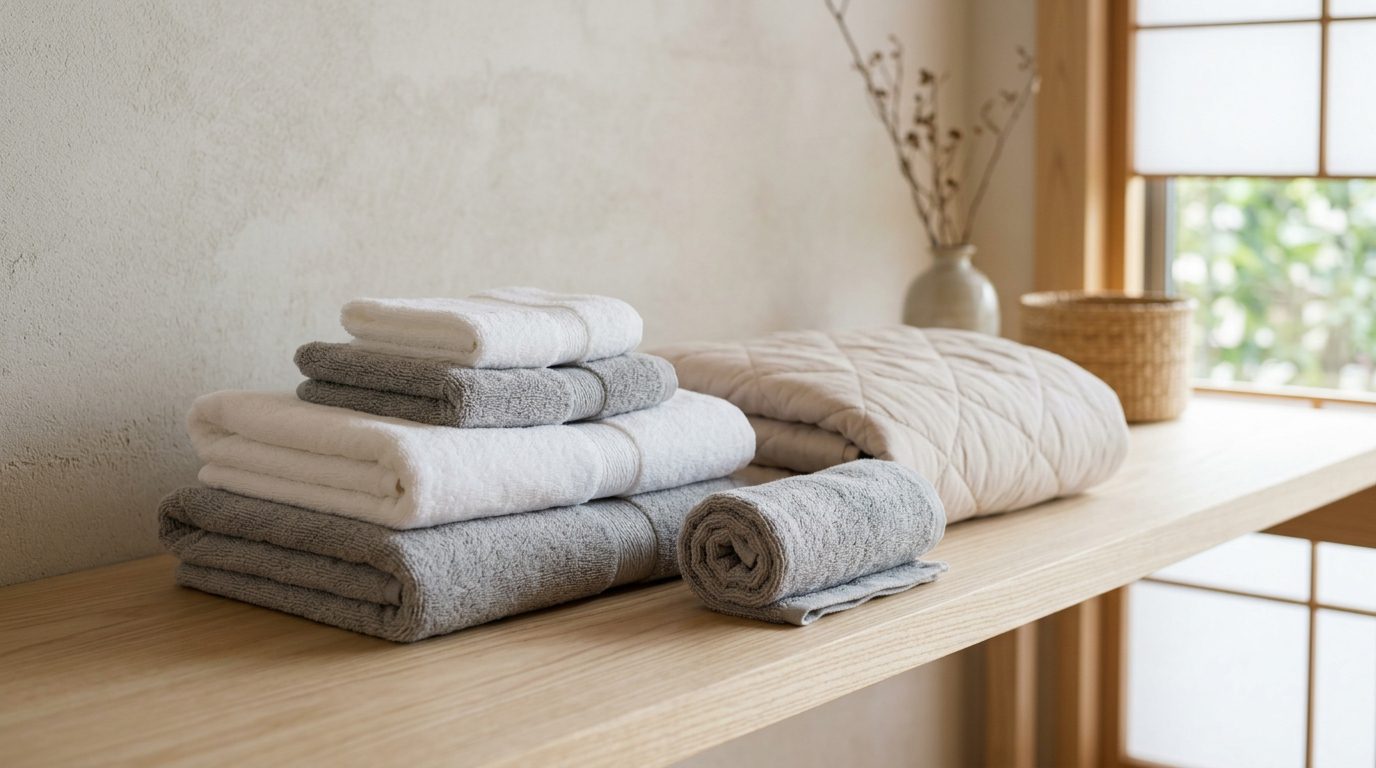
TL;DR
Japanese towels are cheap, excellent and certified by a body that publishes an actual test.
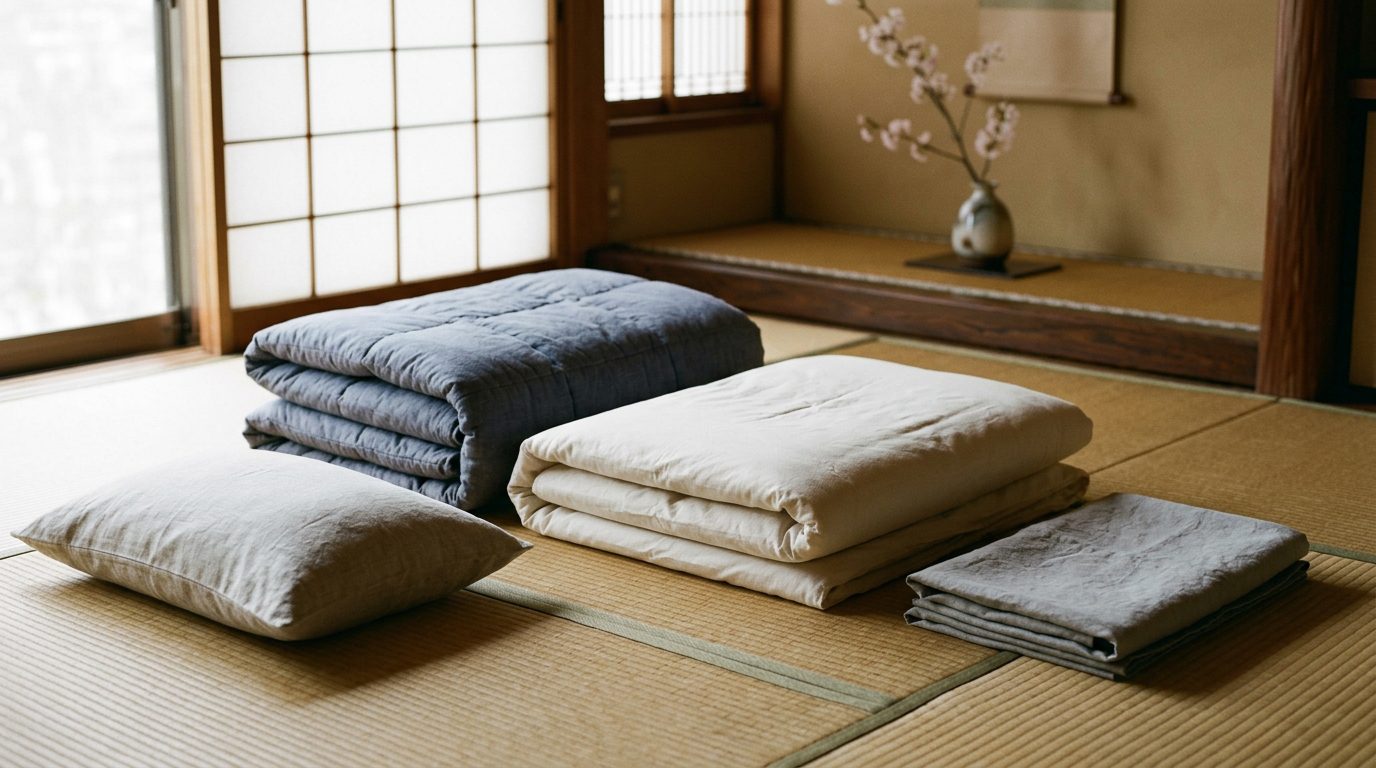
Japanese bedding is excellent and the single worst thing you can put in an international parcel.
Both facts come from the same place: this is a category billed by volume, not by value.
- Real prices, checked on 4 September 2026 — an Imabari face towel at
¥700 (US$4.83), a two-pack at ¥798 (US$5.51), a
60×120 cm bath towel at ¥1,100 (US$7.59), a face-and-hand gift
set at ¥1,548 (US$10.68).[6] - The mark is the product. “Imabari towel” in a listing title is a
description anyone can type. The Imabari Towel Brand certification mark, issued by the local
industry association against a published absorbency test, is the part that means
something.[1] - Japanese bath towels are smaller than yours. A Japanese
basu taoru is around 60×120 cm. A Western bath sheet is not. Read the
centimetres, not the noun. - Bedding is a volumetric-weight trap. A Nishikawa down duvet was
¥22,800 (US$157.32) and a summer down throw ¥7,980
(US$55.06) — but a single duvet in a 60×45×35 cm box bills as about
19 kg of chargeable weight regardless of what it actually weighs. - Japanese bed sizes are their own system. “Single long” is
150×210 cm and will not fit a Western duvet cover bought at home.
As of September 2026, the towel half of this category is one of the best-value
things a proxy parcel can carry and the bedding half is one of the worst. This guide separates
them, and shows the arithmetic that makes the difference.
What the Imabari Certification Actually Is
Imabari, in Ehime Prefecture, has been a towel-weaving town since the late nineteenth
century. The Imabari Towel Brand mark is administered by the local towel industry association
and is granted to products that pass its testing — the best known of which is the
absorbency check often called the “five-second rule”: a piece of the towel fabric dropped on
water should begin to sink within five seconds.[1]
Two things follow from that, and they are the entire buyer’s-guide part of this article:
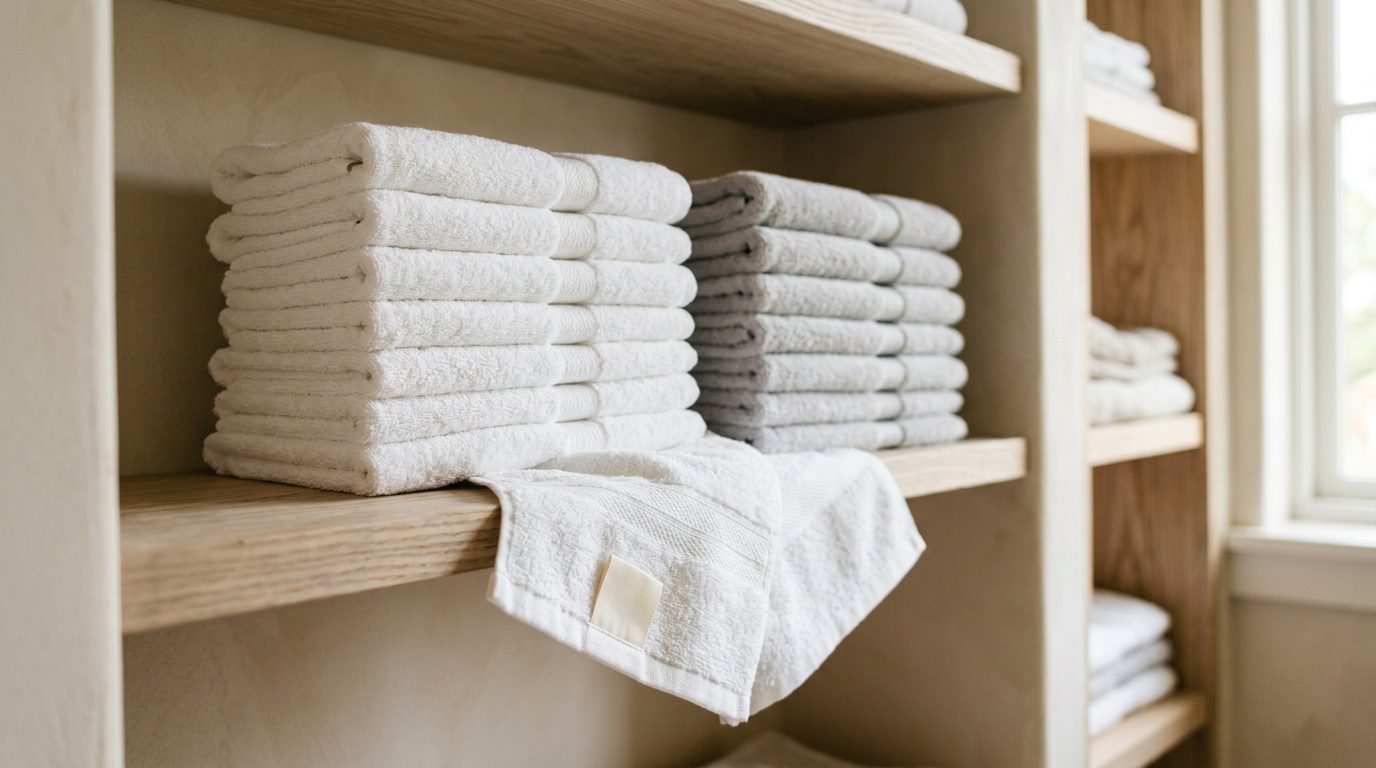
- Certified ≠ made in Imabari ≠ called “Imabari” in a title. Listings
using the words今治タオルare abundant; the certification mark — a red,
blue and white device carried with a certification number — appears on the label of
products that passed. If the photographs show the label, you can check. - The certification is about absorbency and safety, not luxury. A
¥700 certified face towel and a ¥3,000 certified one both passed the same test. What
you pay more for is weight of cotton, yarn, and finishing — not a higher grade of
certificate.
There is a second towel region worth knowing: Senshu, in southern Osaka, which is known for
後晒し (atozarashi, post-weave bleaching) rather than the pre-bleaching
used elsewhere. Senshu towels are usually cheaper than certified Imabari and are the better
buy if you are shipping volume.
Sizes: Read the Centimetres
| Japanese name | Typical size | What it is closest to | Seen on 4 Sep 2026 |
|---|---|---|---|
| ハンドタオル / ハンカチ | 25×25 cm | A pocket handkerchief towel — a genuinely Japanese everyday object | ¥330–¥650 |
| フェイスタオル | 34×75–80 cm | A Western hand towel | ¥700 single; ¥798 for two |
| ミニバスタオル | 45×100 cm | Between a hand towel and a bath towel; sold as the space-saving option | ¥1,390 |
| バスタオル | 60×120 cm | Smaller than a Western bath towel, nowhere near a bath sheet | ¥1,100–¥1,331 |
| ダウンケット | 150×210 cm (single long) | A lightweight summer down throw — no Western equivalent in most shops | ¥7,980 |
| 羽毛布団 (single long) | 150×210 cm | A single duvet, but not the same rectangle as a UK or US single | ¥22,800 |
The bath towel row is the one that generates complaints. Japanese bathing culture does not
use a big towel; a 60×120 cm towel is normal there and will feel undersized if you
expected a bath sheet. Nothing is wrong with the product — the noun just does not
translate.
The Arithmetic That Decides This Category
International shipping is billed on chargeable weight: the greater of the
actual weight and the volume of the box divided by 5,000. Towels and bedding are light and
bulky, so volume wins almost every time, and that single rule explains every recommendation
below.
Towels
Six certified face towels weigh well under a kilogram and compress. Packed flat by a
consolidation warehouse rather than shipped in six separate seller boxes, they stay in a small
carton and a low band. Bought individually and shipped as they arrive, the same six towels are
six parcels, six service fees and six times the air.
Bedding
Here is the number that matters. A single down duvet, folded into a
60×45×35 cm box, is 94,500 cm³. Divide by 5,000 and the chargeable
weight is 18.9 kg — and it will be billed at that even though the
duvet itself is around two. That is the reason a ¥22,800 duvet is rarely a sensible import
and a ¥7,980 summer throw sometimes is: the throw compresses far smaller, and the price it
is competing against at home is lower.
If you do want bedding, two things genuinely help. Ask whether the item can be
vacuum-compressed before it is boxed, and buy the cover rather than the filling
— a Japanese duvet cover or a gauze ケット (the ¥1,620 one above is a
single) is a fraction of the volume and carries most of what makes Japanese bedding pleasant.
The cover has the added advantage of being the part that Japanese sizing makes hard to buy at
home.
Money: Fees, Duty and the Gift Season
- Japanese consumption tax (10%) is already in the listed
price.[2] - The proxy’s service fee is a ¥300 per item on most marketplaces on Rakuten, Mercari,
Suruga-ya and Amazon Japan; Yahoo! Auctions is 3% of the winning bid, between ¥200 and
¥300. Because it is charged per item, a ¥700 towel bought on its own carries the same fee as a boxed gift set
— the set is the better shape. Our
true-cost breakdown works the whole bill through with examples. - Consolidation and storage do the heavy lifting. Free consolidation on your
first six orders (¥100 each afterwards) and 90 days of free storage after arrival (30 days after consolidation) mean you can accumulate
towels across several weeks and pay one freight bill. - Duty. Cotton textiles sit at a higher duty rate than consumer electronics
in most tariff schedules, so check your own before assuming a small parcel arrives clean. The
United States suspended its US$800 de minimis exemption on 29 August
2025[3], and the EU has a temporary flat fee for low-value
imports with normal duty and VAT above it.[4]
Why so many towel gift sets right now
Japan’s Respect for the Aged Day falls on the third Monday of September — 21 September
in 2026 — and towels are the default gift, which is why so much of the current Imabari
inventory is boxed as a set. That is useful to a foreign buyer for a practical reason rather
than a sentimental one: a boxed set of two or three towels is one order and one service fee,
where the same towels bought singly would be three. Our
Japanese year-end shopping calendar maps the rest of the season.
Step-by-Step: Buying Japanese Towels and Bedding From Overseas
- Step 1 — Decide towels or bedding, not both. They have opposite
economics. Towels reward batching; bedding rewards buying the smallest, most compressible
version of what you want. - Step 2 — Search in Japanese.
今治タオルfor towels,
今治タオル ギフトfor the boxed sets,羽毛布団 日本製for
Japanese-made bedding. The towel search is here, the
gift-set search here, and the
bedding search here. - Step 3 — Check the size in centimetres and look for the mark. Ignore
the words “bath towel”; read the dimensions. If certification matters to you, look for the
Imabari Towel Brand label in the product photographs. - Step 4 — Buy sets, not singles. One order carries one service fee.
Three towels from one shop beat three towels from three shops every time. - Step 5 — Ask about compression before ship-out. For anything
quilted or filled, ask whether it can be vacuum-packed. This is the single biggest lever on the
freight bill in this category. - Step 6 — Price the box, not the item. Put your real box dimensions
into the shipping calculator before you commit. If the
chargeable weight comes back at four times the actual weight, that is the answer telling you to
buy the cover instead of the duvet.
Frequently Asked Questions
How do I know a towel is genuinely certified Imabari?
Look for the Imabari Towel Brand mark and its certification number on the sewn-in label in
the product photographs. The phrase in the listing title is not the certification; the label
is.[1]
Are Japanese bath towels really smaller?
Yes. The standard Japanese bath towel is around 60×120 cm, roughly the size of
what many countries would call a large hand towel. If you want a bath sheet, buy two, or accept
the Japanese proportion — it is a deliberate design, not a defect.
Is it ever worth importing a Japanese duvet?
Only if the specific product is unavailable at home and you accept the volumetric bill.
A single duvet in a typical box is charged as roughly 19 kg. The cover, the summer throw
or a gauze ケット gives you most of the character at a fraction of the volume.
Will Japanese bedding fit my duvet cover?
Probably not. Japanese sizing runs on its own set of rectangles — “single long” is
150×210 cm — and none of them map cleanly onto UK, EU or US sizes. If you buy
the filling, plan to buy the Japanese cover with it.
Can towels be shipped compressed?
They can be packed flat and tight by a consolidation warehouse, which is most of the benefit.
Vacuum compression is more useful on quilted goods. Either way, ask before ship-out rather than
after.
The Short Version
Towels: buy certified sets, batch them, ship them flat — a ¥700 face towel that
arrives in a consolidated box is one of the best-value things Japan exports. Bedding: buy the
cover or the summer throw, ask for compression, and price the box before the product. If you
want another Japanese household category with the same fragile-and-bulky arithmetic, our
Japanese ceramics and tableware guide covers it; the
cheapest Japan proxy comparison and the
true-cost breakdown cover the money.
Live Imabari towel listings are here.
Last updated: 2026-09-28.
Buying any of this means going through a domestic-only checkout. The Japan proxy service guide explains the mechanics end to end, and the proxy fee comparison shows where per-item and per-order charges land.
References
- Imabari Towel Industrial Association, official brand and certification information. https://imabari-towel.jp/
- National Tax Agency of Japan, English-language tax information including consumption tax. https://www.nta.go.jp/english/
- U.S. Customs and Border Protection, guidance on the suspension of de minimis duty-free treatment. https://www.help.cbp.gov/s/article/Article-1919
- European Commission, guidance on the temporary flat fee for low-value imports. https://taxation-customs.ec.europa.eu/news/guidance-and-legal-text-temporary-flat-fee-low-value-imports-which-will-apply-until-1-july-2028-2026-06-08_en
- Japan Customs, export and import information. https://www.customs.go.jp/english/index.htm
- OneMall, marketplace used for the towel and bedding price observations recorded in this article on 4 September 2026. https://www.onemall.jp/