
 Shopping Guide
 HELP / FAQs



 By onemall
TL;DR
NJS parts are the components approved for use in Japanese keirin racing. That approval is a safety and fairness rule, not a marketing badge — and it produced a domestic supply of over-engineered steel and aluminium track parts that are still being sold, still being made, and still absurdly cheap to ship. The parts are small and dense; the frames are not. Knowing which side of that line you are shopping on is the whole game.
- Keirin is regulated, and so is the hardware. JKA, the public-interest foundation that governs keirin, sets the 競走車安全基準 (racing-bicycle safety standard) that equipment must satisfy[1][2]. The NJS mark is the visible end of that process.
- NJS parts are still made new. Mikashima (MKS), the Tokyo pedal maker, keeps a dedicated 競輪(NJS)認定品 product category — steel toe clips at ¥2,761, alloy at ¥3,212, Supreme pedals at ¥20,911[3].
- The secondhand layer is where the value is. On 30 August 2026 we found a Shimano Dura-Ace NJS track cog at ¥1,580, a Dura-Ace 52T NJS chainring at ¥3,600 and a Nitto B123 NJS steel bar at ¥4,500.
- Track standards are not road standards. Track hubs are 100 mm front and 120 mm rear[4], keirin chains are 1/8 inch, and Japanese bars like the B123 use a 25.4 mm clamp. Measure before you buy.
- Small parts ship for almost nothing. A cog and a chainring (~700 g) quoted US$20.99 economy air to the United States and US$17.04 EMS to Singapore on 30 August 2026.
As of August 2026. Fixed-gear riders outside Japan have been chasing NJS parts for twenty years, mostly through resellers who mark them up several times. The parts themselves never left the Japanese domestic market; they just never had a direct route out of it.
What NJS Approval Actually Certifies
Keirin is a licensed gambling sport in Japan, run under rules set by JKA[1]. Because the betting is on the riders and not the equipment, the equipment has to be neutralised: a rider must not win because of a part. JKA therefore publishes a safety standard for racing bicycles[2], and components that meet it carry the approval mark riders and mechanics call NJS.
Three things follow that matter to a buyer:
- It is a durability and conformity standard, not a performance standard. NJS parts are built to survive a professional race season on a steep banked track. They are not lighter, stiffer or faster than good modern equipment — they are simply built to a spec that does not permit failure.
- The list of approved makers is short. Approval is granted per part and per manufacturer, which is why the same names recur: Shimano’s Dura-Ace track line, Nitto for bars and stems, Sugino and MKS for cranks and pedals, DID for chain.
- Approval is current, not historical. MKS lists its keirin-approved catalogue today, with prices[3]. If you want new NJS parts rather than 1990s takeoffs, they exist.
Parts Versus Frames: The Split That Decides Your Shipping Bill
This is the single most useful thing to understand before you start. Keirin parts are the best-value item in Japanese cycling: heavy for their size, small in every dimension, and undamaged by a long transit. Keirin frames are the opposite — a boxed frame is bulky, priced on volume rather than mass, and often needs specialist packing.
The practical advice is to buy the parts abroad and source the frame locally, or to accept that the frame is a project with a shipping bill to match. Nothing about the parts market requires you to buy the frame from Japan too.
Live Japanese Listings Right Now
Pulled and stock-checked on 30 August 2026 from Yahoo! Flea Market through OneMall. These are single-unit used-parts listings — a price reference, not a permanent link.
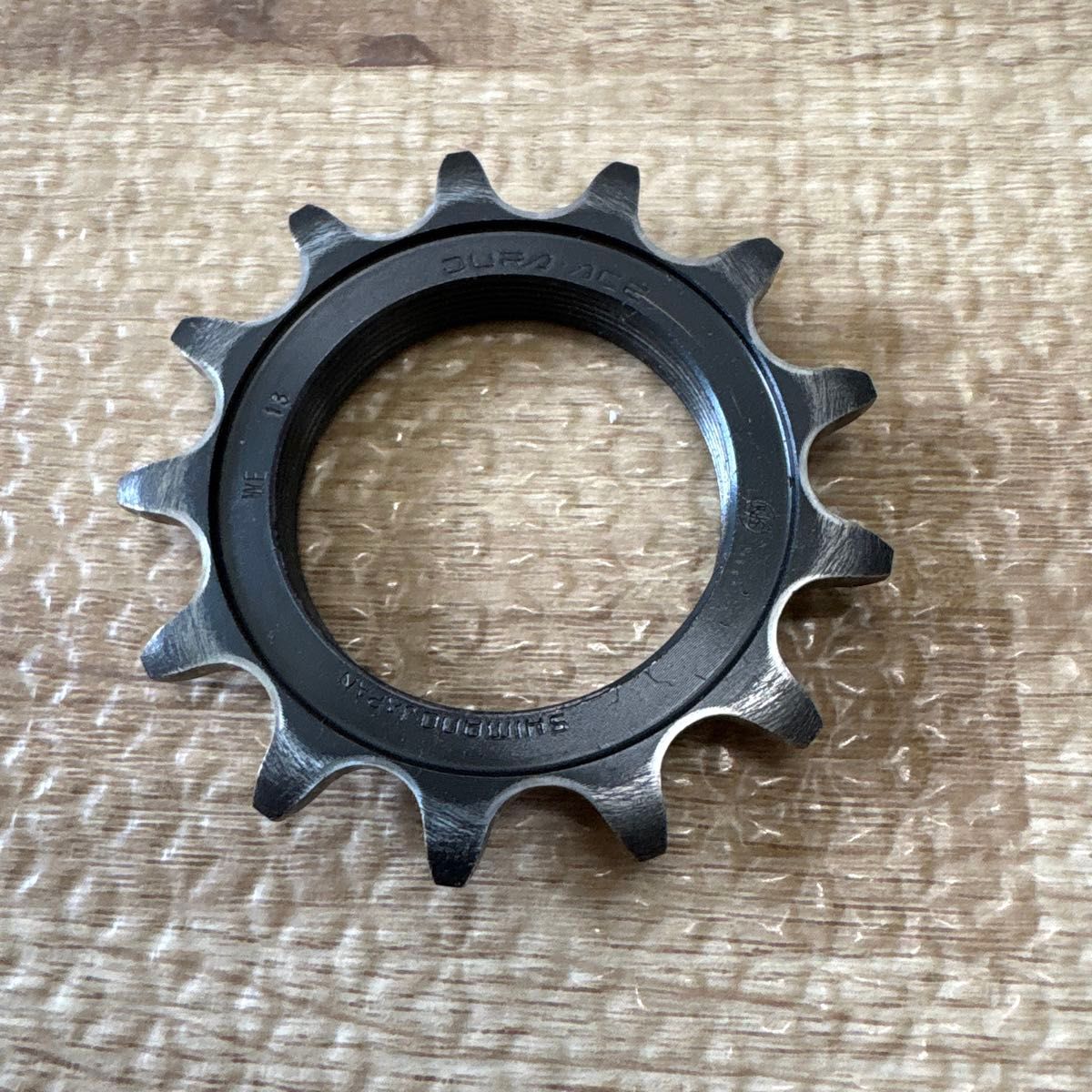


Those are ordinary prices inside Japan and unusual ones outside it. A Dura-Ace track cog at ¥1,710 is roughly US$12 for a part that Western fixed-gear shops treat as a specialty item; the Nitto B123 at ¥4,500 is a steel NJS bar in a 390 mm width that essentially never appears in overseas stock.
Buying Used Track Parts Without Getting Burned
Japanese sellers describe condition precisely, and the vocabulary is worth learning:
- 未使用 / 新品 — unused / new. Common for NJS parts, because racers buy spares by the box and retire with them unopened.
- 美品 — excellent used condition. 中古 is plain used, ジャンク means sold as junk or for parts.
- 単品 / セット — single item versus set. A “chainring and cog set” listing is two parts; a bare 大ギア is one.
For drivetrain parts, check the tooth count and the chain size in the title (1/8 inch for track, 3/32 inch for most road gear), and for a cog check the thread — track cogs thread onto the hub with a reverse-threaded lockring, which is not interchangeable with a freewheel. For bars and stems, the clamp diameter is the number that decides fit; the B123 listed above is 25.4 mm, the traditional Japanese size.
Why Keirin Parts Are Cheap to Import
A cog is 80 g of steel. A chainring is around 150 g. Even a bar and stem together stay under 1.5 kg, and none of it is fragile:
| Destination | Cog + chainring (~700 g) | Bar + stem (~1.4 kg) | Cheapest option |
|---|---|---|---|
| United States | US$20.99 | US$29.88 | Economy air (ECMS), 10–20 days |
| United Kingdom | US$19.17 | US$24.14 | Japan Post Sea Mail, 30–90 days |
| Germany | US$17.75 | US$22.01 | Japan Post Sea Mail, 30–90 days |
| Australia | US$17.75 | US$22.01 | Japan Post Sea Mail, 30–90 days |
| Canada | US$18.46 | US$23.43 | Japan Post Sea Mail, 30–90 days |
| Singapore | US$17.04 | US$27.34 | Japan Post EMS, 4–7 days |
Quoted 30 August 2026 through OneMall’s shipping calculator. Doubling the weight adds a few dollars, not a multiple — which is why a parts order should be a parts order, not one component at a time. Metal in a padded box is also the ideal sea-mail cargo: 30–90 days changes nothing about a steel cog.
Where it stops being cheap
Carriers bill on actual weight or volumetric weight — length × width × height in cm divided by 5,000, whichever is greater[5]. Wheels, frames and anything in a bike-shaped box are volume, not mass, and they price accordingly. If your basket has a wheelset in it, quote the wheelset separately before you commit.
How to Buy NJS Parts From Japan: The Actual Steps
- Step 1 — Search in Japanese. 競輪 (keirin), ピスト (track/fixed), NJS, 大ギア (chainring), コグ (cog), ステム (stem). Searching “NJS” alone in English returns a fraction of what 競輪 ピスト does.
- Step 2 — Confirm the standard, not just the stamp. Tooth count, chain width, clamp diameter, hub spacing[4]. An NJS mark tells you the part passed keirin approval; it does not tell you it fits your bike.
- Step 3 — Order and pay stage one. Item price plus service fee — a ¥300 per item on most marketplaces on Rakuten, Suruga-ya and Mercari; on the Yahoo! auction side it is 3% of the winning bid, ¥200–¥300.
- Step 4 — Build the basket over weeks. Storage is free for 90 days (30 days after consolidation), and used track parts appear one at a time. Patience is how a groupset gets assembled at Japanese prices.
- Step 5 — Consolidate. Free for your first 6 orders, then ¥100 each. Ask for small parts to be packed together rather than in individual seller boxes.
- Step 6 — Choose sea mail unless the bike is on a stand. Nothing in a box of steel parts cares about transit time.
If proxy buying is new to you, our fee comparison of the cheapest Japan proxy services and the buyer’s checklist explain the two-stage payment. The same domestic-market logic drives JDM Shimano fishing tackle — the same company, the same pattern of Japan-only model lines.
Customs in 2026
The United States revoked its US$800 de minimis duty-free exemption on 29 August 2025 under Executive Order 14324[6][7], so US-bound parcels are dutiable regardless of value. The UK charges VAT above its low-value threshold and duty above a higher one[8]. Bicycle parts are an ordinary commercial classification — there is no special restriction on importing them — but they are no longer duty-free by virtue of being cheap.
Frequently Asked Questions
Does an NJS stamp make a part better?
It makes it approved. JKA’s standard exists so that no rider gains an equipment advantage and nothing fails at racing speed[2]. That produces excellent, heavily built parts; it does not make them lighter or faster than current non-approved equipment.
Are NJS parts still manufactured?
Yes. MKS maintains a keirin-approved catalogue with current prices — steel toe clips at ¥2,761 and alloy at ¥3,212 among them[3]. Shimano’s Dura-Ace track line and Nitto’s approved bars and stems are likewise ongoing products, alongside a deep used market.
Will keirin parts fit my road bike?
Mostly no, and that is by design. Track hubs are 100 mm front and 120 mm rear[4] against 100/130 mm on a road bike, track chains are 1/8 inch against 3/32 inch, and a track cog threads on rather than freewheeling. Bars, stems and pedals are the parts that cross over.
Is every keirin frame 120 mm at the rear?
Not quite — 120 mm is the modern norm, but older track frames turn up at 110 mm and frames built around chain adjusters can be 123 mm[4]. If you are buying a hub or a wheel rather than a drivetrain part, measure the frame you actually own before you order.
What does it cost to ship a few parts?
A cog and a chainring quoted US$20.99 to the United States and US$17.04 to Singapore on 30 August 2026; a bar and stem cost US$29.88 and US$27.34. Sea mail to Europe and Australia was under US$25 for either basket. Run yours through the calculator.
Should I buy a keirin frame from Japan?
Only with your eyes open. The frame is the one item in this category where shipping is priced on volume rather than weight[5], and a bike box is mostly air. Quote the frame on its own before you fall in love with the paint.
Ready to Start?
Keirin parts are the rare import where the item is cheap, the shipping is cheap and the domestic supply is genuinely deep. Open a OneMall account, collect parts as they surface over the free 90-day storage window (30 days after consolidation), and ship them as one small heavy box. Or start from a live NJS keirin parts search and see what is on the market today.
Related guides
References
- 公益財団法人JKA, 競輪に係る業務の方法に関する規程 — the regulations under which keirin is operated. https://www.keirin-autorace.or.jp/regulation/keirin/gyoumu.html
- JKA, 競走車安全基準 (racing-bicycle safety standard, as amended 2021). https://www.keirin-autorace.or.jp/documents/www/regulation/keirin/anzen.pdf
- 三ヶ島製作所 (MKS), 競輪(NJS)認定品 product category — current keirin-approved catalogue with prices. https://www.mkspedal.com/?q=ja/product/term/15
- CBN Blog, 自転車タイプ別・エンド幅(オーバーロックナット寸法)まとめ — track/pista: 100 mm front, 120 mm rear (older frames 110 mm; chain-adjuster frames 123 mm). https://blog.cbnanashi.net/2019/02/7390
- OneMall, shipping methods explained — EMS vs DHL vs ECMS vs sea mail, volumetric weight formula. https://blog.onemall.jp/onemall-shipping-methods-explained-2026-…
- The White House, "Suspending Duty-Free De Minimis Treatment for All Countries" (Executive Order 14324, 30 July 2025). https://www.whitehouse.gov/presidential-actions/2025/07/suspending-duty-free-de-minimis-treatment-for-all-countries/
- U.S. Customs and Border Protection, guidance on Executive Order 14324 and duties on international mail. https://www.help.cbp.gov/s/article/Article-1919
- GOV.UK, "Tax and customs for goods sent from abroad". https://www.gov.uk/goods-sent-from-abroad/tax-and-duty
Last updated: 2026-10-26.