
 Shopping Guide
 HELP / FAQs



 By onemall
 TL;DR
As of August 2026, the Canon EOS 1N is a professional-grade 35mm film SLR that Canon launched in 1994, offering a 1/8000s top shutter, 16-zone metering and a rugged all-metal body. It remains one of the best-value autofocus film cameras, with clean secondhand bodies from Japan often selling around $150.
Key Takeaways
- Pro-grade 1994 EOS SLR with the Canon EF mount, 100% viewfinder coverage and up to ~6 fps with a Power Drive Booster.[1]
- Roughly a third the price of the EOS-1V while delivering near-identical shooting performance.[2]
- Runs on a single 2CR5 battery—keep a spare to avoid the “BC” low-battery error.
- Works with any Canon EF lens (50mm f/1.8, 85mm f/1.2) and films like Kodak Portra 400.
- Importing to the US? The $800 de minimis duty-free exemption ended August 29, 2025.[3]
In an era dominated by digital photography, why are some still captivated by film cameras? The answer might just lie in the shutter sound of the Canon EOS 1N. Not only was it the go-to workhorse for professional photographers in the ’90s, but it also stands today as the ultimate “bang-for-your-buck” choice amidst the resurgence of film photography.
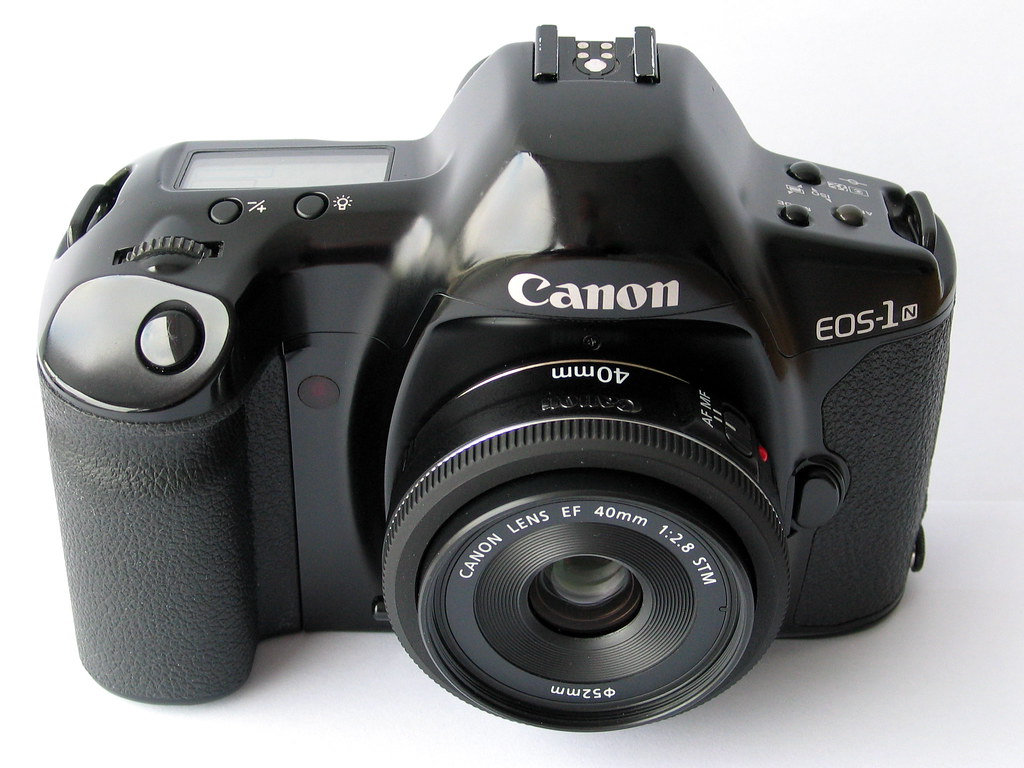
Part 1: Love at First Sight
✨ A Professional-Grade Experience
- Full-metal body with dust- and weather-resistant construction, weighing 835g yet offering a solid grip.
- A crisp, satisfying shutter sound—like pulling the trigger of a finely tuned mechanism.
- 100% viewfinder coverage ensures precise framing with no unwanted cropping.
✨ Cutting-Edge Tech from the Film Era
- 16-zone metering system delivers accurate exposures even in low light.
- 1/8000s maximum shutter speed—perfect for freezing fast-moving subjects like birds in flight.
- Eye-Control Autofocus (ECAF)—wherever your eye looks, the focus follows.
✨ Unbeatable Value for Money
- Now available in the secondhand market for just over $150, making it a budget-friendly alternative to the EOS 1V at a third of the price, with nearly identical performance.
Part 2: Hands-On Shooting Experience
📸 Recommended Film Stocks
For beginners: Kodak Gold 200 (warm portrait tones), Kodak UltraMax 400 (reliable and versatile).

For enthusiasts: Fujifilm Pro 400H (soft pastel tones), Kodak Portra 400 (fine grain and natural colors).

For black-and-white lovers: ILFORD HP5 PLUS (high dynamic range).

🏙️ Best Lenses & Scenarios
- Street Photography: EF 50mm f/1.8—compact, discreet, and perfect for capturing candid moments. Pair with ISO 400 film to ensure fast shutter speeds, even on overcast days.
- Portraits: Eye-Control AF + EF 85mm f/1.2—locks focus onto the subject’s eyes effortlessly, while creamy bokeh transforms background light into dreamlike orbs.
- Landscapes: 16-zone metering + wide-angle lens—handles high-contrast lighting with ease. Try Velvia 50 film for breathtakingly rich and saturated colors.
Part 3: Beginner’s Survival Guide
⚠️ Common Mistakes to Avoid
- Loading film incorrectly: Ensure the film leader is properly placed on the right-side take-up spool.
- Battery issues: The EOS 1N runs on a 2CR5 battery—if you see a “BC” error, it’s time for a replacement. Always carry a spare.
- Metering malfunctions: If exposure readings seem off, check for oxidation on battery contacts.
🎯 Pro Tips
- After loading a new roll, fire two blank shots to ensure the film is properly advanced.
- In low-light conditions, use center-weighted metering to avoid under- or overexposure.
- After finishing a roll, always rewind before opening the film back to prevent accidental light leaks.
Part 4: Why Choose the EOS 1N?
It feels like a seasoned warrior—
- A battle-tested metal body that withstands the elements.
- Professional-grade performance that still holds its own against entry-level digital cameras.
- Every frame advance, every focus lock, every shutter click is a dialogue with time itself.
In this fast-paced world, the Canon EOS 1N teaches us to slow down—
To wait for film to develop, to anticipate the magic of an emerging image, and to embrace the lost art of patience in an era of instant gratification.
Canon Pro Film SLRs Compared
| Model | Released | AF points | Max shutter | Approx. used price* | Best for |
|---|---|---|---|---|---|
| EOS-1N | 1994 | 5-point | 1/8000s | ~$150 | Best-value pro film body |
| EOS-1V | 2000 | 45-point | 1/8000s | Higher (~3× the 1N) | Canon’s last & most advanced film SLR |
| EOS 3 | 1998 | 45-point (Eye-Control) | 1/8000s | Mid | Eye-controlled AF on a budget |
*Secondhand prices vary by condition and seller.
Frequently Asked Questions
Is the Canon EOS 1N still worth buying in 2026?
Yes. As a professional film SLR with a 1/8000s shutter and weather-resistant metal body, it delivers near-flagship performance for a fraction of an EOS-1V, and clean bodies from Japan often sell around $150.
What battery does the EOS 1N use?
A single 2CR5 6V lithium battery. A “BC” warning means it needs replacing, so always carry a spare.
Does it work with modern Canon EF lenses?
Yes—it uses the Canon EF mount, so autofocus EF lenses such as the 50mm f/1.8 and 85mm f/1.2 mount and focus directly.[1]
How can I buy a used EOS 1N from Japan?
Japanese marketplaces like Yahoo Auctions JP and Mercari have the deepest film-camera stock. A proxy such as OneMall (commission a flat ¥300 per item, with the first 6 orders free) can bid, inspect and forward a body worldwide.
Will I pay import duty bringing one into the US?
Likely yes. The US $800 de minimis duty-free exemption ended August 29, 2025, so most imports now face applicable duties.[3]
Related guides
References
- Canon Camera Museum – EOS-1N. global.canon
- Canon Camera Museum – EOS-1V. global.canon
- U.S. Customs and Border Protection – Suspending Duty-Free De Minimis Treatment (E.O. 14324). help.cbp.gov
Last updated: 2026-08-05.