
 Shopping Guide
 HELP / FAQs



 By onemall
 TL;DR
The Japanese guitar brands worth knowing are Ibanez, ESP, Yamaha, Tokai, Greco, FUJIGEN, Takamine, Aria, K.Yairi, Fernandes, Caparison, Sugi, Killer, Zemaitis, Bacchus, Momose, Headway, SeventySeven and History — plus Fender’s Made in Japan line, which is Japanese-built but not a Japanese brand. Most of them are cheaper bought inside Japan than exported, and a large share of the good stuff is domestic-market-only.
- Brand and factory are different things. A handful of workshops — FUJIGEN, Deviser, Tokai, Terada, Dyna Gakki, Takamine — have built guitars sold under dozens of badges, including American ones.
- Nagano and Shizuoka are the guitar country. Matsumoto in Nagano is the single densest cluster of guitar makers in Japan; Hamamatsu in Shizuoka is where Yamaha, Kawai and Tokai grew up.
- “Made in Japan” is not automatically premium. On modern instruments it usually means the top or upper-middle of a brand’s range; on 1960s instruments it often meant the cheapest guitar in the shop.
- MIJ Fenders, 1970s Grecos and Tokais are the collector market, and they are still mostly traded domestically on Yahoo Auctions and Digimart.
- Voltage matters for amps, not guitars. A Japanese guitar needs no adaptation. A Japanese amp runs on 100 V.
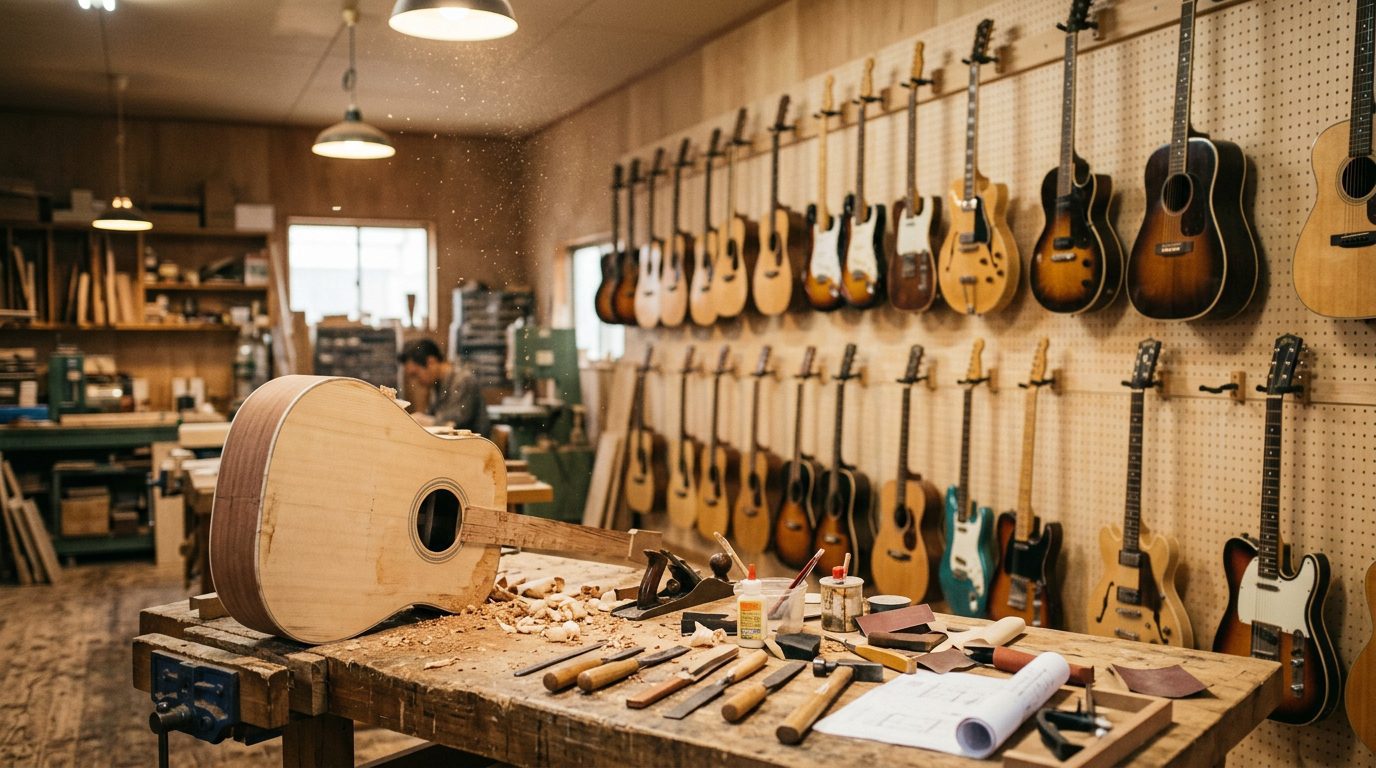
Every Japanese guitar brand that matters, in one table
Each brand name below links to live listings from Japanese marketplaces, because on most of these there is no international dealer at all.
| Brand | Who makes it | What they build | Why it matters |
|---|---|---|---|
| Ibanez | Hoshino Gakki, Nagoya | Electric & bass | Japan’s biggest guitar export brand; thin necks, RG and S superstrats, Prestige and j.custom made in Japan |
| ESP | ESP Co., Ltd., Tokyo | Electric & bass | Founded February 1975 as a repair shop and parts maker in Jingumae[1]; started Japan’s first full custom-order electric guitar system in 1979 |
| Edwards | ESP | Electric | ESP’s mid-tier Japanese line — the value entry into ESP shapes |
| Navigator | ESP | Electric | ESP’s traditional-shape line, started 1976[1]; vintage-accurate Les Paul and Strat types |
| Grassroots | ESP | Electric | ESP’s budget import line; the cheapest way into an ESP-designed shape |
| Yamaha | Yamaha Corporation, Hamamatsu | Electric, acoustic, classical | The company began in 1887 when Torakusu Yamaha repaired a reed organ[2]; SG electrics, LL/LS acoustics, Pacifica, Silent Guitar |
| Fender Japan / Made in Japan | Fender, built by Japanese partner factories | Electric & bass | The MIJ/CIJ Strats and Teles collectors hunt; FujiGen built them under the CBS Fender OEM deal signed April 1982[3] |
| FUJIGEN (FGN) | FUJIGEN INC., Matsumoto | Electric & bass, acoustic, ukulele | Founded May 1960 on the proceeds of three cows, in a converted cowshed[3]; hit 14,000 electrics a month in 1983, then a world record[3] |
| Tokai | Tokai Gakki, Hamamatsu | Electric & acoustic | Founded 1947 to research pianos and harmonicas[4]; the “lawsuit era” Love Rock and Springy Sound; invented the metal-body TALBO in 1983[4] |
| Greco | Kanda Shokai, Tokyo | Electric & bass | Kanda Shokai’s own brand; its electrics took off in 1967[5] and defined the 1970s Japanese copy era |
| Zemaitis | Kanda Shokai (brand holder) | Electric | The metal-front and pearl-front designs of Tony Zemaitis, now built in Japan under Kanda Shokai[5] |
| Takamine | Takamine Gakki, Nakatsugawa | Acoustic & electro-acoustic | Traces to a 1959 workshop in Sakashita[6]; pioneered the stage electro-acoustic with its Palathetic pickup in 1978[6] |
| Aria / Aria Pro II | Arai & Co., Nagoya | Electric, bass, acoustic, classical | One of the oldest Japanese guitar exporters; the SB basses are the cult items |
| K.Yairi | Yairi Guitar, Kani, Gifu | Acoustic | Hand-built acoustics with a lifetime warranty; the connoisseur’s Japanese flat-top |
| Headway | Deviser, Matsumoto | Acoustic | Started 1977 by master builder Yasuo Momose[7]; Aska Team Build is the top line |
| Momose | Deviser, Matsumoto | Electric & bass | Named after the same builder, made at Deviser’s Asuka factory[8]; renewed across the range in 2026[8] |
| Bacchus | Deviser, Matsumoto | Electric & bass | Deviser’s main electric brand; Handmade series WOODLINE at the top, Universe imports at the bottom |
| SeventySeven | Deviser, Matsumoto | Electric | Deviser’s semi-hollow and offset line, made in Nagano |
| STR | Deviser, Matsumoto | Electric & bass | Deviser’s modern high-end line |
| Caparison | Caparison Guitars | Electric | Angular metal-oriented builds; a favourite of technical and progressive players |
| Sugi | Sugi Musical Instruments | Electric & bass | Boutique-tier Japanese builds with exotic tops; short runs, high resale |
| Killer | Killer Guitars | Electric | Founded by Loudness guitarist Akira Takasaki; the shapes are unmistakable |
| Fernandes / Burny | Fernandes | Electric & bass | The Sustainer system, hide signature models, and the ZO-3 travel guitar with a built-in amp |
| History | Shimamura Gakki | Electric & acoustic | Japan’s biggest music retailer’s house brand, built domestically — the quiet value pick |
| Morris | Moridaira | Acoustic | Long-running Japanese flat-top maker, strong in the domestic used market |
The thing nobody tells you: brands are not factories
The most useful fact about Japanese guitars is that the badge on the headstock frequently has nothing to do with who built the instrument. A small number of Japanese workshops have done contract manufacturing for the entire industry for sixty years.
FUJIGEN is the clearest case. It was founded in May 1960 by Yutaka Mimura and Yuichiro Yokouchi, who raised his share of the capital by selling three cows and set the first workshop up in a converted cowshed; the ten-person team started on violin prototypes before switching to classical guitars[3]. Electric guitar production began in October 1962[3]. In April 1982 FUJIGEN signed an OEM agreement with CBS Fender and started building Fender guitars[3] — the origin of every “MIJ Fender” conversation. By April 1983 the plant was turning out 14,000 electric guitars a month, then the highest in the world[3]. It was also, in June 1981, the first guitar maker anywhere to install an NC router[3], and in 1978 it formed a joint venture with Roland that produced the world’s first guitar synthesiser[3]. FUJIGEN today sells under its own FGN badge and still does OEM work.
Deviser, also in Matsumoto, runs Bacchus, Momose, Headway, SeventySeven, STR and JRP out of the same operation[8]. Kanda Shokai is not a factory at all — it is a wholesaler, founded in August 1948, that owns the Greco and Zemaitis brands and has products built for it[5]. So “is Greco a good brand?” is the wrong question; the right one is which factory and which year.
The brands, properly
Ibanez — the export champion
Ibanez is the guitar brand of Hoshino Gakki in Nagoya, and the one Japanese name that became a global standard rather than a domestic one. The reputation rests on thin, fast necks and the superstrat shapes — RG, S, JEM, Universe — that defined shred in the late 1980s. The tiering is worth learning before you buy: Prestige and j.custom are made in Japan, the Premium line is Indonesian, and the Standard/Gio lines are entry-level imports. Japan-only Prestige colourways and Japan-market signature runs are a real reason to buy domestically. Ibanez is also a serious bass brand — SR and BTB are staples — and the AS/AM semi-hollows are underrated.
ESP — and its Edwards, Navigator, Grassroots and LTD tiers
ESP was set up in February 1975 to repair and build top-grade electric guitars and basses and to train repair technicians, opening a combined workshop and shop called the Electric Sound Center in Jingumae, Tokyo[1]. That order — repairs and parts first, brand second — is why ESP’s reputation is built on hardware and construction rather than marketing. The company started its Navigator brand in 1976, began selling body and neck blanks and launched Japan’s first full custom-order electric guitar system in March 1979, opened ESP USA in New York in 1981, and bought Schecter’s US operation in 1987[1]. It also runs guitar-building and music schools, which is unusual for a manufacturer[1].
The tier ladder confuses buyers constantly: ESP Original (top, Japan) → Navigator (traditional shapes, Japan) → Edwards (Japan, mid) → Grassroots (budget import) → LTD (the international import line). Edwards is the sweet spot most overseas buyers are actually looking for, and it is essentially a Japan-market brand.
Yamaha — the one that does everything
Yamaha’s history starts in 1887, when Torakusu Yamaha repaired a broken reed organ and then built one[2]; upright piano production began in 1900[2]. For guitarists the relevant lines are the SG solidbodies (the SG2000 is the serious vintage target), the LL/LS acoustics, the Pacifica — still the default recommendation for a first electric — the Silent Guitar, and the classical range that has trained a large share of the world’s guitar students. Yamaha is also the only Japanese guitar brand whose amps, drums and audio gear you can buy in the same catalogue.
Tokai — the lawsuit-era legend
Tokai was founded in 1947 in Hamamatsu as a research operation for pianos and harmonicas[4]. It developed the Pianica in 1961, moved into classical guitars in 1965, started electric guitar production under the “Hummingbird” brand in 1968, and became C.F. Martin’s sole Japanese distributor in 1972[4]. The Cat’s Eye acoustic brand arrived in 1975 and the LS electric series in 1978[4]. Those late-1970s and early-1980s Les Paul and Stratocaster homages — Love Rock, Springy Sound, Breezysound — are the guitars that made American manufacturers nervous, and they are the single most-hunted vintage Japanese electrics today. Tokai also produced something genuinely original: the TALBO, the world’s first new-material metal-body guitar, developed in 1983[4], put back into production in 1996[4], and still made. In 2021 Tokai integrated management with the reuse company GRACE[4], and it launched a new Tokai Grand series in May 2026.
Greco and Zemaitis — the Kanda Shokai brands
Kanda Shokai was founded in August 1948 with eight staff, selling rhythm instruments and violins[5]. It moved into electric instruments during Japan’s first “eleki” boom in 1964, and by 1967 its own Greco electrics were the core of the business[5]. Greco is the other half of the lawsuit-era story alongside Tokai, and 1970s Grecos — especially the Super Real and Mint Collection eras — are collected hard. Kanda Shokai is also the brand holder for Zemaitis, the metal-front and pearl-front designs of the late Tony Zemaitis, now built in Japan[5].
Takamine — the electro-acoustic pioneer
Takamine begins in 1959, when its founder — a luthier trained in Nagoya who had been displaced by the Isewan Typhoon — opened an acoustic instrument workshop in Sakashita, Gifu, and named it Ozone Gakki[6]. It became Takamine Gakki in 1962[6] and was formally established in May 1962[9]. Under president Masuo Hirade in the mid-1970s it launched its own Takamine brand and partnered with Kaman Music in the United States[6]. The company’s real contribution came in 1978: serious development of stage-usable electro-acoustics produced the Palathetic pickup, which cuts part of the top and suspends the pickup to reduce string-to-string cross-talk and integrates it with the bridge to fight feedback[6]. Takamine now works with 61 distributors across 64 countries from a 90-person operation in Nakatsugawa[9].
The Matsumoto workshops: Headway, Momose, Bacchus, SeventySeven, STR
Headway was started in 1977 by master builder Yasuo Momose in Matsumoto, on the principle of making a guitar someone can play for a lifetime[7]. Today Headway, Momose, Bacchus, SeventySeven and STR all sit under Deviser, whose Asuka factory carries Momose’s name and philosophy into the electric range[8]. Momose was renewed across its basic specifications in 2026[8]. Bacchus splits sharply into a Japanese Handmade series and much cheaper imported Universe models — check which one a listing is before you get excited about the price.
Aria, K.Yairi, Morris and the acoustic side
Aria is the guitar brand of Arai & Co. of Nagoya[10], one of the earliest Japanese exporters; Aria Pro II electrics and especially the SB basses have a devoted following. K.Yairi in Gifu builds hand-made acoustics in small numbers and is the name Japanese players reach for when they want a domestic flat-top rather than a Martin. Morris is the everyday counterpart, hugely common on the Japanese used market and often excellent value.
The boutique and specialist end: Caparison, Sugi, Killer, Fernandes
Caparison builds angular, high-fret-count instruments aimed squarely at metal and progressive players. Sugi occupies the true boutique tier, with exotic tops and short runs that hold value. Killer was founded by Loudness guitarist Akira Takasaki and looks like nothing else. Fernandes and its Burny sub-brand cover the Sustainer system, the hide signature models that trade for serious money, and the ZO-3 — a small guitar with a speaker and amp built into the body, which is the single most Japanese product in this entire article.
History, and the retailer house brands
History is the house brand of Shimamura Gakki, Japan’s largest instrument retail chain, and is built domestically to a genuinely high standard. Because it is a retailer brand it barely exists outside Japan, which keeps used prices low relative to quality — one of the better value plays on this list.
“X guitar made in Japan” — the 1960s badge brands
If you have an old guitar stamped “Made in Japan” with a name nobody recognises, it is almost certainly from the 1960s export boom, when Japanese factories built to order for importers who applied their own badges. Names in this family include Teisco, Guyatone, Kawai, Matsumoku, Winston, Decca, Kent, Norma, Domino, Estrada, Apollo, Kingston, Bolero, Canora, Diamond, Fantasia, Franciscan, Granada, Hokada, Conrad, Lyle, Univox, Vantage, Indiana, Hohner (Japan-built models), Silvertone (Japan-built models). Most came out of a small number of plants — Teisco, Guyatone, Kawai, FUJIGEN and Matsumoku among them — so two differently-badged guitars can be the same instrument.
Value here is driven by weirdness rather than pedigree: four-pickup slabs, gold-foil pickups and monkey-grip bodies fetch more than competent copies. Do not assume “made in Japan” on a 1960s instrument implies quality; at that time it usually implied cheapness. The reversal happened in the late 1970s.
Japanese guitars vs American and their prices
| What you want | Japanese answer | Roughly comparable to |
|---|---|---|
| Fast-neck superstrat | Ibanez Prestige | US Jackson / Charvel |
| Vintage-correct Strat or Tele | Fender Made in Japan, Tokai, Greco, FUJIGEN | Fender American Vintage II |
| Les Paul type | Tokai Love Rock, Edwards, Navigator, Burny | Gibson Les Paul Standard |
| Metal build | ESP, Caparison, Killer | Jackson USA, Schecter USA |
| Stage acoustic | Takamine, Yamaha LL | Taylor, Martin with pickup |
| Hand-built acoustic | K.Yairi, Headway Aska Team Build | Collings, Santa Cruz |
| Boutique electric | Sugi, Momose, STR | Suhr, Tom Anderson |
| First guitar | Yamaha Pacifica, Bacchus Universe, Grassroots | Squier, Epiphone |
The recurring pattern: Japanese-built instruments tend to sit one price tier below their American equivalent for comparable build quality, and the gap is widest on the used domestic market, where a brand with no overseas distribution has no overseas price floor.
Fender, Gretsch, Epiphone and the other American brands built in Japan
A large share of “made in Japan guitar” searches are not about Japanese brands at all — they are about American models that were built in Japan. The list is longer than most people expect:
- Fender. The Made in Japan Stratocaster, Telecaster, Jazzmaster, Jaguar, Mustang, Precision Bass and Jazz Bass are all long-running lines, and the offsets in particular — the MIJ Jaguar and Jazzmaster — are frequently better value than their US equivalents. Japan is also where Fender puts many of its most interesting finishes and short-scale variants.
- Squier. The early Japanese-built Squiers (the JV-era instruments) are collected as seriously as contemporary Fenders.
- Gretsch. The Professional and Players Edition hollowbodies have been Japanese-built for years, and are the ones with the reputation.
- Epiphone. Japanese-built Epiphones from the 1980s and the Japan-market Elitist line are a different animal entirely from the current import range.
- Jackson, Charvel and EVH. Japanese production sits above the Indonesian and Mexican tiers on all three.
- Guild, Washburn, D’Angelico and Ovation have all had Japanese-built runs at various points.
None of these are Japanese brands. What they share is a Japanese factory, and that is usually what the buyer is actually chasing.
Dating a Made in Japan guitar
Two labels get confused constantly. MIJ (“Made in Japan”) and CIJ (“Crafted in Japan”) are different production eras with different factories behind them, and the wording is stamped on the instrument — usually on the headstock or neck plate. Serial numbers on Japanese Fenders normally run as a letter prefix plus digits, and the prefix, not the digits, carries the date range. Because the schemes overlap and were reused, the reliable method is to check the prefix against Fender’s own dating reference and cross-check against the neck-pocket date stamp rather than trusting a seller’s guess. The same caution applies to Japanese-built Gretsch and Epiphone instruments. Online serial-number daters exist for Japanese Fenders and are a reasonable first pass, but they disagree with each other often enough that a pot-code or neck-stamp photograph is worth asking for.
Famous, expensive, cheap: how the Japanese market is actually tiered
Three questions come up constantly, so here they are directly.
The most famous Japanese guitar brands internationally are Ibanez, Yamaha and ESP; domestically you would add Tokai, Greco and Takamine, which carry far more weight in Japan than abroad. The most expensive are the boutique makers — Sugi, Momose, STR, Headway’s Aska Team Build and K.Yairi’s hand-built acoustics — where a single instrument runs well past what a mainstream Japanese electric costs, alongside collector-market 1970s Grecos and Tokais. The cheapest good ones are Bacchus Universe, Grassroots, Yamaha Pacifica and the enormous domestic used market, where a competent Japanese-built guitar with fret wear costs less than a new import.
“Cool” is more subjective, but the Japanese answers most people arrive at are the Tokai TALBO, the Fernandes ZO-3, Ibanez’s Iceman, the Aria Pro II SB bass and anything from Killer.
Where the guitar shops actually are
If you are visiting: Ochanomizu in Tokyo is the guitar district, a few hundred metres of instrument shops
stacked on top of each other, and Shibuya and Shinjuku hold the big chains. Osaka’s equivalent runs
around Namba. Japanese guitar companies, dealers and individual luthiers all list on the same domestic
marketplaces, which is why a proxy reaches stock that never appears on Reverb or eBay.
Left-handed, semi-acoustic and other awkward requests
Left-handed Japanese guitars exist but are genuinely scarce, and the domestic used market is one of the better places to find them because Japanese sellers list them plainly as レフトジャックス. For jazz and semi-acoustic, look at Ibanez’s AS and AM lines, the Japanese-built Gretsch hollowbodies, Yamaha’s SA series and Tokai’s ES models. For a first jazz box, the used Japanese market is significantly cheaper than the equivalent import.
Classical, nylon-string and fingerstyle
Japan has a deep classical guitar tradition that rarely gets exported. Yamaha’s classical range has
taught a large share of the world’s students, Aria builds Spanish-style nylon-string instruments across
several tiers, and there is a whole layer of individual Japanese luthiers building concert classical guitars
that are effectively unavailable abroad. For fingerstyle steel-string, K.Yairi and Headway are the names, and
the Japanese fingerstyle scene is why so many small-bodied Japanese acoustics exist.
Japanese amplifiers, and the rest of the rig
Roland and Boss are the obvious Japanese amplifier names, with Yamaha, Ibanez and a bench of boutique
builders behind them, and the Japanese used market carries amps that were never exported. Two warnings.
Japanese mains is 100 V, so a domestic amp needs a step-down transformer almost everywhere else, and
amps are heavy rather than bulky, which makes them the one category where shipping is priced on real weight
and gets expensive fast. Military-surplus-style cases, vintage hardware from makers such as Gotoh and
Schaller, and Japanese guitar magazines with their model-by-model buyer guides all circulate on the same
domestic marketplaces.
Body shapes and the odd ones out
Beyond the Strat and Les Paul copies, Japanese makers built the shapes nobody else would: the Ibanez Iceman,
the Tokai TALBO, Fernandes’ ZO-3, headless designs from several builders, and Japanese-market Flying V
and Explorer types from ESP, Edwards and Burny. Japan-exclusive finishes and limited artist models are a
recurring reason to buy domestically rather than locally.
Strings, straps, picks, capos, tuners, cables and effects
The Japanese accessory market is worth a search of its own. Gotoh makes tuning machines and bridges fitted by builders worldwide; Providence, Ex-Pro, Oyaide and Custom Audio Japan make cables that command real prices; Ibanez, Boss, Maxon, Roland and Free The Tone cover effects; and there is a deep bench of Japanese string, strap and case makers with no overseas distribution at all.
And the actual traditional Japanese stringed instruments
If you searched for a “traditional Japanese guitar”, the instrument you are thinking of is probably one of three, and none of them is a guitar. The shamisen is a three-stringed fretless lute played with a large plectrum — the sound most associated with Japanese folk and Tsugaru music. The biwa is a short-necked lute used in narrative music. The koto is a long zither played flat, with movable bridges. All three are sold on the Japanese used market, and all three ship as awkward, oversized parcels — worth checking the box dimensions before you commit.
How to buy a Japanese guitar from Japan
Almost all of the interesting stock — Edwards, Navigator, History, Japan-market Ibanez colourways, 1970s Grecos, TALBOs — is sold domestically only. Japan’s guitar shops and online stores, its used-instrument websites and its auction listings are all domestic-facing, and guitar prices in Japan are quoted in yen with domestic delivery assumed. The practical route is a proxy service.
- Search in both scripts. Japanese sellers write brand names in Latin letters but models in Japanese. Searching ギター (guitar) alongside the brand name surfaces listings the English spelling misses.
- Know the used-condition vocabulary. 美品 = excellent, 中古 = used, ジャンク = junk/for parts, 訳あり = has an issue, 傷あり = has damage, ネック反り = neck bow, フレット減り = fret wear.
- Check for a truss rod and fret report before bidding. Neck relief and fret life are the two things photos hide and the two things that cost real money to fix.
- Budget for the case and the shipping shape. Guitars are large, light boxes, so they price on volumetric weight (cm × cm × cm ÷ 5000), not on the scale. A hard case can double the shipping bill; a gig bag is far cheaper but far riskier.
- Amps are a separate problem. Japanese mains is 100 V. Guitars do not care. Amps and powered pedals do.
Two companion guides go deeper on the buying mechanics: how to buy vintage and new Japanese guitars from Japan walks the whole proxy flow, and the Digimart guide covers Japan’s biggest used-instrument marketplace. For ESP specifically, see our ESP guitar guide.
Shopping Japanese brands more widely? We also map Japanese skincare brands and Japanese streetwear brands.
You can browse the whole Japanese market — Yahoo Auctions, Mercari, Rakuten, Amazon Japan and used specialists — through OneMall in one account, in your own currency. Start from Japanese guitars or jump straight to a brand from the table above.
Frequently asked questions
What are the best Japanese guitar brands?
For electrics, Ibanez, ESP (with Edwards and Navigator), Tokai and FUJIGEN. For acoustics, Takamine, K.Yairi, Headway and Yamaha. For boutique work, Sugi, Momose and STR. “Best” depends on which tier of a brand you are actually looking at — every name here has both a Japanese-built line and a cheaper import line.
Are Japanese guitars better than Chinese or Indonesian ones?
At the same price, usually yes, because Japanese-built lines are positioned as the upper tier within each brand. But an Indonesian Ibanez Premium can beat a low-end Japanese guitar from a lesser maker. Compare tiers, not countries.
Is Fender Made in Japan a Japanese brand?
No. Fender is American; MIJ and CIJ instruments are Fender-branded guitars built in Japan by partner factories. FUJIGEN began that production under an OEM agreement with CBS Fender in April 1982[3]. They are excellent and they are collectible, but they are not a Japanese brand.
What is a “lawsuit” guitar?
Shorthand for the late-1970s Japanese copies — principally Tokai, Greco and Ibanez — that were close enough to American originals to trigger legal action. The term is loosely used and mostly a marketing label now, but the underlying instruments from that period genuinely are good.
Where can I buy Japanese guitars online?
Japanese used-instrument marketplaces and Yahoo Auctions carry the deepest stock, and a proxy makes them reachable from overseas. Some brands — Edwards, Navigator, History, most Deviser lines — have no overseas retail channel at all.
Are guitars cheaper in Japan?
For Japanese brands, consistently. For American brands sold in Japan, usually not. The saving comes from buying an instrument in the market where it was distributed, not from Japan being a cheap country.
Which Japanese brands make bass guitars?
Ibanez (SR, BTB), Aria Pro II (SB), ESP and Edwards, Bacchus, Momose, STR, Fernandes and Yamaha (BB, TRBX). The Aria SB and Yamaha BB are the two with genuine vintage followings.
Related guides
References
- ESP Co., Ltd. — company history
- Yamaha Corporation — history
- FUJIGEN INC. — company history
- Tokai Gakki — history
- Kanda Shokai Corporation — company profile and history
- Takamine — company history
- Headway Guitars (Deviser) — about
- Momose Custom Craft Guitars (Deviser) — about
- Takamine Gakki — company profile
- Arai & Co., Inc. (Aria) — company profile
Last updated: 2026-09-09.