
 Shopping Guide
 HELP / FAQs



 By onemall
 TL;DR
Japanese clothing runs about one size smaller than US clothing, so a Japanese L is roughly a US M and a Japanese M is roughly a US S. Women’s items also carry a 号 number — 9号 is the reference size, built for an 83 cm bust — and children’s clothes are labelled by the child’s height in centimetres, not by age.
- Size up one letter going from US to Japan: US M → Japanese L, US L → Japanese LL.
- Women’s 号 numbers run 5, 7, 9, 11, 13… where 9号 = 83 cm bust, the JIS reference body[1].
- The standard was rewritten in 2023 — the first revision in over twenty years[2].
- Kids’ sizes are heights in cm — a “100” is for a 100 cm-tall child, roughly a US 3T–4T.
- Trousers are labelled in waist cm — 76 cm is a US 30-inch waist.
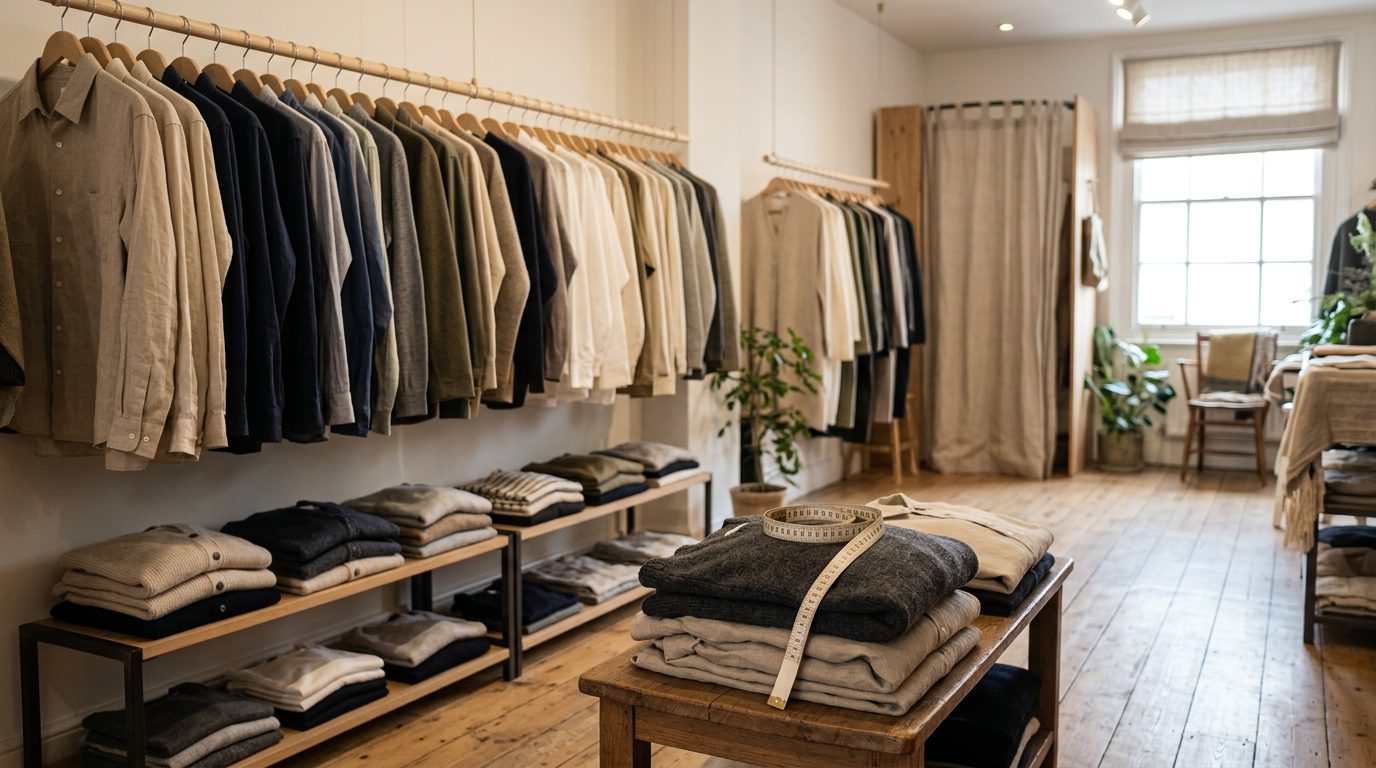
Here is the thing almost every conversion chart online still gets wrong: they describe a standard that no longer exists. As of April 2023, Japan’s clothing size standards — JIS L 4001 through L 4007 — were comprehensively revised for the first time in more than twenty years[2]. The revision widened the range sizes (women’s now runs SS through 6L, men’s through 5L), dropped the old body-type hyphen from the printed label, and, for the first time, added an official unisex size set[2]. If a chart you are reading talks about a 1997 standard, it is nearly thirty years stale. As of September 2026, this is the current picture.
Why Japanese sizes feel a size small
Nothing is mislabelled — the standards are simply calibrated to a different population. JIS L 4005 bins women’s busts from 74 to 92 cm in 3 cm steps and from 92 to 104 cm in 4 cm steps, against reference heights of 142, 150, 158 and 166 cm[1]. A Japanese M is built for a body that a US chart would call an S. Japanese cuts also carry less ease through the shoulder and armhole, which is why the gap feels larger on tailored items than on a hoodie.
The working rule for adults, and the one-line answer to “what is Japan size medium in US”: go up one letter. A Japanese medium is a Western small. If you wear a US M, order a Japanese L. If you wear a US L, order a Japanese LL. Then check the actual centimetres, because the letter is a summary and the centimetres are the fact.
Japanese women’s clothing size conversion chart
Japanese womenswear uses odd numbers — 5, 7, 9, 11, 13 — called 号. The bust figures below are the JIS bins; hips are given for the A body type at the 158 cm reference height, the combination Japanese brands design to by default[1].
| Japanese size (号) | Bust (cm) | Hip (cm) | Japanese letter size | US size | UK size | EU size |
|---|---|---|---|---|---|---|
| 3号 | 74 | 85 | SS | US 00 | UK 4 | EU 32 |
| 5号 | 77 | 87 | SS / XS | US 0 | UK 4 | EU 32 |
| 7号 | 80 | 89 | S | US 2 | UK 6 | EU 34 |
| 9号 | 83 | 91 | M | US 4 | UK 8 | EU 36 |
| 11号 | 86 | 93 | L | US 6 | UK 10 | EU 38 |
| 13号 | 89 | 95 | LL (XL) | US 8 | UK 12 | EU 40 |
| 15号 | 92 | 97 | 3L | US 10 | UK 14 | EU 42 |
| 17号 | 96 | 99 | 4L | US 12 | UK 16 | EU 44 |
| 19号 | 100 | 101 | 5L | US 14 | UK 18 | EU 46 |
| 21号 | 104 | 103 | 6L | US 16 | UK 20 | EU 48 |
The US column is the conversion Japanese retailers themselves publish, and it is approximate by nature: US womenswear has no legal size standard, so a US 4 varies by brand far more than a 9号 does. If you are between two rows, take the larger one.
Under the 2023 revision the range-display example printed by Japan’s testing institutes for a women’s M is bust 79–87 cm, height 154–162 cm[2]. That is a useful sanity check: if your bust is 88 cm, you are not a Japanese M.
Japanese men’s clothing size conversion chart
Men’s sizing under JIS L 4004 is a range display built from a height band and a body type — Y (slimmer hips), A (standard), B (fuller). The S/M/L/LL you see in shops is retail shorthand layered on top of it. These are the JIS ranges[3]:
| JIS range size | Chest (cm) | Waist (cm) | Height (cm) |
|---|---|---|---|
| PB | 80–88 | 68–76 | 145–155 |
| S (SA) | 88–96 | 76–84 | 155–165 |
| MY | 80–88 | 68–76 | 165–175 |
| M (MA) | 88–96 | 76–84 | 165–175 |
| MB | 96–104 | 84–94 | 165–175 |
| LY | 88–96 | 76–84 | 175–185 |
| L (LA) | 96–104 | 84–94 | 175–185 |
| LB | 104–112 | 94–104 | 175–185 |
| TY | 96–104 | 84–94 | 185–195 |
Read it as: a Japanese M is cut for a 165–175 cm man with an 88–96 cm chest. US men’s M is typically drafted for a 96–102 cm chest — a full JIS size up. So a US M buys a Japanese L, and a US L buys a Japanese LL.
The B-suffixed sizes (MB, LB) are the ones to know if you are broader through the chest and waist: LB covers a 104–112 cm chest, which no plain “L” in Japan will fit.
Japanese clothing size vs US, UK, EU, Canada and Australia
The letter conversion is the fastest lookup, and it is the same shift in every direction — Japanese sizing sits one letter below US and UK sizing:
| Japanese letter size | US | UK | EU (menswear) |
|---|---|---|---|
| SS | US XXS | UK XXS | EU 42 |
| S | US XS | UK XS | EU 44 |
| M | US S | UK S | EU 46 |
| L | US M | UK M | EU 48 |
| LL (XL) | US L | UK L | EU 50–52 |
| 3L (XXL) | US XL | UK XL | EU 54 |
| 4L | US XXL | UK XXL | EU 56 |
Compared to American sizing the shift is one letter; compared to European sizing it is a change of scale entirely. Canada uses US sizing, and Australian sizing follows UK sizing for menswear and its own numeric scale for womenswear that runs two numbers above UK (a UK 8 is an AU 10). So compared to Europe, a Japanese M is roughly an EU 46 in menswear and an EU 36 in womenswear; compared to the US, it is one letter smaller.
Japanese plus sizes: 3L, 4L, 5L and 6L
Big-size shopping in Japan used to mean specialist retailers only, and the standard itself was part of the problem. The 2023 revision fixed that: women’s range sizing was extended to SS through 6L and men’s through 5L specifically to cover smaller and larger bodies[2]. In practice a Japanese 3L lands near a US XL and a 4L near a US XXL, and the B-type men’s sizes (MB, LB) are cut for a fuller chest and waist at the same height.
Plus-size Japanese clothing stores are concentrated in the big cities and online, and most domestic big-size lines list every garment measurement in centimetres — which is what you want anyway.
Two habits help. First, shop the domestic big-size lines rather than sizing up in a standard line — the proportions, not just the volume, are drafted differently. Second, always read the garment measurements: on a Japanese listing, 身幅 (chest width, flat) doubled is your true chest circumference, and it is a more reliable signal than any letter.
Japanese pants and waist size conversion
Japanese trousers are usually labelled with the waist measurement in centimetres. Divide by 2.54 for inches:
| Japanese waist label | Actual inches | Closest US jeans size |
|---|---|---|
| 68 cm | 26.8 in | W27 |
| 70 cm | 27.6 in | W28 |
| 73 cm | 28.7 in | W29 |
| 76 cm | 29.9 in | W30 |
| 79 cm | 31.1 in | W31 |
| 82 cm | 32.3 in | W32 |
| 85 cm | 33.5 in | W33 |
| 88 cm | 34.6 in | W35 |
| 91 cm | 35.8 in | W36 |
| 94 cm | 37.0 in | W37 |
| 97 cm | 38.2 in | W38 |
| 100 cm | 39.4 in | W39 |
Japanese denim brands are the exception — most print inch sizes (W30, W32) because the category grew out of American workwear. When a Japanese listing shows both, trust the centimetre number.
Shirts, T-shirts, jackets and dresses: what gets sized how
“Japanese size medium” means different things depending on the garment, because Japan mixes three systems — letters, 号 numbers and raw centimetres — across categories. This is the map:
| Japanese label | Garment | How it is sized |
|---|---|---|
| シャツ / Tシャツ | Shirt / T-shirt | Letter size (S/M/L/LL). Check 身幅 — chest width laid flat, doubled. |
| ジャケット / アウター | Jacket / outerwear | Letter size, or a tailored number (42, 44, 46) that equals chest cm ÷ 2. |
| ワンピース | Dress | Women’s 号 number, or letter size. |
| パンツ / デニム | Trousers / denim | Waist in cm, or inch sizing on denim. |
| スカート | Skirt | Women’s 号 number, or waist in cm. |
| 下着 / インナー | Underwear | Letter size by hip measurement for briefs; bras follow a separate standard. |
| 靴下 | Socks | Foot-length range in cm, e.g. 23–25 cm. |
| ベルト | Belt | Total length or waist range in cm. |
| キッズ | Kids | Height in cm (90, 100, 110…). |
Two Japan-specific labels catch Western buyers out. フリーサイズ (F, “free size”) means one size fits most and is common on shirts, cardigans and outerwear; it is usually cut close to a Japanese M–L, so treat it as a US S–M, not as a true one-size. And tailored jackets sometimes carry a European-style number: a Japanese size 42 jacket is an 84 cm chest, 44 is 88 cm, 46 is 92 cm.
Brand practice varies inside all of this. UNIQLO and GU publish full centimetre charts per item and run closer to Western sizing than most domestic labels; Nike, adidas, New Balance and Converse sell Japanese domestic stock in Japanese sizing even though the brands are Western. Always open the item’s own chart.
Reading a Japanese size chart: the terms you need
Japanese listings publish garment measurements rather than relying on the letter, which is genuinely more useful once you can read the labels. This is the whole translation you need:
| Japanese term | English |
|---|---|
| バスト | Bust |
| 胸囲 | Chest |
| ウエスト | Waist |
| ヒップ | Hip |
| 身長 | Height |
| 着丈 | Body length |
| 身幅 | Chest width, laid flat |
| 肩幅 | Shoulder width |
| 袖丈 | Sleeve length |
| 股下 | Inseam |
| フリーサイズ | Free size — one size fits most |
Traditional wear is measured differently again: a kimono is sized by 身丈 (overall length, roughly your height) and 裄 (shoulder-to-wrist), not by a letter at all.
The single most useful line is 身幅: chest width measured flat. Double it, compare with a shirt you already own, and you have a better fit prediction than any letter conversion. Note that bras and other foundation garments follow their own standard, JIS L 4006, and do not use the letters or 号 numbers above.
Japanese kids and baby clothing sizes
This is the one that surprises people: Japanese children’s clothing is labelled by height in centimetres, not by age. A tag reading 100 means the garment is cut for a child 100 cm tall. Measure the child, buy that number, and ignore age labels entirely.
| Japanese kids label (height) | Typical age | Approx. US size |
|---|---|---|
| 50–60 cm | Newborn – 3 months | US NB–3M |
| 70 cm | 6–12 months | US 6–12M |
| 80 cm | 12–24 months | US 12–24M |
| 90 cm | 2–3 years | US 2T |
| 100 cm | 3–4 years | US 3T–4T |
| 110 cm | 4–5 years | US 5 |
| 120 cm | 6–7 years | US 6–7 |
| 130 cm | 8–9 years | US 8 |
| 140 cm | 9–10 years | US 10 |
| 150 cm | 11–12 years | US 12 |
Toddler and baby sizes below 80 cm are usually printed as 50, 60 or 70 and correspond to length rather than height. Because Japanese children’s clothing is cut generously in the body and short in the sleeve, sizing up one step for a tall child works better than sizing up two.
How to buy Japanese-size clothing from Japan
Most Japanese labels — including the domestic-only lines from brands you already know — never list on US storefronts. A proxy service buys the item inside Japan and forwards it to you. The workflow:
- Step 1 — Take three measurements. Bust or chest, waist, and height, in centimetres. These are the only numbers the charts above need.
- Step 2 — Convert, then verify. Use the tables to get the Japanese label, then open the product page’s own size chart. Japanese listings almost always publish garment measurements in cm — 着丈 (length), 身幅 (chest width), 肩幅 (shoulder), 袖丈 (sleeve).
- Step 3 — Find the item. OneMall searches ZOZOTOWN, Rakuten, Mercari, Rakuma, Yahoo Auctions and Amazon Japan together, so you can compare the same garment new and second-hand in one pass.
- Step 4 — Order and pay stage one. Item price plus the service fees are ¥300 per item on most marketplaces; from ¥200 per item on Yahoo Auctions and LinkBuy.
- Step 5 — Consolidate. Clothing is light but bulky, and international shipping is charged on the greater of actual and volumetric weight. The first six orders combine free, and storage stays free for 90 days while you build a haul.
- Step 6 — Ship. Choose EMS, DHL, ECMS or sea mail[4]; price it first with the shipping calculator.
- Step 7 — Import. Duties on apparel are set by your own customs authority, and thresholds change — check before a large order[5].
For a fee-by-fee breakdown across services, see our proxy fee comparison, or the complete guide to buying from Japan for the full process.
Frequently Asked Questions
Are Japanese shoe sizes done the same way?
No — footwear is the one category that ignores letters entirely. Japanese shoe sizes are the foot length in centimetres, so a 26.0 cm is a US men’s 8 regardless of what letter the rest of the outfit carries. The full chart is in our Japanese shoe size to US guide, and rings have their own scale again — see the Japanese ring size chart.
What is Japanese size L in US size?
Roughly a US M. Japanese sizing runs about one letter smaller than US sizing, so Japanese M ≈ US S, Japanese L ≈ US M, and Japanese LL (XL) ≈ US L.
What does 9号 mean in Japanese clothing?
It is the reference women’s size: an 83 cm bust on the JIS scale, paired with a 91 cm hip at the 158 cm reference height[1]. It corresponds to a Japanese M and roughly a US 4.
How do Japanese kids’ clothing sizes work?
By height in centimetres. A 110 label fits a child who is 110 cm tall — about a US size 5. Age is not used on the label.
What is the average women’s clothing size in Japan?
9号 — the JIS reference body, an 83 cm bust at 158 cm height[1]. It is also the size Japanese brands stock most deeply, which is why 9号 sells out first on limited releases.
Is Japanese size the same as Asian size?
No. “Asian size” on international marketplaces is an unregulated seller shorthand and is frequently smaller than Japanese domestic sizing. Japanese domestic garments follow JIS, which is a published national standard[1].
What is a Japanese men’s size M in US?
A US S. JIS builds a men’s M around an 88–96 cm chest and 165–175 cm height[3], while US M is normally drafted for a 96–102 cm chest.
Related guides
References
- Japanese Standards Association — JIS L 4005:2023, Sizing systems for women’s garments. https://webdesk.jsa.or.jp/books/W11M0090/index/?bunsyo_id=JIS+L+4005:2023
- BOKEN Quality Evaluation Institute — bulletin No.353 (April 2023): the 2023 revision of the JIS clothing size standards. https://www.boken.or.jp/wp-content/uploads/2023/04/topic_353.pdf
- KAKEN Test Center — JIS adult men’s clothing size tables (JIS L 4004:2023 excerpt). https://www.kaken.or.jp/learn/detail/62
- Japan Post — international mail services, EMS and rate finder. https://www.post.japanpost.jp/service/send/oversea/index_en.html
- Japan Customs — official English guidance on import and export procedures. https://www.customs.go.jp/english/
Last updated: 2026-09-09.