
 Shopping Guide
 HELP / FAQs



 By onemall
Last updated: 2026-10-27.
TL;DR
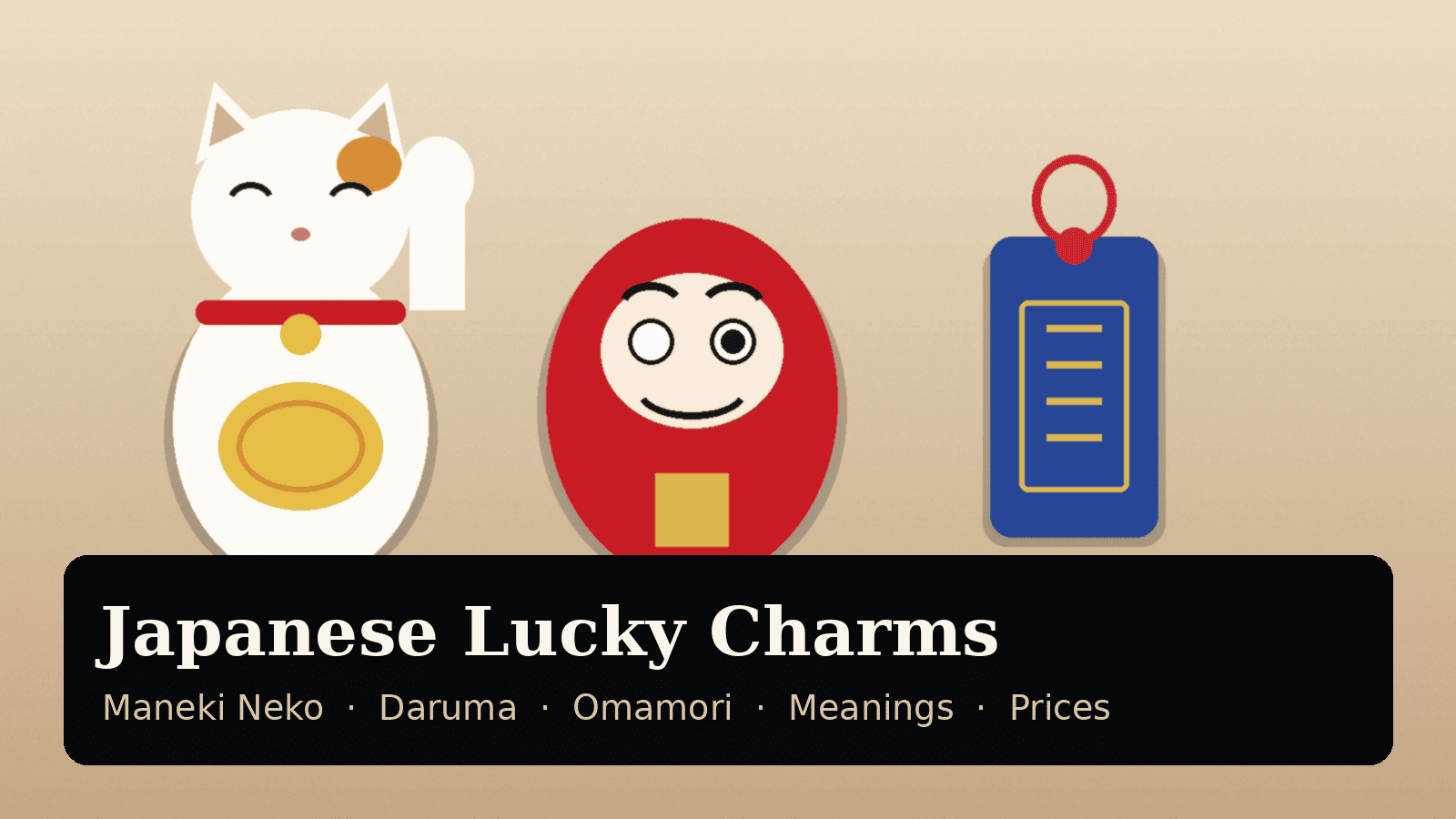
The three Japanese lucky charms most people mean are the maneki neko (招き猫, the beckoning “lucky cat”), the round red daruma doll (だるま) and the omamori (お守り), a small cloth amulet from a shrine or temple. A maneki neko with its right paw up beckons money and one with its left paw up beckons customers; a daruma is bought with blank eyes — you paint one eye when you make a wish and the other when it comes true; an omamori is carried for about a year and then returned to a shrine.
- For a shop or a gift: a maneki neko (Tokoname or Seto ceramic, or a Gotokuji cat).
- For a goal: a daruma — Takasaki in Gunma is the main producer.
- For protection: an omamori for the specific wish (traffic safety, studies, love, health).
As of October 2026, this guide covers what the Japanese lucky charm is called, maneki neko meaning, paw and color meanings, daruma doll meaning, which eye to paint first, omamori types and how to use them, how to dispose of old charms, prices, and how to buy Japanese good luck charms from Japan.
What Is the Japanese Lucky Charm Called?
There is no single name: Japanese good-luck objects as a group are engimono (縁起物). The lucky cat is the maneki neko (literally “beckoning cat”), the wish doll is the daruma, and the shrine amulet is the omamori (“protection”). Other Japanese charms you will see are ema wooden wish plaques, omikuji paper fortunes and ofuda talismans for the home altar. Below, each of the three main ones in turn. In Japanese culture good luck charms are bought by men and women alike — there is no men’s or women’s version, only different wishes and designs. The maneki neko translation is “beckoning cat”; a “real” Japanese lucky cat simply means a ceramic one from Japan (Tokoname or Seto) rather than a plastic import.
Maneki Neko: The Japanese Lucky Cat
Maneki neko meaning, symbolism and origin legend
The Japanese lucky cat (maneki neko, sometimes spelled maneki-neko) is a seated cat with one paw raised in a beckoning gesture — in Japan you wave someone toward you palm-down, so the paw is inviting luck in, not waving goodbye. Its best-known origin story belongs to Gotokuji (豪徳寺), a Zen temple in Setagaya, Tokyo. According to the temple, a lord returning from falconry was beckoned in by a cat at the gate; a thunderstorm broke soon after, and he sat it out in comfort talking with the priest. The lord was Ii Naotaka, head of the Hikone domain, and with his support Gotokuji was rebuilt in 1633. The temple calls the cat 招福猫児 (“fortune-beckoning cat”) and enshrines it in its Shōfukuden hall.[1]
Gotokuji’s white cats raise the right paw and hold no coin. The temple explains why: the cat brings you en — connections with people — not money itself; fortune follows for those who use those connections with gratitude. Many visitors leave a cat at the temple after a wish comes true, which is why the famous rows of hundreds of white cats exist, though the temple says there is no rule about it.[1]
A second strand of the story comes from Imado near Asakusa. The Shizuoka City Museum of Art notes a boom in Edo in 1852 for Marushime-neko (丸〆猫), Imado-ware clay cats it calls “the ancestor of the maneki neko”, apparently sold in the grounds of nearby Sensōji.[2] Today’s Imado Shrine presents itself as a matchmaking (en-musubi) shrine and sells en-musubi omamori for ¥1,000.[3]
Left paw vs right paw (and the arm meaning)
| Paw | Meaning | Notes |
|---|---|---|
| Right paw raised | Beckons money (銭を招く) | Gotokuji’s cats raise the right paw |
| Left paw raised | Beckons customers (お客を招く) | Popular with shops and restaurants |
| Both paws raised | Both at once | A less common variant that beckons both |
Aichi Prefecture’s tourism site gives the standard reading: a raised right paw beckons money, a raised left paw beckons customers.[4] That is why a waving lucky cat in a restaurant window usually has its left paw up. For decor, the direction is simple: place it facing the entrance, beckoning people and money in. Lucky cat lore adds that the higher the raised arm, the further away the luck it can reach. The writing on the koban or bib is a wish such as 千客万来 (“a thousand customers”) or 開運 (“good luck”). Solar-powered “waving” cats that move their paw are the same idea with a battery.
Maneki neko colors
Color meanings are a modern convention, and the list below is the one Aichi Prefecture’s tourism site publishes:[4]
| Color | Meaning |
|---|---|
| White | Beckons good fortune |
| Black | Wards off illness |
| Gold | Beckons financial luck |
| Silver | Long life |
| Pink | Success in love |
| Blue | Traffic safety |
| Red | Wards off evil |
The calico (white with black and orange patches) is the classic look, and a black and white cat reads as a white (fortune) cat; other colors such as yellow, green or purple are sold too, but meanings for them vary by maker. The large oval gold coin the cat holds is a koban (小判), an Edo-period gold coin; on Tokoname cats it stands for business prosperity.[4]
Where maneki neko are made: Tokoname and Seto
Aichi Prefecture is home to the two big production areas. Seto was the first place in Japan to mass-produce porcelain maneki neko, in about 1897–1906, and runs the Maneki Neko Museum.[5] Tokoname started about 50 years later; its chunky cats with a big koban and wide eyes are, in the prefecture’s words, “said to” account for about 80% of national production.[4] On Tokoname’s Maneki Neko Street, the giant cat Tokonyan — 3.8 m tall and 6.3 m wide — peers over a wall above the road, and the street is lined with 39 ceramic cats by 39 local potters.[6][7]
Maneki Neko Day is September 29 (9-2-9, read ku-ru-fuku, “fortune comes”), set by the Japan Maneki Neko Club in 1995; Seto’s Kuru-Fuku Maneki Neko Festival, held since 1996, ran its 31st edition on September 26–27, 2026.[5]
Maneki neko vs Chinese lucky cat
The “Chinese lucky cat” in shop windows in Chinatowns is the Japanese maneki neko design, usually in its gold plastic waving version. Lucky cat figurines with Chinese characters, red-and-gold colors and a battery arm are the export style; ceramic Tokoname or Seto cats are the Japanese originals of the design.
Maneki neko prices
- Gotokuji cats: ¥500 to ¥10,000 at the temple office depending on size; a mini cat in a case is ¥1,000 (some sizes sell out).[8]
- Tokoname and Seto ceramic cats: small pieces cost about the same as a Gotokuji cat; large hand-painted pieces and artist cats cost more.
- Vintage maneki neko: old Seto porcelain and Tokoname cats appear on Yahoo Auctions and Mercari; check photos of the base and any chips.
- Everything else: keychains and keyrings, phone charms and straps, pendants, ornaments, money boxes (piggy banks), lucky cat clocks, garden statues, a golden lucky cat with a moving arm, plush, bowls, tea cups and gashapon capsule toys.
Daruma Dolls
Daruma doll meaning, symbolism and legend
A daruma (だるま / 達磨) is a round, hollow papier-mâché doll modeled on Bodhidharma (Daruma Daishi), an Indian monk regarded as the founder of Chinese Zen. Shorinzan Daruma-ji in Takasaki explains the look: daruma are red because Bodhidharma wore a red robe, and round because they show him in seated meditation — after nine years of wall-facing meditation, the story goes — with his hands and feet hidden inside the robe.[9] The doll is weighted at the bottom so it rights itself when knocked over, which is where the saying 七転び八起き (nana korobi ya oki, “fall down seven times, get up eight”) comes in: a daruma stands for perseverance and achieving a goal.
On a Takasaki daruma, the eyebrows are drawn as cranes and the moustache and beard as a tortoise — two symbols of long life — and wishes such as 家内安全 (family safety) or 商売繁盛 (business prosperity) are written in gold on the sides, with 福入 (“fortune inside”) on the belly.[10][11]
What does a daruma doll represent? Its significance is a goal and the perseverance to reach it; in religion it comes from Zen Buddhism, but its usage today is secular — students, companies, sports teams and election candidates all buy one. Daruma doll lore says that if yours fell down it simply gets back up, which is the whole point. Variations in shape and face exist by region, and the writing on the front (the wish, such as 必勝 “sure victory” or 合格 “pass”) carries the meaning.
Daruma instructions: which eye do you paint first?
- Make your wish (a goal, a year without trouble, passing an exam).
- Paint the first eye: Shorinzan says to paint the eye on your right as you face the daruma — that is the daruma’s own left eye.[9] This is called kaigen (開眼, “opening the eyes”).
- Keep it somewhere you see it — beside the household altar or above eye level.[9]
- Paint the second eye when the wish comes true or you have got through the year safely, as thanks.[10][11]
Use a black marker or a brush with sumi ink; a full round pupil is the usual style. Politicians in Japan famously paint in the second eye on election night when they win.
Daruma colors
Red is the traditional color, and in Takasaki red was also believed to ward off smallpox.[12] Today daruma come in white, gold, black, pink, blue, green, purple and more, and charts online give each a meaning (gold for money, white for purity and so on). Shorinzan Daruma-ji itself says the colors have no difference in meaning — the doll takes on meaning when you paint the eye with your own wish.[9] Pick the color you like; red-and-white pairs and gold daruma are popular as wedding gifts.
Takasaki daruma
Takasaki City in Gunma Prefecture calls itself Japan’s No. 1 daruma production area, and the city’s own planning document describes Takasaki daruma as holding the top share of papier-mâché daruma production and sales in Japan.[11][13] Shorinzan traces them to the 1783 Mount Asama eruption and famine, when the temple’s ninth head priest carved a mould from a daruma drawing and taught Yamagata Tomogorō of Toyooka village to make papier-mâché daruma to help struggling farmers; the temple calls itself the birthplace of the good-luck daruma.[10] Silk-farming households put daruma on their altars because the daruma “getting up” matched silkworms “waking”.[14] “高崎だるま” is now a registered trademark, and the city counts 72 daruma craftspeople.[12]
Daruma market: Shorinzan’s Nanakusa Taisai Daruma-ichi is held every January 6–7 at the temple, with daruma stalls lined up in front of the main hall; the city also runs a daruma market outside Takasaki Station (check the dates for the year).[15][12] Shorinzan’s Daruma Festival is on October 5, Bodhidharma’s memorial day.[9]
Daruma sizes and prices
Daruma sizes are given in gō (号) numbers. Gunma Prefecture quotes a typical range of about ¥500 to ¥40,000.[14] The Takasaki maker Kunimine Bekkoya lists its red fuku-daruma like this (tax included, shipping extra; the price list is several years old, so check current prices):[16]
| Size (gō) | Height | Price |
|---|---|---|
| 1 | 9 cm (3.5 in) | ¥1,000 |
| 3 | 15 cm (5.9 in) | ¥1,500 |
| 5 | 18 cm (7.1 in) | ¥2,000 |
| 7 | 25 cm (9.8 in) | ¥2,800 |
| 10 | 30 cm (11.8 in) | ¥4,200 |
| 12-A | 40 cm (15.7 in) | ¥7,000 |
| 15 | 50 cm (19.7 in) | ¥12,000 |
| 18 | 75 cm (29.5 in) | ¥36,000 |
Small daruma (under 10 cm) make good desk charms and gifts; 15–25 cm is the typical home size; 40 cm and up is what shops and campaign offices buy. Unpainted daruma kits for DIY painting, nesting daruma and angry-faced variants are novelty versions. Other daruma styles include the Okiagari-koboshi tumbler dolls of Aizu, daruma omikuji (paper fortunes inside a small ceramic daruma), daruma keychains and daruma-shaped gashapon.
What to do with an old daruma
Do not just throw it away. Shorinzan Daruma-ji holds a daruma kuyō (memorial burning); the biggest is the Daruma Otakiage on January 15, and the temple accepts old daruma at a drop-off desk daily (offering amount up to you; ask before posting one in).[17] Some shrines do not accept daruma — Kanda Myojin and Dazaifu Tenmangu say so — so check before taking one to a shrine.[18][19] Outside Japan, people usually keep a finished daruma as a reminder or dispose of it respectfully.
Omamori: Japanese Shrine Amulets
Omamori meaning
An omamori (お守り, “protection”) is a small brocade pouch with a prayer slip or wooden tablet inside, sold at Shinto shrines and Buddhist temples. Santai Jinja explains that ofuda and omamori both carry a share of the deity’s spirit: an ofuda (お札) is placed on the household altar (kamidana), and an omamori is a miniature ofuda made to be carried.[20] Each omamori is for a specific wish, and you can hold several from different shrines — Haneda Jinja and Kanda Myojin both say there is no limit, as long as you treat them with care.[21][18] The pouch is customarily left closed.
Omamori types: education, house, love, health and travel charms
The wish is embroidered on the front. These are the common kinds, as listed on Meiji Jingu’s and Haneda Jinja’s pages:[22][23]
| On the pouch | Romaji | For |
|---|---|---|
| 交通安全 | Kōtsū anzen | Traffic safety — often hung in the car |
| 学業成就 | Gakugyō jōju | Success in studies |
| 合格祈願 / 合格成就 | Gōkaku | Passing exams |
| 縁結び | En-musubi | Finding a partner / good relationships |
| 恋愛成就 | Ren’ai jōju | Success in love |
| 安産 | Anzan | Safe childbirth |
| 子授け | Kosazuke | Conception |
| 健康祈願 / 心身健全 | Kenkō | Health, soundness of body and mind |
| 病気平癒 | Byōki heiyu | Recovery from illness |
| 商売繁盛 | Shōbai hanjō | Business prosperity |
| 金運 | Kin’un | Money luck |
| 厄除 | Yakuyoke | Protection from evil and bad-luck years |
| 開運 / 福守 | Kaiun / fuku-mamori | Good fortune in general |
| 勝守 | Kachi-mamori | Victory (Kanda Myojin’s best-known charm) |
| 家内安全 | Kanai anzen | Family safety |
Color and shape meanings are set by each shrine, not by a national rule, so ask at the shrine.[18] Kanda Myojin’s best-known charm is its kachi-mamori victory charm, linked to Tokugawa Ieyasu praying there before the Battle of Sekigahara.[18]
Omamori rules: how to use an omamori
- Tie it on: loop the cord (string) through a bag strap, keyring or phone strap and pull the omamori through the loop — that is how to tie a Japanese good luck charm; the decorative rope, tassel or beads on some charms are part of the design.
- Carry it: in a bag, wallet or on a keychain; a traffic-safety omamori goes in the car.[21][18]
- At home: on the kamidana or somewhere high on white paper.[21]
- Pray first: Kanda Myojin suggests worshipping at the shrine before receiving a charm.[18]
- Does an omamori expire? Replace it after about a year: Haneda Jinja says an omamori is considered valid for one year; Santai Jinja calls a year a guide rather than a fixed rule, and suggests returning it sooner once the wish (an exam, a birth) has come true.[21][20]
How to dispose of an omamori
Return it to the shrine or temple it came from, where old charms are collected in a kosatsu-nōsho (古札納所) and burned in an otakiage ceremony. If that shrine is far away, another shrine of the same deity or a nearby shrine is acceptable.[21][20] Dazaifu Tenmangu and Kanda Myojin accept returns by post.[19][24] New Year fire festivals (dondo-yaki, around January 15) are another traditional time to burn old charms and decorations.[20]
Omamori prices
The price is an offering (初穂料, hatsuhoryō) set by each shrine. Gotokuji and Imado Shrine charge ¥1,000; Kanda Myojin’s online shop lists most charms at ¥1,000, with some at ¥500, ¥1,500, ¥2,000 and ¥2,500 (checked 2026-10-27).[8][3][25] Plan on about ¥500–¥1,500 for most omamori.
Other Japanese Good Luck Symbols
Many smaller Japanese good luck charms are puns or folk symbols. These are the ones behind searches like “Japanese owl charm” or “Japanese charm to stop rain”:
- Teru teru bōzu (てるてる坊主): a white cloth rain charm doll children hang by the window to stop rain and wish for sunny weather — the Japanese weather charm.
- Owl (fukurō): read as 不苦労, “no hardship”, so owl charms are a wealth and happiness charm.
- Frog (kaeru): also means “return”, so a frog charm in a wallet is for money coming back and a safe return home.
- Kitsune (fox): the messengers of Inari shrines, linked to rice and business.
- Hamaya (破魔矢): the New Year “evil-breaking arrow” sold at shrines — the Japanese arrow charm.
- Uchide no kozuchi: the lucky mallet (hammer) of the god Daikoku, which shakes out treasure.
- Hyōtan (gourd), turtle, rabbit, tai sea bream and koi fish: long life, leaping ahead, celebration and perseverance.
- Netsuke: small carved toggles once used to hang pouches from a kimono obi; antique netsuke are collected as art.
- Bells and knots: many charms carry a small bell and a decorative cord tied in a knot (musubi), the word that also means “tying” a connection — that is the “knot” in omamori knot meaning.
- Ema (絵馬): wooden plaques you write a wish on and hang at the shrine (Gotokuji’s are ¥1,000).[8]
- Omikuji: paper fortunes; a bad one is tied to a rack at the shrine.
- Kanji for luck: 福 (fuku, good fortune) and 縁 (en, connection) are the characters you see on charms; 運 (un) means luck in the sense of fate.
- Koi, cranes and tortoises: perseverance and long life — the crane and tortoise are the daruma’s eyebrows and beard.
- Zodiac animals: each New Year’s animal appears on ema and figurines.
Do Japanese Lucky Charms Work?
That depends on belief, but in Japan their purpose is as much about intention as magic: a daruma keeps a goal in front of you, an omamori is a reminder of a prayer, and a maneki neko by the door is a statement that customers are welcome. Daruma come from Zen Buddhism (Bodhidharma), omamori are sold at both Shinto shrines and Buddhist temples, and the maneki neko is a folk charm used by everyone. In tattoo art (irezumi and modern Japanese-style tattoos) the same symbolism carries over — a daruma tattoo with one eye stands for an unfinished goal, a maneki neko tattoo for luck and prosperity, an omamori tattoo for protection.
In English: names and pronunciation
- Maneki neko (mah-neh-kee neh-koh): “beckoning cat”; the lucky cat in English. Its moving arm version is the battery or solar waving cat.
- Daruma (dah-roo-mah): named after Bodhidharma; the daruma doll you draw eyes on.
- Omamori (oh-mah-moh-ree): “protection”; definition — a shrine or temple amulet for one wish.
- Lucky charm in Japanese: お守り (omamori) for an amulet, 縁起物 (engimono) for any good-luck object, お守り 交通安全 for a Japanese charm for safe travel and driving.
Japanese Words for Shopping
| Japanese | Romaji | Meaning |
|---|---|---|
| 招き猫 | maneki neko | beckoning cat / lucky cat |
| 招福猫児 | maneki neko (Gotokuji’s spelling) | fortune-beckoning cat |
| 小判 | koban | oval gold coin the cat holds |
| だるま / 達磨 | daruma | daruma doll; Bodhidharma |
| 開眼 | kaigen | painting in the first eye |
| 必勝 / 合格 | hisshō / gōkaku | sure victory / pass — common daruma wishes |
| お守り | omamori | protective amulet |
| お札 | ofuda | paper or wooden talisman for the home altar |
| 神棚 | kamidana | household Shinto altar |
| 絵馬 | ema | wooden wish plaque |
| おみくじ | omikuji | paper fortune |
| 古札納所 | kosatsu-nōsho | box for returning old charms |
| お焚き上げ | otakiage | ritual burning of old charms |
| 縁起物 | engimono | good-luck object |
| 初穂料 | hatsuhoryō | the offering you pay for a charm |
How to Buy Japanese Lucky Charms From Japan
Shrines and temples treat receiving charms in person as the norm, and their mail-order options are mostly domestic:
- Kanda Myojin sells omamori and ofuda through its online shop but does not ship overseas (Japanese addresses only).[24]
- Shorinzan Daruma-ji takes postal orders for daruma and charms by cash on delivery only, so it is not a route for overseas buyers.[26]
- Meiji Jingu’s amulet office does not take credit cards.[27]
- Gotokuji sells its cats at the temple office.[8]
- Daruma makers: Kunimine Bekkoya says overseas shipping is possible on request.[28]
Maneki neko, daruma and charm goods are also sold by ceramic studios, Takasaki makers and souvenir shops on Rakuten, Amazon Japan, Yahoo Shopping, Mercari and Yahoo Auctions. For a shrine’s own online shop that only ships inside Japan, ask OneMall support before ordering whether its order form can be completed for you — some shrines ask for details a proxy cannot provide.
- Search in Japanese: 招き猫 常滑, 招き猫 瀬戸, 高崎だるま, 必勝だるま or お守り (wish).
- Check size and material: ceramic cats are fragile and heavy for their size; papier-mâché daruma are light but bulky.
- Protect it: package reinforcement (from ¥100) plus unboxing photos (¥500 / ¥700) or a wrong/missing-item check (¥200) at the Tokyo warehouse let you see condition before international shipping. Under OneMall’s policy, damage in international transit is compensated up to the international shipping fee paid, and must be reported within 24 hours with the order number, photos and a full unboxing video.
OneMall buys from Japanese marketplaces such as Mercari, Yahoo Auctions, Rakuten and Amazon Japan, and from other Japanese online stores (including maker web shops) through LinkBuy. Items that need a lottery entry, purchase limit, Japanese identity verification or a merchant account cannot be purchased. International shipping is charged on the greater of actual weight and volumetric weight (length × width × height ÷ 5,000) of the box the warehouse uses.
Service fees are ¥300 per item on most marketplaces; from ¥200 per item on Yahoo Auctions and LinkBuy. The first six orders consolidate free; each additional order costs ¥100. Storage is free for 90 days after arrival (30 days after consolidation). Payment is by Visa, Mastercard or PayPal, settled in USD.
US buyers: since August 29, 2025, US-bound parcels of any value go through customs and pay applicable duties, taxes and fees — the $800 de minimis exemption no longer applies. OneMall currently ships to the United States by ECMS, DHL and Japan Post EMS (DDP — declared value up to USD 2,500, duties prepaid with the shipping fee); the live quote at checkout shows which lines accept your parcel.
Browse Tokoname maneki neko, Takasaki daruma or omamori, and compare the best Japan proxy services and proxy costs by total landed cost. For Japanese New Year traditions see our Japanese New Year guide; for gift ideas see Christmas gifts from Japan and our kokeshi dolls guide.
Frequently Asked Questions
What does a maneki neko mean?
It is a “beckoning cat” that invites good fortune: right paw up for money, left paw up for customers.
Which paw should a lucky cat raise?
Right for money and luck at home, left for customers in a shop; Gotokuji’s cats raise the right paw.
Is the lucky cat Chinese or Japanese?
The maneki neko comes from Japan (Edo-period Tokyo); the gold waving cats sold in Chinatowns follow the same design.
Which eye do you color in first on a daruma?
The eye on your right as you face it (the daruma’s left), when you make the wish; paint the other one when it comes true.
Do daruma colors have different meanings?
Charts online give each color a meaning, but Shorinzan Daruma-ji says the colors make no difference — your wish gives the doll its meaning.
How long does an omamori last?
About a year by custom; then return it to a shrine to be burned and get a new one.
Can I throw away an omamori or daruma?
Customarily no — return it to a shrine or temple (some accept them by post), or keep it.
References
- Gotokuji, Gotokuji and the maneki neko. https://gotokuji.jp/manekineko/
- Shizuoka City Museum of Art, cat exhibition notes. https://shizubi.jp/exhibition/180407_02_4.php
- Imado Shrine. https://imadojinja1063.crayonsite.net/
- Aichi Now (Aichi Prefecture tourism), Tokoname and Seto maneki neko. https://aichinow.pref.aichi.jp/columns/detail/105/
- Maneki Neko Museum (Seto), 31st festival notice. https://www.luckycat.ne.jp/news/newsitem/news20260919.html
- Tokoname Tourism Association, Tokonyan. https://www.tokoname-kankou.net/spot/detail/4/
- Tokoname Tourism Association, Maneki Neko Street. https://www.tokoname-kankou.net/spot/detail/3/
- Gotokuji, Charms and offerings. https://gotokuji.jp/shop/
- Shorinzan Daruma-ji, FAQ. https://www.daruma.or.jp/faq/
- Shorinzan Daruma-ji, Birthplace of the good-luck daruma. https://www.daruma.or.jp/%e7%b8%81%e8%b5%b7%e3%81%a0%e3%82%8b%e3%81%be/
- Takasaki City, About Takasaki daruma. https://www.city.takasaki.gunma.jp/site/sightseeing/3052.html
- Takasaki City, History of Takasaki daruma. https://www.city.takasaki.gunma.jp/page/3053.html
- Takasaki City, Daruma museum basic plan (2024). https://www.city.takasaki.gunma.jp/uploaded/attachment/21302.pdf
- Gunma Prefecture, Traditional craft: Takasaki daruma. https://www.pref.gunma.jp/site/kougei/690379.html
- Shorinzan Daruma-ji, Annual events. https://www.daruma.or.jp/%e5%b9%b4%e9%96%93%e8%a1%8c%e4%ba%8b/
- Kunimine Bekkoya, Fuku-daruma sizes. http://www.takasaki-daruma.jp/fukudaruma.html
- Shorinzan Daruma-ji, Daruma kuyo. https://www.daruma.or.jp/%e3%81%a0%e3%82%8b%e3%81%be%e4%be%9b%e9%a4%8a/
- Kanda Myojin, FAQ. https://www.kandamyoujin.or.jp/faq/
- Dazaifu Tenmangu, FAQ. https://www.dazaifutenmangu.or.jp/faq
- Santai Jinja, Returning omamori. https://www.santai-jinja.jp/blog/omamori-hennou/
- Haneda Jinja, How to treat an omamori. https://www.hanedajinja.com/faq/info05.htm
- Meiji Jingu, Amulet. https://www.meijijingu.or.jp/en/feelshinto/5.php
- Haneda Jinja, Types of omamori. https://www.hanedajinja.com/faq/info10.htm
- Kanda Myojin online shop, Ordering and shipping. https://juyo.kandamyoujin.or.jp/flow/
- Kanda Myojin online shop, Items. https://juyo.kandamyoujin.or.jp/
- Shorinzan Daruma-ji, Charm order form. https://www.daruma.or.jp/juyohin/
- Meiji Jingu, Q&A. https://www.meijijingu.or.jp/en/qa/
- Kunimine Bekkoya, Ordering and shipping. http://www.takasaki-daruma.jp/order.html