 Shopping Guide
 HELP / FAQs


 By onemall
Last updated: 2026-10-26.
TL;DR
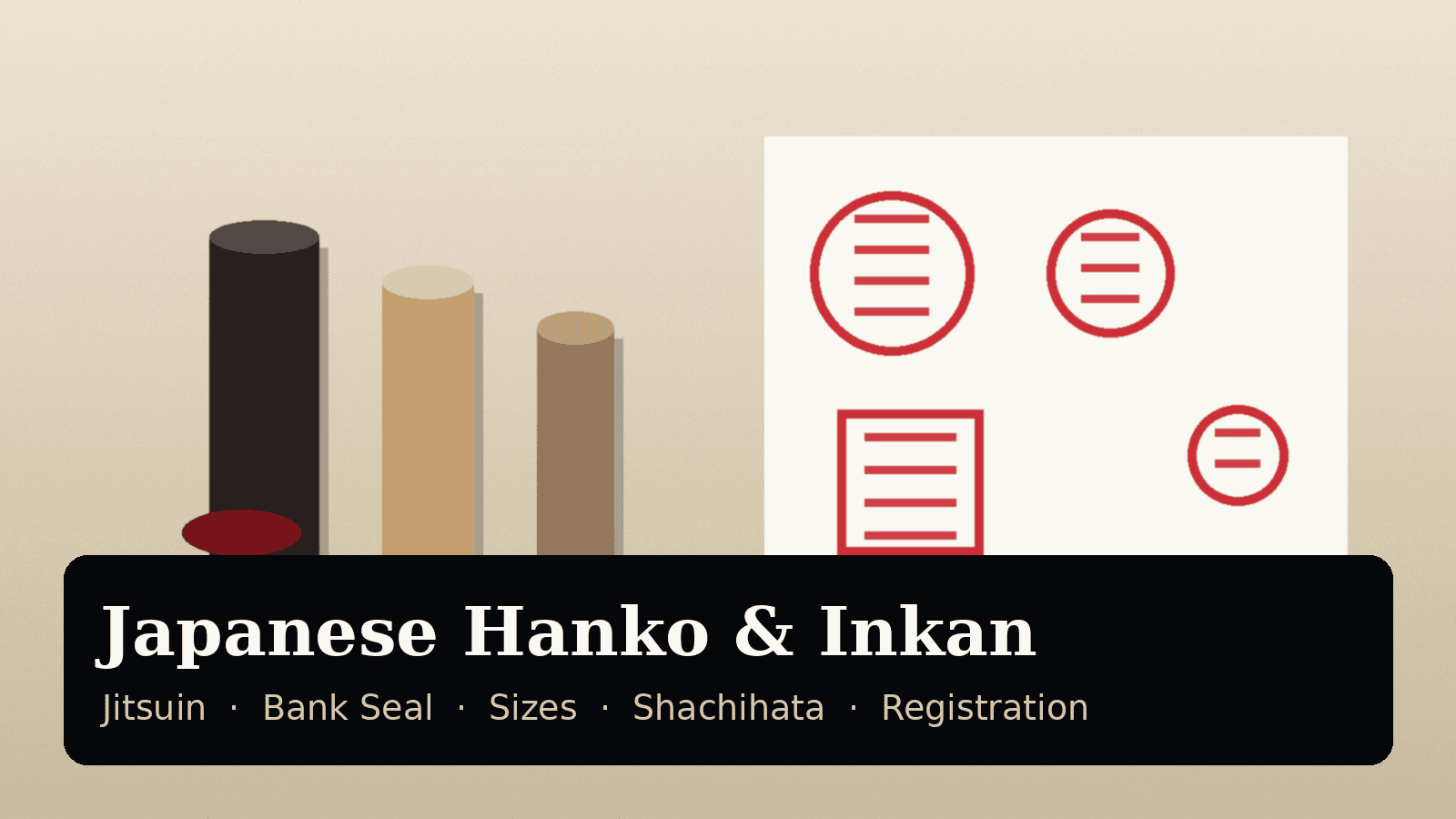
A hanko (はんこ), also called an inkan (印鑑), is the Japanese name stamp or personal seal that people in Japan press in red ink where Americans would sign. There are three everyday kinds: the jitsuin (registered seal) for major contracts, the ginkō-in (bank seal) and the mitome-in (everyday seal). Self-inking Shachihata-type stamps are handy but cannot be registered. A jitsuin is usually 15–18 mm across and carved in boxwood, buffalo horn or titanium.
- Just want a souvenir? A ready-made or custom name stamp in katakana, romaji or kanji works.
- Live in Japan? Register a custom seal at your city office (8–25 mm square, no rubber).
- Typeface: insōtai or tensho for a registered seal.
- Avoid ivory if you are in the US.
As of October 2026, this guide covers what a Japanese signature stamp is called, the hanko vs inkan difference, the types of seal, a hanko size chart, materials and typefaces, how inkan registration and the inkan certificate work (including for foreigners), Shachihata stamps, how to use a hanko, prices, and how to buy a Japanese name stamp from Japan.
What Is a Japanese Name Stamp Called?
The Japanese name stamp — the Japanese signature stamp, personal seal or name seal — is called a hanko (はんこ / 判子) in everyday speech. Strictly, the physical stamp is an inshō (印章), the red mark it leaves is an in’ei (印影), and inkan (印鑑) means an impression registered with a bank or a government office, although people use “inkan” loosely for the stamp itself.[1] “Inkan” comes from 鑑 (kagami), a ledger that impressions were compared against; “hanko” most likely comes from 版行 / 板行, Edo-period block printing.[1]
Inkan definition: a personal seal used in place of a signature. Are hanko stamps unique? A custom, handmade hanko is — which is why city offices refuse mass-produced ready-made ones for registration.
Hanko vs inkan: in practice they mean the same object — the difference between hanko and inkan is mostly register (hanko is casual, inkan is more formal and points to the registered impression). The Japanese word for stamp in the rubber-stamp or postage sense is スタンプ (sutanpu), and the Japanese word for seal as a document seal is 印 (in) or 判 (han). Seal stamp in Japanese is therefore 印鑑 or 判子; a “seal” the animal is アザラシ (azarashi), which is why searches for Japanese seal plush toys have nothing to do with hanko.
Types of Hanko
| Type | In English | Used for | Notes |
|---|---|---|---|
| Jitsuin (実印) | Registered seal | Registered at your city or ward office; used for property, car purchases, inheritance and other major contracts | Custom-carved; cannot be rubber or self-inking |
| Ginkō-in (銀行印) | Bank seal | Registered with a bank to open an account and handle withdrawals | Custom or ready-made; keep it separate from your jitsuin |
| Mitome-in (認印) | Everyday seal | Signing for deliveries, internal paperwork, everyday forms | Ready-made or custom; not registered |
| Shachihata / self-inking (浸透印) | Self-inking name stamp | Fast everyday stamping — deliveries, office circulation | Not suitable for jitsuin or bank seals; the rubber face can deform |
| Sanmonban (三文判) | Cheap ready-made seal | Mass-produced surname stamps sold in stationery and 100-yen shops | Some city offices refuse to register them |
The three uses — jitsuin, bank seal and mitome-in — follow Shachihata’s own explanation.[1] Sanmonban gets its name from Edo-period coin values (i.e., dirt cheap); because many people own identical ones, some municipalities refuse to register them, and self-inking stamps are unsuitable as jitsuin or bank seals because the rubber can deform under pressure.[2]
Hanko Size Chart
What size should a signature stamp be? Japanese hanko sizes are given as the diameter (or side) of the face in millimetres. These are the common recommendations from the hanko maker Heiandō:[3]
| Seal | Men | Women |
|---|---|---|
| Jitsuin (registered seal) | 18 mm (0.71 in) | 15 mm (0.59 in) |
| Ginkō-in (bank seal) | 15 mm (0.59 in) | 12 mm (0.47 in) |
| Mitome-in (everyday seal) | 10.5–13.5 mm (0.41–0.53 in) | 10.5–12 mm (0.41–0.47 in) |
| Shachihata Name 9 | 9.5 mm (0.37 in) diameter | 9.5 mm (0.37 in) diameter |
| Registrable range (Toshima / Higashihiroshima) | 8–25 mm square | 8–25 mm square |
The rule of thumb is jitsuin > bank seal > mitome-in, so the three are easy to tell apart. City offices set a range for registered seals: Toshima City (Tokyo) and Higashihiroshima City both accept impressions between 8 × 8 mm and 25 × 25 mm.[4][5] Round seal stamp size and square seal sizes follow the same mm figures; a corporate seal (company seal) is a separate, larger set and is not covered here.
Hanko Materials
| Material | Character | Example jitsuin price |
|---|---|---|
| Satsuma boxwood (薩摩本柘) | Fine-grained, hard wood from Kagoshima; the classic entry material | Jitsuin from about ¥7,480 (Heiandō) to ¥11,900 (Darumaya) |
| Black buffalo horn (黒水牛) | Dense, durable and the usual recommendation for a jitsuin | About ¥15,180–15,300 |
| White buffalo horn | Lighter-coloured horn | From about ¥18,480 (Heiandō) |
| Titanium | Almost no chipping, wear or deformation | About ¥31,800 (Darumaya) |
| Ivory (象牙) | Traditional but not an option for US buyers | Commercial import into the US is prohibited (see below) |
Prices are each shop’s starting jitsuin prices including tax, checked 2026-10-26.[6][7] Boxwood needs care against drying and cracking; buffalo horn is the shops’ default recommendation; titanium is the long-lasting option.[6] Cheap acrylic and wood mitome-in sit at the bottom of the range.
Ivory hanko and US buyers: the US Fish and Wildlife Service states that “commercial import of African elephant ivory into the United States is prohibited”; the near-total ban on commercial trade took effect on July 6, 2016, and the narrow exceptions (household moves and inheritances of pre-1976 ivory with CITES paperwork) do not cover buying one from a shop.[8] Choose horn, wood or titanium instead.
Hanko Typefaces (Fonts)
| Typeface | Look | Best for |
|---|---|---|
| Insōtai (印相体, also 吉相体) | Characters fill the circle and touch the border | Recommended for jitsuin and bank seals: hard to read, hard to forge, durable |
| Tensho (篆書体) | Ancient seal script | Recommended for jitsuin; the classic “seal” look |
| Koin-tai (古印体) | Rounded, easy to read | Popular for mitome-in |
| Kaisho (楷書体) | Standard printed kanji | The most readable, so the weakest against forgery |
| Gyōsho (行書体) | Semi-cursive brush style | Elegant, but fine details chip easily |
Insōtai and tensho are recommended for a registered seal because they are hard to read (so hard to copy) and the many contact points with the border make the face durable; kaisho is the easiest to read and the weakest against forgery.[9] A “Japanese hanko font”, hanko creator or online Japanese seal generator only makes an image of a seal — fine for a logo, signature graphic or design, but it is not a physical seal and cannot be registered.
Inkan Registration and the Inkan Certificate
To use a jitsuin you register it with the municipality where you live (inkan tōroku / inkan toroku, 印鑑登録). Proof of the registration is the inkan tōroku shōmeisho (inkan shomeisho or inkan toroku shomeisho, 印鑑登録証明書, the seal registration certificate or inkan certificate), which you attach to contracts; many cities also issue a registration card (印鑑登録証, inkan toroku-sho) that you show to get a certificate. The rules differ slightly by city; two examples:
- Toshima City (Tokyo): you must be a registered resident aged 15 or over and apply in person with the seal and your Residence Card; registration costs ¥500 and each certificate ¥400 (¥300 through the My Number Card digital option). Toshima will not register rubber or easily deformed seals, self-inking stamps, mass-produced ready-made seals, blurred impressions, designs mixing the alphabet and Japanese characters, seals without an outer border, initials only, or sizes outside 8–25 mm.[4]
- Higashihiroshima City (Hiroshima): one seal per person; rubber and self-inking name stamps cannot be registered. Registration ¥300; certificates ¥330 at the office or ¥200 at a convenience store with a My Number Card (through April 2028).[5]
Hanko for foreigners
Foreign residents can register a jitsuin too. Toshima accepts the full name as on the Resident Record, the surname only or the first name only, and full-name katakana only for people from countries that don’t use kanji;[4] Higashihiroshima accepts the full alphabet name, a katakana version, the home-country form, or kanji shown on the Residence Card.[5] Hanko makers say most municipalities accept katakana or alphabet seals, but some refuse alphabet ones, so check with your city office first.[10] Shops such as Hankoman carve alphabet, katakana and kanji ateji (kanji picked for their sound) name stamps for foreigners.[11]
Datsu-hanko: do you still need one?
After a July 2020 Cabinet decision on regulatory reform, Japan began dropping seals from paperwork (“datsu-hanko”, 脱ハンコ). On October 16, 2020, Minister Taro Kono said seals could be dropped from 99.247% of about 15,000 administrative procedures; only 111 kept them, mainly those using registered or bank seals.[12] The health ministry, for example, deleted or changed seal fields on forms under 24 laws and rules in December 2020.[13] So in 2026 a jitsuin is still needed for property, cars and inheritance, while most everyday forms take a signature.
Shachihata Stamps
Shachihata (シヤチハタ) is the Nagoya company behind Japan’s self-inking name stamps; it was founded in 1925, and its predecessor invented a stamp pad that never needed re-inking. The Xstamper, with the ink built in so no pad is needed, launched in 1965.[14] Its best-known name stamp is the Name 9 (ネーム9), a 9.5 mm round self-inking stamp: list price ¥1,760, sold for ¥1,293 including tax by the office-supply shop Tanomail (checked 2026-10-26). It is not accepted for seal certification.[15]
Shachihata also makes ink pads, refill ink, date stamps (dater), number stamps, calendar stamps, alphabet rubber stamp sets, roller stamps, Artline pens and markers. “Shachihata” has become the generic Japanese word for any self-inking name stamp, which is why forms say シャチハタ不可 (“no Shachihata”) where a real seal is required.
Shachihata products: its range runs from Xstamper (X stamp) name stamps, letter stamps (including do-it-yourself name stamp kits) to date, number, page-number and perpetual calendar stamps, connecting and layered decorative stamps, and ink pads in mini, quick-dry and oil-based metallic versions; check the listing for whether a pad is oil-based before ordering, since carriers can restrict some inks.
Hanko History and Culture
Seals came to Japan from China, which is also where the English word “chop” for an East Asian seal comes from (via trade-port English). In Japan the inkan culture grew into everyday use: as noted above, the word hanko is traced to Edo-period block printing, and the seal-registration system is what still gives a jitsuin its legal weight. The look of a Japanese signature is therefore a small red circle or square with a surname in kanji — that is what “what does a Japanese signature look like” usually means. Hanko pronunciation: HAHN-koh; the translation is simply “stamp” or “seal”.
Hanko vending machines, workshops and DIY
- Hanko vending machines: some Don Quijote (Donki) stores and tourist spots in Japan have machines that engrave a name stamp in a few minutes, often including katakana or romaji names. Machines, prices and locations vary, so treat them as a souvenir option, not a registrable seal.
- Daiso and 100-yen shops: ready-made surname stamps (inkan) and small hanko holders.
- Hanko stamp making workshops: seal-carving experiences for tourists let you carve your own stamp.
- DIY carving: eraser stamps (消しゴムはんこ) are carved from rubber stamp carving material with a craft knife; stone blanks are used for artist seals (seal carving, 篆刻 tenkoku). A hanko stamp kit usually includes a blank, a knife and an ink pad.
- Hanko stamp ideas: your name in katakana, a kanji ateji name, a small motif next to the name, or a seal for signing artwork.
- Art use: artists press a seal on finished work — the stamp art name is rakkan (see below).
Personalized, luxury, large and vintage hanko: a personalised hanko stamp in a premium material (titanium, metal or horn) with a hand-carved face is the luxury end; large hanko are company seals; vintage and antique hanko turn up on Yahoo Auctions. A family name stamp — a Japanese family seal stamp or autograph stamp — is just a mitome-in with the surname. Hanko stamp dimensions follow the size chart above.
How to Use a Hanko
- Ink it: tap the face lightly on shuniku (朱肉), the vermilion seal paste, several times. Shuniku is an oil-based paste; ordinary stamp pads use water-based ink.[16]
- Pad the paper: put a seal mat (捺印マット) under the document for even pressure.
- Press straight down: hold the seal perpendicular, press gently with a slight circular rocking motion, and lift straight up.
- Let it dry before touching or folding the paper.[17]
Most hanko have a small mark (アタリ, atari) on the side to show which way is up. Ojigi hanko (お辞儀ハンコ) — a junior employee tilting their seal to the left so it “bows” toward the boss’s seal — is an unwritten custom at some companies, mainly in finance, not a rule.[18] Store the seal in a hanko case or hanko stamp holder (印鑑ケース), and keep a jitsuin somewhere safe: with the certificate, it is as powerful as a notarised signature.
Where Hanko Are Made
The Rokugō district of Ichikawamisato in Yamanashi Prefecture calls itself Japan’s No. 1 hanko-producing area; its seal industry grew from the early Meiji era alongside Kōshū crystal craft, and the town runs a seal museum in its local-industry hall.[19] Hand-carved (手彫り) jitsuin from specialist shops cost more than machine-engraved ones.
Hanko Prices
- Ready-made mitome-in (三文判): the cheapest option, sold in stationery and 100-yen shops by surname.
- Shachihata Name 9: list price ¥1,760 (ready-made surnames).[15]
- Custom boxwood jitsuin: from about ¥7,480 including tax.[7]
- Three-piece boxwood set (jitsuin 15 mm + bank seal 13.5 mm + mitome-in), hand-drawn lettering: ¥19,995 including tax at Nishino (checked 2026-10-26).[20]
- Titanium jitsuin: about ¥31,800.[6]
Not a Hanko: Other Japanese Stamps
- Goshuin (御朱印): the brush-written red seals collected at temples and shrines, in a goshuinchō (御朱印帳, temple stamp book).
- Eki stamps (駅スタンプ): free rubber stamps at train stations and stamp rallies.
- Artist seals (落款, rakkan): the red seal an artist or calligrapher presses on a finished work — see our Japanese calligraphy supplies guide.
- Wax seals, rubber stamps and washi tape stamps are stationery; see our Japanese stationery brands guide.
Japanese Words for Shopping
| Japanese | Romaji | Meaning |
|---|---|---|
| はんこ / 判子 | hanko | stamp / seal (everyday word) |
| 印鑑 | inkan | seal; strictly, a registered impression |
| 印章 | inshō | the physical seal |
| 印影 | in’ei | the inked impression |
| 実印 | jitsuin | registered seal |
| 銀行印 | ginkō-in | bank seal |
| 認印 | mitome-in | everyday seal |
| 印鑑登録 | inkan tōroku | seal registration |
| 印鑑登録証明書 | inkan tōroku shōmeisho | seal registration certificate |
| 朱肉 | shuniku | vermilion seal paste |
| 捺印マット | natsuin matto | seal mat |
| 印鑑ケース | inkan kēsu | hanko case |
| 彫刻 / 手彫り | chōkoku / tebori | engraving / hand-carved |
| 書体 | shotai | typeface |
| 既製品 | kiseihin | ready-made |
How to Buy a Hanko From Japan
- Ready-made surnames: search 認印 (surname), シャチハタ ネーム9 (surname) or 印鑑 既製品 on Rakuten, Amazon Japan or Yahoo Shopping. Ready-made stock only covers Japanese surnames.
- Custom name stamps (katakana, romaji or kanji, chosen typeface, size and material) are made to order from text you enter on the shop’s order form. Before ordering one through a proxy, ask OneMall support whether that shop’s engraving form can be filled in for you; otherwise order from a Japanese hanko shop that ships overseas.
- Add a case and shuniku (印鑑ケース, 朱肉) — a hanko set usually includes both. Refill inks and oil-based pads may be restricted by carriers; check the prohibited items list and ask before ordering ink.
- Check before it ships: a wrong/missing-item check (¥200) or unboxing photos (¥500 / ¥700) at the Tokyo warehouse lets you confirm the engraving and spelling.
OneMall buys from Japanese marketplaces such as Mercari, Yahoo Auctions, Rakuten and Amazon Japan, and from other Japanese online stores (including maker web shops) through LinkBuy. Items that need a lottery entry, purchase limit, Japanese identity verification or a merchant account cannot be purchased. International shipping is charged on the greater of actual weight and volumetric weight (length × width × height ÷ 5,000) of the box the warehouse uses.
Service fees are ¥300 per item on most marketplaces; from ¥200 per item on Yahoo Auctions and LinkBuy. The first six orders consolidate free; each additional order costs ¥100. Storage is free for 90 days after arrival (30 days after consolidation). Payment is by Visa, Mastercard or PayPal, settled in USD.
US buyers: since August 29, 2025, US-bound parcels of any value go through customs and pay applicable duties, taxes and fees — the $800 de minimis exemption no longer applies. OneMall currently ships to the United States by ECMS, DHL and Japan Post EMS (DDP — declared value up to USD 2,500, duties prepaid with the shipping fee); the live quote at checkout shows which lines accept your parcel.
Browse Shachihata Name 9 stamps, hanko cases or shuniku seal paste, and compare the best Japan proxy services and proxy costs by total landed cost.
Frequently Asked Questions
What is the Japanese signature stamp called?
A hanko (はんこ) or inkan (印鑑); a registered one is a jitsuin (実印).
What is the difference between hanko and inkan?
Hanko is the everyday word for the stamp; inkan strictly means the registered impression, but both are used for the stamp.
Are signature stamps legal in Japan?
Yes, a hanko stamp is a valid signature in Japan. A registered jitsuin with its seal certificate is used for property, car and inheritance contracts; since 2020 most other government forms no longer need a seal.
What size should a jitsuin be?
Usually 18 mm for men and 15 mm for women; registered seals must fit between 8 and 25 mm square.
Can foreigners get a hanko?
Yes. Residents can register a seal in their name in katakana, the alphabet or Residence Card kanji, depending on the city; anyone can buy a name stamp as a souvenir.
Can I register a Shachihata stamp?
No. Self-inking rubber stamps cannot be registered as a jitsuin and are not suitable as bank seals.
What ink is used for a hanko?
Red shuniku (朱肉) paste for real seals; self-inking stamps carry their own ink.
References
- Shachihata, Column: in’ei and inshō. https://dstmp.shachihata.co.jp/column/14200306/
- Sanby, What is sanmonban. https://www.sanby.co.jp/original/ready-made-seal/
- Heiandō, Choosing an inkan size. https://www.heiando.net/inkansize/
- Toshima City, Registration of Personal Seal. https://www.city.toshima.lg.jp/info/en/personal_seals.html
- Higashihiroshima City, Personal Seal Registration. https://www.city.higashihiroshima.lg.jp/en/3/33833.html
- Darumaya Inbō, Jitsuin materials compared. https://darumaya-inbo.com/dictionary/kojin-inkan/jitsuin-taikyusei-oshi-yasusa-yosan-hikaku
- Heiandō, Standard seals. https://www.heiando.net/category/standard.html
- US Fish and Wildlife Service, Elephant Ivory FAQs. https://www.fws.gov/frequently-asked-questions-about-elephant-ivory
- Hanko21, Typefaces for a jitsuin. https://hanko21.co.jp/columns/jitsuin-font-202304/
- Hanko21, Hanko for foreigners. https://hanko21.co.jp/columns/foreigners-202310/
- Hankoman, Hanko for foreigners. https://hankoman.jp/gaikokujin.php
- ITmedia NEWS, 2020-10-16. https://www.itmedia.co.jp/news/articles/2010/16/news171.html
- Ministry of Health, Labour and Welfare, Seal review. https://www.mhlw.go.jp/stf/newpage_15544.html
- Chubu Electric, Feature on Shachihata. https://koryu.chuden.co.jp/generation_23
- Tanomail, Shachihata Name 9. https://www.tanomail.com/product/3723951/
- Hanko21, Shuniku. https://hanko21.co.jp/columns/shuniku-202401/
- Shachihata, Column: how to press a seal. https://dstmp.shachihata.co.jp/column/01200513/
- Mynavi News, Ojigi hanko. https://news.mynavi.jp/article/20211207-2195324/
- Ichikawamisato Town, Local industry hall (seal museum). https://www.town.ichikawamisato.yamanashi.jp/50sightsee/50guide/jibasangyokaikan.html
- Nishino, Boxwood three-piece set. https://e-nisino.com/kozin-3-tuge-1513/