
 Shopping Guide
 HELP / FAQs



 By onemall
Last updated: 2026-10-25.
TL;DR
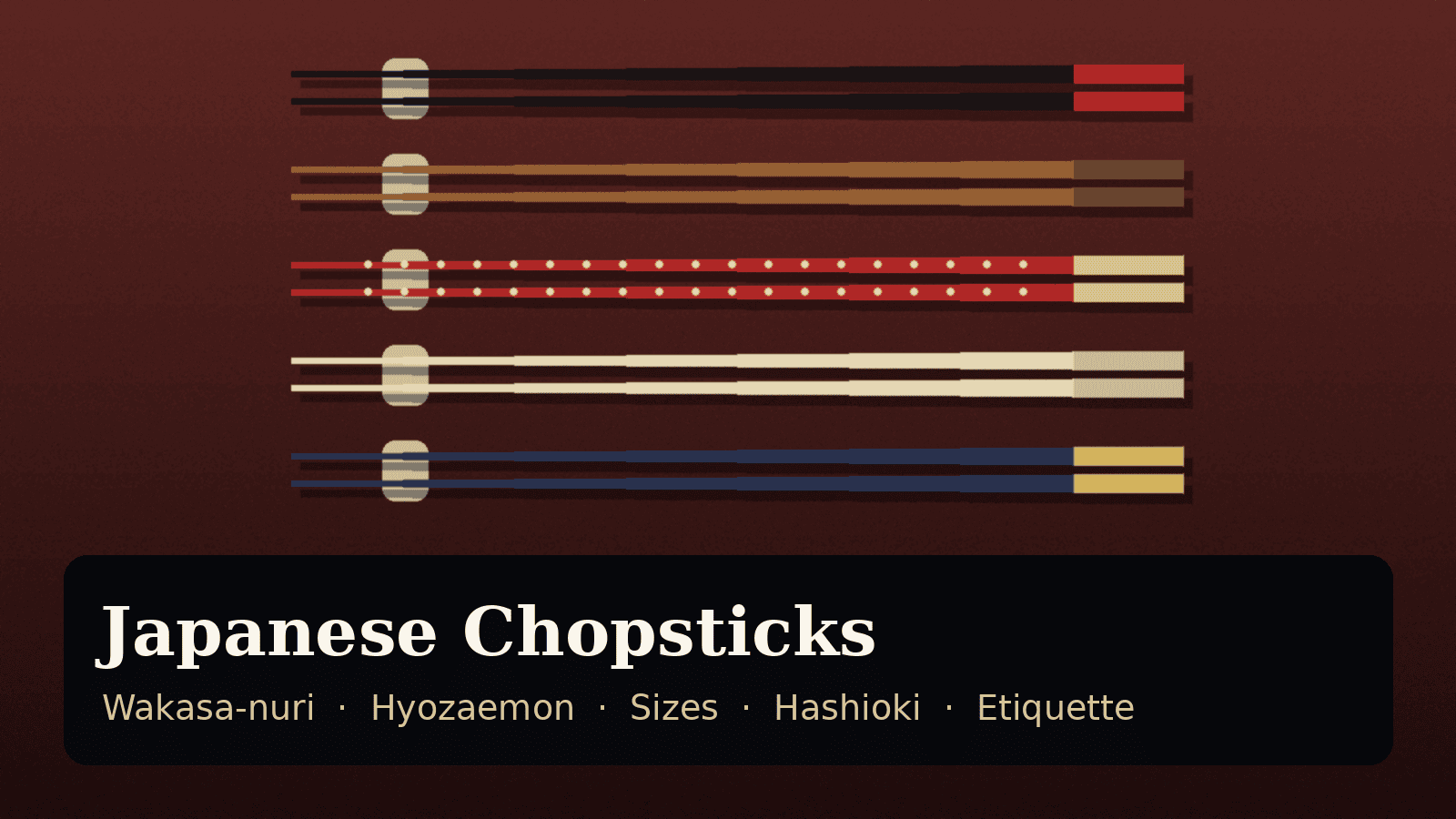
Japanese chopsticks (hashi, 箸) are usually shorter than Chinese chopsticks, made of wood or bamboo, and taper to a fine point. The best known kind is Wakasa-nuri lacquered chopsticks from Obama, Fukui, which by local estimates make up about 80% of Japan’s lacquered chopsticks. Good Japanese chopstick brands to search for are Hyozaemon, Hashikura Matsukan and Tanaka Hashiten (all Obama), Ichihara Heibei Shoten in Kyoto and the Edo-kibashi makers in Tokyo.
- Size: about 1.5 times the span between your thumb and index finger; adults usually use 21.5–23 cm.
- Gift set: a lacquered pair with a chopstick rest (hashioki) and a box.
- Dishwasher: only pairs labelled 食洗機対応.
- Etiquette: never stand chopsticks upright in rice and never pass food chopstick to chopstick.
As of October 2026, this guide covers the Japanese chopstick makers people search for, the types of Japanese chopsticks, a chopstick size chart for adults and kids, Japanese vs Chinese vs Korean chopsticks, chopstick rests, etiquette, care, and how to buy Japanese chopsticks from Japan.
Japanese Chopstick Brands and Makers at a Glance
| Maker | Where / since | Best known for |
|---|---|---|
| Hyozaemon (兵左衛門) | Obama, Fukui; 1921 | Wakasa lacquered chopsticks, dishwasher-safe lines, kids’ sizes, name engraving |
| Hashikura Matsukan (箸蔵まつかん) | Obama, Fukui; 1922 | Wakasa-nuri, ebony, cherry and bamboo; lengths in 0.5 cm steps |
| Tanaka Hashiten (田中箸店) | Obama, Fukui; 1948 | Wakasa lacquered chopsticks, own lacquering workshop |
| Ichihara Heibei Shoten (市原平兵衛商店) | Kyoto; 1764 | Over 400 kinds of chopsticks: ebony, rosewood, ironwood, cedar |
| Daikokuya (大黒屋) | Tokyo | Edo-kibashi: faceted ebony, rosewood and ironwood chopsticks |
| Ginza Natsuno (銀座夏野) | Ginza, Tokyo | Chopstick specialty shop |
| MUJI / Daiso | Nationwide chains | Cheap everyday wooden, bamboo and dishwasher-safe chopsticks |
Founding years come from each maker’s own pages under References. Several Obama makers also sell through Rakuten and their own web shops.
What Are Japanese Chopsticks Called?
Chopsticks in Japanese are hashi (箸), or politely ohashi (お箸). The kanji is 箸. The word for bridge is also pronounced hashi but written 橋; in standard Japanese the two differ only in pitch accent (chopsticks rise on the first syllable, bridge on the second), so “hashi vs bridge” is a common learner joke. Hashi means chopsticks; the pronunciation is HA-shi, stress on the first syllable. A chopstick rest is a hashioki (箸置き), and a chopstick box or case is a hashibako (箸箱).
Wakasa-nuri: Japan’s Lacquered Chopsticks
Obama City in Fukui Prefecture is said to make about 80% of Japan’s lacquered chopsticks.[1] Wakasa-nuri (若狭塗) was designated a national traditional craft on February 6, 1978. Its patterns come from eggshell, seashell, pine needles, cypress leaves, rapeseed and rice husk laid into the lacquer and revealed by repeated grinding and polishing, in some 60 or more steps; the craft dates from the early Edo period.[2] Chopsticks are its best-known product.[3] Local histories trace the technique to Matsuura Sanjuro, lacquer artisan of the Obama domain, in 1597.[1]
Wakasa nuribashi price: everyday Wakasa lacquered chopsticks start at a few thousand yen; for example, Hyozaemon’s dishwasher-safe “Kaben” pair (21.5 cm) was ¥2,200 including tax on its shop page, with name engraving ¥1,320 extra (checked 2026-10-25).[6] Hand-polished shell and gold-leaf pairs cost much more.
Wakasa styles: look for raden (螺鈿, mother-of-pearl inlay), eggshell, gold leaf and pine-needle patterns; black, red and natural-wood finishes are the classic colors, and Wakasa craftsmen also make moribashi (serving chopsticks). Handmade, high-quality and luxury pairs — the fancy, decorative and premium end — cost tens of thousands of yen; expensive does not always mean better for daily use, since heavy decoration can be slippery.
Personalized chopsticks: many Japanese makers sell personalized chopsticks with a name engraved (名入れ), usually a few hundred to about ¥1,500 extra per pair.
Wakasa lacquered, dishwasher safe? Lacquer is sensitive to heat and water pressure, so only pairs sold as dishwasher safe (食洗機対応) should go in a dishwasher; wash the rest by hand.[7]
The Main Makers
Hyozaemon (Obama)
Hyozaemon began in 1921, when founder Uratani Iwazo started making Wakasa lacquered chopsticks; it took the Hyozaemon name in 1960. It makes lacquered chopsticks, lacquerware, tableware and stationery, and its portable “Hachishiro” chopsticks were chosen as gifts at the 2008 G8 and 2016 G7 summits.[4] The company says it uses natural urushi lacquer on the tips, and that worn chopsticks can be re-lacquered; it also notes that Japanese labelling rules let a coating be called “lacquer” even with only a small amount of urushi mixed in, so read the material line (塗料) on any listing.[5]
Hashikura Matsukan (Obama)
Established in 1922, Hashikura Matsukan sells chopsticks in 0.5 cm length steps, kids’ chopsticks, name engraving, and ebony, cherry and bamboo pairs alongside Wakasa-nuri.[8]
Tanaka Hashiten (Obama)
Tanaka Hashiten was founded in 1948 and opened its own lacquering factory in 1987; it specialises in Wakasa lacquered chopsticks.[9]
Ichihara Heibei Shoten (Kyoto)
Founded in 1764, Ichihara Heibei Shoten is a Kyoto chopstick shop with more than 400 kinds of chopsticks.[10] Its menu page lists hand-carved striped ebony (¥4,300), rosewood (¥3,800), ironwood (¥2,400), pine-needle-pattern lacquer (¥33,000) and 10 pairs of red-cedar rikyu chopsticks (¥2,600) — prices as shown on 2026-10-25, with some items out of stock.[11]
Edo-kibashi (Tokyo)
Edo-kibashi (江戸木箸) are chopsticks shaped from hardwoods such as ebony, rosewood and ironwood, often octagonal or otherwise faceted for grip; Daikokuya registered the name as a trademark in 1999.[12]
Ginza Natsuno, MUJI and Daiso
Ginza Natsuno is a chopstick specialty shop in Ginza, Tokyo. For cheap everyday pairs, MUJI and Daiso Japanese chopsticks — wooden, bamboo and dishwasher-safe resin — are the usual budget picks.
Other Japanese Lacquer and Wood Traditions
- Wajima-nuri (Wajima, Ishikawa; designated 1975): known for durability from cloth reinforcement and jinoko powder in the base layers.[13] See our Japanese lacquerware guide for bowls and trays.
- Tsugaru-nuri (Aomori; designated 1975)[14] and Echizen lacquerware (Fukui; designated 1975).[15]
- Yakusugi cedar: Yakushima cedar over 1,000 years old. Felling is banned, so crafts use buried stumps and fallen logs.[16]
Types of Japanese Chopsticks
| Type | Search in Japanese | Used for |
|---|---|---|
| Lacquered chopsticks | 塗り箸 (nuribashi) | Everyday and gift chopsticks; Wakasa, Wajima, Echizen, Tsugaru lacquer |
| Unlacquered wood | 木箸 / 白木箸 | Ebony (黒檀), rosewood (紫檀), ironwood (鉄木), cherry, cedar |
| Bamboo | 竹箸 | Light, cheap and grippy; soot-darkened bamboo (煤竹) is a Kyoto speciality |
| Edo-kibashi | 江戸木箸 | Faceted hardwood chopsticks from Tokyo (octagonal and other shapes) |
| Cooking chopsticks | 菜箸 (saibashi) | Long chopsticks for stirring, frying and plating |
| Serving chopsticks | 取り箸 / 盛り付け箸 | Shared dishes and plating; the tip is often thinner |
| Disposable chopsticks | 割り箸 (waribashi) | Split-apart wooden chopsticks: genroku, tensoge, rikyu |
| Kids’ and training chopsticks | 子供箸 / 矯正箸 | Short lengths from about 13 cm; training clips and rings |
| Pair chopsticks | 夫婦箸 (meoto-bashi) | A longer and a shorter pair sold together; a popular wedding gift |
| Plastic / resin | 樹脂箸 / 食洗機対応 | Dishwasher-safe everyday sets |
| Metal / stainless | ステンレス箸 | Uncommon in Japan; the Korean style is flat metal |
Reusable vs disposable: a reusable bamboo or lacquered pair in a chopstick case (箸箱) is the usual eco alternative to waribashi — a chopstick kit or set with case is easy to carry with a bento. Bulk packs of 100 disposable pairs are sold for parties.
Disposable chopsticks (waribashi): genroku pairs have shaved corners and a groove for easy splitting; tensoge have the head cut at a sharp angle and are the top grade; rikyu taper at both ends and are named after Sen no Rikyu.[17] Shimoichi in Nara calls itself the birthplace of waribashi, first made from leftover Yoshino cedar used for sake barrels.[18]
What are Japanese chopsticks made of? Mostly wood and bamboo, often lacquered; plastic and resin for dishwasher-safe sets; metal and stainless steel chopsticks are rare in Japanese homes. Are wooden chopsticks safe? Yes, used and washed normally; replace pairs whose lacquer has chipped at the tip. Long thin Japanese hair sticks are a separate thing (kanzashi), even though “Japanese chopsticks in hair” is a common search.
Japanese Chopsticks Size Chart
The traditional rule is hitoata-han (一咫半): spread your thumb and index finger at a right angle, measure tip to tip, and multiply by 1.5.[8] Typical lengths:
| Who | Japanese chopstick length | In inches |
|---|---|---|
| Under 100 cm (about age 2) | 13 cm | 5.1 in |
| 100–110 cm (ages 3–4) | 14.5 cm | 5.7 in |
| 110–120 cm (ages 5–6) | 16 cm | 6.3 in |
| 120–130 cm (ages 7–9) | 17.5–18 cm | 6.9–7.1 in |
| Upper elementary | 19–21 cm | 7.5–8.3 in |
| Adult, women (typical) | about 21.5 cm | about 8.5 in |
| Adult, unisex | about 22.5 cm | about 8.9 in |
| Adult, men (typical) | about 23 cm | about 9.1 in |
Kids’ sizes by height follow Hyozaemon’s guide; the adult figures and upper-elementary range follow Hashikura Matsukan.[19][8] Inches are rounded. Japanese cooking chopsticks are much longer, so check the cm length on any listing.
Dimensions of Japanese chopsticks: besides length, a typical adult pair is about 6–8 mm thick at the handle end and narrows to 2–3 mm at the tip; check the cm figures on the listing, because “long” Japanese chopsticks for cooking run 30 cm and more.
How to hold Japanese chopsticks (for beginners)
A quick tutorial on holding chopsticks — good manners start here:
- Rest the lower chopstick in the crook of your thumb and on the side of your ring finger; it stays still.
- Hold the upper chopstick like a pen, between thumb, index and middle finger.
- Move only the upper chopstick to open and close; keep the tips level.
Learning or training chopsticks for children (矯正箸, often with finger rings) and slightly square, faceted pairs such as Edo-kibashi are easier for beginners than round, slippery lacquer.
Japanese vs Chinese vs Korean Chopsticks
Korean chopsticks are flat and made of metal — today stainless steel or bangjja bronze. Chinese chopsticks are longer, for reaching shared dishes at a round table, with blunt tips. Japanese chopsticks are shorter and pointed, which makes it easier to pick fish off the bone.[20] Vietnamese chopsticks are usually long like Chinese ones. Countries using chopsticks every day include China, Japan, Korea, Taiwan and Vietnam; the flat, heavy Korean metal pair is the one most people find hardest to use. So the difference between Chinese chopsticks and Japanese chopsticks is mainly length and the tip; Japanese chopsticks are also the ones most often lacquered.
Different chopsticks by country also show in design: Japanese kitchen chopsticks (saibashi) are long and plain, while table chopsticks carry lacquer artwork. A Japanese artwork chopstick and rest gift set is the usual souvenir.
Japanese chopsticks history in brief: the crafts in this guide trace it — Wakasa lacquer from 1597, Edo-period lacquer and hardwood work, and waribashi from Yoshino cedar offcuts.
Japanese Chopstick Rests (Hashioki)
A hashioki keeps the tips off the table. They come in ceramic, glass, wood and lacquer — cute shapes such as cats, fish and seasonal flowers are a popular small gift — and are often sold as a chopsticks and rest set or with a matching bowl. To use one, lay your chopsticks horizontally in front of you with the tips resting on it between bites and after the meal. Ceramic rests pair well with the plates in our Japanese ceramics and tableware guide.
Chopsticks in Japanese culture: each family member often has their own personal pair at home, which is why named or engraved chopsticks are a common gift. At New Year, families use iwai-bashi (祝い箸), plain willow chopsticks tapered at both ends, in celebratory envelopes.
Japanese Chopstick Etiquette
Japan’s tourism organisation lists two taboos above all: sticking chopsticks upright in rice (tatebashi) and passing food from chopsticks to chopsticks (hashiwatashi), both associated with funeral rites. Also avoid stabbing food, pointing with chopsticks and pulling dishes towards you with them.[21]
- Chopstick placement: lay them horizontally in front of your bowl, on the rest. When finished eating: lay them back on the rest, or in the paper sleeve if they were disposable; some diners fold the sleeve into a small origami rest.
- What not to do with chopsticks in Japan: don’t wave them over dishes deciding what to take, lick them, or use them to point at people.
- When done eating: never leave them stuck in food.
- Hair: Japanese women don’t wear eating chopsticks in their hair, and a chopsticks hairstyle is not a Japanese custom; the decorative hair sticks seen with kimono are kanzashi.
- Leaving chopsticks in the bowl or across it is best avoided at formal meals.
- Do Japanese use chopsticks for everything? For rice, sushi and most dishes, yes; spoons are used for curry rice and some soups, and sushi can also be eaten by hand.
- Ramen: chopsticks for noodles, plus a ramen spoon (renge) for broth.
Care: Washing and Storing Japanese Chopsticks
Wash gently by hand and don’t soak; heat of 40–80 °C and water pressure in a dishwasher can damage lacquer, and lacquer should be stored out of strong sunlight.[7] Unlacquered wood and bamboo dry best standing tips-up in a holder.
Chopsticks Day (Hashi no Hi)
August 4 is Chopsticks Day in Japan — 8 and 4 can be read “ha-shi”. Hie Shrine in Tokyo holds a chopstick thanksgiving festival (箸感謝祭) on that date.[22]
Japanese Words for Shopping
| Japanese | Romaji | Meaning |
|---|---|---|
| 箸 | hashi | chopsticks |
| お箸 | ohashi | chopsticks (polite) |
| 箸置き | hashioki | chopstick rest |
| 箸箱 / 箸ケース | hashibako / hashi kēsu | chopstick box / case |
| 若狭塗 | Wakasa-nuri | Wakasa lacquer |
| 夫婦箸 | meoto-bashi | his-and-hers pair |
| 名入れ | na-ire | name engraving |
| 食洗機対応 | shokusenki taiō | dishwasher safe |
| 天然漆 | tennen urushi | natural lacquer |
| 黒檀 / 紫檀 / 鉄木 | kokutan / shitan / tetsuboku | ebony / rosewood / ironwood |
| 子供箸 | kodomo-bashi | kids’ chopsticks |
| 箸と箸置きセット | hashi to hashioki setto | chopstick and rest set |
How to Buy Japanese Chopsticks From Japan
- Search in Japanese: 若狭塗 箸, 兵左衛門 箸, 箸 箸置き セット, 夫婦箸 ギフト, 江戸木箸, 子供箸 16cm, 菜箸.
- Check length, material and finish (天然漆 vs ウレタン塗装) and whether a pair is 食洗機対応.
- Engraving: 名入れ (name engraving) is a custom order the seller has to set up; buy ready-made pairs unless the shop’s order form lets you enter the name at checkout.
- Bundle: chopsticks are light and slim, so they add little to a parcel. The first six orders consolidate free; add reinforcement (from ¥100) for boxed lacquer gift sets.
- See it before it ships: wrong/missing-item checks (¥200) and unboxing photos (¥500 / ¥700) let you confirm the pattern and length at the Tokyo warehouse.
OneMall buys from Japanese marketplaces such as Mercari, Yahoo Auctions, Rakuten and Amazon Japan, and from other Japanese online stores (including maker web shops) through LinkBuy. Items that need a lottery entry, purchase limit, Japanese identity verification or a merchant account cannot be purchased. International shipping is charged on the greater of actual weight and volumetric weight (length × width × height ÷ 5,000) of the box the warehouse uses.
Service fees are ¥300 per item on most marketplaces; from ¥200 per item on Yahoo Auctions and LinkBuy. The first six orders consolidate free; each additional order costs ¥100. Storage is free for 90 days after arrival (30 days after consolidation). Payment is by Visa, Mastercard or PayPal, settled in USD.
US buyers: since August 29, 2025, US-bound parcels of any value go through customs and pay applicable duties, taxes and fees — the $800 de minimis exemption no longer applies. OneMall currently ships to the United States by ECMS and DHL; the live quote at checkout shows which lines accept your parcel.
Browse Wakasa-nuri chopstick listings, chopstick rests (hashioki) or meoto-bashi pair sets, and compare the best Japan proxy services and proxy costs by total landed cost. For bento-box chopstick cases, see our bento box guide.
Frequently Asked Questions
What are the best Japanese chopstick brands?
For lacquered chopsticks, the Obama makers Hyozaemon, Hashikura Matsukan and Tanaka Hashiten; for wood, Ichihara Heibei Shoten in Kyoto and the Edo-kibashi makers in Tokyo; for cheap basics, MUJI and Daiso.
What length are Japanese chopsticks?
About 21.5 cm for women and about 23 cm for men; kids’ chopsticks run from 13 cm. Use 1.5 times your thumb-to-index span.
Are Japanese chopsticks dishwasher safe?
Only those labelled 食洗機対応. Hand-wash natural lacquer and plain wood.
What is the difference between Japanese and Chinese chopsticks?
Japanese chopsticks are shorter with pointed tips and are often lacquered; Chinese chopsticks are longer with blunt tips.
Why can’t you stick chopsticks in rice in Japan?
Standing chopsticks upright in rice is linked with funeral rites, so it is one of the main table taboos.
What is a Japanese chopstick rest called?
A hashioki (箸置き).
Do Japanese use metal chopsticks?
Rarely. Wood and bamboo are the norm; flat metal chopsticks are the Korean style.
Are Japanese chopsticks a good gift?
Yes — a lacquered pair or meoto-bashi set with hashioki in a box is a classic Japanese souvenir and wedding gift.
References
- Obama City tourism, Wakasa-nuribashi. https://wakasa-obama.jp/obamanavi/wakasa-nuribashi/
- Japan Traditional Crafts (kougeihin.jp), Wakasa-nuri. https://kougeihin.jp/en/craft/0518/
- Japan Traditional Crafts, Wakasa lacquer chopsticks. https://kougeihin.jp/en/info/20161129_wakasa-2/
- Hyozaemon, Company profile. https://www.hyozaemon.co.jp/company/profile/
- Hyozaemon, Q&A. https://www.hyozaemon.co.jp/about/qa/
- Hyozaemon shop, Kaben chopsticks. https://hyozaemon.shop/?pid=139202492
- Hyozaemon, Care. https://www.hyozaemon.co.jp/about/care/
- Hashikura Matsukan, Choosing a chopstick size. https://www.hashikura1922.com/blog/hashi_size/
- Tanaka Hashiten, About us. https://tanaka-hashi.co.jp/about-us/message/
- Ichihara Heibei Shoten. https://ichiharaheibei.com/
- Ichihara Heibei Shoten, Menu. https://ichiharaheibei.com/menu
- Edo-kibashi Daikokuya. https://www.edokibashi-daikokuya.com/
- Japan Traditional Crafts, Wajima-nuri. https://kougeihin.jp/en/craft/0513/
- Japan Traditional Crafts, Tsugaru-nuri. https://kougeihin.jp/en/craft/0501/
- Japan Traditional Crafts, Echizen Shikki. https://kougeihin.jp/en/craft/0517/
- Suginoya, Yakusugi crafts. https://suginoyas.com/yakusugi-kougei/
- Daiwa Bussan, Types of disposable chopsticks. https://www.daiwa-bussan.com/chops/type.html
- Shimoichi Town, Waribashi. https://www.town.shimoichi.lg.jp/0000000062.html
- Hyozaemon shop, Choosing kids’ chopsticks. https://hyozaemon.shop/apps/note/choose/
- Korea.net, Korean chopsticks. https://www.korea.net/NewsFocus/HonoraryReporters/view?articleId=193912
- JNTO, Japanese food etiquette. https://www.japan.travel/en/guide/japanese-food-etiquette/
- Hie Shrine, Events. https://www.hiejinja.net/events/