
 Shopping Guide
 HELP / FAQs



 By onemall
Last updated: 2026-10-24.
TL;DR
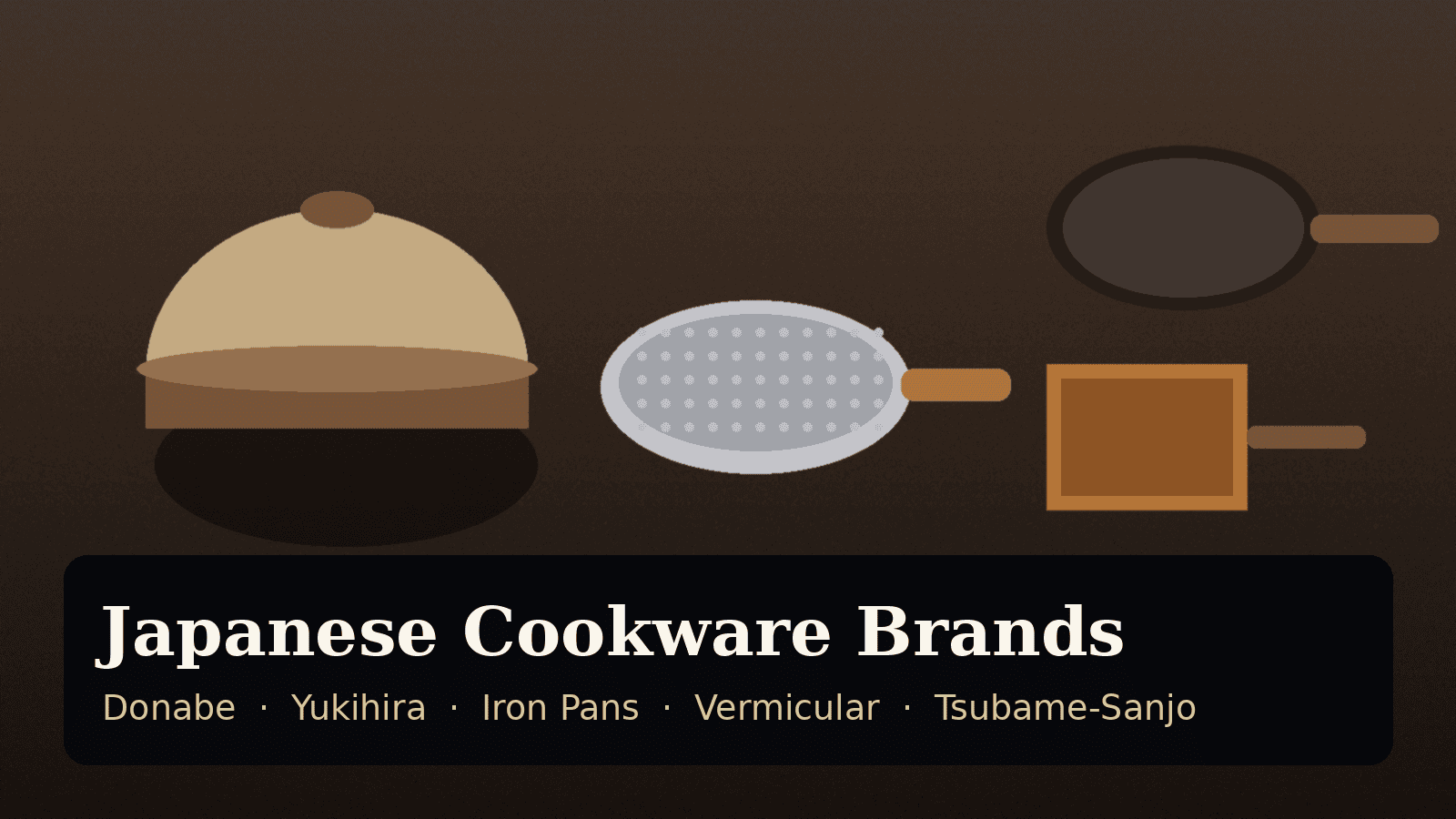
The Japanese cookware brands people search for most are Vermicular (enameled cast iron from Nagoya), Nagatani-en and the Banko-yaki makers for donabe clay pots, Iwachu and Oigen for Nanbu cast iron, Riverlight and Yamada Kogyosho for iron frying pans and woks, and the Tsubame-Sanjo makers (GEO Product, Yoshikawa) for stainless pots and pans. Japanese kitchens also use a few pans most Western kitchens lack: the yukihira saucepan, the square tamagoyaki pan and the donabe.
- Best Japanese pan for everyday cooking: an iron frying pan (Riverlight) or a multi-ply stainless pan (GEO Product).
- Best for rice and hot pot: a donabe or a Vermicular pot.
- Best small saucepan: a yukihira pan.
- Induction hob? Check for IH対応; ordinary donabe will not work.
As of October 2026, this guide lists the main Japanese cookware brands and kitchenware makers by what they make, explains the traditional Japanese pots and pans, and shows how to buy Japanese cookware from Japan. For teapots and kettles, see our separate Japanese cast iron teapot (tetsubin) guide.
Japanese Cookware Brands at a Glance
| Brand | Where / since | Best known for |
|---|---|---|
| Vermicular (Aichi Dobby) | Nagoya; foundry 1936, first pot 2010 | Enameled cast iron Oven Pot, Musui–Kamado induction cooker |
| Nagatani-en (長谷園) | Iga, Mie; kiln opened 1832 | Iga-yaki donabe, Kamado-san rice donabe, IH donabe |
| Banko-yaki makers (萬古焼) | Yokkaichi, Mie | Everyday donabe; roughly 80% of Japan’s domestic donabe market |
| Iwachu | Morioka, Iwate; 1902 | Nanbu ironware: cast iron pans, sukiyaki pans, kettles |
| Oigen | Oshu, Iwate; 1852 | Cast iron skillets, grill pans, rice pots, kettles |
| Riverlight | Founded 1976 | Iron frying pans; Kiwame nitrided iron series |
| Yamada Kogyosho (山田工業所) | Yokohama; 1957 | Hand-hammered iron woks (uchidashi) |
| Miyazaki Seisakusho / GEO Product | Tsubame, Niigata; 1960 (GEO 1996) | Multi-ply stainless pots and pans |
| Yoshikawa | Yahiko / Tsubame, Niigata; 1952 | Stainless and aluminium kitchenware |
| Hokuriku Alumi (北陸アルミ) | Takaoka, Toyama | Aluminium pots and pans |
| Nakamura Douki (中村銅器) | Adachi, Tokyo | Tin-lined copper tamagoyaki pans |
| Kai (貝印) | Seki, Gifu; 1908 | Kitchen tools, peelers, graters, knives |
Founding years come from each company’s own pages or the sources under References. “Japanese brand” and “made in Japan” are not always the same thing: check the 生産国 (country of production) field on the exact listing.
Japanese Pots and Pans: Which Type for What?
| Type | Search in Japanese | Used for |
|---|---|---|
| Donabe | 土鍋 | Clay pot for nabe hot pot, rice and stews; direct flame |
| Yukihira pan | 雪平鍋 | Lidless single-handle saucepan with two spouts; dashi, miso soup, simmering |
| Tamagoyaki pan | 玉子焼き器 / 玉子焼鍋 | Square or rectangular rolled-omelette pan |
| Iron frying pan | 鉄フライパン | Searing, stir-frying; needs oiling, lasts decades |
| Wok | 中華鍋 / 打ち出し | Hammered iron wok for high-heat stir-fry and fried rice |
| Enameled cast iron pot | ホーロー鋳物鍋 | Braising, rice, no-water cooking (Vermicular) |
| Nanbu cast iron pan | 南部鉄器 フライパン / すき焼き鍋 | Sukiyaki, grill pans, skillets |
| Stainless multi-ply pot | 多層鋼 / ステンレス鍋 | All-round pots; most are induction-ready |
| Rice pot | 炊飯土鍋 / ご飯鍋 | Stovetop rice; Kamado-san, Oigen and Vermicular make them |
Vermicular: Japanese Enameled Cast Iron
Vermicular is made by Aichi Dobby, a cast iron foundry founded by the Hijikata family in Nagoya in 1936. The Hijikata brothers introduced the first Vermicular enameled cast iron pot in 2010, after three years and more than 10,000 iterations, and the whole collection is designed, cast and assembled at the Nagoya foundry.[1][2] The precision-machined lid is what the brand’s “musui” (無水, waterless) cooking is built around. The Vermicular Oven Pot (now also Oven Pot 2.0) is the stovetop and oven pot; the Musui–Kamado puts an enameled cast iron pot on an induction heating base.[3] If you are weighing Vermicular vs Instant Pot: Vermicular is a cast iron pot, while Instant Pot is an electric pressure cooker. If you searched Vermicular vs Le Creuset or Vermicular vs Staub: all three are enameled cast iron; Vermicular’s selling point is the tight lid for cooking with little or no added water, so compare weight, lid design and price for the size you need. Vermicular sizes are given by diameter in cm; compare the listing’s dimensions with your burner.
Electric models and voltage: Japan’s mains supply is 100 V AC (50 Hz in the east, 60 Hz in the west).[4] A plug-in cooker such as the Musui–Kamado sold in Japan is built for that supply, so check the model sold for your own country, or the rating plate, before buying a Japanese-market unit. The plain pots and skillets have no voltage issue. The same applies to rice cookers; see our Japanese rice cooker guide.
Donabe: The Japanese Clay Pot
A donabe (土鍋, literally “earthenware pot”) is a pot made of special heat-resistant clay for use over an open flame; it is the pot for nabe hot pot, rice, porridge and stews.[5] Two areas in Mie Prefecture dominate:
- Iga-yaki: Iga clay donabe have been made since 1832.[5] Nagatani-en opened its kiln in 1832 in Marubashira, Iga City, and makes the well-known Kamado-san rice donabe.[6]
- Banko-yaki: Yokkaichi’s Banko-yaki holds roughly 80% of Japan’s domestic donabe market; petalite was added to the clay from around 1959 to improve heat resistance.[7] Most everyday donabe in Japanese supermarkets and home centers are Banko-yaki.
Donabe and induction: an ordinary clay donabe cannot be used on an induction (IH) hob. Nagatani-en’s IH donabe embed a thick carbon heating element in the base, matched to the expansion of Iga clay,[8] and the company says it no longer makes an IH version of Kamado-san; it sells an electric clay-pot rice cooker instead.[9] Look for IH対応 in a listing, or use a donabe on gas or a portable gas burner (カセットコンロ). Gas canisters themselves cannot be shipped internationally.
Using a donabe on an electric stove or glass top: makers generally design ordinary donabe for gas and open flame (直火). On an electric coil stove, a glass-top or ceramic cooktop, use only a donabe whose listing says it supports that heat source, or a metal heat diffuser if the maker allows it; on an induction stove, only an IH donabe. Some donabe are also oven safe or microwave safe — the listing will say オーブン可 or 電子レンジ可. Accessories sold separately include steamer inserts (蒸しすのこ), trivets and replacement lids.
Donabe vs Dutch oven, dolsot or Chinese clay pot: a donabe is porous clay that heats slowly and holds heat; a Dutch oven is cast iron; a Korean dolsot is stone and a ttukbaegi is an earthenware bowl, both for serving bubbling food at the table; a Chinese clay pot and a tagine are other regional clay pots. For rice, a double-lid donabe (二重蓋, used by Kamado-san) cooks white rice and brown rice without boiling over; “donabe gohan” simply means rice cooked in a donabe. Donabe definition and pronunciation: the kanji is 土鍋 and it is pronounced doh-nah-beh; it is the best-known Japanese earthen cookware. A heavy enameled pot or Dutch oven is the closest donabe alternative if you cannot use clay. Donabe types run from small one-person pots to large family pots, in brown, black or white glazes.
Donabe sizes and first use: donabe are sold by 号 (gō), roughly 3 cm of diameter each — a 6号 pot suits one or two people and 8–10号 a family nabe; listings also give 〜人用 (serves … people). Before the first use, follow the maker’s sealing instructions (目止め, medome), usually cooking rice porridge in the pot, and let a hot donabe cool before washing. Search 土鍋 伊賀焼, 土鍋 萬古焼, かまどさん or 土鍋 IH対応.
Yukihira Pan: The Japanese Saucepan
A yukihira pan (雪平鍋) is a lidless, medium-depth pot with one handle and usually a pouring spout on both sides. Today most are aluminium, historically copper or clay; the hammered (tsuchime) pattern began as hand-forging marks and is now often pressed in on cheaper pans, and the wooden handle is usually screwed on so it can be replaced.[10] Its purpose: it is the everyday pot for dashi, miso soup, blanching and simmering. Aluminium (aluminum) yukihira pots heat quickly but do not work on induction; stainless or multi-ply yukihira pans do (check IH対応). Hokuriku Alumi in Takaoka is one aluminium specialist;[11] Tsubame-Sanjo makers sell stainless versions. Search 雪平鍋 18cm, 雪平鍋 IH対応 or 雪平鍋 木柄.
Yukihira pan sets and variations: yukihira pans are sold singly or as sets of two or three sizes (16 / 18 / 20 cm are common), in aluminium or stainless steel, and some come with a glass lid or a steamer. The name is written with the character for snow (雪), which is why it is sometimes called a “snow pan”. If the wooden handle burns or loosens, handle replacement parts (雪平鍋 柄 交換) are sold separately. Small mini yukihira pans and milk pans (ミルクパン) are for one-person portions and warming milk.
Japanese Iron Frying Pans and Woks
Riverlight was founded in 1976 and has made only iron frying pans in its own factory since then. Its Kiwame (極) series is treated by nitriding and oxidation, which makes it highly rust-resistant and means it does not need seasoning before first use.[12][13]
Yamada Kogyosho in Yokohama, founded in 1957, hand-hammers iron woks (打ち出し, uchidashi); each wok takes 5,000–8,000 hammer strikes.[14] Iron pans are heavy for their size, and a round-bottom wok needs a gas burner; for a flat induction hob look for a flat-bottom version.
Japanese cast iron pans: Iwachu (Morioka, founded 1902) and Oigen (Oshu, founded 1852) make Nanbu ironware skillets, sukiyaki pans, grill pans and rice pots as well as kettles.[15][16] They also make griddles with lids, steak plates (ステーキ皿), casseroles and Dutch-oven-style pots. Cast iron is the heaviest thing on this list to ship, so price it with the shipping estimate.
Japanese Specialty Pans
- Takoyaki pan (たこ焼き器): cast iron or non-stick plate with half-sphere wells.
- Taiyaki pan (たい焼き器): fish-shaped waffle mould.
- Gyoza pan: a wide frying pan with a lid, for pan-fried dumplings.
- Tempura pan (天ぷら鍋): a deep iron or stainless frying pot, often with a thermometer and a draining rack.
- Sukiyaki and yakiniku pans (すき焼き鍋 / 焼肉プレート): shallow cast iron pans and ridged griddles.
- Omelet pan: the tamagoyaki egg pan below, or a round pan for omurice.
- Divided frying pan (仕切りフライパン): a pan with two or three compartments or sections, for cooking several bento items at once; also sold as a frying pan with dividers.
- Oblong frying pan: the long rectangular tamago pan (Kansai-style tamagoyaki pan).
The Japanese word for frying pan is フライパン (furaipan, in katakana; ふらいぱん in hiragana); 鍋 (nabe) means pot, and Japanese cooking utensils as a whole are 調理器具 (chōri kigu).
Tamagoyaki Pan: Square Japanese Omelette Pan
The square or rectangular tamagoyaki pan (玉子焼き器) makes the rolled omelette for bento and sushi. Shapes include the square Kanto style and the longer rectangle used in the Kansai area; materials are non-stick aluminium, iron or tin-lined copper. Nakamura Douki in Tokyo, in business for more than 80 years, makes copper tamagoyaki pans from thick copper sheet with tin applied by hand.[17] Copper and aluminium versions do not work on induction unless the listing says IH対応. For lunch boxes, see our Japanese bento box guide.
Tsubame-Sanjo: Japan’s Metal Kitchenware Region
Tsubame and Sanjo in Niigata are Japan’s metalworking region. Tsubame produces over 90% of Japan’s domestic output of metal Western tableware and cutlery; its industry grew from 17th-century nail making into copperware and hammered copper.[18] Sanjo is known for iron crafts, especially knives and scissors.[19] Two Tsubame-area cookware makers:
- Miyazaki Seisakusho was founded in 1960 in Tsubame and launched the GEO Product multi-ply stainless line in 1996, supervised by the cooking educator Yukio Hattori.[20]
- Yoshikawa, established in 1952, has its head office in Yahiko and factories in Tsubame; it makes stainless and aluminium pots, pans and kitchen tools.[21]
Sanjo is also home to the outdoor brand Snow Peak,[19] a common answer for Japanese camping and outdoor cookware, including titanium pots. Stainless and multi-ply pots from these makers are the most practical Japanese cookware for an induction hob. For knives from Sanjo, Seki and Sakai, see our Japanese knife brands guide.
Kappabashi: Tokyo’s Kitchenware Street
Kappabashi Dougu Street (かっぱ橋道具街) between Ueno and Asakusa is Tokyo’s kitchenware district, lined with shops selling pots, pans, knives, tableware and restaurant supplies. If you cannot get there, the same items are listed on Japanese online shops and marketplaces.
Japanese Kitchen Appliance Brands
For electric kitchen appliances, the best-known Japanese brands are Zojirushi, Tiger and Panasonic (rice cookers, kettles, toaster ovens). Japanese-market appliances are built for 100 V, so check voltage before you buy.
Kitchen Tools: Kai and Other Japanese Kitchenware
Kai (貝印) was founded in 1908 and is headquartered in Seki, Gifu;[22] its peelers, graters, scissors and baking tools are some of the most common Japanese kitchen gadgets. Other Japanese kitchenware worth knowing by name: the oroshigane (おろし金) grater, the suribachi (すり鉢) mortar, the makisu (巻きす) bamboo mat, the otoshibuta (落し蓋) drop lid and the seiro (せいろ) bamboo steamer. For tableware — plates, bowls, rice bowls and crockery — see our Japanese ceramics and tableware guide, the Japanese glassware brands guide and the matcha and tea ware guide.
Is Japanese Cookware Good? What to Compare
Quality depends on the line and material rather than the country. A few practical points: iron and cast iron last for decades if kept dry and oiled; donabe crack if heated empty or cooled suddenly; aluminium yukihira pans are light and cheap but dent; multi-ply stainless is the easiest to live with. Non-stick coatings in Japan are often labelled フッ素加工 (fluorine coating); if you want to avoid coated pans, choose iron, stainless, enamel or clay. Japanese cookware is generally sized for smaller households — compare cm diameters with your burners. A Japanese pots and pans set (鍋セット) is less common than buying pieces singly; pans with removable or detachable handles (取っ手が取れる) are popular in Japan because they stack in small kitchens. Read reviews of the exact model rather than the brand as a whole. Japanese aluminum cookware is light and cheap; cast aluminum pans are thicker and hold heat better. A donabe, a yukihira pan or a tamagoyaki pan also makes a practical Japanese kitchenware gift. Japanese cookware essentials for a starter kitchen: a frying pan, a yukihira pan, a tamagoyaki pan and a donabe — pots are the deep vessels (nabe), pans the shallow ones. Handmade pieces such as hammered woks and copper pans cost more than pressed ones; unique or cute Japanese kitchenware (character tamagoyaki pans, animal-shaped lids, porcelain kitchenware) is mostly sold on each maker’s website and on Japanese marketplaces.
Reading Japanese Cookware Listings
| Japanese | Romaji | Meaning |
|---|---|---|
| 土鍋 | donabe | clay pot |
| 雪平鍋 | yukihira nabe | yukihira saucepan |
| 鍋 / フライパン | nabe / furaipan | pot / frying pan |
| IH対応 | IH taiō | induction compatible |
| ガス火専用 / 直火 | gasubi sen’yō / jikabi | gas / open flame only |
| 号 | gō | donabe size (about 3 cm of diameter per 号) |
| 〜人用 | -nin yō | serves … people |
| 鉄 / 銅 / アルミ / ステンレス | tetsu / dō / arumi / sutenresu | iron / copper / aluminium / stainless |
| ホーロー | hōrō | enamel |
| 目止め | medome | first-use sealing of a clay pot |
| 未使用 / 美品 / 中古 | mishiyō / bihin / chūko | unused / very good / used |
| 箱あり | hako ari | comes with box |
How to Buy Japanese Cookware From Japan
- Search in Japanese: brand + type, e.g. バーミキュラ オーブンポットラウンド, 長谷園 かまどさん, 土鍋 萬古焼 8号, リバーライト 極 フライパン, 山田工業所 打ち出し 中華鍋, 雪平鍋 IH対応, 玉子焼き器 銅.
- Check heat source: IH対応 (induction) or ガス火専用 (gas only); for electric items, the 100 V rating.
- Check condition: for used cast iron, look at rust and enamel chips; for donabe, cracks and glaze crazing; ask for the box (箱あり) for fragile pieces.
- See it before it ships: wrong/missing-item checks (¥200) and unboxing photos (¥500 / ¥700) let you inspect the item at the Tokyo warehouse; add package reinforcement (from ¥100 by weight) for clay pots.
- Mind weight and box size: international shipping is charged on the greater of actual weight and volumetric weight (length × width × height ÷ 5,000) of the box the warehouse uses. A boxed donabe is bulky; a cast iron pan is heavy. Consolidating several purchases into one parcel can share the cost.
OneMall buys from Japanese marketplaces such as Mercari, Yahoo Auctions, Rakuten and Amazon Japan, and from other Japanese online stores through LinkBuy. Items that need a lottery entry, purchase limit, Japanese identity verification or a merchant account cannot be purchased. OneMall does not vouch for product condition, so choose sellers with clear photos and descriptions. If a clay pot is damaged in international transit, compensation is capped at the international shipping paid and must be reported within 24 hours with the order number, photos and a full unboxing video.
Service fees are ¥300 per item on most marketplaces; from ¥200 per item on Yahoo Auctions and LinkBuy. The first six orders consolidate free; each additional order costs ¥100. Storage is free for 90 days after arrival (30 days after consolidation). Payment is by Visa, Mastercard or PayPal, settled in USD.
US buyers: since August 29, 2025, US-bound parcels of any value go through customs and pay applicable duties, taxes and fees — the $800 de minimis exemption no longer applies. OneMall currently ships to the United States by ECMS and DHL; the live quote at checkout shows which lines accept your parcel.
Browse donabe listings, Vermicular or yukihira pans, and compare the best Japan proxy services and proxy costs by total landed cost.
Frequently Asked Questions
What are the top Japanese cookware brands?
It depends on the pan. Vermicular for enameled cast iron, Nagatani-en or a Banko-yaki maker for donabe, Riverlight for iron frying pans, Yamada Kogyosho for woks, Iwachu or Oigen for cast iron, and GEO Product or Yoshikawa for stainless.
Is Vermicular made in Japan?
Yes. Vermicular says its whole collection is designed, manufactured and assembled at its foundry in Nagoya.
What is a Japanese clay pot called?
A donabe (土鍋). Most come from Iga (Iga-yaki) or Yokkaichi (Banko-yaki) in Mie Prefecture.
Can you use a donabe on induction?
Not an ordinary one. Only donabe made for induction (IH対応) work on an IH hob.
What is a yukihira pan used for?
Dashi, miso soup, simmered dishes, blanching vegetables and boiling eggs. It is a light, lidless saucepan with a spout on each side.
What pan is used for Japanese omelette?
A square or rectangular tamagoyaki pan (玉子焼き器), in non-stick, iron or tin-lined copper.
Is Japanese cast iron better?
Nanbu cast iron from Iwachu and Oigen has a long tradition, but cast iron from any good maker cooks similarly. Compare weight, finish and price.
References
- Vermicular, Our history. https://www.vermicular.us/help-center/brand/about-us/our-history
- Vermicular, Brand story. https://www.vermicular.us/journal/vermicular-brand-story
- Vermicular, Musui–Kamado. https://www.vermicular.us/products/musui-kamado
- Japan National Tourism Organization, Plugs and electricity. https://www.japan.travel/en/plan/plug-and-electricity/
- Donabe (Wikipedia). https://en.wikipedia.org/wiki/Donabe
- Nagatani-en (Igamono), About. https://igamono.co.jp/at-first/
- 萬古焼 (Wikipedia, Japanese). https://ja.wikipedia.org/wiki/%E8%90%AC%E5%8F%A4%E7%84%BC
- Nagatani-en FAQ, IH donabe. https://nagatanien.life/faq/2519
- Nagatani-en FAQ, Kamado-san and IH. https://nagatanien.life/faq/2690
- 雪平鍋 (Wikipedia, Japanese). https://ja.wikipedia.org/wiki/%E9%9B%AA%E5%B9%B3%E9%8D%8B
- Hokuriku Alumi. https://hokua.com/
- Riverlight, Company introduction. https://riverlight.co.jp/ja/introduction.php
- Riverlight, Kiwame series. https://www.riverlight.co.jp/ja/kiwame_series.php
- Hamarepo, Yamada Kogyosho. https://hamarepo.com/story.php?story_id=1262
- Iwachu. https://www.iwachu.co.jp/
- Oigen. https://www.oigen.jp/
- Shokunin.com, Nakamura Douki tamagoyaki pan. https://www.shokunin.com/jp/nakamuradouki/tamagoyaki.html
- 燕市 (Wikipedia, Japanese). https://ja.wikipedia.org/wiki/%E7%87%95%E5%B8%82
- Sanjō, Niigata (Wikipedia). https://en.wikipedia.org/wiki/Sanj%C5%8D,_Niigata
- Miyazaki Seisakusho, Company. https://brand.miyazaki-ss.co.jp/company
- Yoshikawa, Company profile. https://www.yoshikawa-group.co.jp/company/
- Kai Group, Company. https://www.kai-group.com/global/about/company.html