
 Shopping Guide
 HELP / FAQs



 By onemall
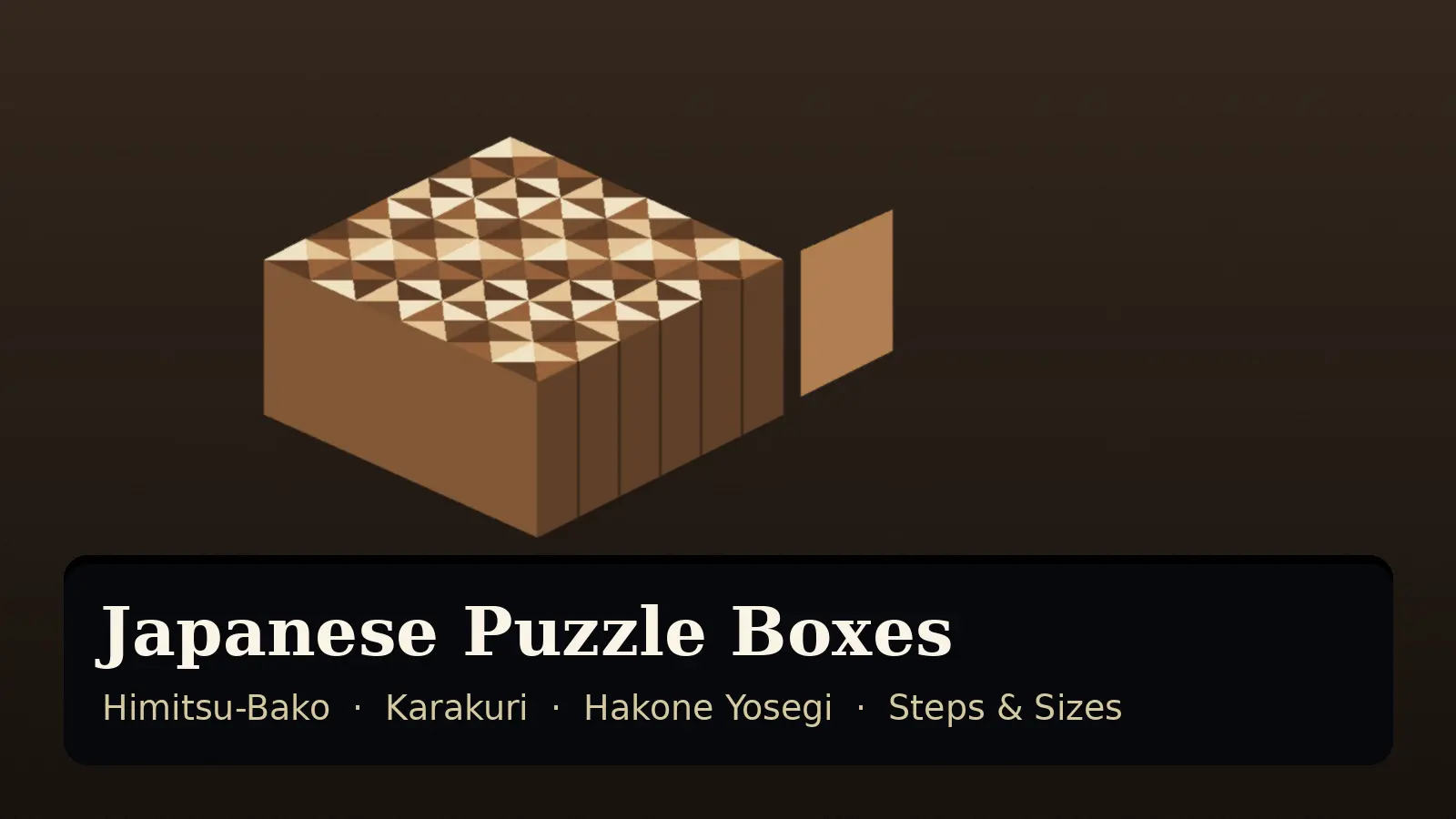
A Japanese puzzle box is a wooden box that only opens when you slide its panels in the right order. In Japanese it is called a himitsu-bako (秘密箱, “secret box”), and the classic version is made in Hakone and Odawara and covered in yosegi (寄木) wood marquetry. Simple ones open in 2 to 4 moves; the hardest boxes you can buy take 54 or 72 moves, and one karakuri box takes 1,536.[15][16][17][18] On October 22, 2026, Japan’s Ministry of Economy, Trade and Industry (METI) designated “Hakone-Odawara karakuri craft” (箱根小田原からくり細工) as a national Traditional Craft.[19] This guide explains what himitsu-bako are, their history, how the mechanism works, the step counts and sizes (sun to inches), 2026 prices in Japan, how to open (and close) one, the modern karakuri boxes, and where to buy them in Hakone, Tokyo or online from Japan.
What Is a Japanese Puzzle Box Called? Himitsu-bako Meaning
Himitsu-bako meaning: 秘密 (himitsu) means “secret” and 箱 (hako, voiced as bako) means “box”, so a himitsu-bako is literally a “secret box”. Shops also write it ひみつ箱. The Kotobank dictionary defines it as one of the signature products of Hakone yosegi zaiku, made in Odawara and Hakone: a wooden box joined without nails in which you must shift the faces several times, like a puzzle, to open it — from a few moves up to dozens.[15][20] In the Meiji era the box was also known as chie-bako (智恵箱, “wisdom box”).[16] Other names you will see are secret box, trick box and karakuri box (からくり箱); the last one is used both for traditional secret boxes and for the new free-form designs described below.[18][21]
Japanese listings name a box by size and number of moves, for example 4寸7回 — a 4-sun box that opens in 7 moves (“steps” in English listings).[22] So when people ask what a Japanese puzzle box is called, the short answer is himitsu-bako; if it is decorated with marquetry it is a yosegi himitsu-bako, and a box from the newer creative tradition is a karakuri box.
Japanese Puzzle Box History and Origin
Nobody knows exactly when or by whom the first secret box was made, and the dates differ by source:[23]
- Purpose: secret boxes were first made, the Hakone shops say, to hide valuables such as jewelry and coins from thieves.[21][24]
- Roots: Hakone Maruyama, a Hakone yosegi specialist shop, says the secret box goes back to around 1830, in the late Edo period.[16][2] One shop story links it to travelers’ wooden box pillows with a hidden space for valuables, and another to the trick locks of Edo-period chests.[21][11]
- The inventor: Hakone sources credit Ryugoro Okawa (大川隆五郎), a sashimono (joined-wood) craftsman in Hakone-Yumoto, with the box in its present form. Hakone Maruyama and Izumiya date it to about 1894 (Meiji 27); local newspaper Town News places Okawa’s invention in the late Edo period; Kotobank says it was devised in the Meiji era.[16][22][25][15] The Karakuri Creation Group shows Okawa’s original box: much plainer than today’s, but already opened by sliding the sides in order.[18]
- A souvenir of Hakone: as Hakone grew into a hot-spring resort from the late Edo period, craftsmen invented many clever souvenirs; most historical karakuri products are no longer made, but the secret box still is.[18][21][26] Hakone Maruyama notes that the late-19th-century puzzle book Puzzles Old and New already showed many secret boxes.[21]
- Before 1907: Master craftsman Yoshio Okiyama wrote that the oldest known box of this shape, the “Post Secret Box”, was probably made before 1907, because its yosegi was a thin plate rather than the paper-thin veneer used after a new planing tool appeared around then.[23]
- Taisho era: secret boxes were exported to Europe and America together with kumiki interlocking puzzles.[21]
- Today: the Hakone-Odawara area has made karakuri craft for over 200 years, starting with four-way drawer boxes, and the secret box has been made without a break for over 130 years.[26] Hakone Maruyama warns that few craftsmen can still make the traditional boxes, and Town News counts about 30 makers of secret boxes and karakuri boxes in Odawara, Hakone, Minamiashigara and nearby.[21][27]
The 2026 Traditional Craft designation
METI’s press release of October 22, 2026 describes Hakone-Odawara karakuri craft as small containers made with sashimono joinery and fitted with tricks — secret boxes and other karakuri boxes, kumiki, coin banks and tobacco cases — enjoyed as puzzles and as souvenirs. The designation brought Japan’s list of Traditional Crafts to 247 items.[19][28] Main production areas are Odawara, Chigasaki, Minamiashigara and Hakone.[25] It is the area’s third designation, after Hakone yosegi zaiku and Odawara lacquerware; the application was led by a liaison group of secret-box and karakuri-box makers chaired by Hiroshi Iwahara.[27][26] If you are in Japan in November 2026, KOUGEI EXPO in KANAGAWA at Pacifico Yokohama (November 7–9) has a corner where you can try opening karakuri boxes.[27][25]
Hakone Yosegi: The Wood Mosaic on the Box
Most himitsu-bako are covered in Hakone yosegi zaiku (箱根寄木細工), a marquetry of naturally colored woods arranged in geometric patterns. It is credited to Nihei Ishikawa (1790–1850) of Hatajuku, on the old Tokaido road over Hakone, who brought yosegi techniques back from Shizuoka in the late Edo period; the patterns are said to have been inspired by the stone paving of the old Hakone road.[29][30][31] Hakone yosegi zaiku was designated a national Traditional Craft in May 1984.[20][30] A Hakone trading company exhibited yosegi at the 1904 St. Louis World’s Fair.[29]
- Zuku-bari (ズク貼り): blocks of colored wood are glued into a patterned “seed board” (tane-ita), then planed into sheets about 0.15–0.2 mm thick and pasted onto boxes. This is the traditional finish on secret boxes.[30][31]
- Muku (無垢): the solid patterned block is cut and turned directly into the product — a postwar technique.[30][29]
- Natural color only: the colors are the woods’ own, with no paint — white from mizuki and mayumi, yellow from nigaki and urushi, red from chanchin and imported padauk, black from katsura-jindai (buried wood) and ebony.[11][30]
- Hiding the joints: yosegi also hides the seams of the sliding panels, which often sit in unnatural places such as the middle of a face.[21][22]
Common patterns (yosegi designs) and their meanings, from Hakone Maruyama: asanoha (hemp leaf) for children’s healthy growth and protection from evil; sayagata (interlocked swastika key fret) for prosperity and long life; seigaiha (waves); uroko (scales); kikko (tortoiseshell hexagons) for longevity; ajiro (wickerwork); and ni-kuzushi (a “kuzushi” broken-stripe pattern) for abundance. Koyosegi (小寄木) — small repeating units — is the classic all-over finish.[32][20]
How Do Japanese Puzzle Boxes Work? The Mechanism
Puzzle box mechanisms vary: modern karakuri boxes may open by pushing, shaking or turning, and some hide strong magnets, but the traditional Hakone secret box uses only sliding wooden panels.[18][33]
Yoshio Okiyama (born 1925 in Hakone), a secret-box master who chaired the Karakuri Creation Group from 2000, explained the mechanism in a text reproduced by Hakone Maruyama:[23]
- The box is an outer box around an inner box. The outer box has aruki (panels that slide up and down) and hashibami (panels that slide left and right). METI’s release also names the moving part the aruki.[23][19]
- Small pegs (botti) inside the aruki travel along stair-like grooves (otoshi). Each little move of a peg frees the next panel, so you open the box by repeating the movement — that sequence is the “steps”.
- The top plate is called koura and the bottom shiki. More otoshi, aruki and hashibami mean more moves and a harder box to make: in a 54-step box one stair of the groove is 8 rin (about 2.4 mm), and for his 122-step box he cut it to 7 rin.
- The smallest number of moves is two; generally the 10- and 27-step boxes sell well; his biggest boxes for shops had 66 and 78 moves, and he completed a 122-step box in 1992.[23]
Because the trick is a hidden sequence, there is no metal lock, no key to unlock it and no nails: the Kotobank entry stresses that the box is assembled with joinery alone.[15] Boxes marked “+1” add one more secret: after the last step and the lid comes off, a hidden compartment (隠し部屋) waits under the lid — handy for hiding a bank book or other flat valuables.[9][10][34]
Japanese Puzzle Box Steps, Sizes and Prices
Step counts on traditional himitsu-bako run 4, 7, 10, 12, 14, 21, 27 and 51 at one Odawara maker (fewer steps are easier), up to 54 and 72 at Hakone Maruyama. Its 72-step box is the highest step count that shop sells, and it keeps a 125-step box on display.[24][16][17]
Sun to cm and inches
Size is given in sun (寸), an old unit of about 3.03 cm (1.19 in). Hakone Maruyama warns that “4 sun” in a product name is a traditional name, not an exact measurement — some craftsmen count the size of the wood before shaping — so always check the millimeter dimensions.[35]
| Size | Centimeters | Inches | Typical boxes (2026 listings) |
|---|---|---|---|
| 2 | 6.1 cm | 2.4 in | Mame (豆, “bean”) boxes and coin banks, such as a 61 mm (2.4 in) cube |
| 4 | 12.1 cm | 4.8 in | The standard size: 4, 7, 10, 12 and 14 steps, about 118–120 mm long |
| 5 | 15.2 cm | 6.0 in | 10, 21 and 27 steps, about 147–151 mm long |
| 6 | 18.2 cm | 7.2 in | 10+4 to 28 steps and 54-step boxes, about 176–184 mm long |
| 7 | 21.2 cm | 8.4 in | 72-step boxes, about 220 mm long |
Sizes in the last column come from shop listings checked November 1, 2026 (and a 2023 Tokyo shop post for the 10+4-step box).[1][2][3][4][5][6][7][8][9][10][36][12][13][14][37]
Prices at a Hakone maker-shop (November 1, 2026)
| Steps | Outer size | Price (tax-in) | Source |
|---|---|---|---|
| 2 (mame coin bank) | 61 × 61 × 61 mm (2.4 × 2.4 × 2.4 in) | ¥2,650 | [1] |
| 4 (4 sun) | 118 × 85 × 51 mm (4.6 × 3.3 × 2.0 in) | ¥7,400 | [2] |
| 7 | 118 × 82 × 53 mm (4.6 × 3.2 × 2.1 in) | ¥8,000 | [3] |
| 10 | 120 × 83 × 53 mm (4.7 × 3.3 × 2.1 in) | ¥8,800 | [4] |
| 12 | 120 × 80 × 50 mm (4.7 × 3.1 × 2.0 in) | ¥9,500 | [5] |
| 14 | 118 × 82 × 53 mm (4.6 × 3.2 × 2.1 in) | ¥10,000 | [6] |
| 21 (5 sun) | 147 × 95 × 68 mm (5.8 × 3.7 × 2.7 in) | ¥15,300 | [7] |
| 27 (5 sun, limited edition) | 151 × 97 × 69 mm (5.9 × 3.8 × 2.7 in) | ¥12,100 | [8] |
| 54 + 1 (hidden compartment) | 184 × 128 × 94 mm (7.2 × 5.0 × 3.7 in) | ¥41,000 | [9] |
| 72 + 1 (7 sun, hidden compartment) | 220 × 159 × 114 mm (8.7 × 6.3 × 4.5 in) | ¥73,000 | [10] |
These are Hakone Maruyama’s listings on Rakuten Ichiba, checked November 1, 2026. Some entry boxes use MDF in parts, as the listings say.[2][3][5] Prices do not rise strictly with steps: the limited-edition 27-step box was cheaper than the 21-step box on the day we checked.
Prices at a Japanese toy shop
| Box | Outer size | Price (tax-in) | Source |
|---|---|---|---|
| Mini, 4 steps | — | ¥2,860 | [11] |
| 2 sun, 5 steps | — | ¥2,530 | [11] |
| 4 sun, 4 steps | — | ¥4,730 | [11] |
| 4 sun, 7 steps | — | ¥5,280 | [11] |
| 4 sun, 10 steps | 120 × 85 × 50 mm (4.7 × 3.3 × 2.0 in) | ¥5,500 | [11][12] |
| 5 sun, 10 steps | 150 × 95 × 64 mm (5.9 × 3.7 × 2.5 in) | ¥7,810 | [11][13] |
| 5 sun, 21 steps | 150 × 95 × 64 mm (5.9 × 3.7 × 2.5 in) | ¥9,680 | [11][14] |
Popuri no Mori lists these Hakone-Odawara made boxes, but all were shown out of stock on November 1, 2026. Each box is handmade by a yosegi craftsman, so stock comes and goes — compare shops.[11][14] For reference, Hakone Maruyama’s English shop sells directly in US dollars — from about USD 117 for a 3-step “Mt. Fuji” box to USD 413 for a 6-sun Horse box and USD 778 for a 6-sun, 28-step box in katsura-jindai wood — and a Tokyo shop listed a 6-sun 10+4-step box at ¥23,210 in 2023.[36][37]
Mame (small) and large boxes
Mame (豆) boxes are the miniature end: a 2-step mame secret box that doubles as a coin bank measures 61 mm on each side, and the English shop sells a 14-step small box of just 44 × 31 × 27 mm (1.7 × 1.2 × 1.1 in) that fits in your palm.[1][36] At the other end, an extra large Japanese puzzle box — 6 or 7 sun — usually means more steps and a “+1” hidden compartment, from about ¥41,000.[9][10]
Difficulty: Which Puzzle Box Is Hard?
| Steps | Typical box | Difficulty |
|---|---|---|
| 2–5 | Mame boxes, coin banks, first puzzle box for kids | Entry level; the shop calls its 4-step box the introductory model and suggests it as a gift for children |
| 7–12 | Standard 4-sun souvenir boxes | Entry to beginner; 10 is “an introductory box”, 12 “for beginners” |
| 14–27 | Mame 14-step, 5-sun 21 and 27-step boxes | Intermediate; 14 is “for intermediate solvers”; 10 and 27 are, in Okiyama’s words, the sizes that “sell well” |
| 54–78 | 6–7 sun boxes, many with a hidden “+1” compartment | Advanced; Okiyama says only master craftsmen can make a 54-step box well |
| 100+ | Show pieces: 102-, 122- and 125-step boxes; the 1,536-step karakuri box | Collector and museum pieces, mostly not for everyday sale |
Sources: [2][4][5][6][10][23][18][16]. Hakone Maruyama describes its 72-step box as for advanced solvers but “not difficult once you get the knack” — a long box is mostly a long repeat of the same few moves, while a box with fewer steps can hide a cleverer idea.[10] A very hard box is not always a long one: the most difficult Japanese puzzle box in practice is often not the one with the most steps but a karakuri box whose trick is not sliding at all (see below).
Japanese puzzle boxes for kids and for adults
- For kids: a 2–4 step box or a mame coin bank. Hakone Maruyama suggests its 4-step box for first-timers and as a present for children.[2] The Karakuri Creation Group asks that small children play under adult supervision, as some works hide strong magnets and moving parts can pinch fingers.[33]
- For adults: 10 to 27 steps is the usual gift range; collectors move on to 54- and 72-step boxes or to karakuri boxes by named craftsmen.[23][38]
A puzzle box as a gift or jewelry box
A puzzle box is a gift and a gift box at once: Hakone Maruyama suggests putting a present inside a secret box as a small surprise for someone special.[39] A 4-sun box has an inner space of about 74–88 × 62–63 × 38–39 mm (2.9–3.5 × 2.4–2.5 × 1.5 in) — enough for a ring, earrings or folded cash, which makes it a jewelry box puzzle or a money gift in one.[2][3]
How to Open a Japanese Puzzle Box (and How to Close It)
Every box has its own sequence, so there is no single “Japanese puzzle box solution” — solutions are per model. But all traditional himitsu-bako follow the same principle, and Hakone Maruyama publishes the full solution for its 4-step box as a tutorial:[40][41]
- Three of the six faces move. Slide face 1 (lower left in their photo) down about 5 mm (0.2 in) — all the way, not halfway.
- Slide the top face to the left.
- Slide face 3 — the side opposite face 1 — down, further than you moved face 1.
- Slide the top face back to the right, and the lid opens.
General approach to solve any box:
- Look for the seams hidden in the yosegi pattern; a face only moves along its seam.
- Push gently, a few millimeters at a time, and move each panel all the way before trying the next. Forcing a panel can break the box.[40][35]
- Expect to return to faces you have already moved — on the 4-step box the top face moves twice, in opposite directions.
- Keep a written log of moves for 10+ step boxes; the instructions and solution sheet are a last resort.
Japanese puzzle box stuck? It won’t open
Almost always an earlier step only moved partway, so the next one jams. Close everything, go back to the first step and move each panel slowly and fully; if it stiffens partway, close it all again and restart.[42][35]
How to close a Japanese puzzle box
Reverse the opening sequence. If the lid will not go in, it is probably backwards: the lid has a direction — one end has a small projection and the other does not — and you insert it from the end without the projection.[42]
Instructions and solution sheets
Instructions normally come with the box. Hakone Maruyama encloses opening instructions in six languages (English, French, Italian, German and simplified and traditional Chinese) on overseas orders, though some items have Japanese only; Izumiya includes instructions and suggests saving them for later; the Karakuri Creation Group packs a solution sheet (解答書) with every box.[43][22][33] If the step-by-step instructions get lost, contact the maker with the product number — Hakone Maruyama repairs only boxes bought from it, with shipping paid both ways, and warns repairs can cost more than the box.[35]
Karakuri Boxes and the Karakuri Creation Group
Karakuri boxes (からくり箱) build on the Hakone secret box but leave the rectangle behind. As the Karakuri Creation Group puts it, they are boxes with tricks “based on the traditional craft of the Hakone and Odawara region, known as the secret box”, made from each craftsman’s own ideas: you push, shake or rotate them, and some look like wooden figurines until they open.[38][18]
- Akio Kamei (亀井明夫), born 1948 in Toyonaka, Osaka, joined a kumiki workshop in 1972, founded his karakuri studio Anbei in 1981, held a solo show at Matsuya Ginza in 1983 and became chairman of the group in 2011. He named his creations “karakuri-bako”; his works include Dragon (a Japanese dragon puzzle box) and Coffee Cup.[44]
- The group was founded in 1999 and is based in Odawara, where its sales company Karakuri Kikaku was set up in 2005.[26][45] It has 12 craftsmen — among them Hiroshi Iwahara, Osamu Kasho, Hideaki Kawashima, Yasuaki Kikuchi, Shou Sugimoto and Fumio Tsuburai — and makes over 40 new karakuri boxes every year, plus traditional trick boxes and books about karakuri boxes.[38]
- Famous designs: the Dice (a cube-shaped Japanese puzzle box, “one of the most famous karakuri boxes”), Coffee Cup (hint: how many sugars?), Egg, the “badly tuned radio”, and a box that takes 1,536 moves to open and 1,536 to close.[18][38]
- Coin banks: Kamei’s Money Bank 3 (2026, from a 1987 design) only lets you take coins out once it is full — a puzzle box you can put money in, and a money gift idea.[46]
- Puzzle Mountain: the company notes that the Odawara–Hakone area has been called “Puzzle Mountain” and “Treasure Mountain” abroad.[45]
Buying karakuri boxes: the group sells through its own web shop (tax-in prices, free shipping within Japan, no returns for change of mind) and the shop has an overseas shipping option.[33][47] Its fan club, the Karakuri Club (since 2005), gets member prices, early sales and a Christmas gift, and the most sought-after works are sold by members-only lottery several times a year, with resale for profit prohibited.[48][49] The group warns that copies of its designs are sold on overseas sites and that 3D-printed copies and their data are unauthorized; it does not sell 3D-print files.[50]
Karakuri Meaning: Dolls, Automata and the Word Itself
Karakuri (からくり, written 絡繰 or 機巧) means a mechanism that moves dolls or tools automatically with springs, gears, mercury, sand or water — the Japanese equivalent of European automata; Kotobank calls it the general name for old automatic machines and devices, a line it traces through to today’s robots. The word comes from the verb karakuru, “to pull strings”, and it also carries a secondary meaning of a trick or scheme.[51] The karakuri definition in Japanese therefore covers far more than boxes:
- Karakuri ningyo (からくり人形, also romanized ningyou; karakuri dolls or puppets): in 1662 Takeda Omi opened a karakuri puppet theater in Dotonbori, Osaka. The tea-serving doll (chahakobi ningyo) that carries a cup to a guest is the best-known mechanical doll, and festival floats such as those at Takayama still carry karakuri puppets.[51]
- Karakuri Zui (機巧図彙, 1796): Hosokawa Yorinao’s three-volume book explained Japanese clocks and the construction of nine mechanical dolls with detailed drawings.[51]
- Karakuri boxes are the woodworking branch: no springs or motors, just sliding panels, hidden pegs and clever joinery.[19][18]
Where to See and Buy Puzzle Boxes in Japan (Hakone, Tokyo, Kyoto)
- Hakone Karakuri Museum (箱根からくり美術館), next to the Hakone Checkpoint by Lake Ashi, one minute from the Sekisho-ato bus stop: about 100 works by the Karakuri Creation Group, historic karakuri boxes and furniture, puzzle designs made in Hakone, a one-of-a-kind electric secret box and pieces you can touch. Open 10:00–16:00 with irregular holidays; adults ¥800, elementary school and younger ¥500, preschoolers free. It has a museum shop and secret-box making workshops.[52]
- Hakone Maruyama (箱根丸山物産), the yosegi shop that runs the museum, sells secret boxes and limited premium karakuri boxes and displays its 125-step box.[34][16]
- Hatajuku Yosegi Kaikan (畑宿寄木会館), in the village where Hakone yosegi began: free entry, tools and works on display, a souvenir shop and a coaster-making class (about 50 minutes, ¥1,600). Open 10:00–16:00, closed Tuesdays and Thursdays (except holidays) and over New Year; two minutes from the Honjin-ato stop on the Hakone Tozan bus K line.[53][54]
- Honma Yosegi Museum (本間寄木美術館), Hakone-Yumoto: a yosegi museum with a ground-floor shop selling pieces from its own workshop — you can shop without buying a museum ticket. Open 10:00–16:00.[55][56]
- Tokyo: MA by So Shi Te, an interior shop in Minami-Aoyama one minute from Gaienmae station, has long stocked dozens of secret boxes and karakuri boxes you can try before buying; Dento Kogei Aoyama Square, a shop for crafts from all over Japan near Aoyama-itchome station, has a Hakone yosegi corner where secret boxes are the top seller.[57][58] Stock changes, so check before you go.
- Kyoto and Osaka: the production area is Hakone–Odawara.[25] We did not find a puzzle-box workshop in Kyoto or Osaka, so if you see boxes in shops there, check the label for the maker and the step count.
Make your own: the Hakone Karakuri Museum runs secret-box making workshops, and Hakone Maruyama sells yosegi craft kits.[52][16]
DIY: How to Make a Japanese Puzzle Box
A traditional himitsu-bako is precise sashimono work: Okiyama describes planing every board to fit, cutting the stair grooves to fractions of a millimeter and choosing wood that will not warp, and Kotobank stresses that no nails are used.[23][15] If you want to build one, start from the principle above — an inner box, sliding outer panels and pegs running in stepped grooves — and design your own sequence. For the easier route in Japan, take the secret-box workshop in Hakone.[52] Free printable plans, PDF downloads and STL files for 3D printing or laser cutting are easy to find online on model-sharing sites such as MakerWorld, but if a design copies a named karakuri box, note the Karakuri Creation Group’s warning that copies and 3D-print data of its works are unauthorized.[50]
Japanese Mystery Box vs Puzzle Box
Searches for a “Japanese mystery box” usually mean something else: a lucky bag (fukubukuro) sold at New Year, a blind box of toys or figures, or viral street videos — not a wooden puzzle box. For lucky bags see our Japan year-end shopping and fukubukuro guide, and for blind-box makers our Japanese toy brands guide. If you meant a boxed jigsaw, see Japanese jigsaw puzzles.
How to Buy a Japanese Puzzle Box from Japan
- Search in Japanese. 秘密箱 (secret box), ひみつ箱, からくり箱 (karakuri box), 寄木細工 秘密箱 (yosegi secret box), plus the steps and size: 秘密箱 21回, 秘密箱 5寸, 豆秘密箱 (mame). For a hidden compartment add 隠し部屋; for vintage, antique or old boxes try 秘密箱 アンティーク or 古い.
- Check the specs. Steps (回), outer and inner size in mm, the pattern (小寄木 koyosegi, 麻の葉 asanoha) and whether the listing mentions MDF.[35][2]
- Compare buying routes. Hakone Maruyama ships abroad directly (it quotes shipping by email; duties or VAT may apply), and the Karakuri Creation Group’s web shop has an overseas option.[43][47] A proxy helps when a Japanese shop or a Mercari / Yahoo Auctions seller does not ship overseas, or when you want to combine a puzzle box with other Japanese purchases in one parcel.
- Know what a proxy cannot buy. Karakuri Club lottery sales need membership and an entry, so LinkBuy cannot buy those works.[49]
- Protect the wood. The Karakuri Creation Group warns that its wood is sensitive to extreme heat, humidity and dryness.[33] Add package reinforcement (from ¥100) and, if you want to see the box before it leaves Japan, unboxing photos (¥500 / ¥700) or a wrong/missing item check (¥200) at the Tokyo warehouse.
OneMall buys from Japanese marketplaces such as Mercari, Yahoo Auctions, Rakuten and Amazon Japan, and from other Japanese online stores (including maker web shops) through LinkBuy. Items that need a lottery entry, purchase limit, Japanese identity verification or a merchant account cannot be purchased. International shipping is charged on the greater of actual weight and volumetric weight (length × width × height ÷ 5,000) of the box the warehouse uses.
Service fees are ¥300 per item on most marketplaces; from ¥200 per item on Yahoo Auctions and LinkBuy. The first six orders consolidate free; each additional order costs ¥100. Storage is free for 90 days after arrival (30 days after consolidation). Payment is by Visa, Mastercard or PayPal, settled in USD.
US buyers: since August 29, 2025, US-bound parcels of any value go through customs and pay applicable duties, taxes and fees — the $800 de minimis exemption no longer applies. OneMall currently ships to the United States by ECMS, DHL and Japan Post EMS (DDP — declared value up to USD 2,500, duties prepaid with the shipping fee); the live quote at checkout shows which lines accept your parcel.
If something breaks: damage caused inside the warehouse by OneMall is refunded at the item’s purchase price; damage in international transit is compensated up to the international shipping fee paid, and must be reported within 24 hours with the order number, photos and a full unboxing video. Loss in transit is handled by the carrier, and OneMall helps confirm with the carrier and file the claim within 72 hours. Duties and customs fees are paid by the buyer.
Browse himitsu-bako secret boxes, karakuri boxes, Hakone yosegi puzzle boxes or mame mini puzzle boxes, and compare the best Japan proxy services and proxy costs by total landed cost.
For more wooden crafts and gifts from Japan, see our guides to kokeshi dolls, Japanese wooden model kits, Japanese lacquerware and Christmas gifts from Japan.
Frequently Asked Questions
What is a Japanese puzzle box called?
A himitsu-bako (秘密箱), “secret box”. Modern free-form designs are called karakuri boxes (からくり箱).
How do Japanese puzzle boxes work?
Sliding panels on an outer box are held by small pegs running in stepped grooves; each move frees the next panel until the lid slides off.
What do the numbers like 4寸7回 mean?
Size in sun (1 sun is about 3.03 cm / 1.19 in) and the number of moves (steps) needed to open it.
How much does a Japanese puzzle box cost?
In Japan, about ¥2,500–¥10,000 for 2–14 step boxes, about ¥9,700–¥15,300 for 21–27 steps, and ¥41,000–¥73,000 for 54- and 72-step boxes (November 2026 listings).
What is the hardest Japanese puzzle box?
For sale, 72-step boxes are the top of Hakone Maruyama’s range; show pieces go to 122 and 125 steps, and one karakuri box takes 1,536 moves.
My puzzle box is stuck. What do I do?
Close it fully, start again from step one and push every panel all the way. Never force it.
Where can I buy a puzzle box in Tokyo?
Shops in Aoyama such as MA by So Shi Te and Dento Kogei Aoyama Square carry Hakone boxes; Hakone itself has the widest choice.
Are Japanese puzzle boxes good for kids?
Yes — 2 to 4 step boxes and mame coin banks are the usual first box, with adult supervision for boxes that use magnets.
References
- 豆秘密箱2回仕掛け 貯金箱(Hakone Maruyama, Rakuten). https://item.rakuten.co.jp/yosegi/h0201/
- 寄木細工 秘密箱4回仕掛け(Hakone Maruyama, Rakuten). https://item.rakuten.co.jp/yosegi/h0401/
- 寄木細工 秘密箱7回仕掛け(Hakone Maruyama, Rakuten). https://item.rakuten.co.jp/yosegi/h0701/
- 箱根寄木細工 秘密箱10回仕掛け(Hakone Maruyama, Rakuten). https://item.rakuten.co.jp/yosegi/h1001/
- 寄木細工 秘密箱12回仕掛け(Hakone Maruyama, Rakuten). https://item.rakuten.co.jp/yosegi/h1201/
- 寄木細工 秘密箱14回仕掛け(Hakone Maruyama, Rakuten). https://item.rakuten.co.jp/yosegi/h1401/
- 箱根寄木細工 秘密箱21回仕掛け 5寸(Hakone Maruyama, Rakuten). https://item.rakuten.co.jp/yosegi/h2101/
- 秘密箱27回仕掛け 5寸 限定版(Hakone Maruyama, Rakuten). https://item.rakuten.co.jp/yosegi/h2706/
- 箱根寄木細工 秘密箱54回+1仕掛け(Hakone Maruyama, Rakuten). https://item.rakuten.co.jp/yosegi/h5401/
- 箱根寄木細工 秘密箱72+1回仕掛け 7寸(Hakone Maruyama, Rakuten). https://item.rakuten.co.jp/yosegi/h7206/
- 秘密箱/箱根寄木細工(Popuri no Mori). https://www.popuri-no-mori.com/SHOP/g17350/list.html
- 秘密箱 4寸10回仕掛け(Popuri no Mori). https://www.popuri-no-mori.com/SHOP/himitsu4-10.html
- 秘密箱5寸10回仕掛け(Popuri no Mori). https://www.popuri-no-mori.com/SHOP/himitsu5-10.html
- 秘密箱5寸21回仕掛け(Popuri no Mori). https://www.popuri-no-mori.com/SHOP/himitsu5-21.html
- 秘密箱(Kotobank, Digital Daijisen Plus). https://kotobank.jp/word/%E7%A7%98%E5%AF%86%E7%AE%B1
- 秘密箱とは(Hakone Maruyama). https://www.hakonemaruyama.co.jp/secret.htm
- New item: Japanese puzzle box 72 steps with secret compartment(Hakone Maruyama, 2025-03-02). https://www.hakonemaruyama.com/2025/03/02/new-item-japanese-puzzle-box-72steps-with-secret-compartment-koyosegi/
- からくり箱とは(Karakuri Creation Group). https://karakuri.gr.jp/about-karakuri/
- 「箱根小田原からくり細工」、「京竹工芸」及び「京七宝」を伝統的工芸品として新たに指定しました(METI, 2026-10-22). https://www.meti.go.jp/press/2026/10/20261022001.html
- 箱根寄木細工(Kotobank). https://kotobank.jp/word/%E7%AE%B1%E6%A0%B9%E5%AF%84%E6%9C%A8%E7%B4%B0%E5%B7%A5
- 秘密箱の歴史(Hakone Maruyama). https://www.hakonemaruyama.co.jp/html/page60.html
- ひみつ箱(Izumiya, yosegi.jp). https://www.yosegi.jp/himitsubako.html
- Yoshio Okiyama, Master Craftsman(Hakone Maruyama, English). https://www.hakonemaruyama.com/yoshio-okiyama-2/
- 秘密箱(ひみつ箱)(Craft Eight / Tsuyuki Mokkosho). https://www.craft8.jp/item/himitsubako.html
- 「箱根小田原からくり細工」が伝統的工芸品に新たに指定(Town News Ashigara, 2026-10-31). https://www.townnews.co.jp/0608/2026/10/31/859114.html
- 「箱根小田原からくり細工」が国の伝統的工芸品に指定されました(Karakuri Creation Group, 2026-10-28). https://karakuri.gr.jp/notice261022/
- 箱根小田原からくり細工 国の伝統的工芸品に指定(Town News Odawara, 2026-10-31). https://www.townnews.co.jp/0607/2026/10/31/859787.html
- 伝統的工芸品(METI Kanto Bureau). https://www.kanto.meti.go.jp/seisaku/chiiki_brand/index_densan.html
- 箱根寄木細工の歴史(Kanazashi Woodcraft). https://www.kanazashi-woodcraft.com/history.html
- 伝統工芸について(Hakone Hamamatsuya). https://www.hamamatsuya.co.jp/pc/craft/index.html
- 箱根寄木細工とは(Japan Kogei). https://www.japan-kogei.com/yosegizaiku-about.html
- 寄木細工の模様と意味(Hakone Maruyama). https://www.hakonemaruyama.co.jp/html/page59.html
- ご利用案内(Karakuri Box Web Shop). https://www.karakuribox-webshop.com/to-order.html
- 箱根寄木細工専門店 箱根丸山物産(Hakone Tourist Association). https://www.hakone.or.jp/408
- よくある質問とその答え(Hakone Maruyama). https://www.hakonemaruyama.co.jp/faq.htm
- Japanese puzzle box category(Hakone Maruyama, English shop). https://www.hakonemaruyama.com/product-category/japanesepuzzlebox/
- 6寸と5寸の大きい秘密箱 縁起の良い柄(MA by So Shi Te blog, 2023-03-16). https://mabysoshite.hatenablog.com/entry/2023/03/16/172444
- KARAKURI BOX — Can you open Karakuri Box?(Karakuri Creation Group, English). https://karakuri.gr.jp/en/
- 秘密箱に入れた、プレゼント(Hakone Maruyama). https://www.hakonemaruyama.co.jp/ring-puzzlebox.htm
- 秘密箱の開け方(Hakone Maruyama). https://www.hakonemaruyama.co.jp/how-to-open.htm
- How to open the Box(Hakone Maruyama, English). https://www.hakonemaruyama.com/how-to-open-the-box/
- 秘密箱が開かない・閉まらない(Hakone Maruyama). https://www.hakonemaruyama.co.jp/close.htm
- 海外発送(Hakone Maruyama). https://www.hakonemaruyama.co.jp/oversea.htm
- 亀井 明夫 Akio Kamei(Karakuri Creation Group). https://karakuri.gr.jp/craftsman/kamei/
- 有限会社からくり企画 概要(Karakuri Kikaku). https://karakuri.gr.jp/company/
- 貯金箱 3 — Akio Kamei(Karakuri Creation Group). https://karakuri.gr.jp/products/m-14-3/
- からくり箱 WEB SHOP top page (shipping country: Overseas / Japan). https://www.karakuribox-webshop.com/
- からくりクラブについて(Karakuri Creation Group). https://karakuri.gr.jp/club/
- 抽選販売について(Karakuri Box Web Shop). https://www.karakuribox-webshop.com/About%20the%20lottery%20sale.html
- 模造品および無断頒布についてのお知らせ(Karakuri Creation Group, 2026-09-10). https://karakuri.gr.jp/notice2609/
- からくり(Kotobank, Nipponica / Heibonsha). https://kotobank.jp/word/%E3%81%8B%E3%82%89%E3%81%8F%E3%82%8A
- 箱根寄木細工 箱根からくり美術館(Hakone Tourist Association). https://www.hakone.or.jp/931
- 施設・アクセス(Hatajuku Yosegi Kaikan). https://yosegi-kaikan.com/about/facility/
- 畑宿寄木会館(Hakone Tourist Association). https://www.hakone.or.jp/5518
- 本間寄木美術館(Hakone Tourist Association). https://www.hakone.or.jp/430
- 寄木ショップについて(Honma Yosegi Museum). https://www.yoseki-museum.com/yosegi-shop/
- 箱根のからくり箱や秘密箱を東京で買うには(MA by So Shi Te blog, 2018). https://mabysoshite.hatenablog.com/entry/50211883
- 【箱根寄木細工】の魅力とは?お土産購入スポットまとめ(THE GATE). https://thegate12.com/jp/article/208