 Shopping Guide
 HELP / FAQs


 By onemall
Last updated: 2026-10-23.
TL;DR
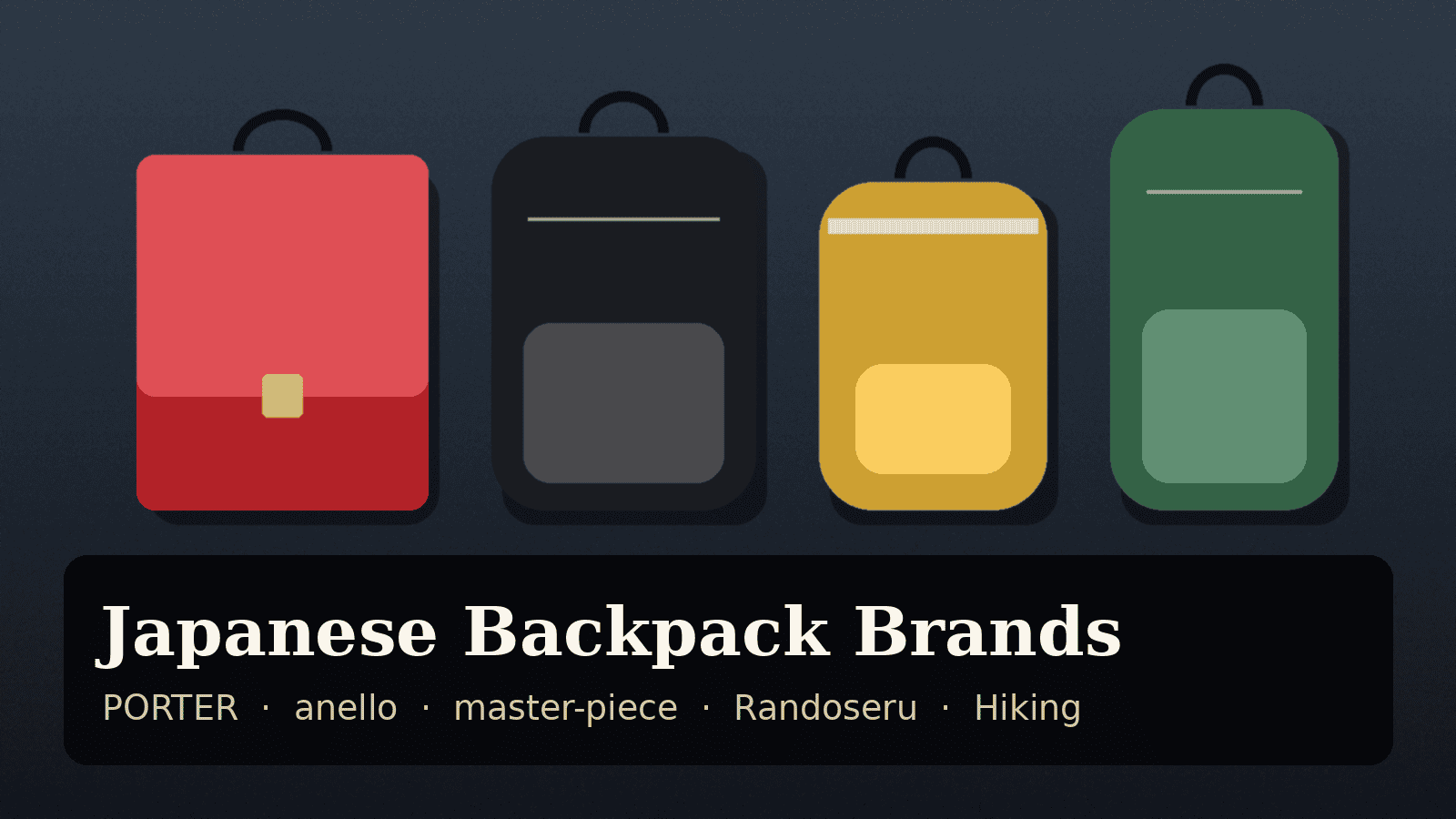
The Japanese backpack brands most people search for are PORTER (Yoshida & Co.) for nylon daily and work backpacks, anello for the wide-mouth kuchigane backpack, master-piece for technical everyday packs, Ace for business and travel bags, mont-bell and Yamatomichi for hiking, and Tsuchiya Kaban for leather backpacks. The famous boxy “Japanese school backpack” is the randoseru (ランドセル), made by dozens of specialist makers; in 2026 the average one cost ¥62,034.
- Best Japanese backpack for travel: master-piece, Ace or mont-bell, depending on whether you want city, carry-on or outdoor.
- For work and laptops: PORTER or master-piece business backpacks.
- Cute and affordable: anello.
- For adults who want a randoseru: leather models from randoseru makers, including adult-size lines.
As of October 2026, “Japanese backpack” covers very different things: a nylon commuter pack from a Tokyo bag company, a colorful wire-mouth rucksack from Osaka, an ultralight hiking pack, a leather briefcase-backpack and a six-year school bag. This guide groups the main Japanese backpack brands and bag brands by what they make, explains the randoseru, and shows how to buy one from Japan.
Best Japanese Backpack Brands at a Glance
| Brand | Where / since | Best known for |
|---|---|---|
| PORTER (Yoshida & Co.) | Tokyo; company founded 1935, PORTER brand 1962 | Nylon backpacks, daypacks and business rucksacks; Tanker and other long-running series |
| anello (Carrot Company) | Osaka; brand launched 2005 | Kuchigane (wire-frame wide-mouth) backpacks, colorful everyday rucksacks, mini backpacks |
| master-piece (MSPC) | Osaka; born 1994 | Technical everyday backpacks made in its own Japanese factory; work and travel packs |
| Ace (エース) | Founded 1940; Tokyo head office, Osaka main office | ace. business backpacks, Proteca suitcases, travel bags |
| mont-bell | Osaka; founded 1975 | Hiking and travel backpacks, packable daypacks, outdoor gear |
| Yamatomichi (山と道) | Started 2011; stores in Kamakura and Kyoto | Ultralight hiking backpacks |
| Tsuchiya Kaban | Tokyo; randoseru maker since 1965 | Randoseru, leather backpacks and briefcases |
| Randoseru makers | Tokyo, Nagoya, Osaka and beyond | Box-shaped leather or Clarino school backpacks for elementary school |
Founding years above come from each company’s own pages or the sources listed under References.[1][2][3][4] “Japanese bag brand” is not the same as “made in Japan”: several of these companies make some lines in Japan and others abroad, so read the 生産国 (country of production) field on the exact listing.
Which Japanese Backpack Brand for Which Use?
| What you need | Search in Japanese | Brands to start with |
|---|---|---|
| Everyday / college backpack | リュック / デイパック | anello, PORTER, master-piece |
| Work and laptop backpack | ビジネスリュック / PC収納 | PORTER, master-piece, ace. |
| Travel backpack | トラベルリュック / 機内持ち込み | Ace, master-piece, mont-bell |
| Hiking backpack | 登山 ザック / ハイキング | mont-bell, Yamatomichi |
| Leather backpack | レザーリュック / 本革 | Tsuchiya Kaban, HERZ |
| Kids school backpack | ランドセル | Randoseru makers, Tsuchiya Kaban |
| High school bag | スクールバッグ / スクバ | EASTBOY, conomi and uniform brands |
| Mini backpack / backpack purse | ミニリュック | anello mini, PORTER small daypacks |
PORTER (Yoshida & Co.): Japanese Nylon Backpacks
Yoshida & Co. was founded in Tokyo by Kichizo Yoshida in 1935; PORTER, branded in 1962, is its main label, alongside LUGGAGE LABEL.[1] When people ask for “the famous Japanese backpack brand” or search Japan backpack Porter, this is usually what they mean: nylon daypacks, rucksacks and business backpacks with very long-running series. Head Porter was a separate private brand designed by Hiroshi Fujiwara that used Yoshida as its maker;[1] Porter Classic is also a different brand from PORTER, so check the label and tag on a secondhand listing.
Series and collaborations: PORTER is organised by series, so shoppers search PORTER with a series name — TANKER, FORCE, HEAT, HYBRID, DRIVE, FLASH, UNION, EXPLORER — plus words like daypack, ripstop, Cordura, tactical or camo. PORTER collab bags and accessories (buyers search names such as Stussy, Neighborhood, mastermind, Undercover, KAWS, BAPE, Marni, Comme des Garçons, JJJJound, Takashi Murakami or Leica) mostly turn up on the used market; check the photos and inside tag to confirm exactly which collaboration a listing is. If you searched PORTER backpacks with a laptop compartment, look for ビジネス or PC収納 in the listing. PORTER also makes Boston bags and shoulder bags, and outlet stock appears in Japan. If you want a PORTER alternative, master-piece and ace. are the closest Japanese matches. (Porter Airlines baggage rules are a different company entirely.)
PORTER backpacks hold their value well in Japan, which makes the used market on Mercari and Yahoo Auctions useful: search ポーター リュック with the series name and compare sold listings, not asking prices.
anello: The Kuchigane Backpack
anello was launched in 2005 by Carrot Company, an Osaka bag maker and wholesaler; the name means “tree ring” in Italian. Its Kuchigane Backpack, released in 2015 for the brand’s 10th anniversary, opens wide thanks to a wire frame in the mouth, and from 2019 the brand moved much of its line from polyester to REPREVE recycled fabric. The brand is especially popular in Southeast Asia.[2]
anello sizes: the kuchigane backpack comes in regular, large and mini or slim versions, plus grande and other lines; capacity in litres and outer dimensions are printed on each product page, so compare those rather than names. Searches like anello backpack fake vs real and anello backpack original come up often: buying from Japanese stores and marketplaces with clear photos of the tag, lining and zipper pulls is the practical step, and sold listings show what a normal price looks like. anello size chart, in practice: regular kuchigane backpacks are the medium all-rounder; large or “big” versions add volume for a laptop compartment or A4 files; mini is for a backpack purse. To compare anello backpack liters, volume and measurements, use each listing’s 容量 and サイズ fields. Most styles are unisex; for a size comparison or a large size measurement, line up the cm figures. Some versions expand with an extra gusset or a separate zip backpack design. Limited-edition colors and Japan-only collaborations appear each season. For country of origin, read the inside tag — “est. 2005” on the label refers to the brand, not the bag. If you want an anello backpack alternative, look at other Osaka-made casual brands or PORTER’s lighter daypacks. anello also makes Disney, Peanuts/Snoopy and other character collaborations, mostly sold in Japan.
master-piece (Masterpiece): Technical Everyday Backpacks
master-piece was born in 1994 as an Osaka bag brand focused on everyday use, combining fashion and function; it develops original materials with suppliers and makes its products in its own factory in Japan.[3] It is a good place to look for a versatile Japanese backpack for work, a laptop backpack or a minimalist travel backpack, and it offers a repair service on its site. Search マスターピース リュック with a series name.
Ace: Japanese Luggage and Business Backpacks
Ace (エース) was founded on January 1, 1940; its head office is in Tokyo and its main office in Osaka. It makes travel bags, suitcases, business bags, sports bags and fashion bags, and its brands include Proteca suitcases, ace., World Traveler and others, with a dedicated backpack research lab.[4] If you searched Japanese luggage brand Ace, Japanese luggage brands list or Japan Ace backpack, this is the company. Suitcases are bulky to ship internationally, so compare a backpack or soft bag against the volumetric weight of a hard case before you buy.
Japanese Hiking and Outdoor Backpack Brands
mont-bell was founded in Osaka on August 1, 1975 by climber Isamu Tatsuno with two partners, and follows a “function is beauty” approach;[5] its backpacks run from packable daypacks to full trekking packs. Yamatomichi (山と道) is an ultralight (UL) hiking brand that started in 2011, with stores in Kamakura and Kyoto; its backpacks are designed around carrying minimal gear.[6] For tents, stoves and other Japanese camping brands, see our Japanese camping and outdoor gear guide; for budget technical wear, the Workman guide.
Japanese Leather Backpacks
Tsuchiya Kaban began when Kunio Tsuchiya started making randoseru in 1965, and the company still makes randoseru alongside leather backpacks, briefcases and small goods.[7] HERZ is another Tokyo leather maker whose backpacks and bags are widely sought secondhand. For a Japanese leather backpack for men or women, search 本革 リュック or レザーリュック with the brand name, and check corners, straps and the base for wear. Our Japanese wallet brands guide covers the same leather makers’ wallets, and the Japanese handbag brands guide covers totes, shoulder and crossbody bags.
What Is a Randoseru? The Japanese School Backpack
The Japanese elementary school backpack is called a randoseru. The word comes from the Dutch ransel (backpack). According to the Japan Randoseru Industry Association, the school bag story starts at Gakushuin, which in 1885 told pupils to carry their own things to school and adopted an army-style backpack; the box shape is traced to 1887, when Ito Hirobumi presented a box-type school bag to the crown prince entering Gakushuin, black leather followed in 1890, and the “Gakushuin type” dimensions were standardised in 1897.[8] An empty randoseru weighs roughly 1.2 kg.[9]
What the industry standard says: randoseru carrying the association’s certificate must be sewn entirely in Japan, be made of leather or synthetic leather, have a flap covering at least two-thirds of the body in a vertical box shape, measure around 31 cm tall and 23 cm wide inside, and come with free repairs for six years of normal use.[10]
Japanese School Backpack Price: Why Is a Randoseru So Expensive?
The association’s 2026 purchase survey of 1,500 parents of children starting school in April 2026 found:[11]
| Randoseru survey 2026 | Result |
|---|---|
| Average purchase price | ¥62,034 (up more than ¥1,200 on the previous survey) |
| Bought at ¥65,000 or more | 46.0% |
| A4 flat-file size | 63.2% |
| Clarino (synthetic leather) / cowhide | 27.5% / 23.1% |
| Most popular color, boys | Black, 54.4% |
| Most popular color, girls | Purple / lavender, 30.0% |
The price reflects six years of daily use, hand sewing in Japan, a stiff box structure and the repair warranty. New randoseru are mostly bought in Japan’s spring and summer for the following April, and popular workshop models can sell out early. Used and unused randoseru are common on Mercari; a used one is the cheapest way to get the real shape if you want one as an adult backpack or a gift.
Earthquake, bulletproof and “floats” claims: you will see posts saying randoseru protect the head in an earthquake, stop bullets or work as a float. These are not specifications that makers or the industry standard list; buy one as a well-made school bag, not as safety equipment. Many models do have reflective trim and a ring for a personal alarm, and communities hand out yellow covers to make children more visible.[9]
Randoseru for Adults
Several makers sell adult-size or “otona randoseru” (大人ランドセル) versions with a laptop pocket, and some leather makers build business backpacks on the same box pattern. Search 大人ランドセル or ランドセル型 リュック. A children’s randoseru fits a small adult frame but straps are short; check strap length in the listing.
Randoseru Questions People Ask
- In English / definition / pronunciation: randoseru is written in katakana (ランドセル, no kanji) and pronounced ran-do-se-ru; explained simply, it is the box-shaped (hako, 箱型) elementary school backpack. The price in yen for a Japanese school kid backpack is covered in the survey table above.
- Makers to search: the association’s member list includes makers such as Kabankobo Yamamoto (鞄工房山本), Ohba, Kazama, Kyowa, Nakamura and many more; Fit-chan, Seiban and department-store and supermarket brands are also widely sold. Shell cordovan models sit at the top of the price range.
- Vegan option: Clarino synthetic-leather randoseru are lighter and contain no animal leather; check the 素材 field.
- Hardware and logo: check the clasp, hooks and the maker’s logo plate on used listings.
- Heavy? The bag is about 1.2 kg empty; most of the weight children carry is books.
- Accessories: rain covers, clear covers, keychain charms, pencil cases and lunch bags are sold separately as ランドセルカバー and ランドセル 小物.
- Second hand: search ランドセル 中古 or ランドセル 美品; condition, scuffs on the flap and the clasp matter most.
Emergency Backpacks (防災リュック)
A Japanese emergency or disaster backpack is a 防災リュック: a backpack pre-packed with water, light, a radio, a foil blanket and similar items for earthquakes. Search 防災リュック セット. Check the contents against shipping rules first: batteries, gas canisters, matches and some liquids may be restricted or prohibited for international shipping.
Japanese High School Bags and Ita Bags
Older students use a school bag (スクールバッグ, “sukubā”): a nylon or synthetic-leather shoulder bag, or a square backpack, often from uniform and youth brands such as EASTBOY or conomi. These are what people mean by the “Japanese JK bag”, the Japanese school girl bag or the school bag in anime; junior high and high school boys and girls, teens and university students use the same styles, and a drawstring knapsack (ナップサック) is the usual PE bag. For bags covered in pins and acrylic badges, see our ita bag size guide.
Japanese Backpacks for Men, Women and Students
Most Japanese backpack brands and manufacturers design unisex models; searches for Japanese backpacks for men, guys, male, ladies, women, teen students and uni or university students land on the same shelves. Streetwear fans look at PORTER collaborations; minimal and utility fans at master-piece; casual and cute at anello. Useful features to filter for: laptop compartment (PC収納), shoe compartment (シューズ収納), side bottle and umbrella pockets (傘ホルダー), and an internal organizer. If you are looking for a Japanese bag brand that starts with M, it is probably master-piece or mont-bell.
Reading Japanese Backpack Listings
| Japanese | Romaji | Meaning |
|---|---|---|
| リュック / リュックサック | ryukku | backpack, rucksack |
| バックパック | bakkupakku | backpack (often outdoor) |
| ランドセル | randoseru | Japanese elementary school backpack |
| 口金リュック | kuchigane ryukku | wire/metal-frame wide-mouth backpack |
| ビジネスリュック | bijinesu ryukku | work backpack |
| PC収納 / A4対応 | PC shūnō / A4 taiō | laptop sleeve / fits A4 files |
| 撥水 / 防水 | hassui / bōsui | water-repellent / waterproof |
| 容量 ○L | yōryō | capacity in litres |
| 中古 / 美品 / 未使用 | chūko / bihin / mishiyō | used / very good condition / unused |
| 6年保証 | rokunen hoshō | 6-year warranty (randoseru) |
How to Buy a Japanese Backpack From Japan
- Search in Japanese: brand + type, e.g. ポーター リュック, アネロ 口金リュック, マスターピース リュック, 土屋鞄 ランドセル, 大人ランドセル.
- Check size and capacity: compare outer dimensions (cm) and 容量 in litres; check whether a laptop sleeve fits your computer.
- Check condition: for used bags, look at corners, base, zippers, straps and the lining; for randoseru, ask whether the 6-year warranty card is included; repairs are arranged through the store or maker that sold it.
- See it before it ships: wrong/missing-item checks (¥200) and unboxing photos (¥500 / ¥700) let you inspect the bag at the Tokyo warehouse.
- Mind the box size: international shipping is charged on the greater of actual weight and volumetric weight (length × width × height ÷ 5,000) of the box the warehouse uses. A randoseru weighs about 1.2 kg, but a 40 × 30 × 25 cm box counts as 6 kg. Soft backpacks can often be packed flatter; consolidating several purchases into one parcel shares the cost.
OneMall buys from Japanese marketplaces such as Mercari, Yahoo Auctions, Rakuten and Amazon Japan, and from other Japanese online stores through LinkBuy. Items that need a lottery entry, purchase limit, Japanese identity verification or a merchant account cannot be purchased, which matters for some limited randoseru and collaboration bags. OneMall does not verify brand claims or vouch for product condition, so choose sellers with clear photos and descriptions.
Service fees are ¥300 per item on most marketplaces; from ¥200 per item on Yahoo Auctions and LinkBuy. The first six orders consolidate free; each additional order costs ¥100. Storage is free for 90 days after arrival (30 days after consolidation). Payment is by Visa, Mastercard or PayPal, settled in USD.
US buyers: since August 29, 2025, US-bound parcels of any value go through customs and pay applicable duties, taxes and fees — the $800 de minimis exemption no longer applies. OneMall currently ships to the United States by ECMS and DHL; the live quote at checkout shows which lines accept your parcel.
Browse PORTER backpack listings, anello backpacks or randoseru, and compare the best Japan proxy services and proxy costs by total landed cost.
Frequently Asked Questions
What is the best Japanese backpack brand?
There is no single best. PORTER for nylon daily and business backpacks, anello for affordable wide-mouth rucksacks, master-piece for technical everyday packs, mont-bell or Yamatomichi for hiking, and Tsuchiya Kaban for leather.
What is the Japanese school backpack called?
A randoseru (ランドセル), from the Dutch word ransel. High school students usually carry a school bag (スクールバッグ) instead.
How much does a Japanese school backpack cost?
The industry association’s 2026 survey put the average new randoseru at ¥62,034, with 46.0% of buyers spending ¥65,000 or more. Used ones cost much less.
Are Japanese backpacks good?
The well-known brands are known for practical layouts and careful construction, but quality varies by line, material and country of production. Compare specific models.
Is anello a Japanese brand?
Yes. anello was launched in 2005 by Carrot Company, a bag maker and wholesaler based in Osaka.
What does kuchigane mean?
Kuchigane (口金) is the metal or wire frame at the mouth of a bag. On an anello kuchigane backpack it lets the top open wide.
Can adults use a randoseru?
Yes. Some makers sell adult-size randoseru with laptop pockets, and used children’s randoseru suit small frames.
Is Porter Classic the same as PORTER?
No. PORTER is the main brand of Yoshida & Co.; Porter Classic is a different brand.
References
- Yoshida & Co., Ltd. (Wikipedia). https://en.wikipedia.org/wiki/Yoshida_%26_Co.,_Ltd.
- ZOZO Fashion Tech News, anello. https://fashiontechnews.zozo.com/en/articles/anello
- master-piece, About. https://www.master-piece.co.jp/about/
- Ace Co., Ltd., Company profile. https://www.ace.jp/company/
- Montbell UK, About Montbell. https://www.montbell.co.uk/pages/about-montbell
- Yamatomichi, About Us. https://www.yamatomichi.com/about
- Tsuchiya Kaban, About Us. https://tsuchiya-kaban.com/pages/aboutus
- Randoseru Industry Association, History of the randoseru. http://www.randoseru.gr.jp/history/rekishi.html
- Randoseru (Wikipedia). https://en.wikipedia.org/wiki/Randoseru
- Randoseru Industry Association, Randoseru certificate. https://www.randoseru.gr.jp/about/hoshou.html
- Randoseru Industry Association, 2026 purchase survey. https://www.randoseru.gr.jp/graph/